
Animal Symbols of Protection: Meanings Across Different Cultures
Quick Summary
Animal symbols of protection appear in architecture, jewelry, funerary objects, religious art, royal regalia and oral tradition. A lion may guard a tomb entrance, a beetle-shaped a...
Animal symbols of protection appear in architecture, jewelry, funerary objects, religious art, royal regalia and oral tradition. A lion may guard a tomb entrance, a beetle-shaped amulet may accompany the dead, a serpent may shelter sacred teachings, and a dog may stand at the boundary between life and death. These examples can look similar from a distance, but they do not mean the same thing.
The phrase “animal symbol of protection” is therefore useful only when it is followed by a specific cultural and historical explanation. Protective meanings come from the animal’s observed behavior, religious narratives, political authority, ritual practice, artistic convention and the material object in which the image appears. The same animal can symbolize safety in one setting, danger in another and both at once in a third.
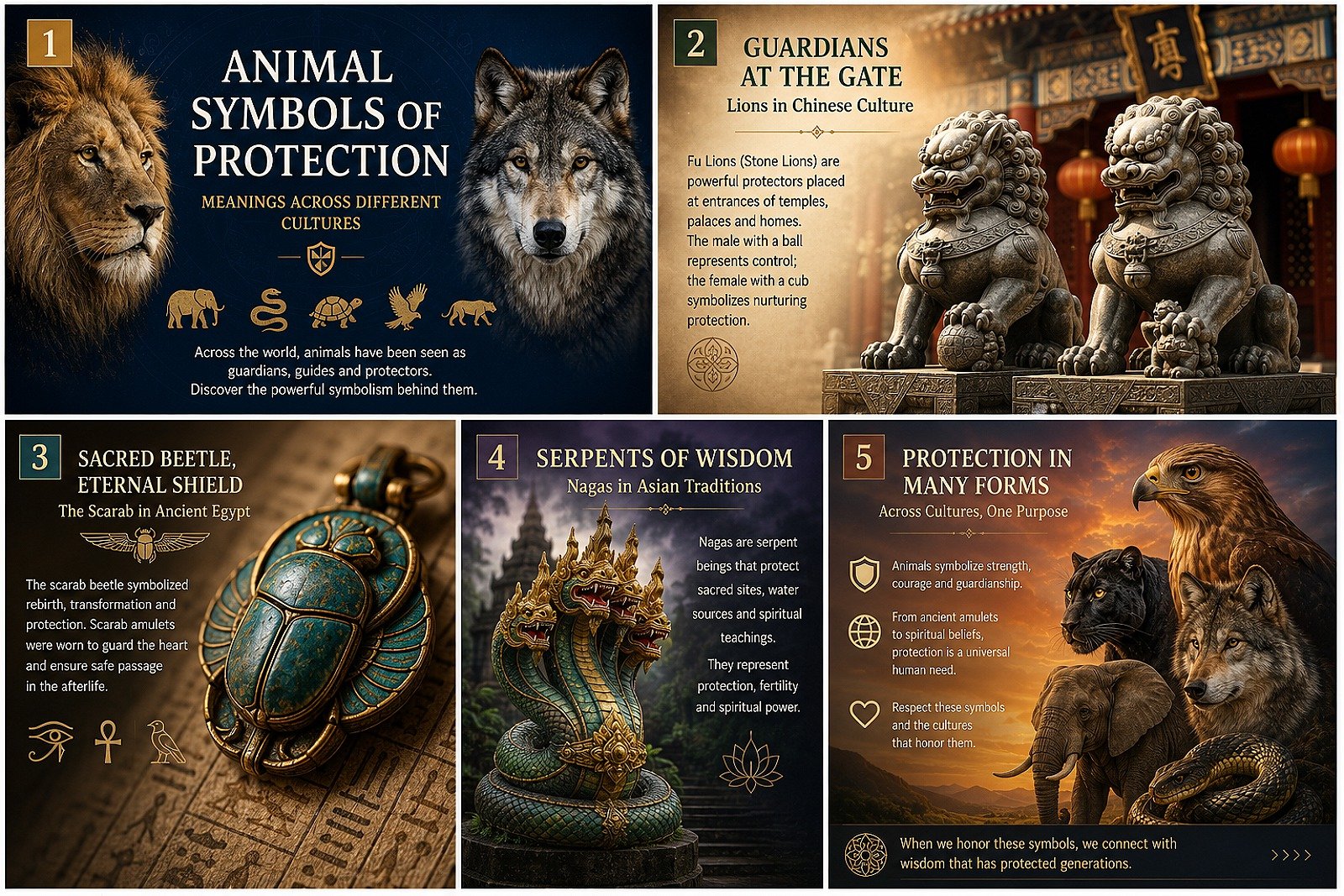
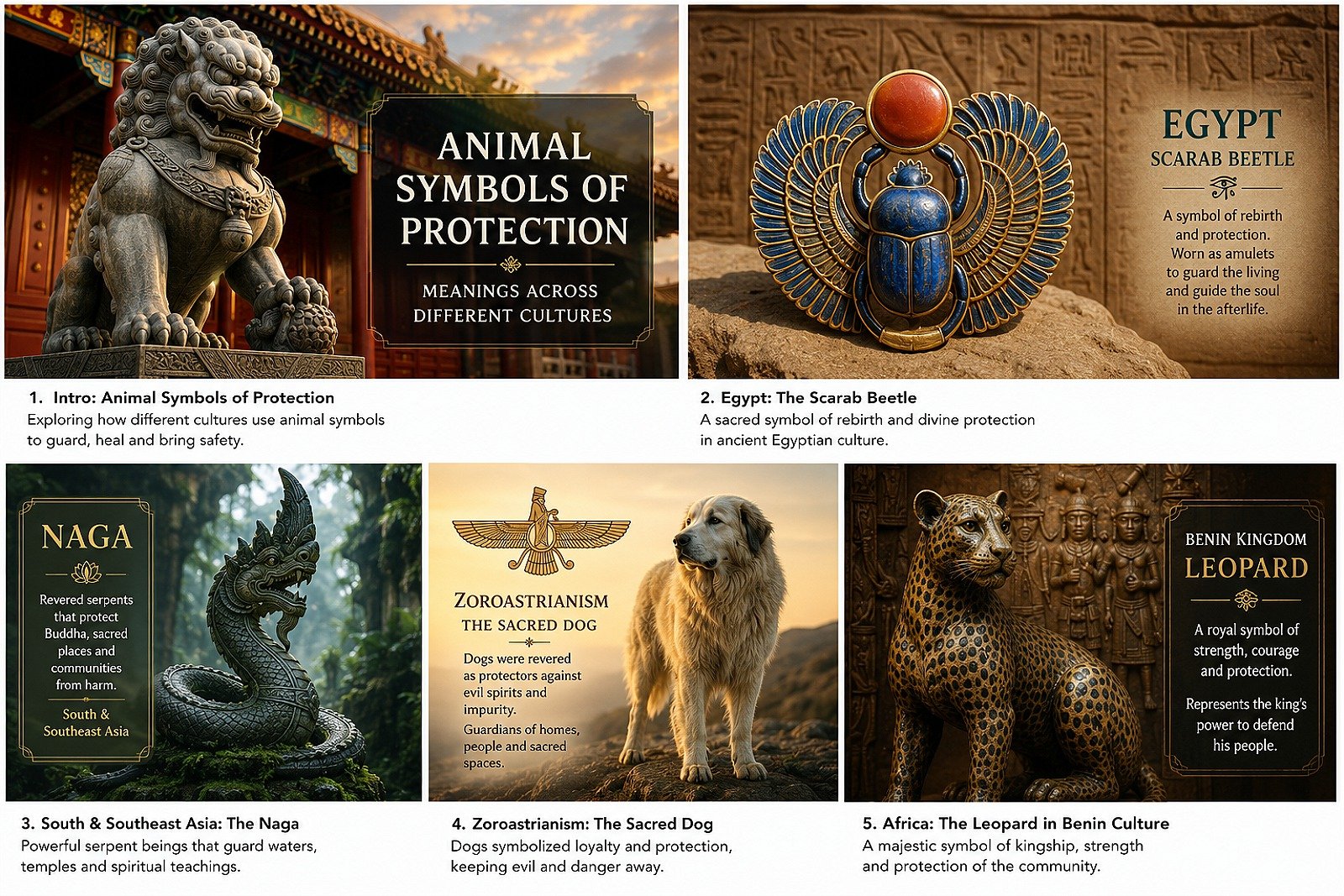
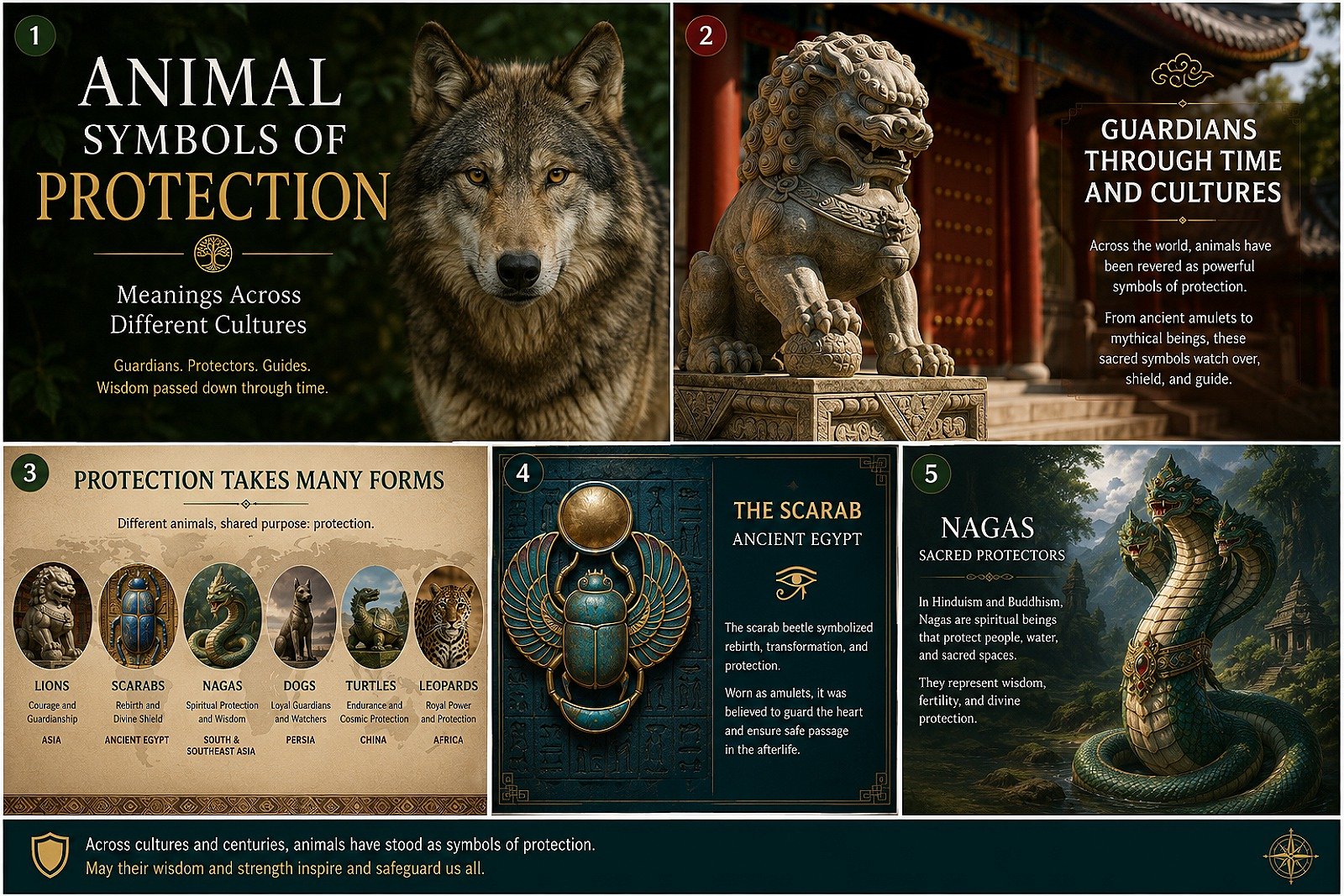
This guide examines six documented examples: Chinese guardian lions, ancient Egyptian scarabs, Buddhist nagas, dogs in Zoroastrian tradition, Xuanwu as the tortoise-and-snake guardian of the north, and leopard imagery in the Benin Kingdom. It also explains how to approach these symbols respectfully instead of turning living traditions into a universal spiritual shopping list.
Quick Answer
Animals commonly associated with protection include lions, scarab beetles, serpents, dogs, tortoises and leopards, but their meanings are culture-specific. Chinese lions guard thresholds; Egyptian scarabs functioned as amulets of regeneration; Buddhist nagas protected sacred teachings; Zoroastrian dogs had purificatory and guardian roles; Xuanwu guarded the north; and Benin leopard imagery expressed royal power and protection.
| Image number | Image 1 - Featured image |
|---|---|
| Purpose | Introduce the cross-cultural topic through a museum-style editorial scene that keeps objects visually separate rather than blending traditions into one invented symbol. |
| Detailed scene | A refined museum gallery with five separate illuminated display cases containing a Chinese guardian lion sculpture, an ancient Egyptian scarab amulet, an early Buddhist naga relief fragment, a Xuanwu tortoise-and-snake model and a Benin leopard-themed ceremonial object. Each object remains in its own case with no readable labels. |
| Specific culture or historical context | Contemporary educational museum display representing historically distinct protective animal traditions. |
| People shown | Optional diverse adult visitors viewed from behind at a respectful distance. |
| Location | Modern museum gallery with neutral walls and conservation-quality cases. |
| Clothing | Contemporary visitor clothing; no ceremonial costume. |
| Architecture | Minimal museum interior with separate vitrines. |
| Objects | Five culturally distinct artifacts, each displayed independently. |
| Lighting | Controlled gallery lighting with realistic shadows and no supernatural effects. |
| Composition | Wide 16:9 editorial photograph; cases form a visual sequence across the frame. |
| SEO-friendly filename | animal-symbols-of-protection-across-cultures.webp |
| Image title | Guardians Across Cultures |
| Alt text | Museum display of protective animal symbols from several historical cultures |
| Caption | Protective animal imagery takes different forms in different cultural, religious and historical settings. |
| Recommended placement | After the introduction and Quick Answer. |
| Article section supported | Article overview and cultural-specificity principle. |
| Important elements to avoid | Fusing objects into one fantasy creature, fake labels, sacred objects used as decoration, embedded text, watermarks, glowing magic. |
Why Animals Become Symbols of Protection
Humans often build symbolic meaning from what animals visibly do. Teeth, horns, claws, armor, vigilance, speed, maternal defense, nocturnal awareness and territorial behavior can all become metaphors for protection. Yet symbolism is not a simple copy of biology. Communities select, reinterpret and combine animal qualities according to their own histories.[1]
Protection also has several meanings. It can mean guarding a doorway, defending a ruler, keeping harmful forces away, supporting safe childbirth, protecting a corpse, securing a community’s moral order or guiding a soul through a dangerous transition. A symbol that protects in a funerary context may not be intended for household decoration, and a royal emblem may not function as a personal charm.
The object matters as much as the animal. A living dog, a carved lion, a scarab seal, a temple serpent and a leopard-patterned tunic operate differently. Their materials, placement, ritual use and authorized users shape what the image communicates.
Protection Is Often Paired with Controlled Danger
Many protective animals are dangerous or intimidating. The guardian does not become harmless; its threatening capacity is redirected. A lion’s claws, a serpent’s strike, a leopard’s predatory power or a dog’s vigilance can be imagined as serving a tomb, temple, ruler or moral order.
This helps explain why protective symbolism often contains an apparent contradiction. The same force that frightens outsiders reassures those inside the protected boundary. In visual culture, bared teeth, raised paws, coiled bodies and watchful eyes communicate readiness rather than comfort.
No Animal Has One Universal Meaning
A snake may be a protector, ancestor, healer, danger, fertility symbol or cosmic being depending on the tradition. A dog may guard, guide, pollute, heal or accompany the dead. Even within one culture, meanings change over time and across regions, social groups and religious schools.
For that reason, broad claims such as “the lion always means courage” or “the turtle universally means protection” are too simple. A responsible interpretation names the community, historical period and object whenever possible.
Protection Can Be Personal, Architectural or Political
Protective symbolism operates at different scales. A pendant may be worn against personal misfortune, while paired sculptures defend an architectural entrance. A royal emblem may protect by displaying the authority of the state, and a funerary image may secure the dead during a religious transition. These functions should not be treated as interchangeable.
The difference also affects who may use the image. Some symbols were inexpensive and widely available; others belonged to rulers, priests, military officials or initiated members of an association. An animal image can therefore communicate not only safety but also social rank, legal authority, religious obligation and access to specialized knowledge.
When an object is removed from its original setting, its protective function may become difficult to reconstruct. Museum documentation, archaeological context and community scholarship help restore the relationship between the animal, the object and the people who gave it meaning.
Protective Animal Symbols at a Glance
The table below summarizes the examples explored in this article. It is a map of specific traditions, not a universal ranking of the “strongest” guardian animal.
| Protective figure | Cultural setting | Protective function | Common form |
|---|---|---|---|
| Guardian lion | China; Buddhist and funerary contexts | Threshold, tomb and sacred-space protection | Pairs of stone lions, architectural guardians |
| Scarab beetle | Ancient Egypt | Life, regeneration and protective amuletic power | Seal amulets, heart scarabs, funerary objects |
| Naga serpent | Early Buddhist India and later South/Southeast Asian traditions | Protective spirit and guardian of Buddhist sacred space | Stupa reliefs, temple balustrades, images sheltering the Buddha |
| Dog | Zoroastrian religious tradition | Guarding, purity and protection at the boundary of death | Sagdīd ritual and bridge-protecting dogs in religious texts |
| Xuanwu: tortoise and snake | Chinese cosmology; later East Asian traditions | Guardian of the north, winter and water | Tomb objects, charms and directional iconography |
| Leopard | Benin Kingdom, Edo peoples, Nigeria | Royal authority, controlled danger and protection of warriors | Ceremonial armor, court art and royal emblems |
1. Chinese Guardian Lions: Protectors of Tombs and Thresholds
Stone lions have served as protective figures in China for many centuries. The Metropolitan Museum of Art notes that pairs of lions were found protecting Han-dynasty tombs and became increasingly prominent in Buddhist cave temples and later tomb contexts. A Northern Qi example was positioned as one of a pair defending the entrance to the innermost burial chamber.[2]
Their placement is crucial. The lion is not simply an abstract symbol of strength; it is a guardian stationed at a boundary. A threshold divides ordinary space from a tomb, palace, temple or institution. The paired sculptures announce that the space beyond is watched and protected.
Lions were not native to most of China, so the image was shaped through long-distance exchange, tribute, Buddhist visual culture and artistic imagination. Chinese guardian lions are therefore stylized rather than zoological portraits. Their elaborate manes, muscular bodies, open mouths and commanding paws communicate authority and vigilance.
Why Are Guardian Lions Usually Shown in Pairs?
Pairs create balance and reinforce the idea of controlled entry. Later architectural conventions often distinguish the two lions through objects beneath their paws, although details vary by date, region and site. The essential idea is not a modern decorative formula but the protection of an important threshold.
Because the tradition has a long history, it should not be reduced to a generic “good-luck statue.” A lion at a tomb, Buddhist site, imperial building or modern business entrance may participate in different layers of meaning.
What the Lion Symbolizes in This Context
In this specific Chinese architectural and funerary context, the lion can communicate guardianship, authority, strength and the ability to repel intrusion. The protective meaning comes from both the animal’s imagined power and the sculpture’s physical position at the entrance.
| Image number | Image 2 |
|---|---|
| Purpose | Show the architectural role of Chinese guardian lions as paired protectors at an entrance. |
| Detailed scene | A historically informed pair of stone guardian lions flanking the entrance to a Chinese temple or tomb approach. The lions are shown as sculpted guardians, with detailed paws, manes and alert expressions. |
| Specific culture or historical context | Chinese guardian-lion tradition, with visual cues consistent with historic temple or funerary architecture. |
| People shown | A few contemporary visitors may appear at a distance for scale. |
| Location | Temple gate or tomb avenue in China. |
| Clothing | Ordinary contemporary clothing if people appear. |
| Architecture | Historically plausible Chinese stone steps, gate and roof details. |
| Objects | Paired stone lions positioned symmetrically at the threshold. |
| Lighting | Soft morning light revealing the carved surfaces. |
| Composition | Wide 16:9 symmetrical architectural photograph. |
| SEO-friendly filename | chinese-guardian-lions-protection-symbol.webp |
| Image title | Chinese Guardian Lions at a Threshold |
| Alt text | Pair of Chinese stone guardian lions protecting an architectural entrance |
| Caption | Pairs of lions have guarded tombs and sacred entrances in China for centuries. |
| Recommended placement | After the Chinese guardian-lion section. |
| Article section supported | Lion symbolism, thresholds and architectural protection. |
| Important elements to avoid | Calling them a universal feng shui cure, fantasy dragons, mixed Japanese and Chinese architecture, embedded text, exaggerated gold. |
2. Scarab Beetles: Protective Amulets in Ancient Egypt
Ancient Egyptian protection was frequently carried in small objects worn on the body or placed with the dead. The Metropolitan Museum of Art defines amulets as objects believed to transfer beneficial properties to their owners. Their power could be shaped by form, color, material, inscription and ritual action.[3]
The scarab became one of the most widespread animal forms. Egyptians associated the beetle’s rolling behavior with the movement of the sun and connected its name with becoming or coming into being. Scarabs therefore carried ideas of life, regeneration and renewal. Many were also used as seals, but their protective amuletic function remained central.[4]
Not every scarab had the same purpose. Some named officials and sealed documents or containers. Heart scarabs were placed in funerary contexts and connected with the judgment of the deceased. Naturalistic funerary scarabs and winged scarabs had other specific uses. “Scarab meaning” must therefore be tied to object type and context rather than treated as one fixed message.
How the Scarab Protected
The protective logic of the scarab was not based on the beetle physically guarding a doorway. Instead, the amulet was thought to transfer regenerative and beneficial powers to the wearer or deceased. Its small size made protection portable and intimate.
Color and material could add further meaning. Blue and green faience were associated with life and regeneration, while inscriptions or divine images could strengthen an amulet’s intended function.[3] This layered design shows why ancient symbols cannot be understood from animal shape alone.
Is a Modern Scarab Necklace the Same Thing?
A modern necklace inspired by a scarab may express admiration, heritage, fashion or personal spirituality. It is not automatically equivalent to an excavated Egyptian amulet used in a documented ritual or funerary setting. Responsible use begins by learning which object type inspired the design and avoiding claims that a commercial copy carries an identical ancient power.
| Image number | Image 3 |
|---|---|
| Purpose | Explain how a small animal-shaped object could function as a protective amulet in ancient Egypt. |
| Detailed scene | A museum-quality macro photograph of a glazed steatite scarab amulet resting in a conservation mount, with both the beetle-shaped upper surface and an inset reflection or secondary view of the inscribed underside. |
| Specific culture or historical context | Ancient Egyptian Middle Kingdom to New Kingdom scarab-amulet tradition. |
| People shown | None. |
| Location | Museum conservation or collection photography setup. |
| Clothing | Not applicable. |
| Architecture | None. |
| Objects | One authentic-looking scarab amulet and neutral archival support. |
| Lighting | Soft raking light that reveals carving and glaze without fantasy glow. |
| Composition | Wide 16:9 close-up with generous negative space for editorial use. |
| SEO-friendly filename | ancient-egyptian-scarab-protection-amulet.webp |
| Image title | Ancient Egyptian Scarab Amulet |
| Alt text | Close view of an ancient Egyptian scarab-shaped protective amulet |
| Caption | Scarab-shaped objects could serve as seals, symbols of regeneration and protective amulets. |
| Recommended placement | After the ancient Egyptian scarab section. |
| Article section supported | Amulets, regeneration and funerary protection. |
| Important elements to avoid | Modern jewelry styling, inaccurate hieroglyphs, treasure-pile clichés, gold overload, embedded text. |
3. Nagas: Protective Serpents in Buddhist Art
Serpents are often presented online as either evil or wise, but naga traditions resist that simple division. In early Buddhist art from India, nagas could appear as powerful nature beings integrated into Buddhist sacred narratives and architecture. The Met’s “Tree & Serpent” materials describe the naga as a protective spirit that becomes a shield for Buddhist teachings.[5]
On stupa reliefs, a coiled or multi-headed naga can guard relics, sacred trees, water sources or the Buddha. Later South and Southeast Asian traditions developed many local forms, including serpent balustrades, hooded canopies and guardian figures at temple approaches. These forms should be identified by site and tradition rather than combined into one pan-Asian symbol.
Why a Serpent Can Be Protective
Serpents live close to the ground, disappear into hidden places, inhabit water and can defend themselves suddenly. These qualities can support associations with fertility, rain, hidden wealth, territorial guardianship and sacred power. Protection comes not from making the serpent gentle but from recognizing and directing its potency.
One famous Buddhist image shows the naga king Mucalinda sheltering the meditating Buddha from a storm. The protective hood communicates refuge, but the story belongs to a religious narrative, not to a generic instruction that every snake image is a household protection charm.
Naga Is Not Simply Another Word for Snake
“Naga” refers to a category of beings in South Asian religious and mythological traditions, not merely to a zoological snake. Nagas may be represented in fully serpentine, multi-headed or partly human form. Translation should preserve that religious specificity.
| Image number | Image 4 |
|---|---|
| Purpose | Show the naga in its documented role as a protective serpent within early Buddhist sacred art. |
| Detailed scene | A carefully reconstructed early Indian Buddhist stupa relief showing a multi-headed naga coiled protectively beneath or around sacred architecture and tree imagery. The carving should resemble weathered limestone and museum-documented early Buddhist sculpture. |
| Specific culture or historical context | Early Buddhist India, approximately 200 BCE-400 CE, inspired by documented stupa art. |
| People shown | Carved worshippers may appear only if historically plausible within the relief. |
| Location | Museum gallery or archaeological-site reconstruction. |
| Clothing | Any carved figures should follow early Indian sculptural conventions without modern costume. |
| Architecture | Stupa drum panel or railing fragment. |
| Objects | Multi-headed naga, tree and sacred architectural motifs. |
| Lighting | Museum raking light emphasizing relief depth. |
| Composition | Wide 16:9 close view of the relief, no modern labels. |
| SEO-friendly filename | naga-protective-serpent-buddhist-art.webp |
| Image title | The Naga as a Buddhist Protector |
| Alt text | Early Buddhist stone relief of a multi-headed naga protective serpent |
| Caption | In early Buddhist art, nagas could be represented as protective spirits guarding sacred teachings and spaces. |
| Recommended placement | After the naga section. |
| Article section supported | Protective serpent symbolism and Buddhist visual culture. |
| Important elements to avoid | Generic fantasy snake, modern temple mashup, eroticized figures, invented ritual, embedded text. |
4. Dogs in Zoroastrianism: Guardians at the Boundary of Death
Dogs occupy an unusually important place in Zoroastrian religious literature and ritual. Encyclopaedia Iranica describes dogs at the Chinvat Bridge as protectors associated with the soul’s passage after death. It also documents the ritual known as sagdīd, literally “seen by the dog,” in which a dog was brought to look upon a corpse as part of funerary purification and protection.[8][9]
The dog’s role combines ordinary qualities such as vigilance and loyalty with a specific religious understanding of purity, death and harmful forces. In later Zoroastrian practice, the dog’s gaze was believed to help drive away the pollution or demonic presence associated with a corpse.[8]
This is not the same as saying that dogs are universal symbols of protection in every Iranian religion or that a pet dog automatically performs a sacred function. The meaning belongs to Zoroastrian texts, ritual practice and community history.
The “Four-Eyed” Dog
Some Zoroastrian texts and ritual descriptions give special importance to a dog with markings above the eyes, creating the appearance of four eyes. The extra “eyes” intensify the image of supernatural vigilance. Two bridge-protecting dogs also appear in descriptions of the soul’s journey.[8]
These details show how real animal features can be interpreted symbolically without transforming the dog into a separate fantasy species.
Why Context and Sensitivity Matter
Funerary practices are among the most sensitive cultural subjects. They should not be recreated casually, turned into décor or presented as entertainment. Educational writing can explain the dog’s role while respecting the religious community and avoiding graphic spectacle.
5. Xuanwu: The Tortoise-and-Snake Guardian of the North
Xuanwu, often translated as the Dark or Mysterious Warrior, is one of the directional animals in Chinese cosmology. The British Museum identifies Xuanwu as a turtle-and-snake figure, Guardian of the North, associated with winter, black and water. Related traditions in Japan and Korea know the figure as Genbu and Hyun Moo.[6]
A Northern Song porcelain model in the Metropolitan Museum shows a tortoise entwined with a snake and identifies the figure as the symbol of the north.[7] Unlike an ordinary turtle emblem, Xuanwu is a composite cosmological being whose meaning comes from the system of four directions, seasons, colors and celestial regions.
Why Tortoise and Snake Are Combined
The tortoise suggests endurance, longevity and defensive strength through its shell. The snake contributes movement, transformation and alert power. Together they form a guardian image greater than either animal alone.
The combination also demonstrates that protective animal symbols are sometimes intentionally hybrid. Their power lies in the relationship between creatures, directions and cosmic order rather than in a single animal trait.
From Cosmology to Charms and Tombs
Xuanwu appears in tomb art, religious imagery, architecture, charms and later popular culture. The symbol’s function changes with medium and period. A tomb object, a temple image and a modern logo should not be assumed to operate identically, even when all depict the tortoise-and-snake form.
6. The Leopard in Benin Court Art: Royal Power and Warrior Protection
In the historic Benin Kingdom of present-day Nigeria, leopard imagery was closely associated with the Oba, the king. The leopard was understood as ruler of the forest, while the Oba was ruler of the human realm. Court art used this relationship to express dangerous authority, control over life and death and the king’s power to command forces beyond ordinary society.[10]
A surviving ceremonial warrior’s surcoat in the British Museum is covered with leopard-head motifs. The museum describes the motifs as badges of honor and protective devices for military chiefs, while also referring to the authority delegated by the Oba. The leopard image therefore protects within a political and ceremonial hierarchy; it is not merely a personal symbol of courage.[10]
The object’s colonial collection history also matters. It entered the museum through the aftermath of the British military expedition against Benin in 1897. Any modern discussion of Benin court objects should acknowledge both their original cultural setting and the histories through which they reached European collections.
Protection Through Delegated Authority
The leopard’s strength belongs symbolically to the Oba, and military chiefs wear leopard imagery as an extension of that power. Protection is therefore connected with rank, duty and controlled violence. The motif communicates that the wearer acts under royal authority.
Avoid the Generic “African Leopard Symbol”
Africa contains thousands of communities and artistic traditions. It is inaccurate to describe the Benin example as what “the African leopard” universally means. The correct frame is Benin court culture, Edo peoples, Nigeria, and the particular object or ceremony being discussed.
| Image number | Image 5 |
|---|---|
| Purpose | Represent the leopard’s protective and royal significance in Benin court culture through a documented ceremonial object rather than a generic wildlife portrait. |
| Detailed scene | A museum-style presentation of a Benin ceremonial warrior tunic or court object featuring repeated leopard-head motifs, photographed with a contextual silhouette or archival-style reconstruction of a military chief wearing comparable regalia. |
| Specific culture or historical context | Benin Kingdom, Edo peoples, Nigeria; royal and military ceremonial art. |
| People shown | At most one dignified Edo adult model in historically researched ceremonial reconstruction, or no person if an object-only display is safer. |
| Location | Museum gallery or historically grounded court-art reconstruction. |
| Clothing | If worn, the leopard-motif tunic must follow documented Benin examples and should not be combined with unrelated African regalia. |
| Architecture | Neutral museum or subtle Benin court setting. |
| Objects | Leopard-head ceremonial armor or emblem, displayed clearly. |
| Lighting | Controlled warm gallery light with accurate material textures. |
| Composition | Wide 16:9 editorial image focused on the leopard motifs and object craftsmanship. |
| SEO-friendly filename | benin-leopard-symbol-protection-warriors.webp |
| Image title | Leopard Protection in Benin Court Art |
| Alt text | Benin ceremonial object with leopard motifs associated with royal power and protection |
| Caption | In Benin court art, leopard imagery could express the Oba’s dangerous authority and provide symbolic protection to military chiefs. |
| Recommended placement | After the Benin leopard section. |
| Article section supported | African royal symbolism, power and protection. |
| Important elements to avoid | Generic safari leopard, pan-African costume mixture, colonial expedition staging, sensational violence, embedded text, watermarks. |
Other Animals Associated with Protection
Many other animals appear in protective roles, but each requires its own research. Ancient Egyptian amulets included cobras, wedjat eyes connected with Horus, hippopotamus-based protective deities such as Taweret and numerous animal forms. Chinese lore includes roosters believed to repel harmful influences. African art traditions include crocodiles, pythons, pangolins, buffalo and composite beings in roles connected with authority, moral order, ancestors or protection.[1][3]
These examples should not be assembled into a universal “top ten” without context. A useful article asks four questions: Who used the image? In what period? On what object or building? What exactly was being protected?
What Is the Strongest Animal Symbol of Protection?
There is no culturally neutral answer. “Strongest” depends on the system and function. A guardian lion is powerful at a threshold; a scarab is powerful as an amulet of regeneration; a naga protects sacred teachings; a Zoroastrian dog acts at a funerary boundary; Xuanwu guards a direction in cosmology; and a Benin leopard emblem expresses delegated royal power.
Ranking them erases their different purposes. A better question is: which documented symbol fits the cultural, historical or educational context you are studying?
How to Interpret a Protective Animal Symbol
Use the following method before assigning meaning to an animal image.
1. Identify the Community and Period
Name the culture, religious tradition, region and approximate date. “Asian,” “African” or “ancient” is rarely precise enough. A Chinese Northern Qi tomb lion belongs to a different setting from a contemporary restaurant lion or Japanese komainu.
2. Identify the Medium and Location
Ask whether the animal appears on a tomb, temple, amulet, garment, royal object, manuscript, mask, coin or household item. Placement often reveals function. A guardian at a doorway does different work from a pendant worn on the body.
3. Look for Primary or Museum Documentation
Museum collection records, archaeological reports, religious texts and scholarship by community members provide stronger evidence than unsourced symbolism lists. Pay attention to uncertainty. A museum may describe an interpretation as likely, regional or period-specific rather than universal.
4. Separate Historical Meaning from Personal Interpretation
A person may privately see a lion as encouragement or a turtle as emotional safety. That personal meaning is valid as personal reflection, but it should not be presented as the documented belief of another culture without evidence.
Using Animal Symbols Respectfully
Respectful use begins with attribution and restraint. Learn the symbol’s name, community, history and function. Support artists and educators connected with the tradition when purchasing culturally specific work. Avoid copying restricted ceremonial imagery or claiming initiation, ancestry or authority you do not have.
The phrase “spirit animal” deserves particular care. The National Museum of the American Indian explains that the popular non-Native activity of choosing a “spirit animal” can trivialize the complex relationships that Native nations maintain with animal relatives, clan histories and sacred teachings.[11] Native Governance Center similarly advises against using the phrase casually outside the cultures to which specific teachings belong.[12]
A respectful alternative is to say “an animal I feel connected to,” “a personal animal motif” or “an animal that inspires me.” These phrases describe an individual preference without borrowing a sacred identity.
Do Not Copy Sacred Designs
An animal species is not owned, but a specific clan crest, ceremonial mask, sacred narrative, tattoo pattern or ritual object may carry community rights and obligations. Copying the design while removing its history can cause harm even when the user intends admiration.
Avoid Claims of Guaranteed Protection
Historical communities may have believed that an object protected its wearer or space. Modern writers should accurately report that belief rather than promise that purchasing a symbol will prevent illness, violence, misfortune or spiritual harm. Symbolic meaning is not a substitute for medical, legal or practical safety measures.
Can the Same Animal Mean Protection and Danger?
Yes. Protective symbolism often depends on ambivalence. A snake can defend a sacred site because it is powerful and dangerous. A leopard can protect warriors because its predatory force is imagined as controlled by royal authority. A lion guards an entrance by threatening intruders.
The same animal can also acquire negative associations in another religion, period or story. Meaning is produced by context, not stored permanently inside the species.
Common Misunderstandings
Treating one website’s animal dictionary as a universal cultural source.
Calling every protective animal a “totem” or “spirit animal.”
Combining unrelated African, Asian, Indigenous and ancient Mediterranean symbols into one invented ritual.
Assuming a modern jewelry design has the same function as an excavated amulet.
Confusing a deity with an ordinary animal symbol.
Ignoring whether an image belonged to royalty, initiates, priests or a specific clan.
Promising supernatural safety from a symbol.
Omitting colonial collection histories when discussing museum-held sacred or royal objects.
Key Takeaways
Animal symbols of protection are culturally specific rather than universal.
Chinese guardian lions protect thresholds and tombs through paired architectural presence.
Ancient Egyptian scarabs could function as protective amulets connected with life and regeneration.
Buddhist nagas demonstrate that serpents can act as guardians of sacred teachings and places.
Dogs hold ritual and guardian roles in Zoroastrian traditions surrounding death and purity.
Xuanwu is a tortoise-and-snake guardian of the north within an East Asian cosmological system.
Benin leopard imagery connects protection with the Oba’s royal authority and military office.
Respectful interpretation requires naming the community, period, object and function, and avoiding casual use of “spirit animal.”
People Also Ask
What animal is a symbol of protection?
Many animals symbolize protection in specific traditions. Examples include Chinese guardian lions, ancient Egyptian scarabs, Buddhist nagas, Zoroastrian dogs, Xuanwu and Benin leopards. No single animal is the universal symbol of protection.
Which animal represents protection and strength?
Lions and leopards often communicate strength and guardianship, but their meanings depend on context. Chinese lions protect thresholds, while leopard imagery in Benin court art expresses royal authority and warrior protection.
Are snakes symbols of protection?
They can be. In Buddhist art, nagas may protect sacred teachings, relics, water and the Buddha. In other traditions snakes may carry very different meanings, so the image should be identified culturally.
What does a scarab protect against?
Ancient Egyptian scarab amulets were associated with beneficial power, life and regeneration. Specific types had different uses, including personal, sealing and funerary functions. They should not be reduced to one modern promise.
Is “spirit animal” a respectful term?
Using it casually as a synonym for a favorite animal can trivialize Indigenous traditions. “Animal I feel connected to” or “personal animal symbol” is usually a more respectful phrase unless discussing a specific community’s teaching with appropriate authority.
Frequently Asked Questions
Can I wear an animal protection symbol from another culture?
Context matters. Learn the object’s origin, avoid restricted ceremonial designs, buy from responsible makers and describe your use honestly. Wearing a general animal image is different from copying a sacred insignia or claiming a religious authority you do not possess.
Do animal symbols really protect people?
Historical and living communities may understand symbols as spiritually protective. From a practical standpoint, an image does not replace safety planning, medicine, law or other evidence-based protection. An article should distinguish documented belief from guaranteed effect.
What animal symbolizes family protection?
There is no universal answer. Animals that defend young, such as lions, elephants, bears or hippopotami, may inspire family-protection symbolism, but the cultural meaning must be documented. Ancient Egyptian Taweret, for example, combined hippopotamus and other animal traits in maternal protection.
Why are dangerous animals used as guardians?
Their dangerous capacity can be imagined as redirected against threats. Teeth, claws, venom, speed and territorial behavior make the guardian visibly capable of defending a boundary.
What is the difference between a guardian animal and an animal deity?
A guardian animal may be a symbolic creature or sculpted protector. An animal deity is a divine being whose identity, worship and narratives belong to a religious tradition. Some figures blur the categories, so the tradition’s own terminology should guide the description.
Conclusion
Animals become protectors through stories, rituals, artworks and social institutions. A lion at a Chinese tomb, a scarab on an Egyptian body, a naga on a Buddhist stupa, a dog in Zoroastrian funerary practice, Xuanwu in directional cosmology and a leopard on Benin military regalia each protects in a different way.
The richest interpretation does not ask for one universal meaning. It asks how a particular community transformed an animal’s body, behavior or mythic identity into a guardian of a threshold, person, ruler, sacred teaching or cosmic direction. By keeping those histories visible, animal symbolism can be explored with both spiritual curiosity and cultural respect.
Research Sources and Further Reading
[1] National Museum of African Art, Smithsonian Institution. “Artful Animals.” Exhibition materials on animal imagery, leadership, moral values, protective deities and culturally specific meanings. https://africa.si.edu/exhibitions/artful-animals
[2] The Metropolitan Museum of Art. “Guardian Lion,” China, Northern Qi dynasty, mid-6th century. Collection record describing paired protective lions at tomb entrances. https://www.metmuseum.org/art/collection/search/49575
[3] Stünkel, Isabel. “Ancient Egyptian Amulets.” The Metropolitan Museum of Art, 2019. https://www.metmuseum.org/essays/egyptian-amulets
[4] The Metropolitan Museum of Art. “Scarab of an Official,” Middle Kingdom. Collection records explaining scarabs as protective amulets and seals. https://www.metmuseum.org/art/collection/search/545216
[5] The Metropolitan Museum of Art. “Tree & Serpent: Early Buddhist Art in India, 200 BCE-400 CE.” Exhibition and audio-guide materials describing the naga as a protective spirit and shield of Buddhist teachings. https://www.metmuseum.org/exhibitions/tree-and-serpent
[6] British Museum. “Xuanwu 玄武.” Collection biography describing the turtle-and-snake figure as Guardian of the North. https://www.britishmuseum.org/collection/term/BIOG158294
[7] The Metropolitan Museum of Art. “Model of tortoise entwined with snake, Symbol of the North (Xuanwu),” Northern Song dynasty. https://www.metmuseum.org/art/collection/search/44384
[8] Encyclopaedia Iranica. “Dog,” section ii, In Zoroastrianism. Discussion of bridge-protecting dogs, sagdīd and ritual roles. https://www.iranicaonline.org/articles/dog/
[9] Encyclopaedia Iranica. “Sagdīd.” Cross-reference and ritual summary. https://www.iranicaonline.org/articles/sagdid-crossref/
[10] British Museum. Ceremonial Benin warrior surcoat with leopard-head motifs, collection record Af1897,520. https://www.britishmuseum.org/collection/object/E_Af1897-520
[11] National Museum of the American Indian. “Honoring Animal Relatives.” Reference guide cautioning against universalized “spirit animal” activities and copied Indigenous imagery. https://americanindian.si.edu/nk360/informational/native-american-spirit-animal
[12] Native Governance Center. “Cultural Appropriation and Wellness Guide.” Guidance on avoiding misuse of culturally specific spiritual language and symbols. https://nativegov.org/resources/cultural-appropriation-guide/
Article Information
- Publisher
- Ancestral Temple
- Editor
- Ancestral Temple
- Last updated
- Jul 26, 2026
- Last reviewed
- Jul 26, 2026
- Content version
- 05b39f61e3
This educational article should be read as cultural and spiritual information, not as medical, legal, financial, or emergency advice.
Helpful Related Guidance
Explore This Topic
Related Topic Cluster
Dreams & Symbolism
About the Author
 Ancestral Temple
Spiritual guide and practitioner with decades of experience in ancestral wisdom, rituals, and divine guidance.
Related Posts
View All












Leave a Comment
We'd love to hear your thoughts.