
Difference Between Talismans and Amulets
Cornerstone Content
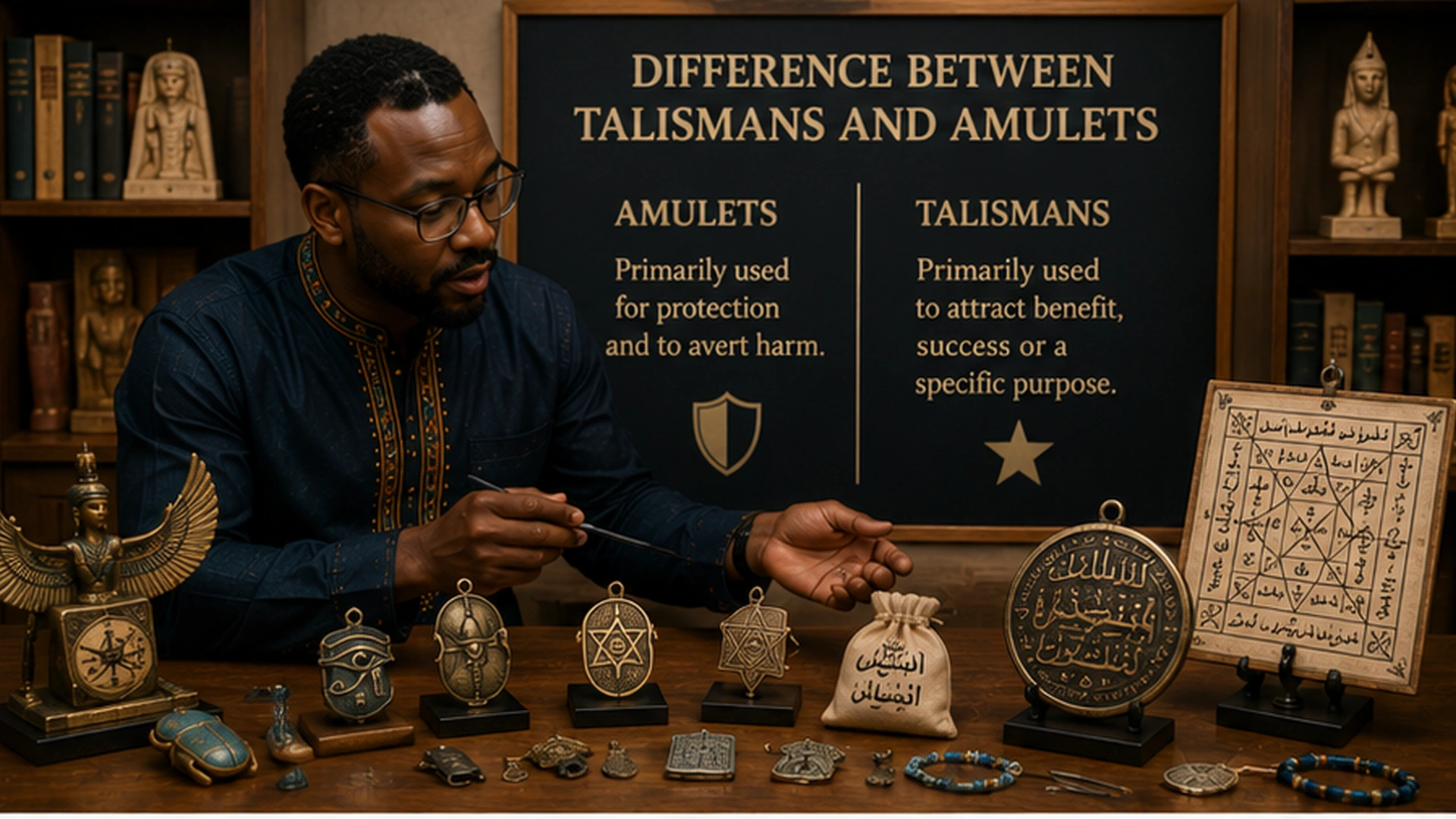
Quick Summary
Amulets and talismans are closely related protective or beneficial objects, but the terms are not always identical. Amulets are commonly associated with preventing harm, while talismans are often linked with attracting a desired benefit or achieving a particular purpose. Historical usage overlaps across cultures, periods, religions, and museum classifications.
Difference Between Talismans and Amulets explains the meaning, background and cultural context of talisman versus amulette différences in clear educational language. The article answers the main topic near the beginning, preserves the original examples and highlights important distinctions for respectful understanding.
Talismans and amulets are often mentioned together, and in everyday speech the words may be used interchangeably. Both can refer to objects believed to carry religious, spiritual, magical, symbolic, or protective significance.
The most common modern distinction is simple: an amulet is primarily intended to protect against harm, while a talisman is often intended to attract a benefit, strengthen an ability, or help achieve a specific purpose.
That distinction is useful, but it is not universal. Museums, historians, religious communities, collectors, and practitioners may classify the same object differently. A pendant inscribed for protection may be called an amulet, a talisman, a charm, a devotional object, or several of these at once.
The Metropolitan Museum describes ancient Egyptian amulets as objects believed to possess positive properties that could be bestowed upon their owners. Its discussion of Islamic material also uses both amulet and talisman for inscribed protective objects. The Oxford Pitt Rivers Museum notes that definitions of amulets and charms overlap considerably. These sources show that function and cultural context matter more than forcing every object into one rigid English category.
Suggested scene: Black African museum educator comparing several documented protective pendants, inscribed objects, and talismanic charts in a conservation-safe educational display.
Key Points
Amulets are most commonly associated with protection, prevention, or averting harm.
Talismans are commonly associated with attracting good fortune, strength, success, healing, or another desired outcome.
The distinction is useful but not universal.
An object can sometimes function as both an amulet and a talisman.
Amulets are often worn, carried, attached to clothing, placed in a home, or buried with the dead.
Talismans may be worn, carried, displayed, inscribed, stored, or installed in buildings.
Materials, symbols, prayers, names, colors, shapes, and rituals may all affect how an object is understood.
Different religions and cultures interpret protective objects differently.
Historical objects should be identified by culture, period, language, and community.
Claims that such objects scientifically guarantee protection or success are not established.
The Basic Difference
Feature
Amulet
Talisman
Most common purpose
To avert harm, illness, misfortune, envy, danger, or unwanted influence
To attract a desired benefit, opportunity, ability, victory, healing, prosperity, or specific result
Typical action in simplified explanations
Protective or preventive
Attractive, strengthening, or purpose-directed
Common forms
Pendant, bead, ring, bracelet, pouch, written text, figurine, object attached to clothing
Inscribed plate, seal, ring, chart, pendant, written square, image, object made for a named goal
Common location
Worn, carried, placed in a house, attached to a person or possession, buried with the dead
Worn, carried, displayed, installed, placed in a building, or prepared for a purpose
Can overlap?
Yes
Yes
A useful memory aid is: an amulet is usually described as shielding, while a talisman is often described as drawing or directing. However, historical vocabulary is inconsistent, and many objects combine both functions.
What Is an Amulet?
An amulet is generally a relatively small object worn, carried, attached, or placed because it is believed to protect a person, animal, possession, household, building, journey, pregnancy, or the dead.
The Oxford Pitt Rivers Museum quotes a dictionary definition emphasizing an object worn to prevent evil, mischief, disease, or witchcraft. The Metropolitan Museum defines an ancient Egyptian amulet through the positive properties believed to be transferred to its owner. These descriptions emphasize protection and well-being.
Common Purposes of Amulets
Averting illness or danger
Protection during travel
Guarding pregnancy or childbirth
Protection from envy or the evil eye
Safeguarding children
Protecting homes, animals, or possessions
Supporting the dead in funerary traditions
Expressing religious trust or identity
Common Amulet Forms
Pendants and necklaces
Beads and bracelets
Rings
Small figurines
Written or folded texts
Pouches containing selected materials
Coins, teeth, shells, stones, or plant material
Objects attached to doors, clothing, beds, or vehicles
What Is a Talisman?
A talisman is generally an object believed to carry or direct power toward a desired purpose. Depending on the tradition, that purpose may include protection, prosperity, healing, authority, courage, victory, fertility, learning, favorable travel, or another goal.
Historically, talismans were sometimes designed for a particular person, time, place, astrological configuration, inscription, or ritual purpose. Some were portable, while others were placed in architecture or stored in a significant location.
Common Purposes of Talismans
Attracting good fortune
Supporting success in work or study
Strengthening courage or authority
Seeking healing or well-being
Encouraging prosperity
Supporting a journey or undertaking
Focusing prayer, intention, or remembrance
Protecting a person, place, or object
Common Talisman Forms
Inscribed rings or seals
Metal plates
Written charts or diagrams
Pendants
Textile objects
Engraved stones
Architectural deposits
Objects prepared for a named person or purpose
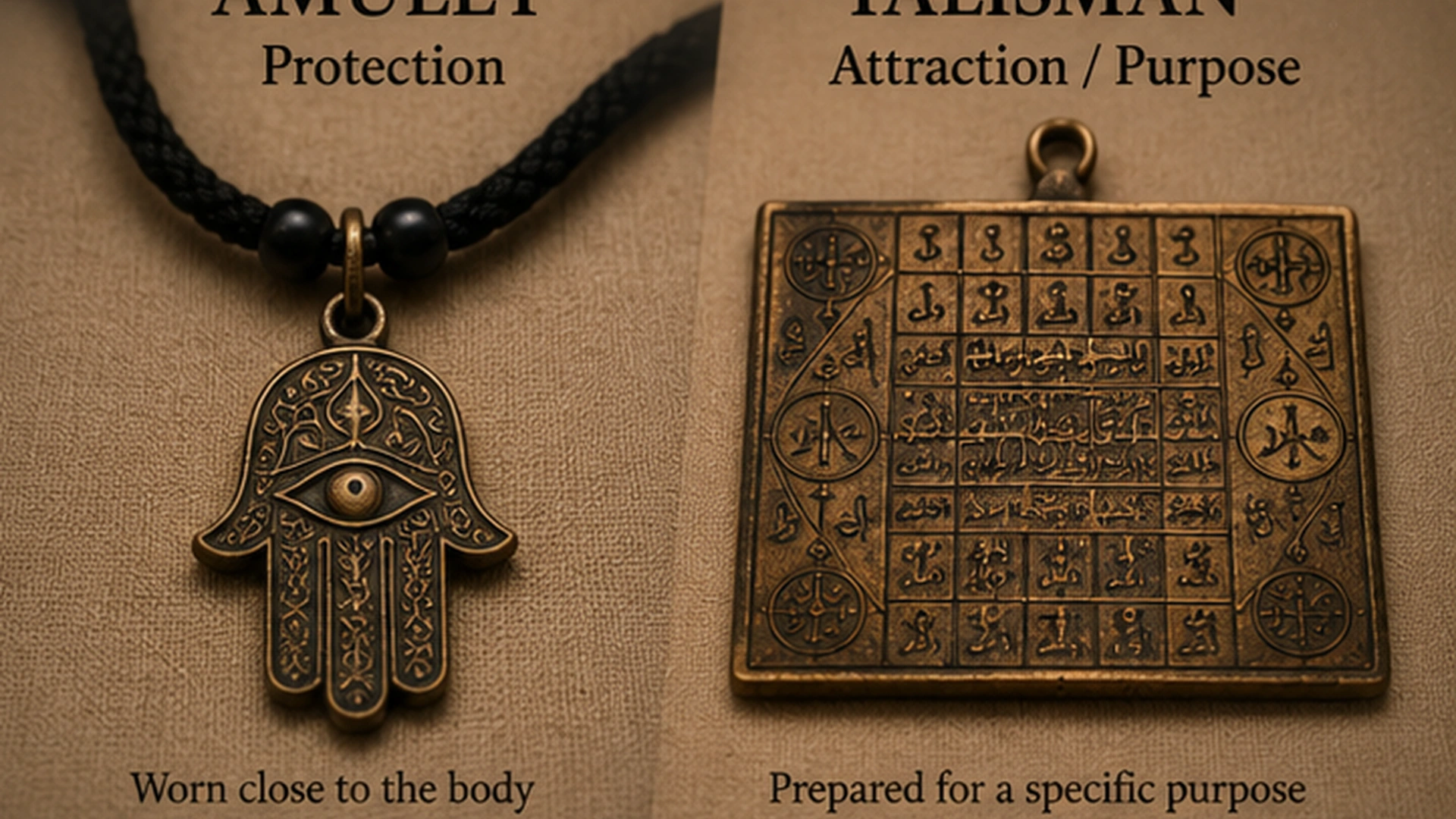
Suggested scene: Museum display comparing a protective amulet worn as a pendant with a larger inscribed talismanic object prepared for a defined purpose.
Can One Object Be Both?
Yes. The boundary is often blurred.
An inscribed pendant may protect the wearer from danger and also attract good fortune. A household object may be intended both to repel harmful influence and invite prosperity. A religious text carried in a pouch may be described as an amulet because it protects, and as a talisman because it is prepared for a specific beneficial purpose.
For this reason, museum catalogues and scholars sometimes use combined phrases such as “amulet and talisman” or “talismanic amulet.” The label should follow the documented cultural use rather than a rigid modern formula.
Amulet, Talisman, Charm, and Pendant
Term
General meaning
Important caution
Amulet
Object associated mainly with protection or averting harm
May also attract benefit and may not always be worn
Talisman
Object associated with a desired power, benefit, or purpose
Can also be protective
Charm
Broad term that may mean an object, spoken formula, written spell, or lucky token
Usage varies greatly
Pendant
A physical object suspended from a necklace or cord
Describes form, not spiritual function
Devotional object
Object used in religious remembrance, prayer, blessing, or devotion
Should not automatically be called magical
A pendant can be purely decorative. It becomes amuletic or talismanic only when a community, owner, maker, or tradition assigns it a protective or beneficial function.
How Function Is Assigned
The meaning of an object may come from several interacting features:
Material, such as metal, stone, shell, wood, textile, or paper
Shape, animal form, deity, saint, eye, hand, knot, plant, or geometric design
Color
Written names, prayers, verses, formulas, or invocations
The reputation of the maker
A blessing, consecration, prayer, or ritual process
The person or situation for which it was prepared
Where it is worn, placed, or buried
Community tradition and inherited explanation
The same material or symbol can have different meanings in different cultures. Similar shapes do not prove that two communities held the same belief.
Ancient Egyptian Amulets
Amulets were widely used in ancient Egypt by both the living and the dead. They could take the form of deities, animals, body parts, hieroglyphic signs, plants, or sacred symbols.
The Metropolitan Museum explains that an Egyptian amulet was believed to possess positive properties that could be transferred to its owner. Materials, colors, words, and shapes mattered. Some amulets were worn during life, while others were placed within mummy wrappings for funerary protection.
Examples
Wedjat eye amulets associated with restoration and protection
Scarab forms connected with transformation and renewal
Figures of deities associated with childbirth, healing, judgment, or protection
Djed pillars associated with stability
Heart scarabs used in funerary contexts
These objects should be interpreted within ancient Egyptian religion and funerary practice, not as generic modern “energy jewelry.”
Amulets and Talismans in Islamic Societies
Across many historical Muslim societies, protective and talismanic objects could include Qur’anic verses, divine names, names of prophets, prayers, seals, numerical arrangements, geometric forms, or religious narratives.
The Metropolitan Museum notes that talismans bearing names of prophets and religious heroes were believed to protect individuals from danger and hardship. Surviving examples include jewelry, scrolls, shirts, bowls, seals, and written charts.
Muslim legal and theological views have not been uniform. Some communities distinguish acceptable prayer, blessing, or scripture from practices considered forbidden magic or superstition. A museum object should therefore not be used to claim that every Muslim accepted the same practice.
African Contexts and Cultural Specificity
Africa does not have one universal amulet or talisman tradition.
Different communities have used protective or beneficial objects connected with ancestors, divinities, Islamic scholarship, Christianity, healing systems, kingship, warfare, childbirth, travel, and household protection.
The British Museum describes Brazilian balangandan charm assemblages as invoking African deities, Catholic saints, and symbolic objects for protection and good fortune. This example reflects Afro-Brazilian history and colonial religious mixture; it should not be generalized to every African community.
Responsible writing should identify the specific community, language, region, period, religious setting, and source.
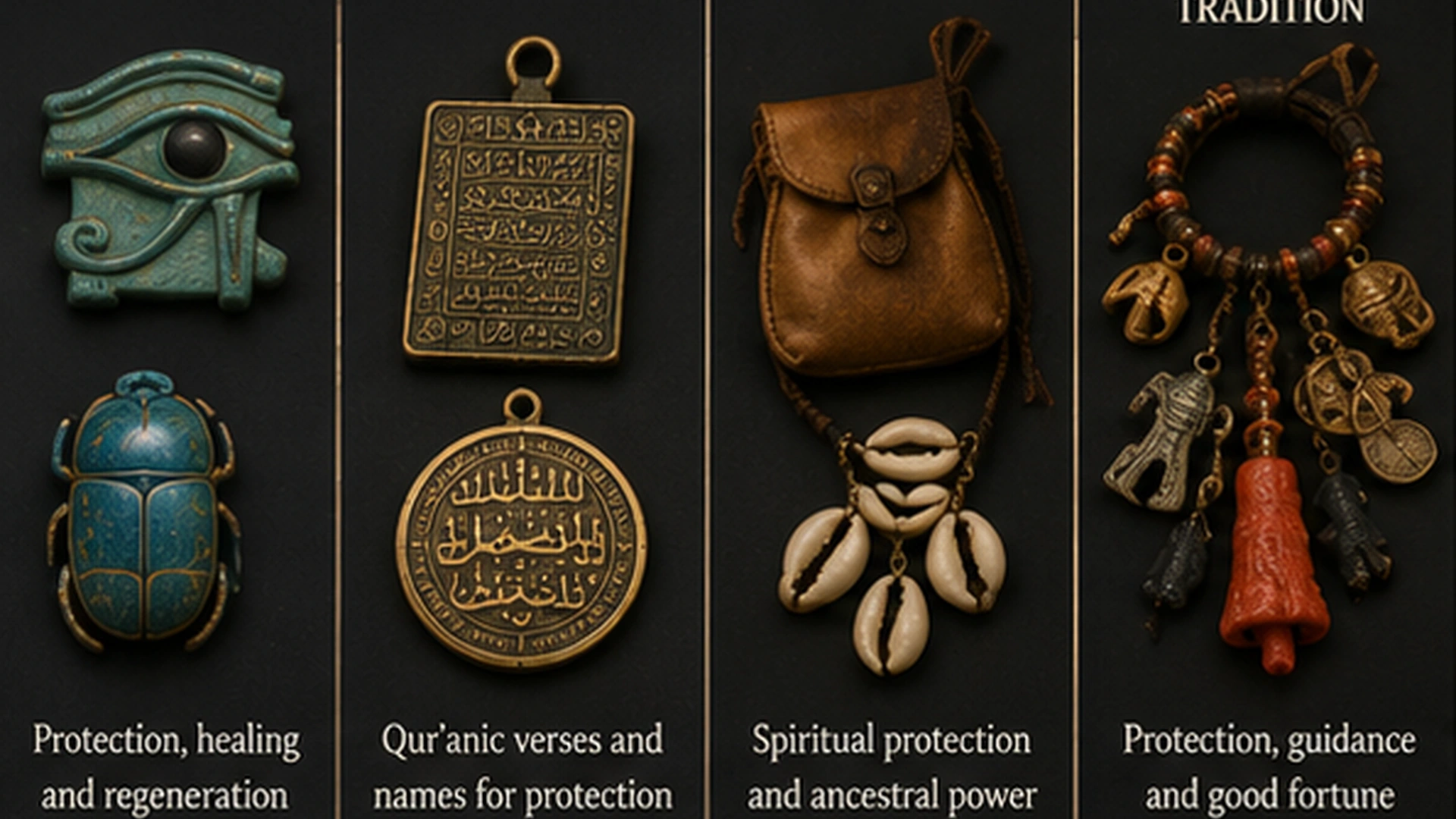
Suggested scene: Black African museum researchers comparing culturally specific Egyptian, Islamic, West African, and Afro-Brazilian protective objects in separate labeled study areas without combining them into one ritual.
Where These Objects Were Used
On the body as necklaces, bracelets, rings, belts, or sewn objects
Inside clothing or pouches
On children, travelers, soldiers, rulers, or healers
At entrances, roofs, walls, beds, or foundations
In graves or mummy wrappings
On animals or possessions
In courtly, domestic, religious, medical, or funerary contexts
Do Talismans Always Need Activation?
No universal rule exists.
Some traditions teach that an object’s material, shape, text, or inherited sacred association is sufficient. Others require blessing, prayer, consecration, ritual timing, contact with a sacred place, or preparation by a qualified religious or ritual specialist.
Modern online language about “charging” or “activating” every object is not a reliable description of all historical traditions.
Are All Religious Objects Amulets?
No.
A cross, rosary, medal, scripture, prayer bead, icon, or other devotional object may be used for worship, remembrance, identity, or prayer without being understood as an independently magical object.
Classification depends on the teachings and practices of the community. Writers should avoid calling sacred objects “magic” when adherents understand them through devotion, blessing, remembrance, or divine protection.
Are Amulets and Talismans Scientifically Proven?
Museum collections and historical sources establish that people have believed in and used amulets and talismans across many periods and societies.
That historical evidence does not establish that an object scientifically guarantees protection, healing, prosperity, fertility, victory, or another result.
A meaningful object may provide comfort, identity, confidence, memory, social connection, or a focus for prayer. These human effects are different from proving a supernatural mechanism.
Protective objects should not replace medical care, legal advice, emergency planning, financial safeguards, or practical safety measures.
Common Misconceptions
“Amulets only repel harm, while talismans only attract good.”
This is a useful simplified distinction, but historical usage overlaps.
“Every pendant is an amulet.”
Pendant describes form. Spiritual function depends on use and meaning.
“Talismans are always made through astrology.”
Some traditions use astrological timing, but many do not.
“All protective objects are pagan.”
Protective and devotional objects appear in many religious and cultural settings.
“Every African community uses the same charms.”
African traditions are diverse and culturally specific.
“Old objects prove supernatural power.”
Age proves historical use, not scientific efficacy.
“A costly object is more powerful.”
Price does not establish religious authenticity or effectiveness.
“A broken amulet always means it absorbed danger.”
That is a belief in some settings, not a universal fact.
“Owning an object gives permission to copy its ritual use.”
Museum access or purchase does not remove cultural, religious, or ethical boundaries.
Ethical Red Flags
Guaranteed healing, pregnancy, wealth, legal victory, or protection
Claims that a person will die or suffer unless they buy an object
Pressure to purchase repeated replacements
Objects marketed with invented ancient histories
Sacred symbols taken from living communities without context or permission
Use of protected wildlife, human remains, stolen artifacts, or illegally exported antiquities
Instructions to replace medical, legal, or practical safety measures
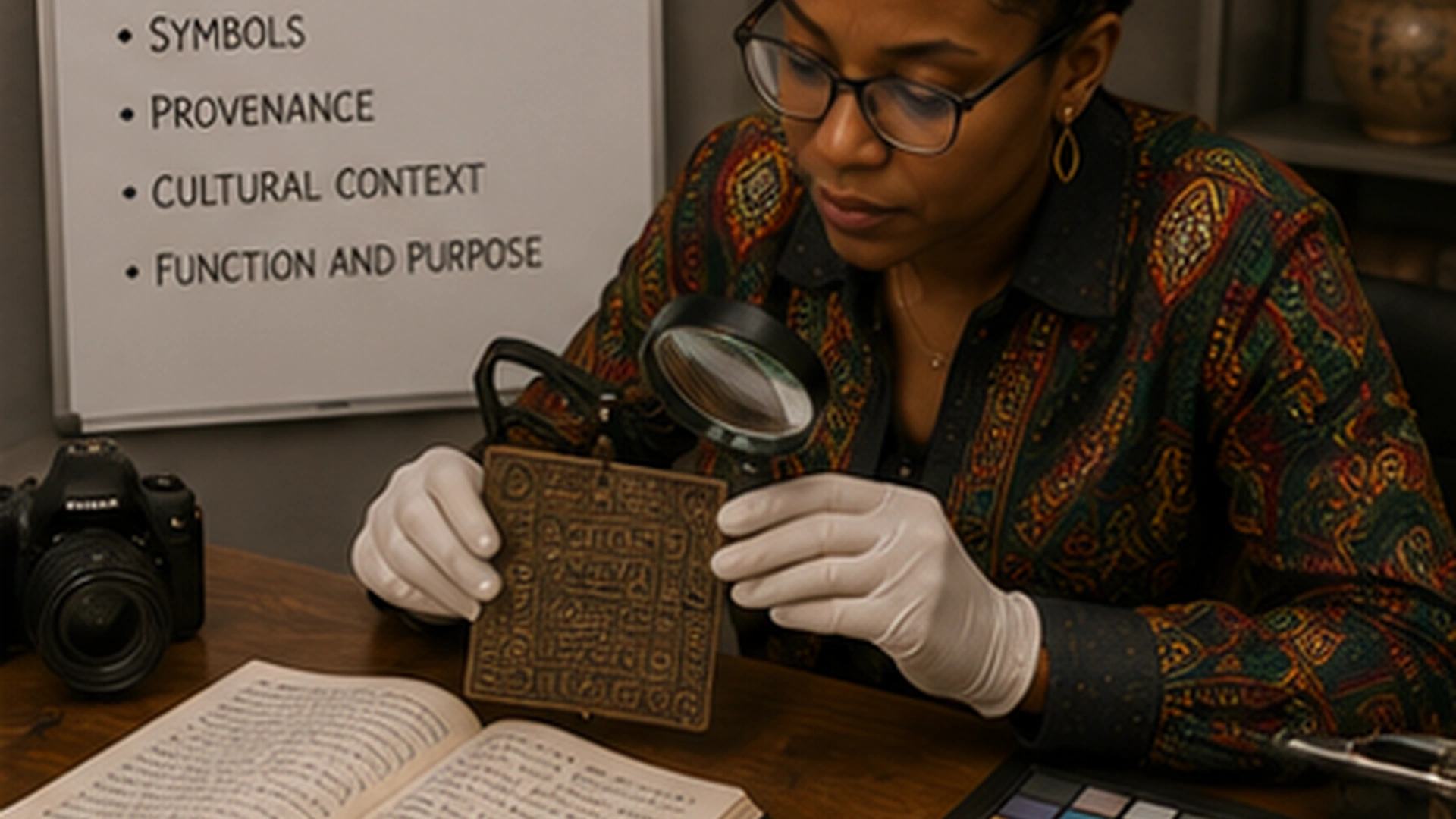
Suggested scene: Black African conservator documenting the materials, inscriptions, provenance, and community context of protective objects in a museum laboratory.
How to Describe an Object Responsibly
Identify the culture, region, language, and period.
State whether the original users called it an amulet, talisman, charm, devotional object, seal, pendant, or another term.
Describe what the object was believed to do without claiming that the effect is scientifically proven.
Separate protective, beneficial, devotional, decorative, medical, and funerary functions.
Explain uncertainty when the original use is unknown.
Avoid translating every sacred object into modern energy language.
Check provenance and whether the object was acquired ethically.
Respect restrictions involving sacred, secret, funerary, or community-controlled knowledge.
Key Takeaways
Amulets are commonly associated with protection and averting harm.
Talismans are commonly associated with attracting or directing a desired benefit.
The terms overlap and are not universal scientific categories.
An object can function as both an amulet and a talisman.
Pendant describes physical form, while amulet and talisman describe attributed function.
Materials, inscriptions, symbols, blessings, placement, and cultural context shape meaning.
Ancient Egyptian, Islamic, African, European, Asian, and other traditions should be discussed separately.
Historical use does not scientifically prove supernatural efficacy.
Protective objects should not replace practical, medical, legal, or financial safeguards.
People Also Ask
What is the main difference between a talisman and an amulet?
An amulet is most commonly associated with preventing harm, while a talisman is often associated with attracting a benefit or achieving a purpose. The distinction overlaps in historical use.
Can an object be both an amulet and a talisman?
Yes. Many objects are intended both to protect and to attract good fortune, healing, courage, or another desired benefit.
Is a charm the same as an amulet?
Sometimes, but charm is broader. It may refer to an object, spoken formula, written text, or lucky token.
Does an amulet have to be worn?
No. Amulets may be worn, carried, placed in homes, attached to possessions, installed in buildings, or placed with the dead.
Does a talisman need to be inscribed?
Not always. Some are inscribed, while others derive meaning from material, shape, blessing, maker, or cultural tradition.
Are religious medals amulets?
Some outsiders may classify them that way, but adherents may understand them as devotional or blessed objects. Community interpretation matters.
Are amulets scientifically proven to work?
Historical evidence proves that people used and valued them, but it does not establish guaranteed supernatural protection or healing.
Did ancient Egyptians use amulets?
Yes. Amulets were used by both the living and the dead and could represent deities, animals, sacred symbols, or hieroglyphic forms.
Are Islamic talismans all the same?
No. Forms and interpretations differ by region, period, school, and community, and Muslim views about such objects have varied.
How should museums describe protective objects?
They should identify cultural context, material, date, provenance, documented function, and uncertainty without imposing one universal explanation.
Key Takeaways
The difference between talismans and amulets is best understood as a difference of emphasis rather than an absolute boundary.
Amulets are most often associated with protection. Talismans are often associated with attracting, strengthening, or directing a desired result. Yet historical objects frequently combine both functions, and communities may use different words for the same type of object.
The most accurate interpretation begins with context: who made the object, who used it, what language they used, what religious or cultural system gave it meaning, where it was placed, and what it was believed to accomplish.
These objects deserve neither sensationalism nor dismissal. They are valuable evidence of human creativity, fear, hope, faith, identity, and the desire for safety and well-being.
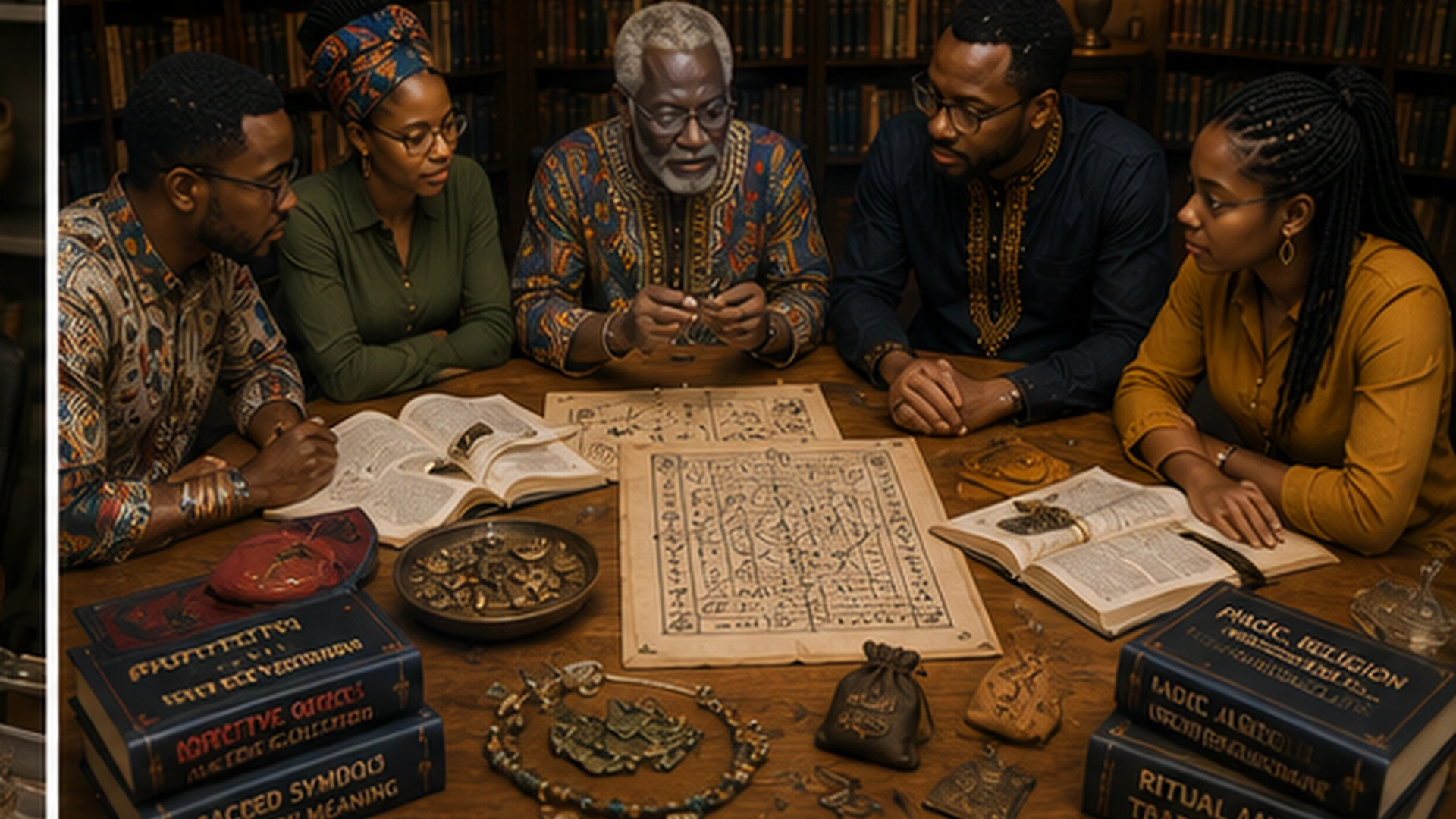
Suggested scene: Multigenerational African museum study group comparing amulets, talismans, charms, devotional objects, and decorative pendants using catalogues and provenance records.
Research Sources and Further Reading
The Metropolitan Museum of Art, “Ancient Egyptian Amulets.”
The Metropolitan Museum of Art, “Amulets and Talismans from the Islamic World.”
Pitt Rivers Museum, “Amulets and Charms Introductory Guide.”
British Museum collections of amulets, protective pendants, and balangandan charm assemblages.
Science Museum Group Journal, “A History of Amulets in Ten Objects.”
Academic scholarship on Arabic and Persian seals, amulets, and talismanic objects.
Frequently Asked Questions
What should readers know first about african spirituality and cultural history?
African spirituality and cultural history: Read clear guidance, key signs, practical steps, and private support from Ancestral Temple.
What causes difference-between-talismans-and-amulets?
The safest next step is to compare the signs, prepare clear details, and request private guidance when the matter feels personal.
How does difference-between-talismans-and-amulets work?
The safest next step is to compare the signs, prepare clear details, and request private guidance when the matter feels personal.
Is it possible to get private guidance for difference-between-talismans-and-amulets?
The safest next step is to compare the signs, prepare clear details, and request private guidance when the matter feels personal.
How long does difference-between-talismans-and-amulets take to understand?
The safest next step is to compare the signs, prepare clear details, and request private guidance when the matter feels personal.
Can difference-between-talismans-and-amulets affect relationships, family, work, or personal peace?
The safest next step is to compare the signs, prepare clear details, and request private guidance when the matter feels personal.
Why do people seek spiritual guidance for difference-between-talismans-and-amulets?
The safest next step is to compare the signs, prepare clear details, and request private guidance when the matter feels personal.
What signs should someone notice before asking about difference-between-talismans-and-amulets?
The safest next step is to compare the signs, prepare clear details, and request private guidance when the matter feels personal.
When should someone contact a private spiritual guide?
The safest next step is to compare the signs, prepare clear details, and request private guidance when the matter feels personal.
What causes african spirituality and cultural history?
African spirituality and cultural history: Read clear guidance, key signs, practical steps, and private support from Ancestral Temple. The safest next step is to compare the signs, prepare clear details, and request private guidance when the matter feels perso
Article Information
- Publisher
- Ancestral Temple
- Editor
- Ancestral Temple
- Last updated
- Jul 26, 2026
- Last reviewed
- Jul 13, 2026
- Content version
- dc8d372a58
This educational article should be read as cultural and spiritual information, not as medical, legal, financial, or emergency advice.
Helpful Related Guidance
Explore This Topic
What Is Spiritual Cleansing · African Spirituality And Cultural History
Related Topic Cluster
African Spirituality And Cultural History
Complete Guide Why Homes Have Been Blessed Throughout HistoryAbout the Author
 Ancestral Temple
Spiritual guide and practitioner with decades of experience in ancestral wisdom, rituals, and divine guidance.
Related Posts
View All






Leave a Comment
We'd love to hear your thoughts.
I appreciated the warning that historical usage overlaps.
The protection-versus-attraction distinction was very easy to understand.