
The History of Protective Amulets
Cornerstone Content
Quick Summary
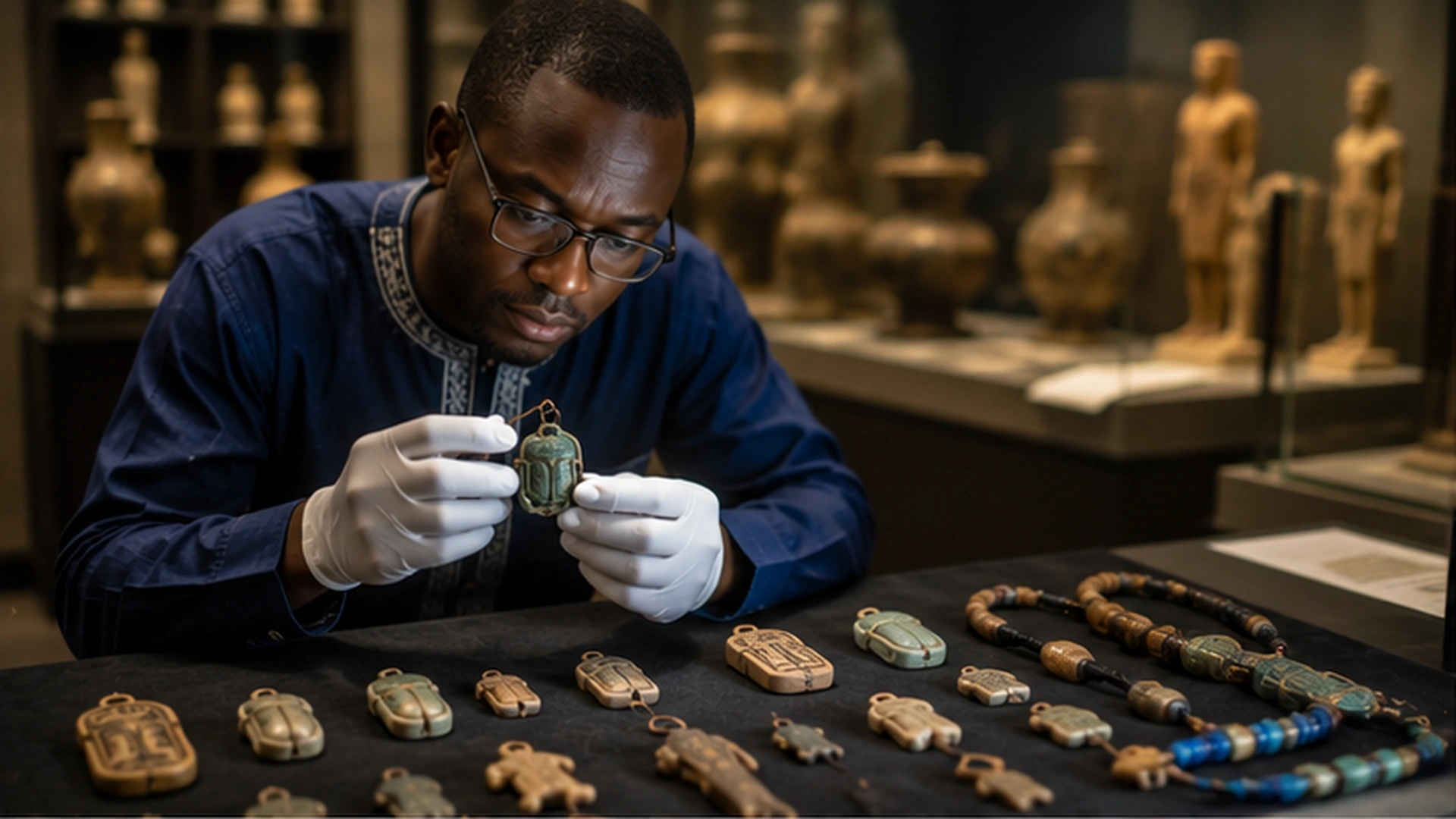
Protective amulets have been worn, carried, buried, sewn into clothing, and inscribed with prayers for thousands of years. This guide explores their history across ancient Egypt, Ethiopia, West African Muslim communities, the Mediterranean world, Judaism, Christianity, and Islam while separating cultural belief from scientifically proven protection.
Protective amulets are among the most widespread forms of personal material culture in human history.
They have been carved from stone, molded from clay, cast in metal, sewn from leather, written on parchment, enclosed in fabric, incorporated into jewelry, attached to clothing, and placed with the dead.
People have used them in connection with childbirth, illness, travel, military service, religious devotion, burial, social identity, protection from envy, and hopes for general well-being.
However, an amulet does not have one universal meaning.
An ancient Egyptian scarab, an Ethiopian protective scroll, a leather Qur’anic amulet case made by a Wolof artisan, and a Christian devotional medal belong to different histories and systems of belief.
They should not be mixed together as examples of one mysterious worldwide practice.
The history of protective amulets is instead the history of people using portable objects to make religious beliefs, social relationships, prayers, fears, and hopes physically present in everyday life.
Key Points
A protective amulet is an object worn, carried, attached to clothing, placed in a building, or buried with a person because its owner or community believes it can provide protection, blessing, healing support, or spiritual benefit.
Amulets have included:
- Carved stones
- Animal-shaped pendants
- Scarabs
- Eye symbols
- Written prayers
- Metal plaques
- Leather cases
- Cloth packets
- Scrolls
- Religious medals
- Beads
- Rings
- Inscribed jewelry
- Miniature figures
- Objects placed in burial wrappings
The word amulet comes from the Latin amuletum, although modern scholars use it broadly for objects from cultures that had their own names and classifications.
Protective claims associated with amulets are matters of religious or cultural belief. Wearing an amulet does not provide scientifically established protection from disease, violence, accidents, pregnancy complications, legal problems, or financial loss.
What Is a Protective Amulet?
A protective amulet is a portable or wearable object believed to guard a person, animal, household, possession, or deceased individual against a particular danger or general misfortune.
Its perceived importance may come from:
- Its material
- Its shape
- Its color
- An image or symbol
- Words written on it
- A prayer spoken over it
- The person who made it
- The place from which it came
- Contact with a sacred person or location
- The way it was prepared
- The identity of its owner
In museum and academic writing, the words amulet, talisman, and charm sometimes overlap.
A useful distinction is that an amulet is commonly understood as an object carried for protection, while a talisman may be created or inscribed to produce a more specific desired effect. This distinction is helpful but not absolute because different scholars, museums, religions, and communities use the terms differently.
Plain-Language Meaning
An amulet is a small object that someone believes can help protect them.
A person might wear it around the neck, keep it in a pocket, sew it into clothing, attach it to a child’s garment, place it in a home, or include it in a burial.
Its meaning comes from the beliefs of the person or community using it—not simply from how the object looks.
A necklace is not automatically an amulet. A stone is not automatically sacred. An object becomes an amulet within a particular cultural, religious, or personal context.
Why the Earliest History Is Difficult to Trace
It is impossible to identify the first amulet in human history.
Archaeologists have discovered prehistoric beads, shells, animal teeth, carved figures, and unusual stones, but it is not always possible to determine whether these objects were decorative, protective, religious, social, or practical.
Modern observers may call an ancient pendant an amulet because of its burial location or symbolic shape, but the original owner’s exact understanding may be unknown.
Written sources create another difficulty.
The people who manufactured or wore amulets were not always the people who produced surviving written records. Historical descriptions may therefore reflect the opinions of priests, rulers, missionaries, colonial officials, archaeologists, or collectors rather than those of ordinary users.
A careful history must distinguish between:
- What an object physically is
- Where it was discovered
- What inscriptions say
- How similar objects were used
- What scholars infer
- What living communities explain
- What remains uncertain
Ancient Egyptian Protective Amulets
Ancient Egypt provides some of the best-preserved evidence for the historical use of protective amulets.
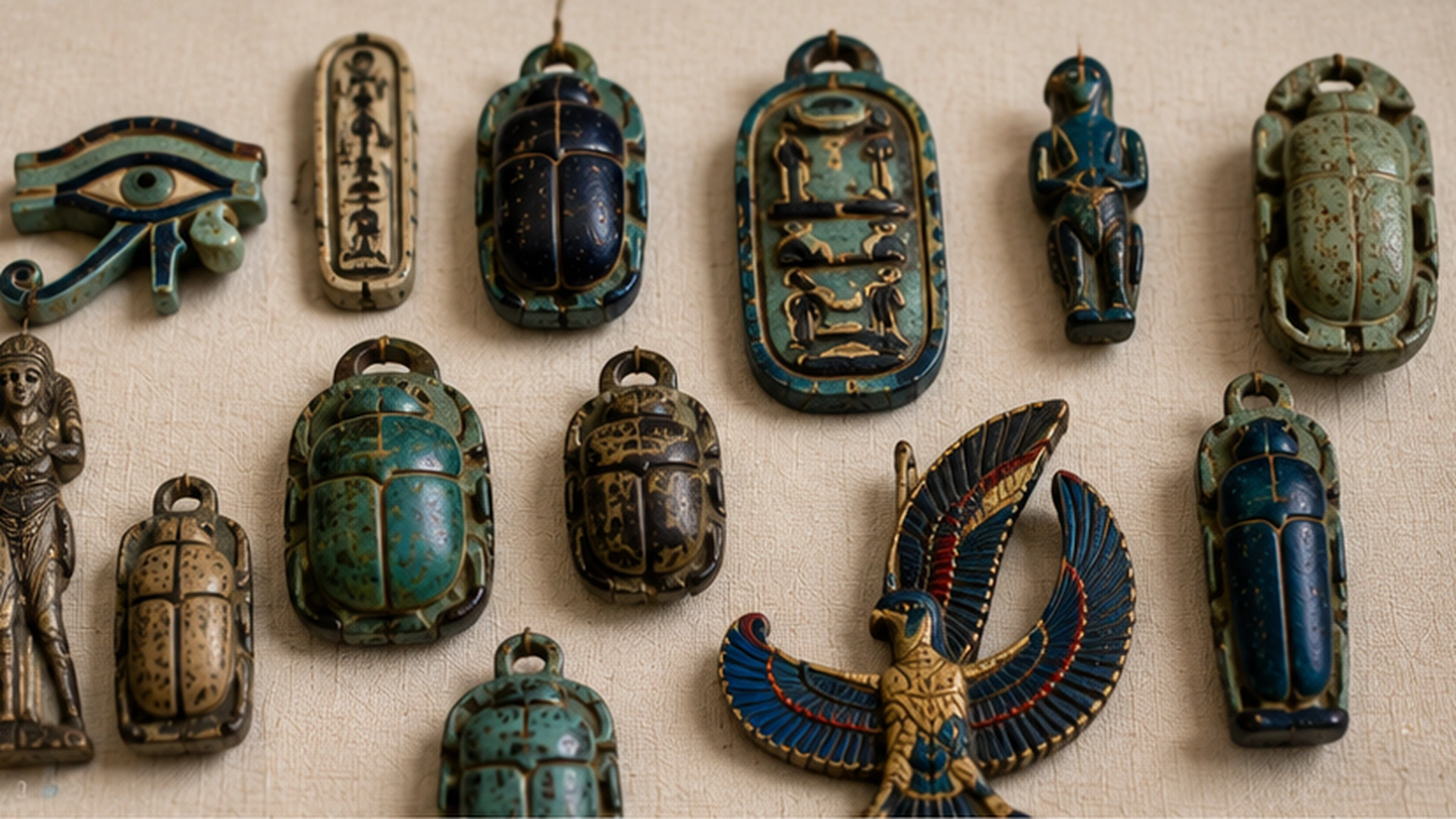
Amulets were worn by living people and placed among the wrappings of the dead. Their forms could represent deities, animals, body parts, sacred symbols, royal objects, or hieroglyphic signs.
Materials included faience, stone, glass, metal, wood, and other substances. Material and color could contribute to an amulet’s intended meaning.
The Metropolitan Museum of Art notes that Egyptian amulets were valued for both their form and material, and that they could provide protection or transfer desirable qualities to their owners.
Scarab amulets
The scarab beetle became one of ancient Egypt’s most recognizable amulet forms.
The beetle’s movement of a ball across the ground was associated with the sun’s daily journey. Its apparent emergence from the earth also connected it with creation, transformation, and regeneration.
Scarabs served several purposes.
Some were used as seals. Others carried personal names, titles, images, or short inscriptions. Certain scarabs were worn by the living, while heart scarabs were placed with the dead.
Heart scarabs
Ancient Egyptians associated the heart with life, thought, memory, and moral character.
In funerary belief, the heart was judged against maat, the principle of justice and order. Heart scarabs were intended to support the deceased during this judgment and could contain inscriptions asking the heart not to testify against its owner.
These objects should not be marketed today as generic “Egyptian protection stones.” They belonged to specific religious ideas about death, judgment, morality, and the afterlife.
The wedjat eye
The wedjat, often called the Eye of Horus, represented restoration, healing, wholeness, and protection.
Amulets in this form were used by the living and the dead. The symbol’s meaning emerged from Egyptian religious narratives and should not be separated from that historical context.
Funerary amulets
Ancient Egyptian burial practices could include several amulets positioned at particular places on the body.
Winged scarabs, for example, could be attached to mummy wrappings and were associated with rebirth.
This demonstrates that an amulet’s placement could be as important as its appearance.
Protective Amulets in the Ancient Mediterranean
Amulet traditions also appeared throughout ancient Greece, Rome, Italy, the eastern Mediterranean, and communities connected through trade and empire.
People wore or carried objects associated with:
- Childbirth
- Fertility
- Childhood
- Military service
- Travel
- Illness
- Envy
- The evil eye
- Personal safety
- Sexual and reproductive health
Amber objects in parts of the ancient Greek and Italian worlds were sometimes connected with fertility, pregnancy, childbirth, and the protection of children.
Roman soldiers and civilians also used protective pendants and charms. Archaeological evidence from Roman military contexts shows that personal adornments could carry protective meanings alongside their decorative or social functions.
Some amulets carried written names, prayers, formulas, divine figures, or symbols.
An inscribed agate amulet preserved by the Getty Museum contains a protective prayer arranged in a repeated letter pattern.
Ancient Mediterranean amulets should not be described as one coherent magical system. Greek, Egyptian, Roman, Jewish, Christian, and locally established traditions interacted, but they did not become identical.
Jewish Protective Amulets
Jewish communities in different historical periods have used written amulets containing biblical passages, divine names, prayers, angelic names, or protective formulas.
The Metropolitan Museum has documented fifth- or sixth-century gold and silver amulets discovered in Jewish tombs in present-day Jordan. The objects contained inscriptions and were originally rolled or enclosed.
Jewish attitudes toward amulets have varied.
Some rabbis and communities accepted particular amulets, especially when prepared by a recognized or experienced writer. Others criticized amulet use when it appeared to rely on superstition, unauthorized names, or beliefs inconsistent with religious law.
It is therefore inaccurate to describe amulets as either universally accepted or universally rejected within Judaism.
A mezuzah should also not automatically be called an amulet. In Jewish law and practice, it is a commanded religious text placed on a doorway, although outsiders have sometimes interpreted it primarily through the category of protection.
Christian Amulets, Medals, and Devotional Objects
Early and medieval Christians sometimes wore crosses, inscribed pendants, relic containers, biblical texts, and objects bearing the names or images of Christ, Mary, saints, or angels.
Christian authorities regularly distinguished approved devotional objects from forbidden magic.
Within Catholicism, medals, crosses, scapulars, and blessed objects may be understood as sacramentals that direct believers toward prayer and faith. They are not supposed to function as independent magical devices that automatically force a desired result.
Official Catholic guidance warns that devotional signs can be misunderstood when they are treated mechanically, commercially, or superstitiously rather than within religious teaching and practice.
Protestant, Orthodox, Catholic, Ethiopian Orthodox, Coptic, Anglican, Pentecostal, and other Christian traditions differ in how they understand wearable devotional objects.
A cross necklace may serve as an expression of faith, identity, remembrance, or prayer without its wearer describing it as an amulet.
Amulets and Talismans in Islamic History
Protective objects have appeared across many Muslim societies, although their acceptance and interpretation have been debated.
Some objects contain:
- Qur’anic passages
- Divine names
- Prophetic names
- Prayers
- Number arrangements
- Geometric designs
- Letter combinations
- Pious sayings
- References to religious figures
The Metropolitan Museum describes Islamic-world amulets and talismans containing inscriptions intended to connect the bearer with sacred protection.
Muslim scholars have not held one universal position.
Some accept written Qur’anic passages or prayers when the wording is understood and the believer recognizes God as the source of protection. Others reject the wearing of amulets entirely because of concerns about superstition, improper dependence on objects, unknown formulas, or religious innovation.
These debates vary according to legal school, scholarly tradition, historical period, region, Sufi affiliation, reform movement, and local practice.
The Arabic concept of baraka, usually translated as blessing or divine grace, may be connected with people, places, words, objects, or actions in some Muslim traditions. It should not be translated as a scientifically measurable energy.
Qur’anic Amulet Cases in African Muslim Communities
In parts of Africa, Islamic scholarship interacted with local clothing, leatherwork, metalwork, military history, healing practices, trade, and family traditions.
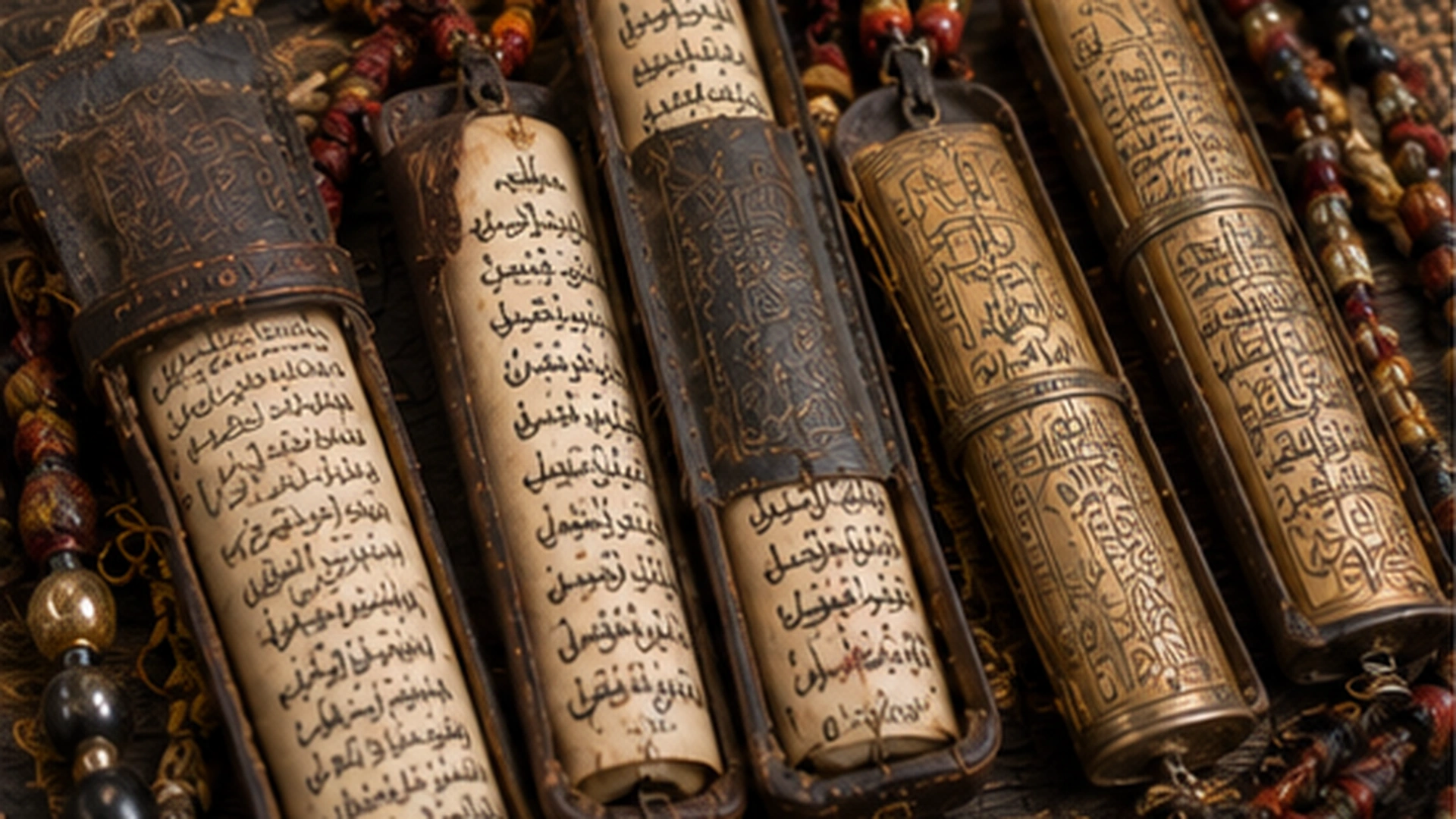
Written Qur’anic passages or prayers could be folded and enclosed in protective cases worn around the neck, arm, waist, or sewn into clothing.
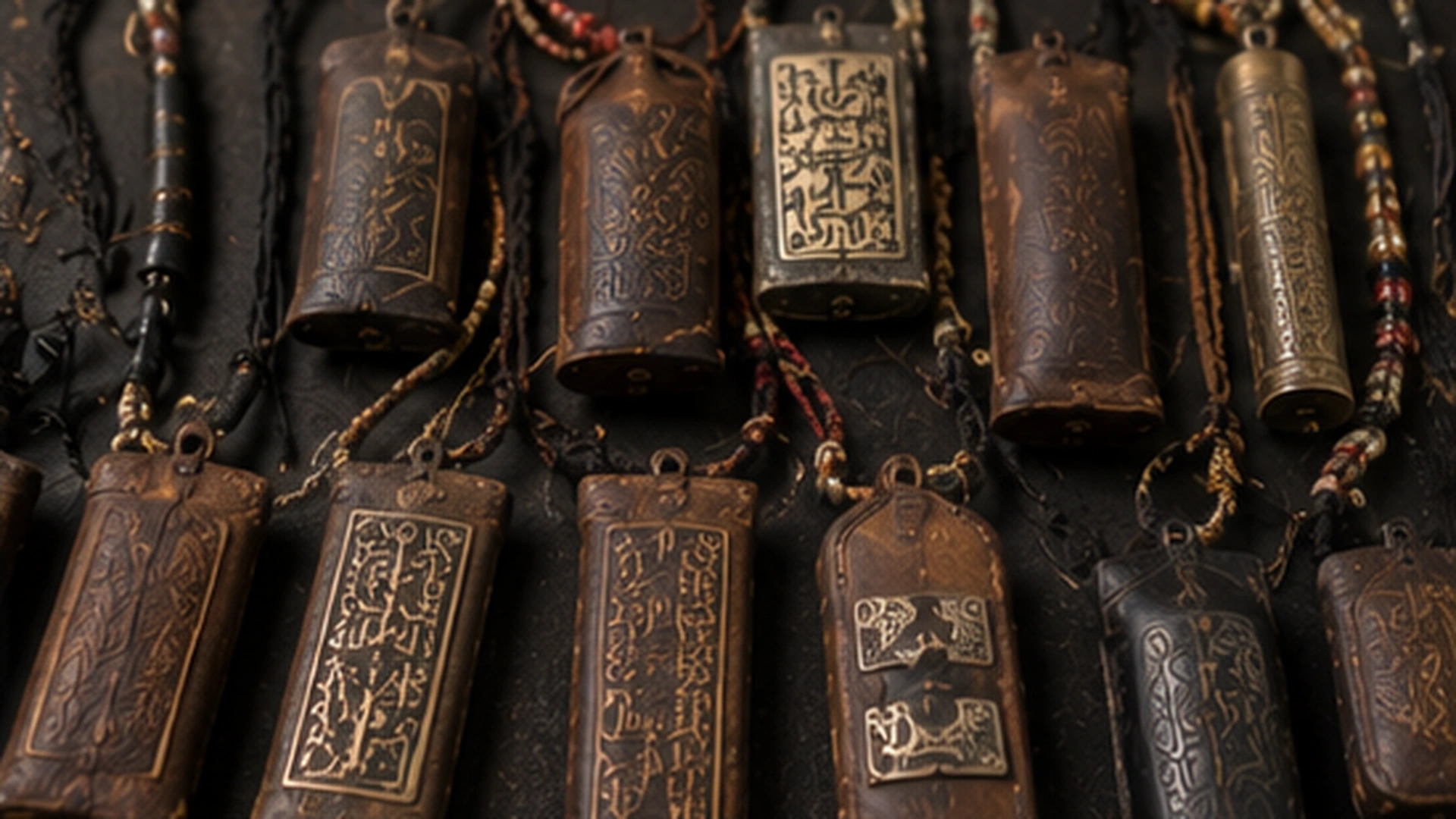
A nineteenth-century leather amulet in the British Museum was made by a Wolof artisan in The Gambia and contains paper bearing a Qur’anic inscription.
Another museum object, probably made in South Sudan, consists of several leather cases containing Qur’anic texts arranged as a necklace.
These examples demonstrate cultural and material diversity.
They should not be presented as a single “African Muslim amulet.” A Wolof leather case from The Gambia has a different history from an object made in Sudan, Ethiopia, Morocco, Nigeria, or another Muslim community.
Protective writings could also be incorporated into garments. A Mandinka-associated robe from Liberia includes patterns resembling Islamic protective amulet designs, showing how written and geometric forms could move between paper, leather, clothing, and regional trading networks.
Ethiopian Protective and Healing Scrolls
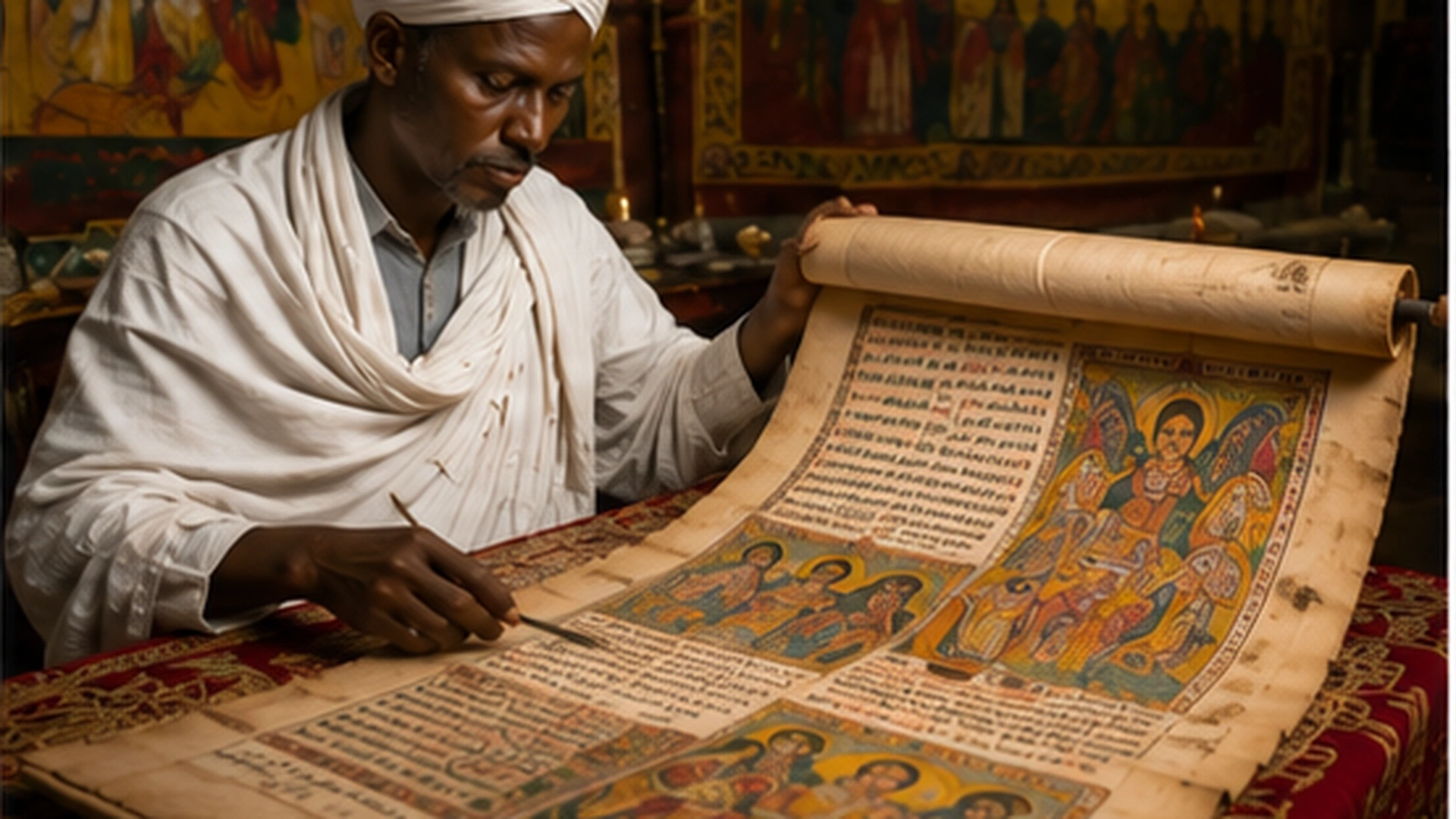
Ethiopian protective scrolls are among the most distinctive African traditions involving personalized written and visual objects.
Often associated with Amhara or Tigrinya-speaking communities, these parchment scrolls may combine Christian prayers, sacred names, talismanic designs, angelic imagery, geometric forms, and other religious material.
They were traditionally prepared for a particular individual rather than mass-produced for anonymous buyers.
The Metropolitan Museum explains that such scrolls were customized according to the intended owner and could be carried on the body or displayed in connection with protection and healing.
The role of the däbtära
Some scrolls were prepared by a däbtära, an unordained Ethiopian Orthodox cleric trained in religious learning, chant, manuscript traditions, and related fields.
A däbtära should not automatically be described as a priest, magician, healer, or monk. The role is historically specific and may involve several forms of religious and scholarly expertise.
Museum documentation identifies particular scrolls as works prepared by däbtäras for individuals facing illnesses understood through religious frameworks.
Scroll dimensions and personalization
A scroll could be made in relation to the height or physical identity of its intended owner. Prayers and images were selected for the individual rather than copied without variation.
This personalization is important because it separates the traditional object from modern decorative reproductions.
A museum print or commercially produced scroll pattern is not automatically a functioning protective object within Ethiopian religious life.
Health claims and historical interpretation
Historical users may have understood illness through spiritual, environmental, physical, and social causes.
Modern educational writing should explain those beliefs without claiming that a scroll has been scientifically shown to cure disease.
A person experiencing illness should seek qualified medical care. Traditional or religious support may accompany appropriate treatment, but it should not replace diagnosis, medication, emergency services, or mental-health assistance.
WHO emphasizes that traditional and complementary practices should be approached through evidence, safety standards, ethical practice, regulation, and informed decision-making.
Amulets, Charms, Talismans, and Related Objects
These terms are often used loosely, but they are not always identical.
- Term
- General meaning
- Amulet
- An object worn or carried mainly for protection
- Talisman
- An object prepared or inscribed for a particular purpose or desired result
- Charm
- A broad term for an object or spoken formula believed to influence events
- Devotional object
- An object supporting prayer, religious identity, or remembrance
- Relic
- Physical remains of, or an object associated with, a sacred person
- Medicine bundle
- A culturally specific collection of substances or objects connected with healing, authority, or protection
- Amulet case
- A container holding writing, substances, or another protective item
- Protective scroll
- A written object prepared for protection, prayer, or healing support
These definitions are only guides.
A community may have a specific name that is more accurate than any English category.
How Protective Amulets Were Made
Amulets could be produced by:
- Jewelers
- Stone carvers
- Metalworkers
- Leatherworkers
- Scribes
- Religious scholars
- Clerics
- Healers
- Family members
- Specialist artisans
- Commercial workshops
Their production could involve ordinary craft knowledge, religious authorization, specialized writing, prayer, ritual preparation, or a combination of these.
Some were inexpensive and widely available. Others required valuable materials or access to respected specialists.
The idea that every amulet was handmade secretly by a spiritual authority is historically inaccurate.
Ancient Egyptian faience amulets, for example, could be produced in substantial numbers using molds, while personalized scrolls and written objects required more individual preparation.
How Amulets Were Worn or Used
Amulets could be:
- Worn as necklaces
- Attached to bracelets
- Sewn into clothing
- Tied to an arm or waist
- Carried in a pouch
- Placed near a sleeping child
- Attached to military clothing
- Hung in a building
- Kept with travel possessions
- Placed in mummy wrappings
- Buried with the dead
- Installed near doors or entrances
The method of use may reveal who the object was meant to protect and from what danger.
An amulet placed on a deceased person had a different purpose from one worn during childbirth or military service.
Children, Pregnancy, and Protective Objects
Many societies have considered pregnancy, childbirth, infancy, and childhood periods of particular vulnerability.
Protective objects have therefore frequently been associated with:
- Fertility
- Pregnancy
- Safe delivery
- Infant survival
- Childhood illness
- Protection from envy
- Social recognition of a child
Ancient Egyptian amulets representing deities such as Taweret could be associated with pregnancy and motherhood.
Ancient Mediterranean amber amulets were also connected with reproductive and childhood concerns.
These historical beliefs should never be presented as substitutes for prenatal care, trained maternity services, vaccination, pediatric care, or emergency medicine.
Small amulets can also create choking, strangulation, or injury risks for children.
Amulets in War and Travel
Soldiers, travelers, sailors, merchants, and migrants have historically carried objects associated with protection.
The dangers of travel included:
- Violence
- Illness
- Shipwreck
- Weather
- Theft
- Accidents
- Separation from family
- Unfamiliar environments
An amulet might express religious faith, family connection, identity, courage, or hope.
It did not provide physical armor or replace practical preparation.
Modern travelers still require identification documents, vaccines where appropriate, insurance, secure transport, emergency contacts, and awareness of local risks.
Colonial Descriptions and Misleading Labels
European collectors, missionaries, soldiers, and colonial officials often labeled unfamiliar African objects as:
- Fetishes
- Charms
- Witchcraft objects
- Superstitions
- Magic
- Idols
- Curiosities
These terms frequently ignored the object’s actual name, maker, owner, language, religious setting, or social function.
An object described in an old museum catalogue as a “native charm” may have been:
- A Qur’anic text
- A family heirloom
- A healer’s professional object
- A sign of military rank
- A child’s protective necklace
- A devotional item
- A medicine container
- A symbol of social identity
Modern scholarship increasingly attempts to recover more precise histories, although museum records may remain incomplete.
Museum Ethics and Cultural Ownership
Many amulets entered museums through archaeology, purchase, missionary collecting, military activity, colonial expeditions, or private donations.
Important questions include:
- Was the object obtained with consent?
- Was it removed from a burial?
- Does it contain human remains?
- Does it reveal restricted religious knowledge?
- Is the community of origin identified correctly?
- Should sacred writing be displayed openly?
- Should descendants be consulted?
- Is repatriation appropriate?
UNESCO’s ethical principles state that communities, groups, and relevant individuals should play the primary role in safeguarding their cultural heritage.
Photographing or publishing an amulet in a museum does not automatically make every associated prayer, name, substance, or preparation method public knowledge.
Protective Amulets in Modern Life
Amulets remain part of contemporary religious, family, commercial, and cultural life.
People may wear them because of:
- Faith
- Family tradition
- Cultural identity
- Personal comfort
- Fashion
- Memory
- Community affiliation
- Fear of misfortune
- Advice from a religious or traditional specialist
Modern mass production has made amulet-shaped jewelry widely available.
This creates several complications.
An object sold as an “African protection necklace” may combine symbols from unrelated Egyptian, Ethiopian, West African, North African, and diaspora traditions.
It may also contain invented meanings designed for marketing.
A replica can be appreciated as art or jewelry, but it should not be presented as an authentic ritual object without reliable provenance and community context.
Are Protective Amulets Scientifically Proven?
There is no reliable scientific evidence that wearing an amulet can create a supernatural shield against disease, violence, pregnancy complications, accidents, curses, legal problems, or financial loss.
An amulet may still have emotional, religious, cultural, or psychological meaning for its owner.
It may:
- Remind someone of family
- Encourage prayer
- Provide comfort
- Strengthen identity
- Represent a commitment
- Reduce feelings of isolation
- Connect a person with community support
These experiences should be distinguished from claims that an object physically prevents infection, stops bullets, cures illness, guarantees pregnancy, or controls another person.
Any seller or practitioner promising guaranteed protection should be treated cautiously.
Safety Risks
Amulets can create practical risks when they contain:
- Toxic metals
- Lead
- Mercury
- Unknown powders
- Unidentified herbs
- Contaminated animal material
- Sharp objects
- Flammable substances
- Skin irritants
- Materials unsafe for children
Risks also arise when people are told to:
- Swallow an amulet
- Insert it into the body
- Burn unknown materials indoors
- Stop medication
- Avoid hospitals
- Pay large sums under threat
- Hide abuse or criminal activity
- Use an object instead of physical security
Traditional objects connected with health should be evaluated carefully. WHO’s current traditional-medicine strategy emphasizes evidence, safety, quality, regulation, autonomy, and community engagement.
Common Misconceptions
“All amulets are African spiritual objects”
False.
Protective objects have appeared in Africa, Asia, Europe, the Middle East, the Americas, and many other regions.
“Every African necklace is an amulet”
False.
Jewelry may indicate beauty, wealth, age, marriage, office, ethnicity, fashion, mourning, religion, or professional identity.
“Ancient Egyptian symbols all mean protection”
False.
Egyptian symbols could relate to kingship, writing, divinities, life, death, rebirth, offerings, identity, or other concepts.
“Amulet and talisman always mean exactly the same thing”
Not necessarily.
The words overlap, but talisman may imply a more specific purpose while amulet often emphasizes protection.
“Every written African amulet contains secret magic”
False.
Some contain Qur’anic passages, Christian prayers, biblical texts, names, number arrangements, or other written material.
“An old object automatically has spiritual power”
That is a matter of belief, not a historical fact.
Age may increase an object’s archaeological, artistic, financial, or family importance without proving supernatural effectiveness.
“A replica works exactly like the original”
Not within traditions where meaning depends on ownership, preparation, prayer, authorization, material, or context.
“Protective amulets can replace medicine or security”
False.
They do not replace medical care, locks, legal protection, insurance, safety planning, or emergency services.
How to Study Protective Amulets Respectfully
Identify the specific community
Avoid vague labels such as “African charm.”
Use the most precise available information about:
- Maker
- Community
- Language
- Region
- Date
- Religion
- Materials
- Owner
- Purpose
- Collection history
Separate evidence from interpretation
State clearly whether a claim comes from:
- An inscription
- Archaeological context
- Community testimony
- Museum documentation
- Historical writing
- Scholarly interpretation
- Commercial advertising
Respect restricted knowledge
Do not publish private prayers, sacred names, formulas, burial locations, or hidden contents without appropriate permission.
Avoid guaranteed claims
Describe what people believed or intended rather than declaring that the object objectively worked.
Credit makers and knowledge holders
Whenever possible, identify named artisans, scribes, scholars, communities, and institutions instead of treating objects as anonymous cultural products.
Consider provenance
Ask how the object entered a collection and whether colonial violence, grave removal, unequal trade, or religious suppression shaped its history.
Key Takeaways
- Protective amulets are portable objects believed to offer protection or spiritual benefit.
- Their history cannot be traced to one first culture or object.
- Ancient Egyptian amulets included scarabs, heart scarabs, wedjat eyes, divine figures, and funerary objects.
- Mediterranean amulets were associated with childbirth, childhood, travel, military life, envy, and illness.
- Jewish, Christian, and Muslim communities developed different traditions and debates concerning protective objects.
- Qur’anic texts were enclosed in leather amulet cases in particular African Muslim communities.
- Ethiopian protective scrolls were personalized religious manuscripts, often prepared by trained däbtäras.
- Amulets, talismans, charms, relics, and devotional objects are related but not always identical categories.
- Not every necklace, symbol, or old object is an amulet.
- Museum labels created during colonial periods may be inaccurate or disrespectful.
- Communities should help determine how sacred and restricted objects are described and displayed.
- Amulets are not scientifically proven to prevent disease, violence, accidents, or financial loss.
- Protective objects must not replace medicine, legal help, physical security, or emergency services.
- Commercial replicas should not be presented as authentic ritual objects without evidence.
People Also Ask
What is a protective amulet?
A protective amulet is an object worn, carried, displayed, or buried because a person or community believes it can offer protection, blessing, or spiritual benefit.
What is the oldest known protective amulet?
There is no single confirmed oldest amulet because archaeologists cannot always determine whether prehistoric ornaments were decorative, social, religious, or protective.
Why did ancient Egyptians wear amulets?
Ancient Egyptians wore amulets for protection, health, identity, regeneration, divine support, and preparation for the afterlife.
What is the difference between an amulet and a talisman?
An amulet usually emphasizes protection, while a talisman may be created for a more specific purpose. The terms often overlap.
What are Ethiopian protective scrolls?
They are personalized parchment manuscripts combining prayers and sacred imagery, historically prepared for particular individuals in Ethiopian religious contexts.
What are Qur’anic amulet cases?
They are containers, often made from leather or cloth, holding Qur’anic passages or prayers and worn in some Muslim communities.
Are amulets accepted in all religions?
No. Acceptance varies within Judaism, Christianity, Islam, Indigenous religions, and other traditions.
Do protective amulets really work?
Their spiritual effectiveness is a matter of belief. They have not been scientifically proven to prevent illness, violence, accidents, or misfortune.
Is it respectful to wear an amulet from another culture?
It depends on the object. Public symbols may be worn respectfully, but restricted, sacred, official, or culturally specific objects require greater care and permission.
Can an amulet replace medical treatment?
No. An amulet should never replace qualified medical care, medication, emergency treatment, or mental-health support.
Frequently Asked Questions
1. What is a protective amulet?
A protective amulet is a portable or wearable object believed to protect a person, animal, household, possession, or deceased individual.
2. Where did protective amulets originate?
They developed in many societies. No single culture can be identified as the origin of all amulets.
Frequently Asked Questions
What should readers know first about african spirituality and cultural history?
African spirituality and cultural history: Read clear guidance, key signs, practical steps, and private support from Ancestral Temple.
What causes History of Protective Amulets?
The safest next step is to compare the signs, prepare clear details, and request private guidance when the matter feels personal.
How does History of Protective Amulets work?
The safest next step is to compare the signs, prepare clear details, and request private guidance when the matter feels personal.
Is it possible to get private guidance for History of Protective Amulets?
The safest next step is to compare the signs, prepare clear details, and request private guidance when the matter feels personal.
How long does History of Protective Amulets take to understand?
The safest next step is to compare the signs, prepare clear details, and request private guidance when the matter feels personal.
Can History of Protective Amulets affect relationships, family, work, or personal peace?
The safest next step is to compare the signs, prepare clear details, and request private guidance when the matter feels personal.
Why do people seek spiritual guidance for History of Protective Amulets?
The safest next step is to compare the signs, prepare clear details, and request private guidance when the matter feels personal.
What signs should someone notice before asking about History of Protective Amulets?
The safest next step is to compare the signs, prepare clear details, and request private guidance when the matter feels personal.
When should someone contact a private spiritual guide?
The safest next step is to compare the signs, prepare clear details, and request private guidance when the matter feels personal.
What causes african spirituality and cultural history?
African spirituality and cultural history: Read clear guidance, key signs, practical steps, and private support from Ancestral Temple. The safest next step is to compare the signs, prepare clear details, and request private guidance when the matter feels perso
Article Information
- Publisher
- Ancestral Temple
- Editor
- Ancestral Temple
- Last updated
- Jul 26, 2026
- Last reviewed
- Jul 13, 2026
- Content version
- fa55e151e9
This educational article should be read as cultural and spiritual information, not as medical, legal, financial, or emergency advice.
Helpful Related Guidance
Explore This Topic
African Spiritual Traditions · African Spirituality And Cultural History
Related Topic Cluster
African Spirituality And Cultural History
Complete Guide Why People Have Carried Talismans Throughout HistoryAbout the Author
 Ancestral Temple
Spiritual guide and practitioner with decades of experience in ancestral wisdom, rituals, and divine guidance.
Related Posts
View All




Leave a Comment
We'd love to hear your thoughts.
The conclusion summarized the topic without sensationalizing protective traditions.
A downloadable glossary of sacred-object terms would be helpful.
I appreciated the advice to separate inscriptions, archaeological evidence, and scholarly interpretation.
The article clearly showed that similar-looking objects may have very different meanings.
Can modern jewelry designers use ancient amulet symbols respectfully?
The discussion of material culture helped explain why these objects matter historically.
I would enjoy a comparison between ancient Egyptian and Ethiopian protective objects.
The section on children and pregnancy avoided making unsafe health promises.
A future article about museum repatriation and sacred objects would be valuable.
I appreciated the warning about unknown powders and toxic metals.
The article handled cultural beliefs without presenting them as scientific facts.
Could you write a guide about safely preserving inherited family jewelry?
The point that age does not prove supernatural power was important.
The article was long but organized well enough to read comfortably on a phone.
I would like more detail about amulets used by soldiers in ancient societies.
The explanation of colonial labels was necessary and respectfully written.
Could you discuss how amulet traditions changed through trade and migration?
I liked the reminder that community terminology is often more accurate than English museum categories.
The comparison table made the different terms easy to understand.
I would enjoy a separate article about the history of protective writings.
How can a buyer determine whether a supposed ancient amulet is authentic?
The section on Jewish amulets was balanced and acknowledged different religious opinions.
I appreciated the explanation that Christian devotional objects are not intended to work mechanically.
Could you explore protective jewelry traditions in North African communities?
The article shows why the phrase “African charm” is often too vague.
A follow-up article about amulets sewn into clothing would be useful.
I had never realized that scarabs could also function as seals.
The health and safety boundaries were clear and responsible.
Can Ethiopian protective scrolls be displayed publicly if they were originally made for one person?
I appreciated that the role of the däbtära was explained carefully.
The section about museum provenance raised several important ethical questions.
I would like more information about protective objects connected with pregnancy in ancient history.
The article correctly avoided calling every sacred object magic.
Could you discuss how museum labels for African objects have changed over time?
Thank you for explaining that replicas are not automatically traditional ritual objects.
A full article about Wolof leatherwork and written amulet cases would be interesting.
I found the difference between an amulet and a talisman especially useful.
The section on Qur’anic amulet cases showed that Muslim traditions are not identical everywhere.
The warning about choking risks for children was very important.
Could you write more about how archaeologists determine whether an object was an amulet?
I appreciated the distinction between religious belief and scientifically proven protection.
The Ethiopian protective-scroll section was detailed without revealing private instructions.
I would like a separate article about the wedjat eye and how its meaning changed over time.
The section about scarabs and heart scarabs made the differences much easier to understand.
I appreciated the clear explanation that not every necklace or old object should automatically be called an amulet.