
The Eye Symbol Across Cultures
Cornerstone Content
Quick Summary
The eye is one of the world’s most recognizable symbols, but it does not carry one universal meaning. In different traditions it can signify healing, protection, harmful envy, divine awareness, spiritual insight, royal authority, moral watchfulness, or enlightened perception.
The Eye Symbol Across Cultures explains the meaning, background and cultural context of the eye symbol across cultures in clear educational language. The article answers the main topic near the beginning, preserves the original examples and highlights important distinctions for respectful understanding.
The human eye is an unusually powerful symbol because it combines seeing and being seen. It can suggest knowledge, attention, vulnerability, judgment, protection, envy, presence, identity, or spiritual awareness.
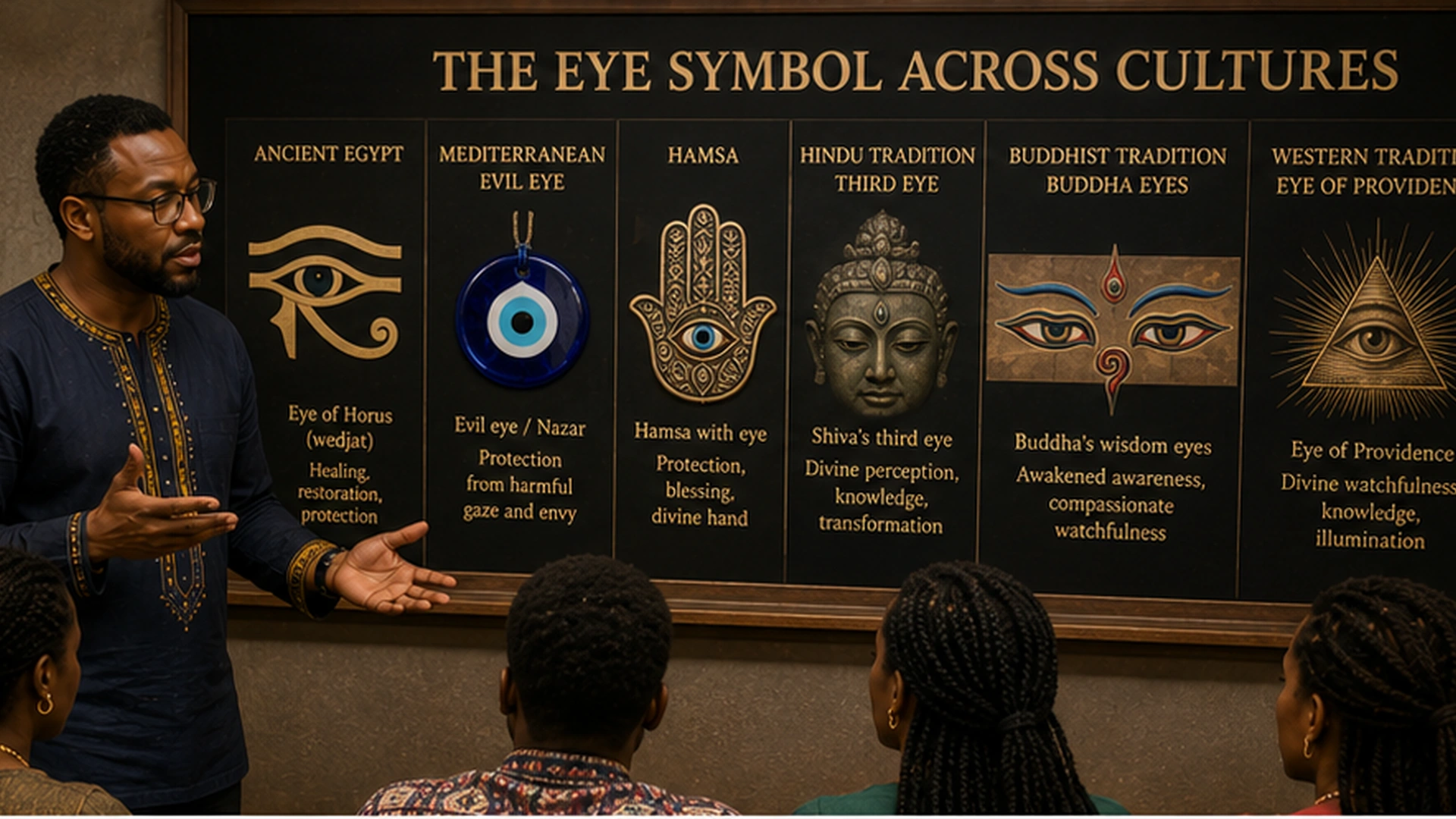
Yet the eye symbol does not mean the same thing everywhere. The ancient Egyptian wedjat eye, Mediterranean evil-eye amulets, the hand-shaped hamsa, Shiva’s third eye, the painted eyes of Nepalese stupas, and the Christian Eye of Providence developed within different languages, religions, historical periods, and artistic traditions.
Visual similarity does not prove shared origin. Two cultures may use an eye form independently, or a symbol may travel through trade, migration, conquest, pilgrimage, and artistic exchange while acquiring new meanings.
A responsible comparison begins by identifying the community, object, date, material, and documented use. It avoids presenting every eye symbol as a generic protection charm or as evidence of one hidden universal religion.
Suggested scene: Black African cultural historian introducing distinct eye symbols from ancient Egypt, the Mediterranean, South Asia, Nepal, and European Christian art in a museum classroom.
Key Points
The ancient Egyptian wedjat eye represented restoration, well-being, healing, rebirth, and protection.
The evil eye is a belief that harmful attention, praise, or envy can cause misfortune in some societies.
Eye-shaped amulets are often intended to avert or reflect harmful attention rather than represent the harmful gaze itself.
The hamsa is a hand-shaped protective emblem used in several Jewish, Muslim, and regional traditions; an eye may appear within it, but the hand and eye are not identical symbols.
Shiva’s third eye signifies extraordinary perception, divine knowledge, and powerful transformative force in Hindu art.
Painted eyes on Nepalese stupas express awakened awareness and the Buddha’s all-seeing wisdom within specific Buddhist settings.
The Eye of Providence represents divine watchfulness in Christian and Western political iconography.
Eye symbols can also communicate royal authority, moral judgment, identity, or spiritual insight.
No eye symbol has scientifically demonstrated guaranteed supernatural protection.
Why Eye Symbols Are So Widespread
Eyes are biologically and socially important. Humans use gaze to recognize faces, read attention, communicate emotion, detect danger, and establish social relationships.
Symbolically, the eye can therefore become a metaphor for:
Knowledge and awareness
Presence and attention
Protection and vigilance
Judgment
Envy or harmful observation
Identity
Spiritual insight
Divine omniscience
Royal authority
Healing and restoration
These themes are broad human possibilities, not proof that every eye symbol came from one original source.
1. The Wedjat Eye in Ancient Egypt
The ancient Egyptian wedjat eye, widely known as the Eye of Horus, represented the healed or restored eye of the falcon god Horus.
Its ancient name referred to being sound or restored. In mythology, Horus’s eye was injured or taken during conflict with Seth and later restored. The symbol therefore became associated with healing, wholeness, regeneration, rebirth, and protection.
Wedjat amulets were used by both the living and the dead. They appeared as pendants, rings, coffin decoration, mummy amulets, seals, and combined protective designs.
Eye of Horus and Eye of Ra
The Eye of Horus and Eye of Ra are related but not universally identical. Solar, lunar, royal, protective, healing, and destructive meanings could overlap differently according to the deity, direction of the eye, object, and historical period.
Important caution
The wedjat should not be treated as a generic modern evil-eye bead. Its meaning belongs to ancient Egyptian mythology, writing, funerary religion, and material culture.
2. The Evil Eye Belief
The evil eye is not one single symbol or religion. It is a family of beliefs found in parts of the Mediterranean, Middle East, North Africa, South Asia, Central Asia, Europe, and the Americas.
In many versions, envy, excessive admiration, praise, or hostile attention is believed to cause illness, loss, weakness, or misfortune.
The feared force is the harmful gaze. The protective object is often an eye-shaped bead, pendant, hand, prayer, textile motif, coral object, or other culturally specific response.
Term
Meaning
Evil eye
The feared harmful gaze or influence.
Eye amulet
An object intended to avert, reflect, distract, or protect against that gaze.
Apotropaic
Designed to turn away or repel harm.
Nazar
A word used in several languages and regional settings for gaze, sight, or evil-eye belief.
Nazar boncuğu
A blue-and-white eye-shaped bead strongly associated with modern Turkish protective culture.
Frequently Asked Questions
What should readers know first about african spirituality and cultural history?
African spirituality and cultural history: Read clear guidance, key signs, practical steps, and private support from Ancestral Temple.
What causes the-eye-symbol-across-cultures?
The safest next step is to compare the signs, prepare clear details, and request private guidance when the matter feels personal.
How does the-eye-symbol-across-cultures work?
The safest next step is to compare the signs, prepare clear details, and request private guidance when the matter feels personal.
Is it possible to get private guidance for the-eye-symbol-across-cultures?
The safest next step is to compare the signs, prepare clear details, and request private guidance when the matter feels personal.
How long does the-eye-symbol-across-cultures take to understand?
The safest next step is to compare the signs, prepare clear details, and request private guidance when the matter feels personal.
Can the-eye-symbol-across-cultures affect relationships, family, work, or personal peace?
The safest next step is to compare the signs, prepare clear details, and request private guidance when the matter feels personal.
Why do people seek spiritual guidance for the-eye-symbol-across-cultures?
The safest next step is to compare the signs, prepare clear details, and request private guidance when the matter feels personal.
What signs should someone notice before asking about the-eye-symbol-across-cultures?
The safest next step is to compare the signs, prepare clear details, and request private guidance when the matter feels personal.
When should someone contact a private spiritual guide?
The safest next step is to compare the signs, prepare clear details, and request private guidance when the matter feels personal.
What causes african spirituality and cultural history?
African spirituality and cultural history: Read clear guidance, key signs, practical steps, and private support from Ancestral Temple. The safest next step is to compare the signs, prepare clear details, and request private guidance when the matter feels perso
Article Information
- Publisher
- Ancestral Temple
- Editor
- Ancestral Temple
- Last updated
- Jul 26, 2026
- Last reviewed
- Jul 13, 2026
- Content version
- a5a7439f4a
This educational article should be read as cultural and spiritual information, not as medical, legal, financial, or emergency advice.
Helpful Related Guidance
Explore This Topic
Evil Eye Protection Rituals · Protection Spells And Rituals
Related Topic Cluster
African Spirituality And Cultural History
Complete Guide Why Homes Have Been Blessed Throughout HistoryAbout the Author
 Ancestral Temple
Spiritual guide and practitioner with decades of experience in ancestral wisdom, rituals, and divine guidance.
Related Posts
View All






Leave a Comment
We'd love to hear your thoughts.
I appreciated the distinction between the harmful gaze and the protective amulet.
The article clearly showed that eye symbols are not interchangeable.