
Meaning Behind Protective Charms
Cornerstone Content
Quick Summary
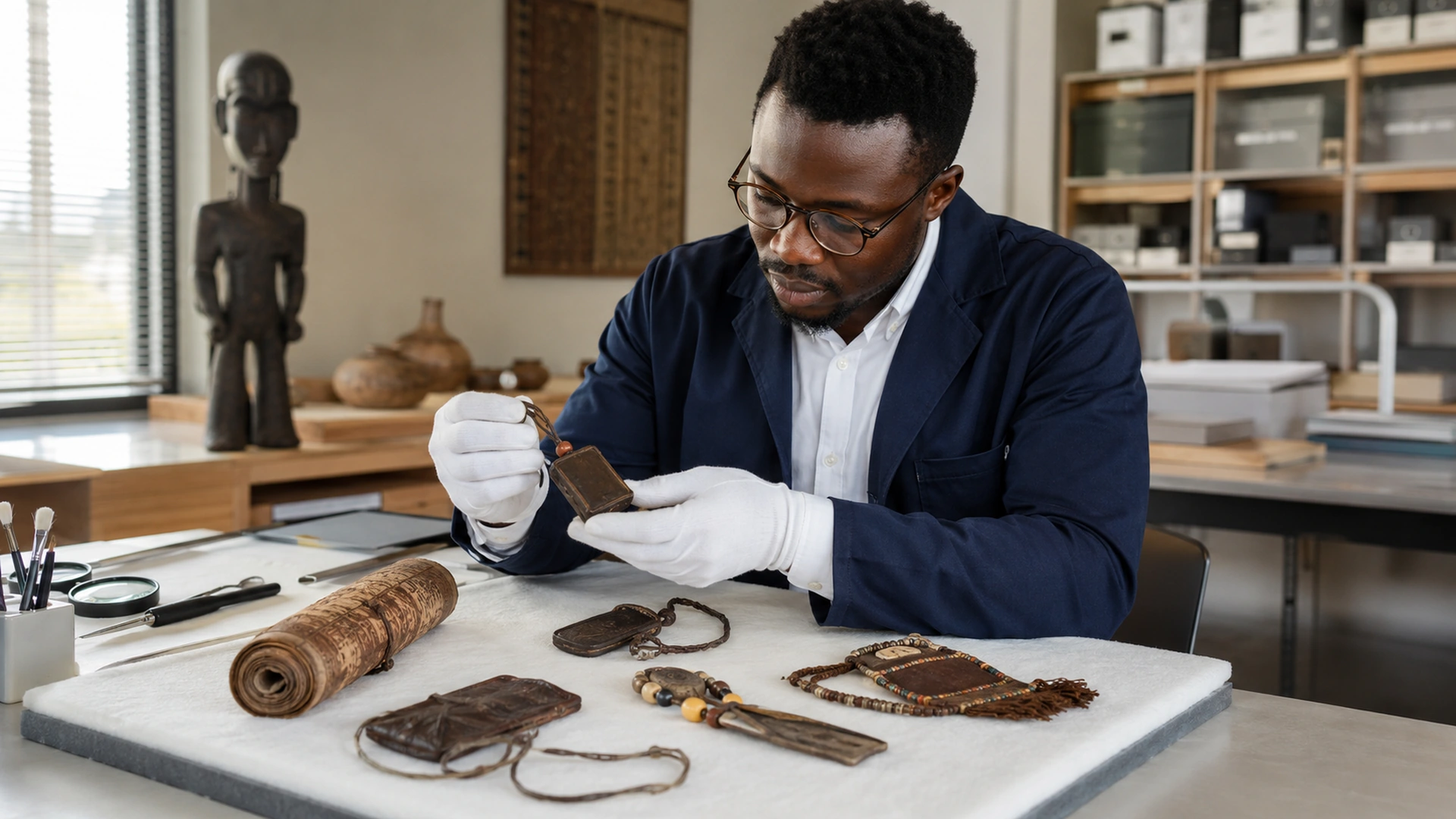
Protective charms have been worn, carried, wrapped, displayed, and passed through families for centuries. Their meanings may involve prayer, identity, childbirth, travel, community law, healing support, or remembrance. This guide explains culturally specific examples while separating traditional belief from scientifically proven protection.
Protective charms are small objects, written texts, pendants, packets, figures, or personal possessions that people associate with safety, blessing, well-being, or defense against danger.
They may be worn around the neck, tied to clothing, placed near a child, carried during travel, displayed inside a home, or included in burial preparations.
Yet the word charm can be misleading.
It is often used as a broad English label for objects that their makers understood through much more specific categories. An ancient Egyptian Taweret amulet, a Wolof leather case containing Qur’anic writing, an Ethiopian protective scroll, and a Sakalava mohara ody do not belong to one universal spiritual system.
Their materials, makers, users, religious beliefs, and intended purposes differ.
Understanding the meaning behind a protective charm therefore requires more than looking at its shape. We must ask who made it, who used it, what it contained, what community recognized it, and what historical evidence survives.
Key Points
A protective charm is an object believed to support protection, blessing, health, courage, good fortune, or defense against misfortune.
Protective charms may include:
- Pendants
- Beads
- Carved figures
- Written prayers
- Leather cases
- Cloth packets
- Scrolls
- Religious medals
- Stones
- Rings
- Knotted cords
- Miniature symbols
- Family heirlooms
- Objects sewn into clothing
- Items placed in homes or graves
Their meaning may depend on:
- Material
- Shape
- Color
- Inscription
- Religious association
- Owner
- Maker
- Preparation
- Placement
- Family history
- Community recognition
The words charm, amulet, and talisman often overlap in museum catalogues and everyday speech. An amulet usually emphasizes protection, while a talisman is often understood as an object prepared for a more specific purpose. These distinctions are useful but not universal.
Protective charms can carry emotional, historical, cultural, or religious meaning. They are not scientifically proven to prevent illness, violence, accidents, pregnancy complications, legal problems, or financial loss.
What Is a Protective Charm?
A protective charm is an object that a person or community believes can help guard its owner against danger, illness, misfortune, spiritual harm, envy, or another identified threat.
The term may also describe an object associated more generally with:
- Good fortune
- Courage
- Childbirth
- Travel
- Family identity
- Religious devotion
- Healing support
- Community authority
- Remembrance
- Hope
The perceived meaning may come from the object’s material, inscription, maker, religious association, location, or relationship with its owner.
A charm is not defined by appearance alone.
A bead may be decorative in one context and protective in another. A cross may be worn as a statement of Christian faith rather than as an amulet. A leather pouch may be an ordinary container or may hold a religious text.
Plain-Language Meaning
A protective charm is something a person carries or wears because it makes them feel connected with protection, prayer, family, or spiritual support.
Its message might be:
- May I travel safely.
- May this child be protected.
- May I remember my faith.
- May I remain connected with my family.
- May this prayer stay close to me.
- May this household remain secure.
- May I have courage during difficulty.
The object itself may be small, but its meaning can be connected with large ideas about faith, vulnerability, identity, and responsibility.
Where Does the Word “Charm” Come From?
The English word charm has been used for both objects and spoken formulas believed to influence events.
Over time, museums, collectors, missionaries, anthropologists, and commercial sellers used terms such as charm, amulet, talisman, fetish, and medicine for many unrelated cultural objects.
These labels were not always accurate.
The British Museum’s collection search contains hundreds of objects classified under overlapping categories such as amulet, charm, pendant, medicine, pouch, and figure. The variety of cultural origins represented in those records demonstrates that “amulet” is a museum classification rather than the name of one global tradition.
Whenever possible, culturally specific terms should be used instead of relying only on the word charm.
Charm, Amulet, and Talisman: What Is the Difference?
- Term
- General educational meaning
- Charm
- A broad term for an object or spoken formula believed to support protection, luck, or another result
- Amulet
- An object primarily worn or carried for protection
- Talisman
- An object prepared or inscribed for a particular intended purpose
- Devotional object
- An object supporting prayer, religious identity, or remembrance
- Relic
- Physical remains of, or an object associated with, a sacred or respected person
- Protective scroll
- A written object associated with prayer, protection, or healing support
- Amulet case
- A container holding writing, substances, or another object considered protective
- Power object
- A culturally specific object used through recognized religious or community authority
These categories overlap.
The Metropolitan Museum of Art uses both amulet and talisman for objects from Islamic societies containing sacred inscriptions, prayers, divine names, or references to religious figures.
A community’s own terminology is usually more accurate than a broad English label.
Why People Use Protective Charms
Protection During Vulnerable Moments
People are especially likely to seek protection during periods of uncertainty.
These may include:
- Pregnancy
- Childbirth
- Infancy
- Illness
- Marriage
- Migration
- Military service
- Travel
- Exams
- Leadership transitions
- Burial
- Economic hardship
The charm may provide a physical reminder that the person is not facing the danger alone.
Religious Devotion
A protective object may keep prayer or sacred writing close to its owner.
Its importance may come from belief in God, a divinity, a saint, an ancestor, a religious text, or another sacred relationship.
The object should not automatically be described as magical if the person using it understands it primarily as a devotional or religious item.
Family and Cultural Identity
Some charms are inherited.
A person may value an object because it belonged to a parent, grandparent, religious teacher, or respected community member.
Its meaning may therefore include:
- Memory
- Lineage
- Family continuity
- Migration history
- Cultural belonging
- Personal identity
An inherited object can remain meaningful even when later generations interpret it differently.
Emotional Reassurance
A familiar object may help a person feel calmer during uncertainty.
It might encourage prayer, remind the wearer of family support, or symbolize courage.
This emotional role is real, but it should not be confused with scientific proof that the object physically prevents danger.
Ancient Egyptian Protective Charms
Ancient Egypt provides some of the best-preserved archaeological evidence for personal protective objects.
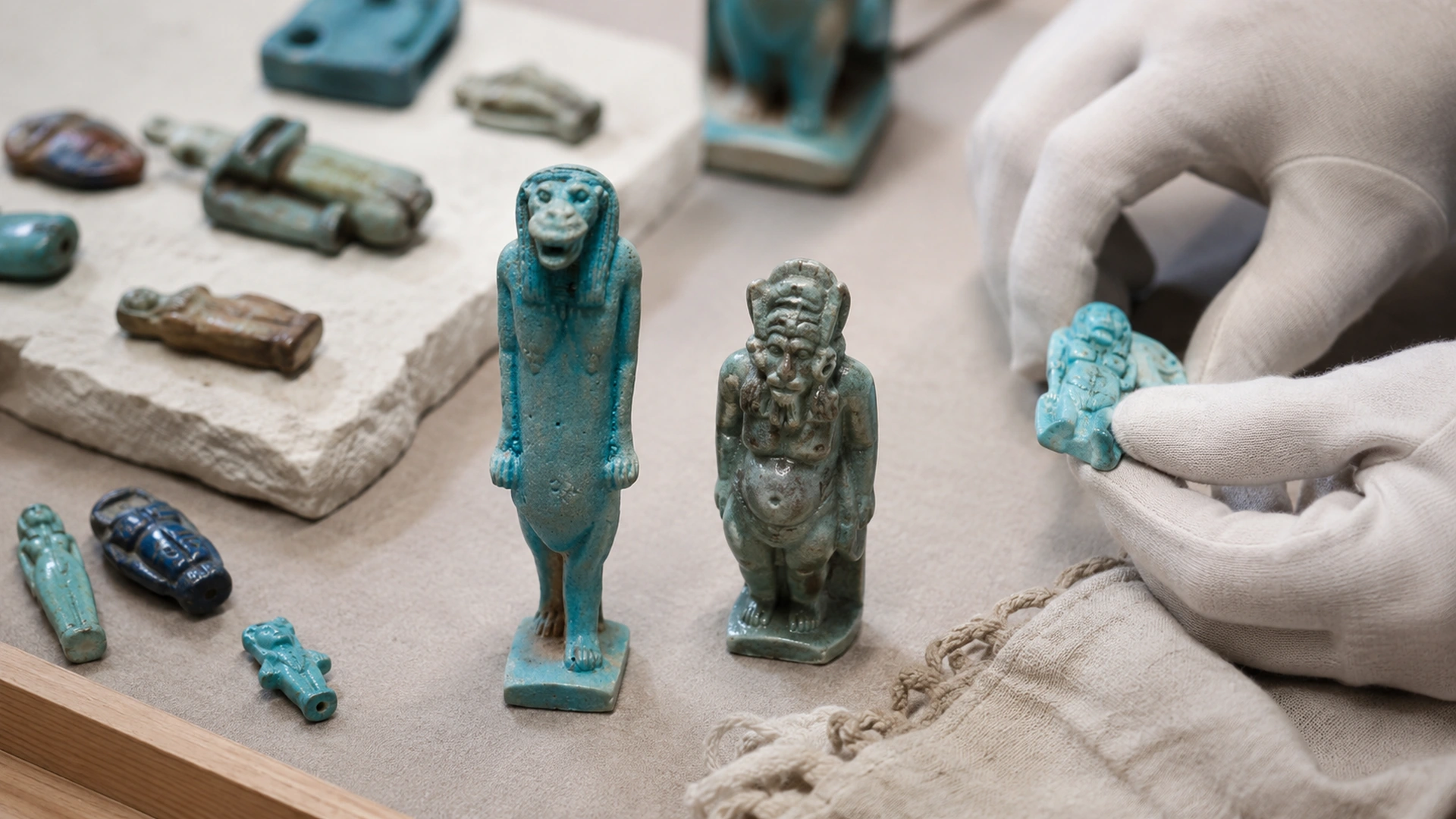
Egyptians produced amulets from faience, stone, metal, glass, wood, and other materials. Their forms represented divinities, animals, body parts, sacred symbols, royal objects, and hieroglyphic signs. Small objects could be worn by living people or placed with the dead.
Taweret and Protection During Childbirth
Taweret was an ancient Egyptian deity particularly associated with protecting women during pregnancy and childbirth.
She was represented through a powerful combination of hippopotamus, lion, crocodile, and human features. These dangerous animal qualities communicated protective strength rather than horror for its own sake.
Taweret amulets were made in materials such as faience and worn or used in household and funerary settings.
A surviving linen necklace from approximately 1000–945 BCE contains six Taweret amulets and twenty-four regularly spaced knots. The Metropolitan Museum suggests that the knots may have connected the deceased with the solar cycle and rebirth.
These objects belonged to ancient Egyptian religious understandings. A modern Taweret pendant is not medically proven to prevent pregnancy or childbirth complications.
Bes and Household Protection
The Bes-image represented protective divine figures associated especially with guarding children and mothers during childbirth.
Small images could be worn or kept in household settings. Archaeological evidence also includes molds used to produce Bes-shaped amulets, showing that some protective objects were manufactured through repeatable workshop processes rather than individually carved in secret.
This challenges the assumption that every charm was rare, private, or created through an elaborate ceremony.
Charms in the Ancient Mediterranean
People in ancient Greek, Etruscan, Roman, and neighboring Mediterranean societies also wore objects associated with protection, health, fertility, childhood, hunting, and travel.
Getty Museum research on ancient amber explains that amber ornaments could be understood as charms connected with good fortune, health, protection, love, childbirth, or averting danger.
The same object could have several functions.
A pendant might be:
- Attractive jewelry
- A sign of wealth
- A family possession
- A religious symbol
- A protective amulet
Archaeologists therefore examine find location, wear marks, inscription, burial context, comparable objects, and historical texts before proposing an interpretation.
Protective Charms in Specific African Contexts
The phrase African protective charm is too broad to describe any one object accurately.
The following examples illustrate different traditions. They should not be combined into one generic ritual.
Wolof Qur’anic Amulet Case from The Gambia
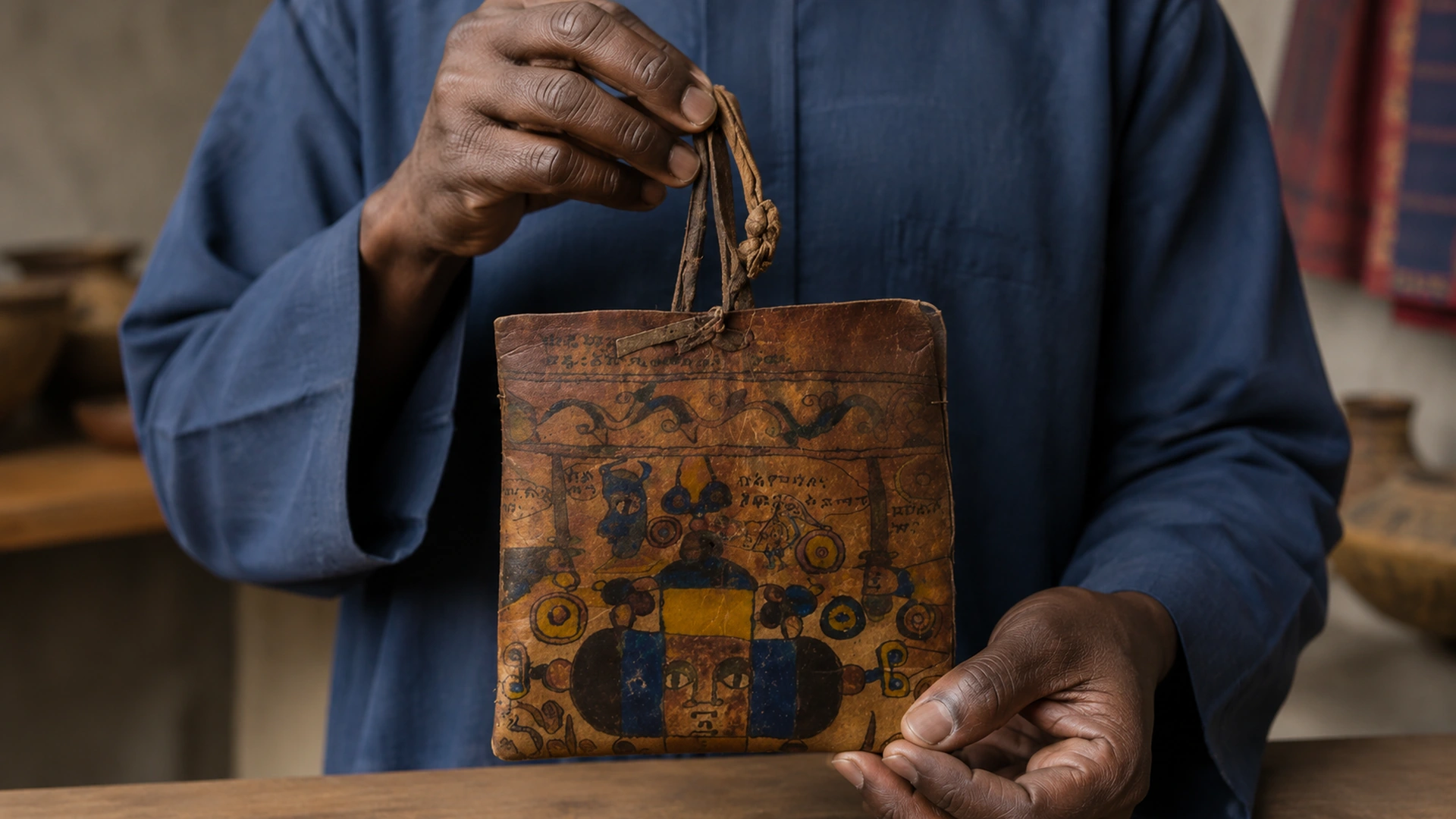
A nineteenth-century protective amulet in the British Museum was made by a Wolof artisan in The Gambia.
The object consists of a rectangular leather case containing paper with a Qur’anic inscription. It is decorated with woven grass and suspended from a leather strap so that it could be worn around the neck.
Its meaning comes from several connected elements:
- Qur’anic writing
- Islamic devotion
- Leatherworking
- Portability
- The relationship between written text and wearer
- Regional craft traditions
It should not be described simply as an “African magic pouch.”
The religious significance may lie primarily in the enclosed writing rather than the case itself.
Muslim opinions about wearable amulets differ. Some scholars and communities permit known Qur’anic texts when God is understood as the source of protection, while others reject amulets because of concerns about superstition, unknown formulas, or dependence on objects. Islamic-world amulets therefore belong to a history of both practice and theological debate.
Ethiopian Protective and Healing Scrolls
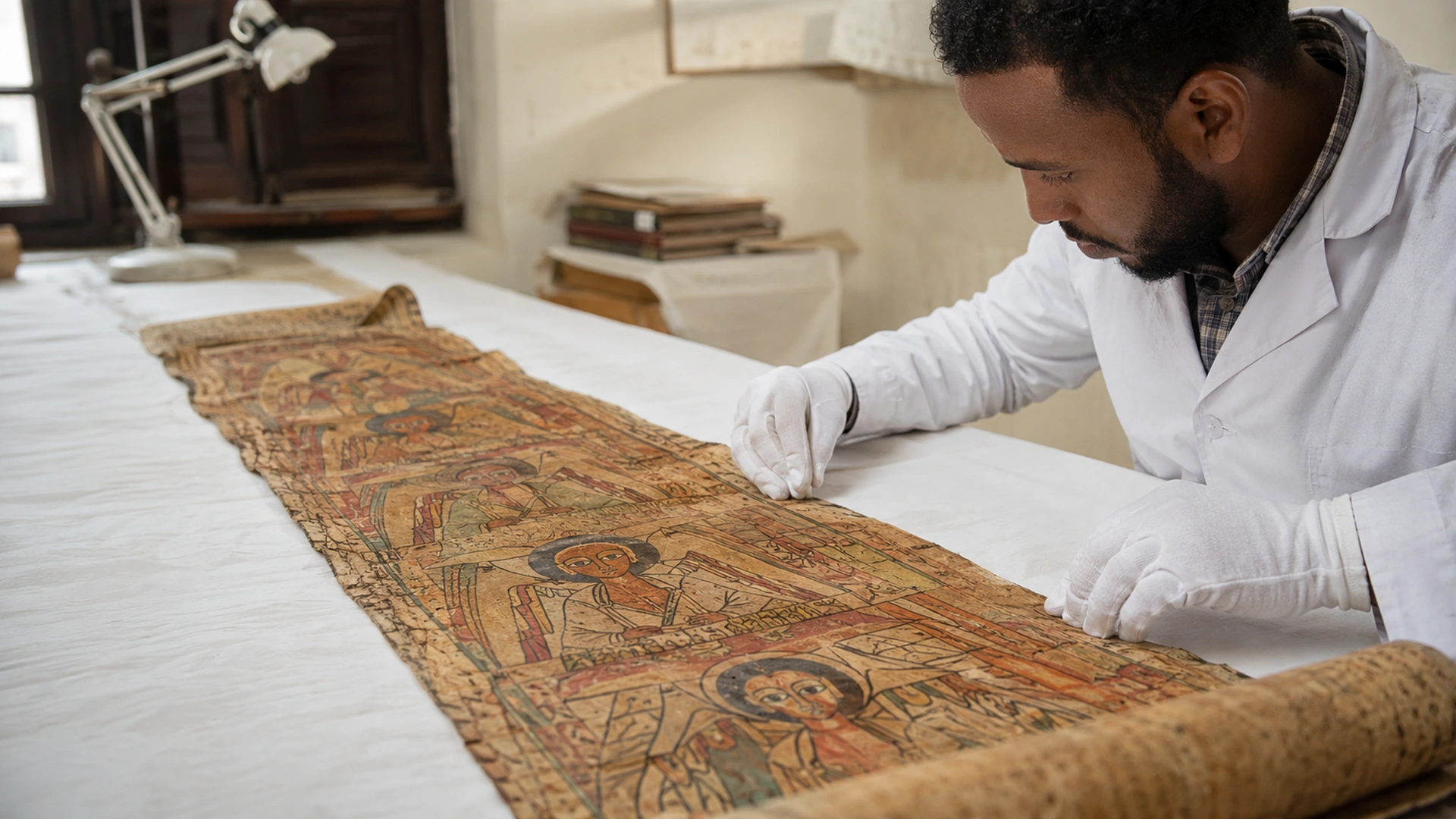
Ethiopian protective scrolls are personalized parchment manuscripts associated particularly with Amhara and Tigrinya-speaking settings.
They may contain Christian prayers, sacred names, geometric designs, angelic imagery, and talismanic forms. Many were prepared by a däbtära, an unordained Ethiopian Orthodox religious scholar trained in chant, manuscripts, and related fields.
The scroll was usually created for a particular person.
Its dimensions, prayers, imagery, and use could be connected with the intended owner. Portable scrolls might be rolled, enclosed, suspended, or stored in the home.
These scrolls should not be reduced to generic “African spell papers.”
They developed through complex interaction among Ethiopian Christian manuscript traditions, local healing concepts, and wider Jewish, Christian, and Muslim textual practices. Religious and political authorities have also debated or criticized them at different times.
Historical beliefs about their protective or healing role can be explained respectfully without claiming that they cure disease.
Sakalava Ody and Mohara Ody in Madagascar
Among particular Sakalava communities in southwestern Madagascar, the term ody refers to a range of objects associated with health, safety, or defense against danger.
A documented mohara ody in the Metropolitan Museum was made from cattle horn, wood, glass beads, fiber, and thread. The horn served as a container for substances, while thread was wrapped around its base and the object was worn at the neck or waist.
The object belonged to a specific historical context involving Sakalava ideas about protection, masculinity, cattle, divination, and specialist preparation.
Its original association with cattle raiding should not be romanticized or removed from its social context.
A horn pendant copied by a modern seller is not automatically a culturally authentic mohara ody.
Kongo Minkisi and Community Protection
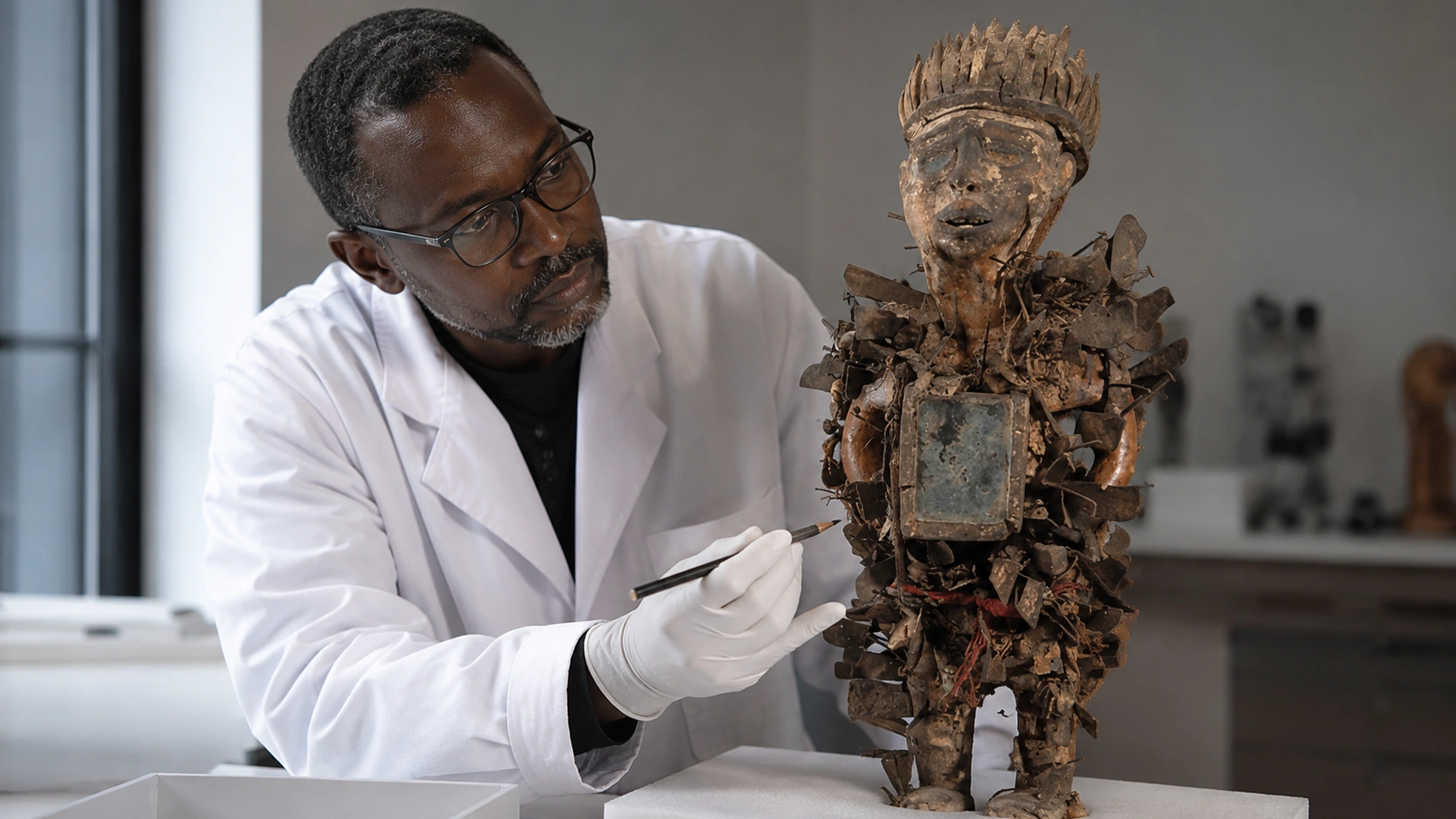
A Kongo nkisi is not simply a charm.
Minkisi—the plural form—were power objects created through collaboration between artists and ritual specialists known as banganga or an individual nganga.
They could address healing, agreements, wrongdoing, social order, or community protection.
The Mangaaka power figure in the Metropolitan Museum was associated with jurisprudence and the defense of community standards. Metal elements inserted into the figure recorded vows, agreements, and occasions when its authority was invoked.
Calling such an object a “luck charm” would erase its legal, political, artistic, and religious functions.
An ordinary person cannot create an equivalent nkisi by adding nails, cords, or packets to a carved figure.
What Gives a Charm Its Meaning?
The Material
Materials may have historical or symbolic associations.
Examples include:
- Faience in ancient Egyptian amulets
- Amber in Mediterranean ornaments
- Leather in Qur’anic amulet cases
- Parchment in Ethiopian scrolls
- Horn in Sakalava protective objects
- Wood, iron, resin, fiber, and ceramic in Kongo figures
Material alone does not establish meaning.
Two objects made from leather may belong to completely different traditions.
The Shape
A charm’s shape may represent:
- A deity
- An animal
- An eye
- A body part
- A sacred letter
- A religious symbol
- A family emblem
- A container
- A geometric pattern
The same shape may carry different meanings in different periods.
Ancient Egyptian religious imagery changed over roughly three thousand years and varied across places and contexts, so even Egyptian symbols should not be treated as having one fixed definition.
The Inscription
Written charms may contain:
- Scripture
- Prayer
- Divine names
- Personal names
- Titles
- Protective statements
- Numerical arrangements
- Religious figures
- Letter combinations
A person should not assume that unfamiliar writing is a secret spell.
It may be a recognizable scriptural or devotional text.
The Maker
The maker may be:
- A craftworker
- Scribe
- Cleric
- Religious scholar
- Healer
- Jeweler
- Leatherworker
- Family member
- Ritual specialist
- Commercial manufacturer
The person who crafts the physical case may not be the person who writes the enclosed prayer.
The Owner
Some protective objects are personalized.
An owner’s name, physical dimensions, family history, health concern, or religious identity may affect how the object is prepared and understood.
The Community
A charm gains much of its meaning from collective recognition.
Without that context, an outside viewer may see only a decorative object.
Protective Charms and Children
Children have often been associated with protective objects because infancy and childhood were historically dangerous periods.
However, physical safety must come first.
Potential risks include:
- Choking on small beads or pendants
- Strangulation from neck cords
- Cuts from sharp metal
- Lead or toxic pigments
- Allergic reactions
- Unknown powders
- Contaminated organic material
- Delayed medical treatment
Ancient beliefs about protecting children should not be converted into unsafe modern advice.
A charm cannot replace vaccination, pediatric care, safe sleeping practices, appropriate nutrition, or emergency treatment.
Protective Charms and Pregnancy
Pregnancy charms have existed in many societies.
Ancient Egyptian Taweret and Bes objects are particularly well documented in connection with pregnancy and childbirth.
Their historical importance does not prove medical effectiveness.
A person who is pregnant should receive qualified prenatal care and should seek urgent medical assistance when warning signs occur.
Unknown herbs, powders, oils, or substances attached to charms should not be swallowed, burned, applied to the body, or used during pregnancy without appropriate medical evaluation.
Protective Charms During Travel
Travelers may carry:
- Religious medals
- Written prayers
- Family photographs
- Necklaces
- Amulet cases
- Heirlooms
- Scripture
- Small tokens from relatives
Such objects may support courage or prayer.
They do not replace:
- Identification documents
- Visas
- Vaccination where required
- Insurance
- Safe transportation
- Emergency contacts
- Medication
- Awareness of local laws
Protective Charms in Modern Fashion
Protective symbols now appear widely in jewelry, clothing, online stores, and social media.
Modern products may combine:
- Ancient Egyptian imagery
- Ethiopian manuscript designs
- Qur’anic cases
- Mediterranean eye symbols
- Beads from unrelated African communities
- Invented spiritual meanings
This mixing can create cultural misinformation.
A product should be described honestly as:
- Inspired jewelry
- A modern artistic interpretation
- A replica
- A family keepsake
- A devotional object
- A museum reproduction
It should not be marketed as an authentic ancient or community-authorized charm without evidence.
Cultural Appropriation and Misrepresentation
Problems arise when sellers or content creators:
- Use the phrase “ancient African charm” without naming a community
- Combine unrelated traditions
- Invent guaranteed meanings
- Sell funerary symbols as casual protection tools
- Copy restricted objects
- Use sacred clothing as costume
- Claim titles they have not earned
- Hide the maker or community
- Promise supernatural results
- Use inaccurate colonial terminology
UNESCO’s safeguarding framework emphasizes respect for communities and for customary rules governing access to secret or sacred aspects of heritage.
Museum Labels and Colonial History
Many protective objects entered museums during colonial rule, missionary activity, military expeditions, private collecting, or unequal trade.
Older catalogue terms may describe objects as:
- Fetishes
- Magic
- Native medicine
- Superstition
- Witchcraft
- Curiosities
These labels often failed to identify the maker, owner, religious institution, language, or community function.
Modern interpretation should investigate:
- Provenance
- Collection circumstances
- Community name
- Original terminology
- Restricted knowledge
- Whether repatriation is appropriate
- Whether the object should remain sealed
- Whether descendants should be consulted
Living heritage should not be frozen or separated from the communities that continue to understand and recreate it.
Are Protective Charms Scientifically Proven?
There is no reliable scientific evidence that carrying or wearing a charm creates a supernatural shield against:
- Infection
- Violence
- Accidents
- Pregnancy complications
- Legal consequences
- Financial loss
- Relationship problems
- Natural disasters
- Every form of misfortune
A charm may still provide cultural, emotional, religious, or psychological value.
It may remind someone to pray, connect them with family, represent a commitment, or provide comfort during uncertainty.
Those meanings should be respected without making unsupported medical or supernatural claims.
WHO’s Global Traditional Medicine Strategy 2025–2034 emphasizes evidence, safety, effective regulation, autonomy, community engagement, and culturally respectful integration into health systems.
Practical Safety Risks
Protective charms can become dangerous when they contain:
- Lead
- Mercury
- Toxic paint
- Unknown herbs
- Unidentified powders
- Contaminated animal material
- Sharp metal
- Flammable substances
- Tight cords
- Small detachable pieces
An unknown charm should not be:
- Swallowed
- Inserted into the body
- Burned inside a poorly ventilated room
- Applied to an open wound
- Given to an infant
- Opened near food
- Used instead of medical care
- Used to conceal illegal activity
A sealed inherited object may contain fragile writing, sharp material, biological substances, or culturally restricted content.
It should not be opened casually.
Common Misconceptions
“Every charm is a magical object”
False.
Some are devotional, commemorative, decorative, historical, or connected with family identity.
“All African charms mean the same thing”
False.
African communities have different languages, religions, specialists, materials, and historical institutions.
“Every bead necklace is protective”
False.
Beads may communicate beauty, rank, marriage, wealth, fashion, mourning, age, or community identity.
“Every written charm contains a spell”
False.
It may contain scripture, prayer, a personal name, or another known religious text.
“Ancient automatically means powerful”
False.
Age may increase historical or financial value but does not prove supernatural effectiveness.
“A replica works like an original”
Not necessarily.
Meaning may depend on recognized preparation, ownership, prayer, authority, material, or community context.
“Protective charms guarantee safety”
False.
No charm guarantees healing, pregnancy, love, wealth, travel safety, legal victory, or protection from violence.
“Museums always identify charms correctly”
False.
Museum descriptions can be incomplete and may reflect outdated colonial terminology.
Ethical and Safety Boundaries
Educational content should not reveal:
- Secret prayers
- Restricted sacred names
- Initiation formulas
- Private methods of preparing charms
- Instructions for controlling another person
- Unknown substances
- Protected burial locations
- Confidential healing information
- Ceremonial details communities have not made public
Protective objects should never be used to pressure someone to:
- Stop medication
- Avoid a hospital
- Remain with an abuser
- Pay excessive fees
- Withdraw a legal complaint
- Enter marriage
- Participate in a ceremony
- Believe that misfortune is their fault
How to Study a Protective Charm Respectfully
Identify the object accurately
Ask:
- What is its community name?
- Where was it made?
- When was it made?
- Who made it?
- Who used it?
- What materials were used?
- What does it contain?
- Was it public or restricted?
Separate evidence from interpretation
Distinguish between:
- What the object looks like
- What an inscription says
- What the owner reported
- What a museum recorded
- What scholars infer
- What commercial sellers claim
Respect uncertainty
It is acceptable to say that an object’s precise meaning is unknown.
Guessing can create false cultural claims.
Respect the community
Community members and relevant knowledge holders should have a central role in decisions about documentation, display, publication, and safeguarding.
Avoid guaranteed claims
Use language such as:
- “The wearer believed…”
- “Within this historical context…”
- “The object was associated with…”
- “Museum records identify it as…”
Do not say that the charm objectively worked unless discussing an ordinary physical function.
Key Takeaways
- Protective charms are objects associated with safety, prayer, blessing, courage, identity, or defense against danger.
- Charm, amulet, and talisman are overlapping but not identical terms.
- The meaning of a charm depends on its community, owner, maker, material, inscription, and use.
- Ancient Egyptian Taweret and Bes objects were associated particularly with childbirth, mothers, and children.
- Ancient Mediterranean amber ornaments could be understood as protective or beneficial amulets.
- A Wolof leather amulet from The Gambia contains Qur’anic writing and belongs to a specific Islamic and regional craft context.
- Ethiopian protective scrolls are personalized religious manuscripts connected with Amhara and Tigrinya-speaking settings.
- Sakalava ody and mohara ody belong to particular Malagasy protective traditions.
- Kongo minkisi are complex community institutions rather than simple luck charms.
- Not every bead, necklace, pouch, figure, or religious symbol is a charm.
- Commercial replicas should not be presented as authentic sacred objects without evidence.
- Museum labels may preserve colonial misunderstandings.
- Protective charms are not scientifically proven to prevent disease, accidents, violence, or financial loss.
- Unknown objects may create toxic, choking, strangulation, or contamination risks.
- Cultural communities should guide documentation and public interpretation.
People Also Ask
What is the meaning behind a protective charm?
A protective charm may represent prayer, safety, courage, family identity, religious devotion, healing support, or defense against misfortune.
What is the difference between a charm and an amulet?
Charm is a broad term, while an amulet usually refers specifically to an object worn or carried for protection.
Are protective charms found only in Africa?
No. Protective objects have appeared in Africa, Europe, Asia, the Middle East, the Americas, and other regions.
Why did ancient Egyptians wear protective charms?
They wore amulets for childbirth, health, personal protection, divine support, identity, death, and preparation for the afterlife.
What is inside a Qur’anic amulet case?
It may contain Qur’anic passages, prayers, divine names, or other religious writing.
What is an Ethiopian protective scroll?
It is a personalized parchment manuscript containing prayers and sacred imagery connected with protection or healing support.
Are Kongo minkisi protective charms?
Some minkisi addressed protection, but they were complex religious, legal, healing, and community institutions rather than ordinary charms.
Do protective charms really work?
Their spiritual effectiveness is a matter of belief. They are not scientifically proven to prevent illness, violence, accidents, or misfortune.
Is it safe for children to wear protective charms?
Not always. Neck cords and small objects may create strangulation or choking hazards.
Can someone wear a charm from another culture?
It depends on whether the object is public, restricted, official, funerary, sacred, or commercially reproduced. Accurate identification and respect are essential.
Frequently Asked Questions
1. What is a protective charm?
A protective charm is an object worn, carried, displayed, or stored because someone associates it with protection, blessing, courage, or well-being.
2. Are charms and talismans the same?
The words overlap, but charms are broad protective or beneficial objects, while talismans are often prepared for a more specific purpose.
Frequently Asked Questions
What should readers know first about african spirituality and cultural history?
African spirituality and cultural history: Read clear guidance, key signs, practical steps, and private support from Ancestral Temple.
What causes Meaning Behind Protective Charms?
The safest next step is to compare the signs, prepare clear details, and request private guidance when the matter feels personal.
How does Meaning Behind Protective Charms work?
The safest next step is to compare the signs, prepare clear details, and request private guidance when the matter feels personal.
Is it possible to get private guidance for Meaning Behind Protective Charms?
The safest next step is to compare the signs, prepare clear details, and request private guidance when the matter feels personal.
How long does Meaning Behind Protective Charms take to understand?
The safest next step is to compare the signs, prepare clear details, and request private guidance when the matter feels personal.
Can Meaning Behind Protective Charms affect relationships, family, work, or personal peace?
The safest next step is to compare the signs, prepare clear details, and request private guidance when the matter feels personal.
Why do people seek spiritual guidance for Meaning Behind Protective Charms?
The safest next step is to compare the signs, prepare clear details, and request private guidance when the matter feels personal.
What signs should someone notice before asking about Meaning Behind Protective Charms?
The safest next step is to compare the signs, prepare clear details, and request private guidance when the matter feels personal.
When should someone contact a private spiritual guide?
The safest next step is to compare the signs, prepare clear details, and request private guidance when the matter feels personal.
What causes african spirituality and cultural history?
African spirituality and cultural history: Read clear guidance, key signs, practical steps, and private support from Ancestral Temple. The safest next step is to compare the signs, prepare clear details, and request private guidance when the matter feels perso
Article Information
- Publisher
- Ancestral Temple
- Editor
- Ancestral Temple
- Last updated
- Jul 26, 2026
- Last reviewed
- Jul 13, 2026
- Content version
- 973308877f
This educational article should be read as cultural and spiritual information, not as medical, legal, financial, or emergency advice.
Helpful Related Guidance
About the Author
 Ancestral Temple
Spiritual guide and practitioner with decades of experience in ancestral wisdom, rituals, and divine guidance.
Related Posts
View All






Comments
We'd love to hear your thoughts.
This article provides a respectful introduction without making unsupported promises.
A downloadable comparison chart for charms, amulets, and talismans would be useful.
The conclusion clearly summarized why historical context matters.
I appreciated the distinction between a sealed religious text and an unknown magical substance.
How can researchers distinguish commercial replicas from community-recognized objects?
The article explains cultural complexity without using fear-based language.
I would enjoy a detailed article about Wolof leatherworking traditions.
The child-safety information should be included in every article about wearable charms.
Can designers use Taweret imagery respectfully if they clearly identify it as inspired jewelry?
The article showed that jewelry can have many meanings beyond spirituality.
I appreciated the clear warning against guaranteed protection claims.
Could you write a guide about documenting an inherited family object?
The advice not to open unknown packets casually was practical.
The article was long but easy to follow because of the headings.
I would like to learn more about charms used by travelers in ancient societies.
The explanation of Sakalava ody was detailed and respectful.
Can a museum return a sacred object if its exact original owner is unknown?
A follow-up article about cultural appropriation in protection jewelry would be valuable.
The section about emotional reassurance was clearly separated from supernatural claims.
I appreciated that the article did not generalize all African communities.
How should families store old charms made from leather and paper?
The glossary entry for provenance was especially useful.
The discussion of Islamic disagreement about amulets was balanced.
Could you explore protective charms in North African communities?
The article helped me understand why the maker and owner matter when interpreting an object.
I liked the explanation that a cross necklace may be devotional rather than an amulet.
A comparison between ancient Egyptian and Mediterranean charms would be useful.
The pregnancy section respected historical traditions while prioritizing medical care.
Can modern scanning technology read a sealed amulet without opening it?
I appreciated the reminder that old museum labels may be incomplete or disrespectful.
The museum-provenance section raised important ethical questions.
I would like more information about women who made or owned protective objects.
The article clearly explains why a Kongo nkisi is not simply a luck charm.
Could you write more about protective charms used during travel?
Thank you for explaining why the phrase “African magic charm” is usually inaccurate.
A full article about Bes and household protection would be interesting.
I had not realized that some protective objects were produced using workshop molds.
The Ethiopian scroll section was detailed without becoming an instructional guide.
The warning about choking and strangulation risks for children was important.
How can someone determine what is inside an inherited leather charm without damaging it?
I liked that the article separated religious meaning from scientific evidence.
The Wolof amulet-case example was culturally specific and informative.
I would enjoy a separate article about Taweret and ancient Egyptian childbirth traditions.
The distinction between charms, amulets, and talismans was very helpful.
I appreciated the explanation that a charm cannot be understood from its appearance alone.