
Spiritual Practices in the Kingdom of Kush
Cornerstone Content
Quick Summary
The Kingdom of Kush developed a distinctive religious world in the Nile Valley of present-day Sudan. Kushite rulers and communities honored Amun, Isis, Osiris, and other deities shared with Egypt while also sustaining Nubian traditions and promoting indigenous gods such as the lion-headed Apedemak.
Spiritual Practices in the Kingdom of Kush explains the cultural and historical meaning of spiritual practices in the Kingdom of Kush without treating one tradition as universal. The article preserves safety cautions, distinguishes spiritual interpretation from medical or legal advice, and avoids guaranteed-result claims.
The Kingdom of Kush was one of ancient Africa’s major states. Centered in Nubia along the Nile in what is now northern Sudan and southern Egypt, it developed powerful capitals and sacred centers at Kerma, Napata, Jebel Barkal, and Meroe.
Kushite religion cannot be described simply as a copy of Egyptian religion. Kushites adopted and transformed Egyptian divine names, temple forms, royal symbols, funerary ideas, and writing while maintaining local landscapes, political institutions, artistic styles, languages, and deities.
Religious practice changed across many centuries. The Napatan phase emphasized Jebel Barkal, Amun, royal coronation, and close engagement with Egyptian traditions. The later Meroitic phase continued many of these forms while giving greater prominence to indigenous deities, Meroitic language and script, regional temple networks, and distinct royal imagery.
Much remains uncertain because Meroitic texts are not yet fully understood and many sites have been damaged by time, excavation, looting, dams, and conflict. Responsible interpretation must distinguish archaeological evidence from modern speculation.
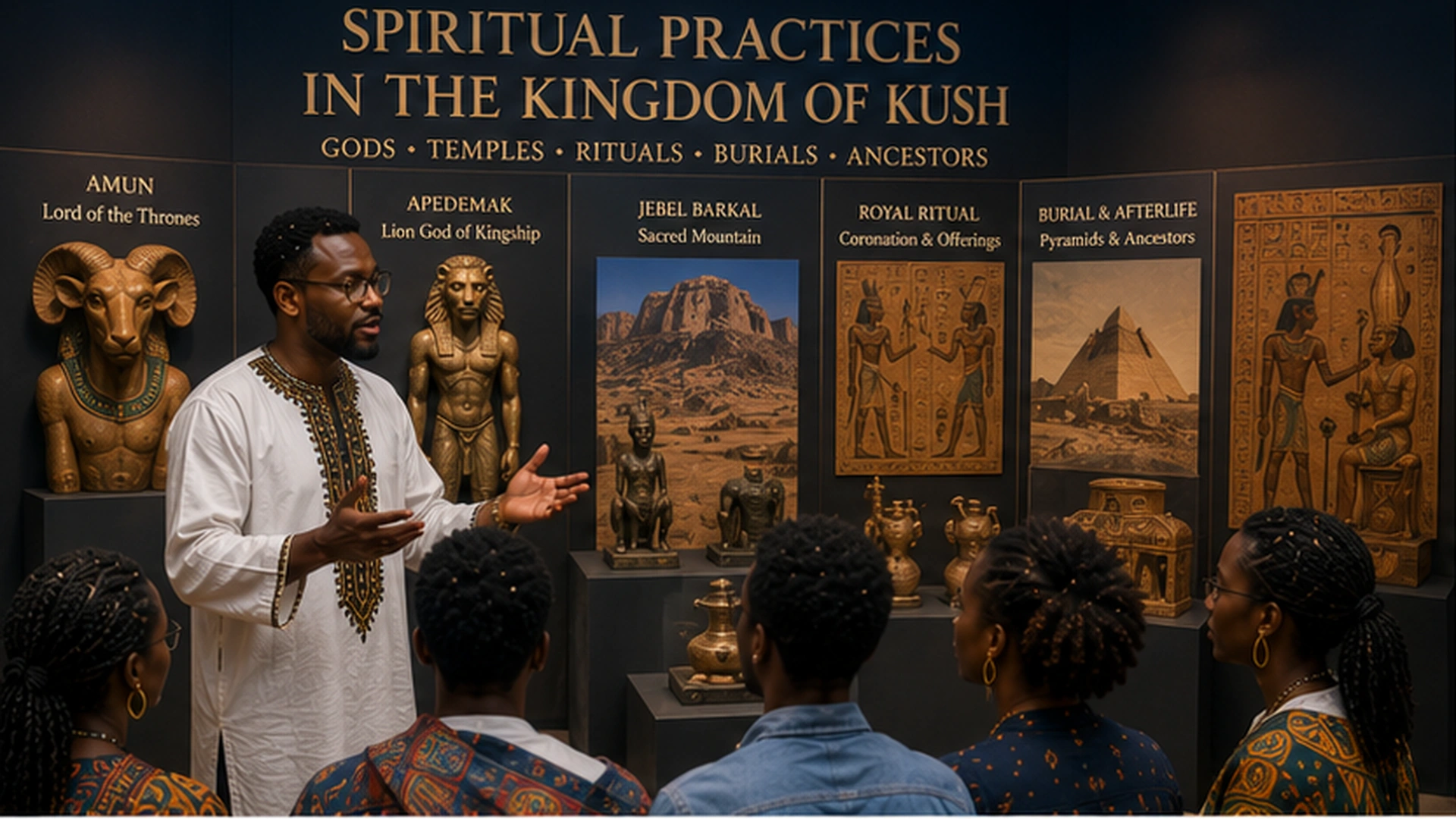
Suggested scene: Black Sudanese archaeologist introducing Kushite sacred centers, Amun, Apedemak, royal ritual, offerings, and pyramid burials through separate museum displays.
Key Points
Kushite spirituality combined indigenous Nubian traditions with transformed Egyptian, Mediterranean, and regional influences.
Amun was central to royal selection, coronation, legitimacy, and major temple institutions, especially around Jebel Barkal and Napata.
Apedemak was a major Meroitic lion deity associated with royal power, warfare, protection, and kingship.
Temples functioned as sacred, political, economic, and administrative institutions.
Kings and queens presented offerings, built temples, consulted divine authority, and appeared before deities in royal reliefs.
Pyramid burials, chapel decoration, offerings, and Osirian imagery expressed death, regeneration, memory, and royal ancestry.
Pilgrimage, graffiti, votive offerings, and temple access show that devotion extended beyond royal ceremonies.
Meroitic religion included indigenous deities and local sacred landscapes that cannot be fully explained through Egyptian categories.
Kandakes and royal women held visible political and ceremonial authority.
Kushite religious history changed from Kerma through Napata and Meroe and should not be treated as one fixed system.
Historical and Religious Timeline
Period
Approximate dates
Religious significance
Kerma kingdom
c. 2500-1500 BCE
Monumental burials, local ritual traditions, cattle symbolism, communal feasting, and early Nubian state religion.
Egyptian New Kingdom rule in Nubia
c. 1500-1070 BCE
Egyptian temples and state cults expanded southward, creating long-term religious entanglement.
Napatan Kingdom of Kush
c. 8th-4th centuries BCE
Amun at Jebel Barkal, royal coronation, Twenty-fifth Dynasty, pyramid cemeteries at el-Kurru and Nuri.
Meroitic Kingdom
c. 300 BCE-350 CE
Capital at Meroe, Meroitic script, Apedemak temples, royal kandakes, regional sacred landscapes, and continued Amun worship.
1. Nubia, Kush, and Religious Identity
Nubia was never a single unchanging culture. Communities along the Nile and in surrounding deserts developed distinct political and religious traditions while maintaining trade and conflict with Egypt, the Red Sea, central Africa, and the Mediterranean.
Kushite religion emerged from this long regional history. It included local practices that predated Egyptian political control as well as religious forms adopted, reinterpreted, or strategically used by Kushite rulers.
The safest language is therefore religious interaction, adaptation, and entanglement—not passive imitation.
2. Jebel Barkal as a Sacred Mountain
Jebel Barkal is a sandstone mountain near the Nile at modern Karima. Kushite and Egyptian rulers treated it as a major sacred center associated especially with Amun.
Its dramatic pinnacle was interpreted within royal and divine symbolism. Temples at its base connected the mountain, the Nile, kingship, and the authority of Amun.
For Kushite rulers, control of this sacred landscape supported political legitimacy and linked Napata with older Egyptian traditions while giving those traditions a distinctly Nubian setting.
Frequently Asked Questions
What should readers know first about african spirituality and cultural history?
African spirituality and cultural history: Read clear guidance, key signs, practical steps, and private support from Ancestral Temple.
What causes spiritual-practices-in-the-kingdom-of-kush?
The safest next step is to compare the signs, prepare clear details, and request private guidance when the matter feels personal.
How does spiritual-practices-in-the-kingdom-of-kush work?
The safest next step is to compare the signs, prepare clear details, and request private guidance when the matter feels personal.
Is it possible to get private guidance for spiritual-practices-in-the-kingdom-of-kush?
The safest next step is to compare the signs, prepare clear details, and request private guidance when the matter feels personal.
How long does spiritual-practices-in-the-kingdom-of-kush take to understand?
The safest next step is to compare the signs, prepare clear details, and request private guidance when the matter feels personal.
Can spiritual-practices-in-the-kingdom-of-kush affect relationships, family, work, or personal peace?
The safest next step is to compare the signs, prepare clear details, and request private guidance when the matter feels personal.
Why do people seek spiritual guidance for spiritual-practices-in-the-kingdom-of-kush?
The safest next step is to compare the signs, prepare clear details, and request private guidance when the matter feels personal.
What signs should someone notice before asking about spiritual-practices-in-the-kingdom-of-kush?
The safest next step is to compare the signs, prepare clear details, and request private guidance when the matter feels personal.
When should someone contact a private spiritual guide?
The safest next step is to compare the signs, prepare clear details, and request private guidance when the matter feels personal.
What causes african spirituality and cultural history?
African spirituality and cultural history: Read clear guidance, key signs, practical steps, and private support from Ancestral Temple. The safest next step is to compare the signs, prepare clear details, and request private guidance when the matter feels perso
Article Information
- Publisher
- Ancestral Temple
- Editor
- Ancestral Temple
- Last updated
- Jul 26, 2026
- Last reviewed
- Jul 13, 2026
- Content version
- 98baf90be6
This educational article should be read as cultural and spiritual information, not as medical, legal, financial, or emergency advice.
Helpful Related Guidance
Explore This Topic
Sacred Natural Places In African Spirituality · African Spiritual Traditions
Related Topic Cluster
African Spirituality And Cultural History
Complete Guide Why Homes Have Been Blessed Throughout HistoryAbout the Author
 Ancestral Temple
Spiritual guide and practitioner with decades of experience in ancestral wisdom, rituals, and divine guidance.
Related Posts
View All



Leave a Comment
We'd love to hear your thoughts.
I appreciated the focus on Sudan and Nubian history.
The article clearly showed that Kushite religion was not simply copied from Egypt.