
Spring vs Autumn Equinox: Meaning, Dates and Seasonal Significance
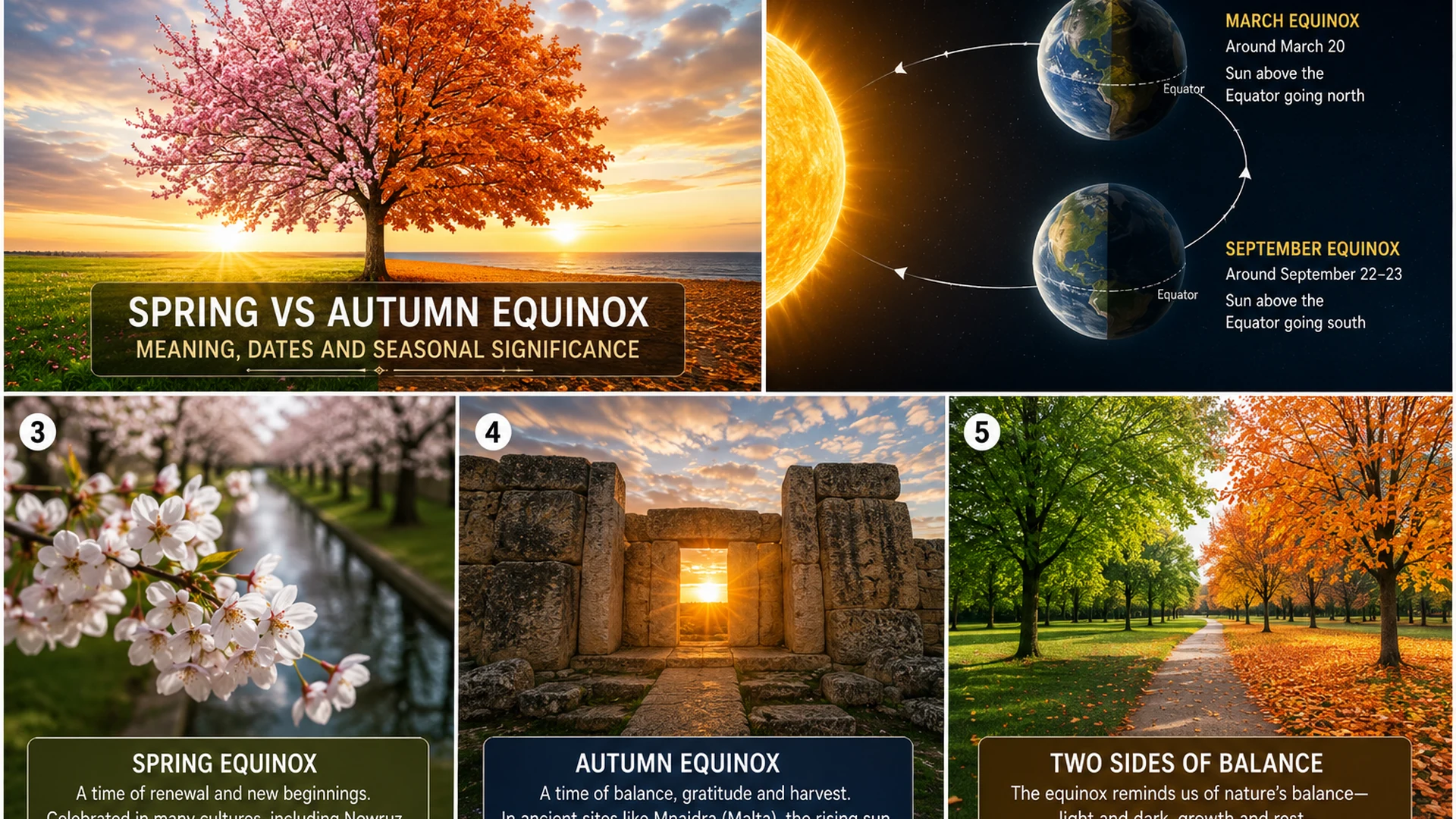
Quick Summary
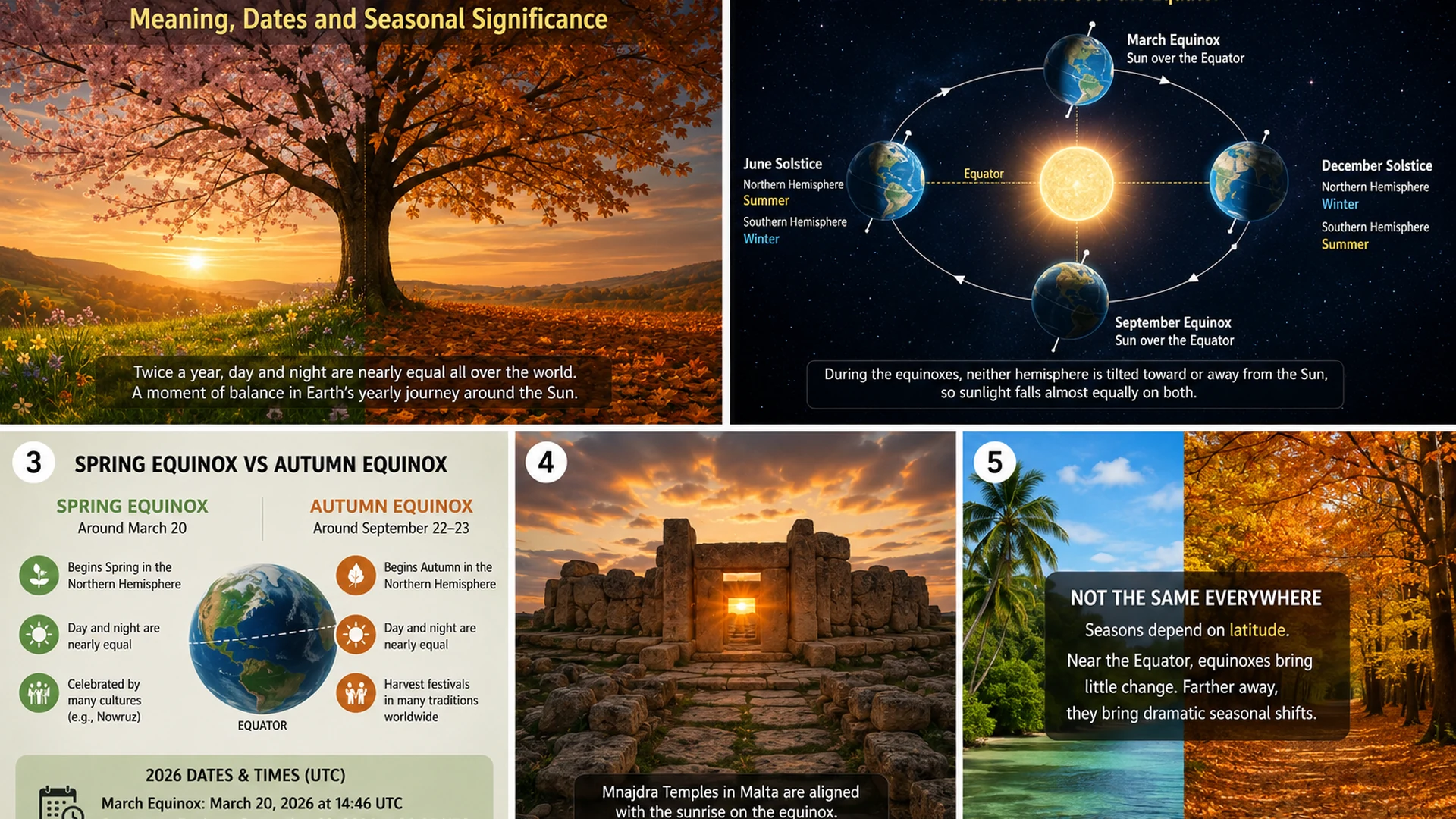
The spring and autumn equinoxes are two of the year’s clearest astronomical turning points. They occur when the center of the Sun crosses Earth’s equatorial plane, placing neither...
The spring and autumn equinoxes are two of the year’s clearest astronomical turning points. They occur when the center of the Sun crosses Earth’s equatorial plane, placing neither hemisphere in the more sunward seasonal position. The result is nearly equal daylight across the planet and a change in the direction of seasonal daylight: one hemisphere moves deeper into spring while the other moves deeper into autumn.
The names can be confusing because “spring equinox” and “autumn equinox” depend on location. The March equinox begins astronomical spring north of the equator but autumn south of it. The September equinox does the reverse. For a global explanation, March equinox and September equinox are more precise.
This guide compares their dates, daylight, seasonal effects, cultural meanings, and common misconceptions. It also explains why an equinox is not a guaranteed spiritual event, why day and night are not exactly equal, and why tropical communities may experience seasonal change through rainfall rather than a four-season calendar.
Quick Answer
The spring and autumn equinoxes are the same two astronomical crossing events viewed from opposite seasonal directions. At each equinox, the Sun’s center crosses Earth’s equatorial plane and neither hemisphere is tilted more toward the Sun. The March equinox begins spring in the Northern Hemisphere and autumn in the Southern Hemisphere; the September equinox reverses those seasons. Day and night are nearly, but not exactly, equal.
Specific culture or historical context: Contemporary scientific astronomy; no cultural ritual is implied.
People shown: No people.
Location: Low Earth-orbit perspective showing Africa, Europe, and parts of Asia.
Clothing: Not applicable.
Architecture: No architecture.
Objects: Earth, cloud systems, oceans, continents, thin atmosphere, straight day-night boundary.
Lighting: Realistic sunlight with restrained contrast and scientifically plausible shadows.
Composition: 16:9 landscape; Earth fills the right two-thirds, with clean dark space on the left for optional website cropping. No text inside the image.
SEO-friendly filename: spring-vs-autumn-equinox-earth-seasons.webp
Image title: Spring and Autumn Equinoxes on Earth
Alt text: Earth at the equinox with a north-south day-night boundary and both hemispheres evenly illuminated
Caption: At an equinox, neither hemisphere is tilted toward the Sun more than the other.
Recommended placement: After the Quick Answer.
Article section supported: Definition and core comparison.
Important elements to avoid: Astrology symbols, labels, arrows, split-screen layout, fantasy light beams, inaccurate continent shapes, exaggerated auroras, logos, or embedded text.
Spring vs Autumn Equinox at a Glance
| Feature | Spring equinox | Autumn equinox |
|---|---|---|
| Global event name | March equinox or northward equinox | September equinox or southward equinox |
| Northern Hemisphere | Astronomical spring begins; daylight continues increasing | Astronomical autumn begins; daylight continues decreasing |
| Southern Hemisphere | Astronomical autumn begins; daylight continues decreasing | Astronomical spring begins; daylight continues increasing |
| Sun’s apparent movement | Crosses the celestial equator northward | Crosses the celestial equator southward |
| Common symbolic themes | Renewal, return, planting, beginnings | Harvest, completion, remembrance, preparation |
| Typical civil date | March 19–21, depending on year and time zone | September 21–24, depending on year and time zone |
| 2026 UTC time | March 20 at 14:46 UTC | September 23 at 00:05 UTC |
| 2026 East Africa Time | March 20 at 5:46 p.m. EAT | September 23 at 3:05 a.m. EAT |
What Is an Equinox?
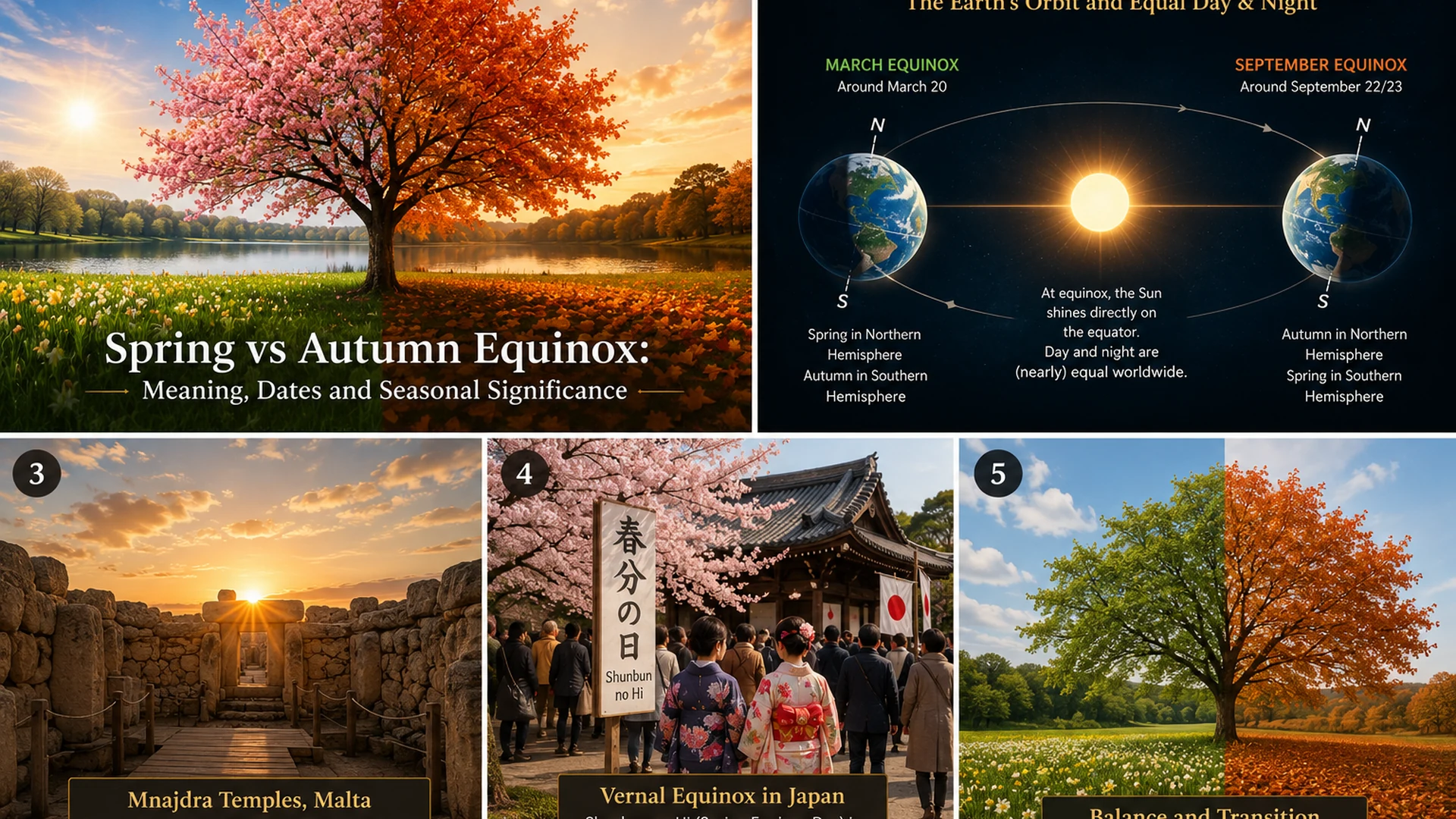
An equinox is the exact moment when the center of the Sun crosses the plane of Earth’s equator. In sky-coordinate language, the Sun crosses the celestial equator. The event happens twice during each orbit: once while the Sun’s apparent position moves northward in March and once while it moves southward in September. [1][3]
The word equinox comes from Latin roots commonly translated as “equal night.” The name describes the near balance of daylight and darkness around these dates, but it should not be read as a promise of exactly twelve hours of each in every place. The astronomical event is a moment, not an entire day, and every location experiences that same moment according to its own local clock.
Why the March and September Names Are More Precise
“Spring equinox” and “autumn equinox” are useful only after the hemisphere is known. The March event is spring north of the equator but autumn south of it. The September event is autumn in the north and spring in the south. For a global audience, March equinox and September equinox are clearer. Northward equinox and southward equinox describe the Sun’s apparent direction across the celestial equator.
When Are the Spring and Autumn Equinoxes in 2026?
The U.S. Naval Observatory lists the 2026 March equinox at 14:46 Universal Time on March 20 and the September equinox at 00:05 Universal Time on September 23. NASA publishes the same times. Because the event is simultaneous worldwide, the local calendar date can differ west or east of the International Date Line. [1][3]
For East Africa Time, which is UTC+3, the March equinox occurred at 5:46 p.m. on March 20, 2026. The next equinox after publication is the September event at 3:05 a.m. EAT on September 23, 2026. In parts of the Americas, that same September event occurs on the evening of September 22 because local clocks are behind UTC.
| Event | Universal Time | East Africa Time | Northern Hemisphere | Southern Hemisphere |
|---|---|---|---|---|
| March equinox | 20 March 2026, 14:46 UTC | 20 March 2026, 17:46 EAT | Spring begins | Autumn begins |
| September equinox | 23 September 2026, 00:05 UTC | 23 September 2026, 03:05 EAT | Autumn begins | Spring begins |
Why Equinox Dates Change
Equinoxes do not occur at a fixed civil time every year because the tropical year is not exactly 365 days, leap-year corrections shift calendar alignment, and Earth’s orbital speed is not perfectly uniform. The March event normally falls on March 19, 20, or 21 in UTC, while the September event normally falls on September 21, 22, 23, or 24. The date shown on a local calendar also depends on the time zone.
What Causes Both Equinoxes?
Earth’s seasons are caused primarily by its axial tilt, about 23.4 to 23.5 degrees relative to its orbital plane, together with Earth’s yearly orbit around the Sun. The axis keeps nearly the same orientation in space as Earth moves around the Sun. At the June and December solstices, one hemisphere is tilted most strongly toward the Sun. At an equinox, the axis is oriented sideways relative to the Sun, so neither hemisphere receives the seasonal advantage. [3][4]
Seasons are not caused by Earth moving dramatically closer to or farther from the Sun. Earth is actually closest to the Sun in early January, during Northern Hemisphere winter, and farthest in early July, during Northern Hemisphere summer. If distance caused the seasons, both hemispheres would warm and cool together. Instead, they experience opposite seasons because the angle and duration of sunlight are different.
What Changes After the Spring Equinox?
After a hemisphere’s spring equinox, daylight continues to increase until that hemisphere’s summer solstice. The Sun follows a higher daily path through the sky, sunrise moves farther toward the summer side of the horizon, and sunset occurs later. Increasing sunlight supports warming, plant growth, animal activity, and agricultural change, although the weather may remain cold or unstable for weeks.
What Changes After the Autumn Equinox?
After a hemisphere’s autumn equinox, daylight continues to decrease until the winter solstice. The Sun’s daily path becomes lower, nights lengthen, and the amount of solar energy received at the surface declines. In temperate regions this often accompanies cooling, leaf change, migration, harvest, and preparation for winter. The timing varies with latitude, altitude, ocean influence, and local climate.
Specific culture or historical context: Contemporary public astronomy education in East Africa.
People shown: One Black female educator and two Black adult learners.
Location: Open hill or lakeside overlook in Uganda with a clear eastern horizon.
Clothing: Practical contemporary outdoor clothing; no invented ceremonial dress.
Architecture: Minimal or distant modern structures only.
Objects: Hand compass, portable globe, notebook, optional small tripod-mounted camera.
Lighting: Natural golden sunrise; realistic shadows and skin texture.
Composition: Landscape 16:9; Sun near the horizon on the left third, educator and globe on the right third.
SEO-friendly filename: equinox-sunrise-due-east-observation.webp
Image title: Observing the Equinox Sunrise
Alt text: Black science educator using a compass and globe to explain the equinox sunrise in Uganda
Caption: Near an equinox, the Sun rises close to due east and sets close to due west for most locations.
Recommended placement: After the section explaining equinox astronomy and daylight.
Article section supported: How the equinox works and what can be observed.
Important elements to avoid: Magical glow, zodiac wheel, ritual poses, embedded compass labels, distorted hands, school uniforms, or inaccurate sunrise direction.
Are Day and Night Exactly Equal?
Not usually. On the equinox, the geometric center of the Sun is above the horizon for about twelve hours, but ordinary sunrise and sunset are defined using the upper edge of the solar disk. The Sun has a visible diameter rather than being a point, and Earth’s atmosphere bends sunlight so that the Sun appears above the horizon even when it is geometrically slightly below it. Those effects add minutes of apparent daylight. [2][3]
The date when daylight and darkness are closest to exactly twelve hours each is often called the equilux. It depends on latitude. In the Northern Hemisphere, equal day and night generally occur before the March equinox and after the September equinox. In the Southern Hemisphere, the order is reversed. Near the equator, daylight remains close to twelve hours throughout the year, but sunrise-to-sunset time is still usually a few minutes longer than the night because of the same solar-disk and refraction effects. [2]
Does the Sun Rise Due East and Set Due West?
For most locations, the equinox sunrise is close to due east and sunset is close to due west. Local hills, buildings, elevation, atmospheric conditions, and the definition of the horizon can shift the observed point. At the geographic poles, sunrise and sunset behave differently because the Sun moves almost parallel to the horizon around the equinox.
Is the Sun Directly Overhead at the Equator?
At the instant of an equinox, the subsolar point lies on the equator: the Sun is directly overhead at solar noon at the longitude facing the Sun at that moment. It is more accurate to say the Sun can be overhead at the equator around local solar noon than to say it is overhead everywhere along the equator at the same civil clock time.
Spring Equinox Meaning and Seasonal Significance
In temperate Northern Hemisphere environments, the March equinox is associated with lengthening days, emerging vegetation, animal activity, planting, and the end of winter darkness. In temperate Southern Hemisphere environments, the corresponding spring meanings belong to the September equinox. The astronomical event does not force flowers to bloom on one date; it marks the sunlight pattern within which local ecological changes unfold.
Words such as renewal, awakening, beginnings, fertility, and growth are therefore understandable seasonal metaphors. They may be important in particular religions, spiritual paths, family traditions, or personal practices. They are not one universal ancient meaning shared by every culture, and they should not be presented as scientifically measurable spiritual forces.
Practical Spring Significance
Daylight becomes longer than nighttime in the relevant hemisphere.
The Sun’s path continues moving toward its summer extreme.
More daylight can accelerate warming and biological activity, although weather lags behind.
Communities may prepare fields, change work schedules, hold new-year festivals, or mark religious observances.
Individuals may use the date as a reflective symbol of beginning, but no ritual outcome is guaranteed.
Autumn Equinox Meaning and Seasonal Significance
In temperate Northern Hemisphere environments, the September equinox is associated with harvest, shorter days, cooling, migration, leaf color, and preparation for winter. In the Southern Hemisphere, these autumn meanings belong to the March equinox. The event is a midpoint in changing daylight, not an instant switch that produces autumn weather everywhere.
Completion, gratitude, balance, remembrance, letting go, and preparation are common modern metaphors for the autumn equinox. They may fit particular harvest customs or spiritual practices, but they should not be described as a single inherited belief of all ancient peoples. Seasonal meaning is shaped by local crops, climate, religious calendars, labor, and family history.
Practical Autumn Significance
Nighttime becomes longer than daylight in the relevant hemisphere.
The Sun’s path continues moving toward its winter extreme.
Falling sunlight supports cooling and seasonal biological change, with strong regional variation.
Harvest and storage may become central where crops mature at this point in the local year.
Communities may emphasize ancestors, thanksgiving, endings, or preparation according to their own traditions.
Why Weather Does Not Change Instantly at the Equinox
Astronomical seasons describe Earth-Sun geometry. Weather and ecological seasons respond more slowly. Land, oceans, lakes, vegetation, and the atmosphere absorb and release heat over time, so the warmest and coldest periods often occur after the solstices rather than on them. A similar lag means that spring weather can remain wintry after the spring equinox and summer heat can continue after the autumn equinox.
Latitude also matters. At high latitudes, daylight changes rapidly around the equinox. Near the equator, the annual change in day length is small. Coastal climates respond differently from continental interiors, while mountain elevations can retain cold conditions long after nearby lowlands have warmed.
Astronomical, Meteorological and Ecological Seasons
The word season can refer to different systems. Astronomical seasons begin at equinoxes and solstices. Meteorological seasons use fixed three-month blocks that make climate statistics easier to compare. In the Northern Hemisphere, meteorological spring is March through May and meteorological autumn is September through November. [5]
Ecological or phenological seasons are recognized through local events such as first rains, flowering, leaf emergence, migration, river flooding, pasture growth, or harvest. These may begin earlier or later from year to year and can shift as climate conditions change.
| Season system | Basis | Main advantage | Main limitation |
|---|---|---|---|
| Astronomical | Earth’s orbit, axial tilt, equinoxes and solstices | Clear global astronomical moments | Does not describe local weather instantly |
| Meteorological | Fixed calendar months and annual temperature cycle | Useful for statistics and forecasting comparisons | Dates are conventional rather than astronomical |
| Ecological / phenological | Observed plants, animals, rainfall, rivers and farming conditions | Closely reflects local experience | Varies by place and year |
| Cultural / religious | Community calendars, festivals and inherited observances | Preserves social meaning and identity | Cannot be generalized across unrelated cultures |
Do Tropical and Equatorial Regions Have Spring and Autumn?
The equinox is real everywhere, but the familiar four-season model is not equally useful everywhere. Near the equator, day length changes little across the year and temperature may vary less than rainfall. Many tropical regions organize seasonal life around wet and dry periods, monsoon movement, flooding, planting, pasture, or harvest rather than spring and autumn temperatures.
NASA explains that the Intertropical Convergence Zone shifts north and south with the seasons and strongly affects rainfall in equatorial countries. In some places the movement contributes to two rainy periods; farther from the equator, those periods may merge into one main wet season. Local topography, lakes, oceans, and regional circulation make the pattern more complex than a simple rule. [6]
For Uganda and neighboring equatorial regions, the March and September solar crossings may occur near important rainfall transitions, but it would be inaccurate to say the equinox mechanically causes every rainy season or that all communities follow one equinox calendar. Agricultural knowledge often combines rain, soil, plants, animals, stars, and community experience.
Specific culture or historical context: Contemporary agricultural life in Uganda; ecological seasonality rather than an invented equinox ritual.
People shown: Two Black Ugandan adults discussing field conditions.
Location: Highland or lakes-region farm landscape in Uganda.
Clothing: Practical farm clothing and rain protection; no ceremonial attire.
Architecture: A modest distant farm structure only.
Objects: Field notebook, soil sample bag, farming tools placed naturally nearby.
Lighting: Mixed soft sunlight and approaching rain, realistic tropical atmosphere.
Composition: Wide 16:9 environmental portrait; people on one side, landscape and rain bands visible across the rest of the frame.
SEO-friendly filename: equatorial-seasons-uganda-rainfall-farming.webp
Image title: Seasonal Change Near the Equator
Alt text: Ugandan farmer and agronomist watching seasonal rain approach a cultivated field
Caption: Near the equator, rainfall, planting, and ecological cycles may define the seasons more clearly than spring and autumn temperatures.
Recommended placement: After the section on tropical and equatorial seasons.
Article section supported: Regional differences and seasonal significance.
Important elements to avoid: Invented ritual, generic safari imagery, poverty stereotypes, ceremonial masks, impossible storm lighting, distorted tools, text, logos, or claims that all African communities use the same calendar.
Historical Observation of the Equinox
People have observed the changing sunrise, sunset, shadow length, and seasonal sky for thousands of years. Such observations helped communities organize calendars, farming, architecture, navigation, ceremonies, and political or religious life. Evidence must be evaluated site by site; the existence of one solar alignment does not prove a universal global equinox religion.
Mnajdra in Malta
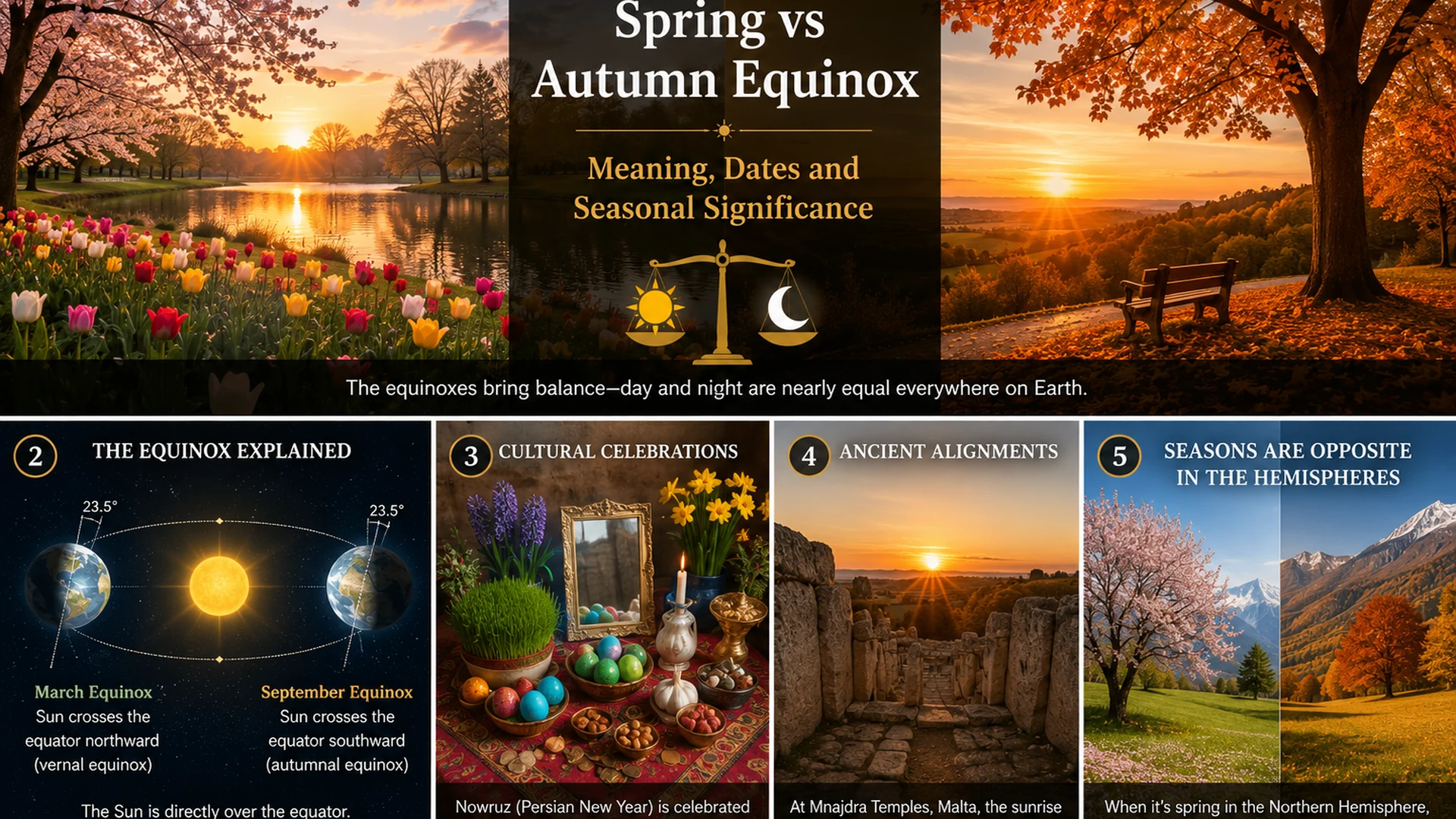
At Mnajdra’s South Temple in Malta, the main doorway is aligned with sunrise at the spring and autumn equinoxes. Heritage Malta describes how solstice sunlight reaches different parts of the entrance area. The site offers a specific archaeological example of architecture connected with seasonal solar observation. Interpretations of intention should still be framed carefully, because the surviving alignment cannot reveal every belief or ceremony of the builders. [9]
Specific culture or historical context: Mnajdra megalithic temple complex in Malta, built during the fourth and third millennia BCE; modern heritage presentation.
People shown: One Maltese heritage guide and three diverse adult visitors, small in the frame.
Location: Mnajdra Archaeological Park, Malta.
Clothing: Contemporary visitor clothing; no invented prehistoric costumes.
Architecture: Accurate honey-colored megalithic stone architecture and central doorway.
Objects: Stone passage, protective visitor path, subtle guide flashlight kept off.
Lighting: First sunrise rays aligned through the doorway; natural dawn sky.
Composition: Low interior viewpoint looking outward toward sunrise, 16:9 landscape, visitors secondary to the architecture and light.
SEO-friendly filename: mnajdra-temple-equinox-sunrise-malta.webp
Image title: Equinox Sunrise at Mnajdra
Alt text: Sunrise illuminating the central passage of Mnajdra temple in Malta at the equinox
Caption: Mnajdra’s South Temple is aligned with sunrise at the spring and autumn equinoxes.
Recommended placement: After the historical observation and monument section.
Article section supported: Historical and archaeological significance.
Important elements to avoid: Stonehenge, fantasy priests, glowing runes, invented carvings, modern railings dominating the scene, text, logos, or claims of a universal ancient religion.
Was Stonehenge Built for the Equinox?
Stonehenge is often included in general equinox imagery, but English Heritage states that there is no clear evidence that its prehistoric builders marked the equinoxes. The monument’s strongest known solar relationships concern the solstices. Modern visitors may gather there at an equinox, but modern use should not be projected backward as proof of prehistoric practice. [10]
Cultural Traditions Connected With the Equinoxes
Equinox-related traditions are diverse. Some are directly calculated from the astronomical event, some occur near it, and others are modern celebrations that use equinox language. A respectful comparison names the community and avoids merging unrelated customs.
Nowruz and the March Equinox
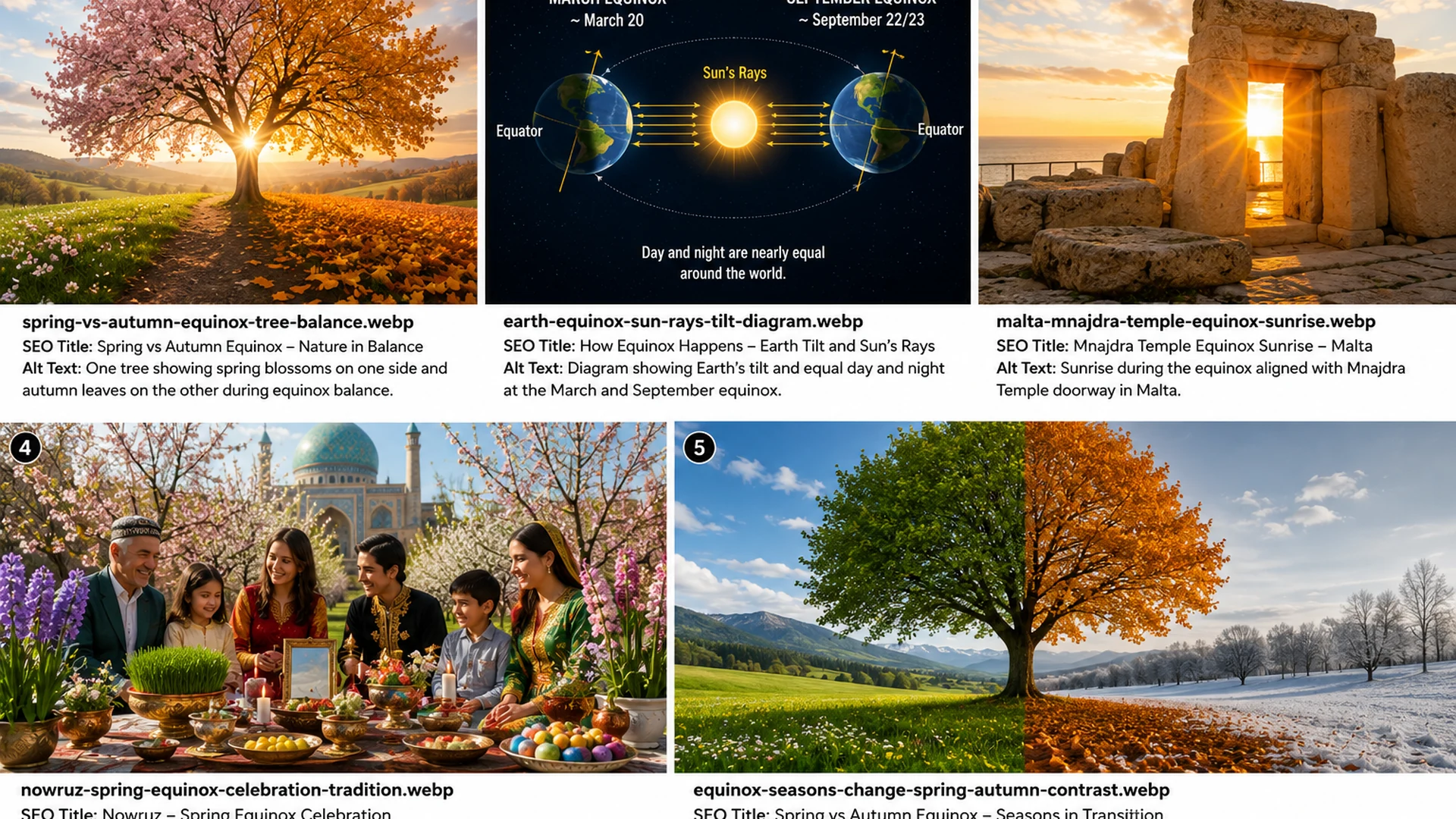
Nowruz, meaning “new day,” marks a new year and the arrival of spring across communities in parts of the Balkans, Black Sea region, Caucasus, Central Asia, Middle East, and beyond. UNESCO describes regionally varied customs that can include family visits, special meals, new clothing, gifts, music, games, and rituals of renewal. UNESCO inscribed Nowruz on the Representative List of the Intangible Cultural Heritage of Humanity through a multinational nomination. [7]
Nowruz should not be reduced to one identical ceremony practiced in every country. Names, foods, household displays, religious interpretations, and public events vary. Its importance demonstrates how an astronomical seasonal threshold can become part of family memory, civic identity, and living heritage.
Specific culture or historical context: Contemporary Iranian Nowruz family celebration; presented as one regional tradition within a much wider Nowruz heritage.
People shown: Iranian grandmother, two adults, and two children.
Location: Contemporary Iranian family living room.
Clothing: Modern modest celebratory clothing appropriate to the family setting.
Architecture: Contemporary home interior with subtle Persian decorative elements.
Objects: Haft-Seen table items, spring flowers, family tea service.
Lighting: Soft daylight and warm domestic illumination.
Composition: Documentary 16:9 scene; family interacting naturally around the table, not posing directly at the camera.
SEO-friendly filename: nowruz-spring-equinox-family-renewal.webp
Image title: Nowruz and the Arrival of Spring
Alt text: Iranian family preparing a Haft-Seen table for Nowruz near the spring equinox
Caption: Nowruz connects the arrival of spring with renewal, family visits, food, gifts, and regionally varied traditions.
Recommended placement: After the cultural significance section.
Article section supported: Spring equinox traditions and cultural meaning.
Important elements to avoid: Mixing unrelated Middle Eastern cultures, religious stereotyping, fantasy fire rituals indoors, embedded Persian text, logos, or incorrect Haft-Seen objects presented as mandatory everywhere.
Japan’s Vernal and Autumnal Equinox Days
Japan recognizes Vernal Equinox Day and Autumnal Equinox Day as national holidays whose dates are determined astronomically. The Cabinet Office describes Vernal Equinox Day as a time to honor nature and care for living things. Autumnal Equinox Day is described as a time to honor ancestors and remember those who have died. [8]
These official purposes exist alongside Buddhist Higan observances and family customs that may include cemetery visits and offerings. Practices differ among households, regions, and religious affiliations, so the holidays should not be presented as one uniform ritual.
Modern Spiritual Interpretations
Contemporary Pagan, New Age, and personal spiritual communities may describe the equinox as a moment of balance, renewal, gratitude, release, or intention-setting. These practices can be meaningful to participants, but claims that the equinox opens a scientifically proven energy portal, guarantees manifestation, cures illness, or determines fate are not supported by astronomy or medicine.
A responsible presentation distinguishes living belief and personal symbolism from established physical effects. The Sun’s changing angle and daylight are measurable; a promised supernatural outcome is not.
Spring Equinox vs Autumn Equinox in Astrology
In tropical Western astrology, the March equinox defines zero degrees Aries and the beginning of the tropical zodiac, while the September equinox corresponds with zero degrees Libra. Astrologers may associate the March point with initiation and the September point with relationship or balance. These are astrological interpretations rather than scientific descriptions of the equinox.
The tropical zodiac is anchored to seasonal points, whereas sidereal systems use stellar reference frameworks. Readers interested in that distinction should consult Ancestral Temple’s broader astrology and zodiac resources rather than treating an astronomical equinox article as proof of astrological influence.
Common Equinox Misunderstandings
“Everywhere Gets Exactly Twelve Hours of Daylight”
Daylight and darkness are close to equal, but atmospheric refraction, the width of the solar disk, latitude, and local horizon conditions make the actual sunrise-to-sunset period longer than twelve hours in many places.
“Spring Starts in March Everywhere”
March begins astronomical spring only in the Northern Hemisphere. It begins autumn in the Southern Hemisphere, and tropical regions may use wet and dry seasonal categories instead of spring and autumn.
“The Equinox Lasts All Day”
The equinox is an exact instant. People commonly use “equinox day” for the local civil day containing that instant.
“Earth’s Distance From the Sun Causes Spring and Autumn”
Axial tilt and orbital position drive the seasons. Opposite hemispheres experience opposite seasons at the same Earth-Sun distance.
“Every Ancient Monument Was an Equinox Observatory”
Solar alignment claims require archaeological and architectural evidence. Some sites, such as Mnajdra, have documented equinox relationships; others are primarily solstitial or remain uncertain.
“All Equinox Traditions Share One Ancient Origin”
Nowruz, Japanese holidays, modern Pagan observances, local harvest customs, and archaeological sites belong to different histories. Similar themes do not prove a single global tradition.
How to Observe an Equinox Responsibly
The equinox can be observed without special equipment. Choose a location with a clear horizon, check the official event time, and record sunrise or sunset positions over several days. The day-to-day movement is easier to understand as a sequence than as a single photograph.
Never look directly at the Sun through binoculars, a telescope, a camera viewfinder, or unfiltered optical equipment.
Use a compass carefully; magnetic north and true north are not identical, and phones can be affected by nearby metal.
Note that hills and buildings change the visible sunrise and sunset points.
Record the location, date, weather, and horizon features so observations can be compared later.
For heritage sites, follow access rules and do not touch, climb, mark, or alter archaeological structures.
When joining a cultural celebration, follow community guidance rather than copying sacred or private practices from social media.
Key Takeaways
The March and September equinoxes are two moments when the Sun’s center crosses Earth’s equatorial plane.
The spring equinox in one hemisphere is the autumn equinox in the other.
In 2026, the equinoxes occur on March 20 at 14:46 UTC and September 23 at 00:05 UTC.
Day and night are nearly, not exactly, equal because the Sun is a disk and the atmosphere refracts light.
Earth’s axial tilt causes seasonal daylight changes; Earth-Sun distance does not create opposite hemisphere seasons.
Astronomical, meteorological, ecological, and cultural seasons use different definitions.
Near the equator, wet and dry seasons may be more meaningful than spring and autumn temperatures.
Nowruz, Japan’s equinox holidays, and Mnajdra’s solar alignment are specific examples, not parts of one universal tradition.
Modern spiritual meanings may be personally valuable but should not be presented as scientific guarantees.
This page should remain focused on spring-versus-autumn comparison and link to the broader Ancestral Temple solstice-and-equinox pillar.
People Also Ask
What is the main difference between the spring and autumn equinox?
They are the same type of astronomical crossing in opposite directions. The spring equinox begins the half of the year with increasing daylight in a hemisphere, while the autumn equinox begins the half with decreasing daylight.
What date is the spring equinox in 2026?
The March equinox occurs on March 20, 2026, at 14:46 UTC. It is the spring equinox in the Northern Hemisphere and autumn equinox in the Southern Hemisphere.
What date is the autumn equinox in 2026?
The September equinox occurs on September 23, 2026, at 00:05 UTC. It is the autumn equinox in the Northern Hemisphere and spring equinox in the Southern Hemisphere.
Does the equinox happen at the same time worldwide?
Yes. It is one astronomical instant worldwide, but clocks and even the local calendar date differ by time zone.
Are day and night exactly equal on the equinox?
Usually not. Atmospheric refraction and the Sun’s visible diameter make sunrise-to-sunset daylight slightly longer than twelve hours in many places.
Why are the seasons reversed in the Southern Hemisphere?
Earth’s axis is tilted. When one hemisphere receives longer, more direct sunlight, the other receives shorter, less direct sunlight.
Does the Sun rise exactly due east?
Near an equinox it rises close to due east and sets close to due west for most places, but the visible point can be shifted by terrain, elevation, and atmospheric conditions.
What does the spring equinox symbolize?
Many people connect it with renewal, growth, beginnings, and return. These are cultural or personal meanings rather than one universal ancient doctrine.
What does the autumn equinox symbolize?
It is often connected with harvest, gratitude, completion, remembrance, and preparation. Meanings depend on the community and local season.
What is an equilux?
An equilux is the local date when day and night are closest to exactly twelve hours each. It usually falls a few days away from the astronomical equinox and varies by latitude.
Do tropical countries have spring and autumn?
The astronomical events occur everywhere, but tropical climates are often described more usefully through wet and dry seasons, monsoons, or ecological cycles.
Was Stonehenge built for the equinox?
English Heritage says there is no clear evidence that Stonehenge’s prehistoric builders marked the equinoxes; its strongest solar alignments concern the solstices.
Frequently Asked Questions
1. Is the spring equinox always on March 20?
No. In UTC it can fall on March 19, 20, or 21, and the local date depends on the time zone.
2. Is the autumn equinox always on September 22?
No. It may fall between September 21 and 24 depending on the year and time zone.
3. Is “fall equinox” the same as “autumn equinox”?
Yes. Fall is the common North American term for autumn. Both refer to the same seasonal event when used for the same hemisphere.
4. Why does the September equinox sometimes occur on September 22 in the United States but September 23 in UTC?
The astronomical instant is the same, but U.S. time zones are several hours behind UTC, so the local civil date may still be September 22.
5. Which equinox is vernal?
Vernal means spring. The March equinox is vernal in the Northern Hemisphere, while the September equinox is vernal in the Southern Hemisphere.
6. Which equinox is autumnal?
The September equinox is autumnal in the Northern Hemisphere, while the March equinox is autumnal in the Southern Hemisphere.
7. Are temperatures the same at the two equinoxes?
No. Similar daylight geometry does not produce identical weather because oceans, land, winds, snow, vegetation, and stored heat differ between spring and autumn.
8. Does the equinox affect tides?
Tides are driven mainly by the gravitational relationships among Earth, the Moon, and the Sun. An equinox is not itself a separate tidal force, though spring tides occur near new and full moons in any season.
9. Can an equinox affect human health or fertility?
No reliable evidence shows that the equinox guarantees health, fertility, emotional, financial, or protective outcomes. Medical concerns require qualified care.
10. Can I celebrate both equinoxes?
Yes. People may observe seasonal change through nature study, family traditions, worship, cultural festivals, or personal reflection, while respecting the origins and boundaries of specific community practices.
Conclusion
The spring and autumn equinoxes are not competing events but complementary crossings in Earth’s annual relationship with the Sun. Each marks a moment when neither hemisphere is tilted more toward the Sun, while the seasons move in opposite directions north and south of the equator.
Their astronomical meaning is precise: the Sun’s center crosses the equatorial plane. Their seasonal meaning is local: daylight begins to favor longer days or longer nights. Their cultural meaning is diverse: communities may connect the dates with new year, nature, ancestors, harvest, heritage, or modern spiritual reflection.
Understanding those layers prevents two common mistakes—treating Northern Hemisphere seasons as universal and treating every equinox tradition as one ancient global belief. The equinox is shared by the planet, but its lived significance depends on place, climate, history, and community.
Final Summary
The March equinox begins spring in the Northern Hemisphere and autumn in the Southern Hemisphere. The September equinox reverses those seasons. In 2026 they occur on March 20 at 14:46 UTC and September 23 at 00:05 UTC. Day and night are nearly equal, but atmospheric refraction and the Sun’s visible disk prevent a perfect twelve-hour split in most places. Scientific, ecological, cultural, and spiritual meanings should be clearly distinguished.
Research Sources and Further Reading
Major scientific, historical, cultural, and date claims in this package are traceable to the sources below. Cultural examples are presented as specific traditions rather than evidence of one universal equinox religion.
1. Earth’s Seasons: 2026 Equinoxes and Solstices — U.S. Naval Observatory. Official 2026 equinox times in Universal Time.
2. Length of Day and Night at the Equinoxes — U.S. Naval Observatory. Explains why equinox daylight is not exactly twelve hours and how the equilux varies by latitude.
3. Embracing the Equinox — NASA Science. Defines the equinox, gives 2026 dates, and explains the hemisphere reversal.
4. Why Does Earth Have Seasons? — NOAA/NESDIS. Explains axial tilt and why seasons are not caused by Earth’s distance from the Sun.
5. Meteorological Versus Astronomical Seasons — NOAA National Centers for Environmental Information. Distinguishes orbit-based astronomical seasons from fixed meteorological seasons.
6. The Intertropical Convergence Zone — NASA Earth Observatory. Explains why wet and dry seasons can be more meaningful than four temperature seasons near the equator.
7. International Day of Nowruz — UNESCO. Documents Nowruz as a spring and renewal celebration across several countries and communities.
8. About Japan’s National Holidays — Cabinet Office, Government of Japan. Provides the official purposes of Vernal Equinox Day and Autumnal Equinox Day.
9. Ħaġar Qim and Mnajdra Archaeological Park — Heritage Malta. Describes the South Temple doorway’s alignment with equinox sunrise.
10. Understanding Stonehenge — English Heritage. Clarifies that Stonehenge has strong solstice alignments but no clear evidence of prehistoric equinox marking.
11. Solstices and Equinoxes Explained — Ancestral Temple. Existing broad pillar page for internal linking and cannibalization control.
12. Seasonal Festivals Explained — Ancestral Temple. Existing supporting article on culturally specific seasonal celebrations.
13. The Moon in African Calendars — Ancestral Temple. Existing supporting article on African calendrical and ecological timekeeping.
Editorial and Publishing Notes
Replace the 2026 date emphasis or add the next year’s official times during the annual refresh.
Keep the phrase “spring vs autumn equinox” in the H1, opening paragraph, Quick Answer, comparison table, and one subheading only; do not repeat it unnaturally.
Do not change the Mnajdra section into a claim that all megalithic monuments tracked equinoxes.
Do not describe Nowruz as identical across all participating countries or communities.
Do not present modern “energy portal,” fertility, healing, financial, or manifestation claims as established effects.
Article Information
- Publisher
- Ancestral Temple
- Editor
- Ancestral Temple
- Last updated
- Jul 26, 2026
- Last reviewed
- Jul 26, 2026
- Content version
- 7bcf5c1fef
This educational article should be read as cultural and spiritual information, not as medical, legal, financial, or emergency advice.
Helpful Related Guidance
Explore This Topic
Related Topic Cluster
Dreams & Symbolism
About the Author
 Ancestral Temple
Spiritual guide and practitioner with decades of experience in ancestral wisdom, rituals, and divine guidance.
Related Posts
View All










Leave a Comment
We'd love to hear your thoughts.