
Water Ceremonies Explained: Meaning, Rituals and Cultural Traditions
Quick Summary
Water ceremonies are structured religious, spiritual or cultural practices in which water carries a meaning beyond ordinary washing or drinking. Depending on the tradition, water m...
Water ceremonies are structured religious, spiritual or cultural practices in which water carries a meaning beyond ordinary washing or drinking. Depending on the tradition, water may represent purification, rebirth, blessing, healing, covenant, ancestral memory, fertility, transition, protection, communal identity or the living presence of a river, spring, lake or sea. The action may involve immersion, sprinkling, bathing, pouring, carrying water, making offerings, processing to a riverbank, blessing a vessel, or simply gathering beside a body of water for prayer and remembrance.
There is no single universal “water ceremony.” A Yoruba festival beside the Osun River in southwestern Nigeria, Ethiopian Timkat, Hindu pilgrimage bathing, Shinto misogi and Christian baptism all use water, but they do not have the same theology, history, authority or ritual rules. Similar outward actions can express very different beliefs. A respectful explanation therefore begins with cultural specificity rather than treating all water traditions as interchangeable.
This guide answers the core questions behind searches for water ceremonies, water rituals, spiritual rivers and river spiritual meaning. It explains the recurring symbolism of water, presents documented examples, identifies common misunderstandings and offers ethical and practical guidance for studying or attending living traditions.
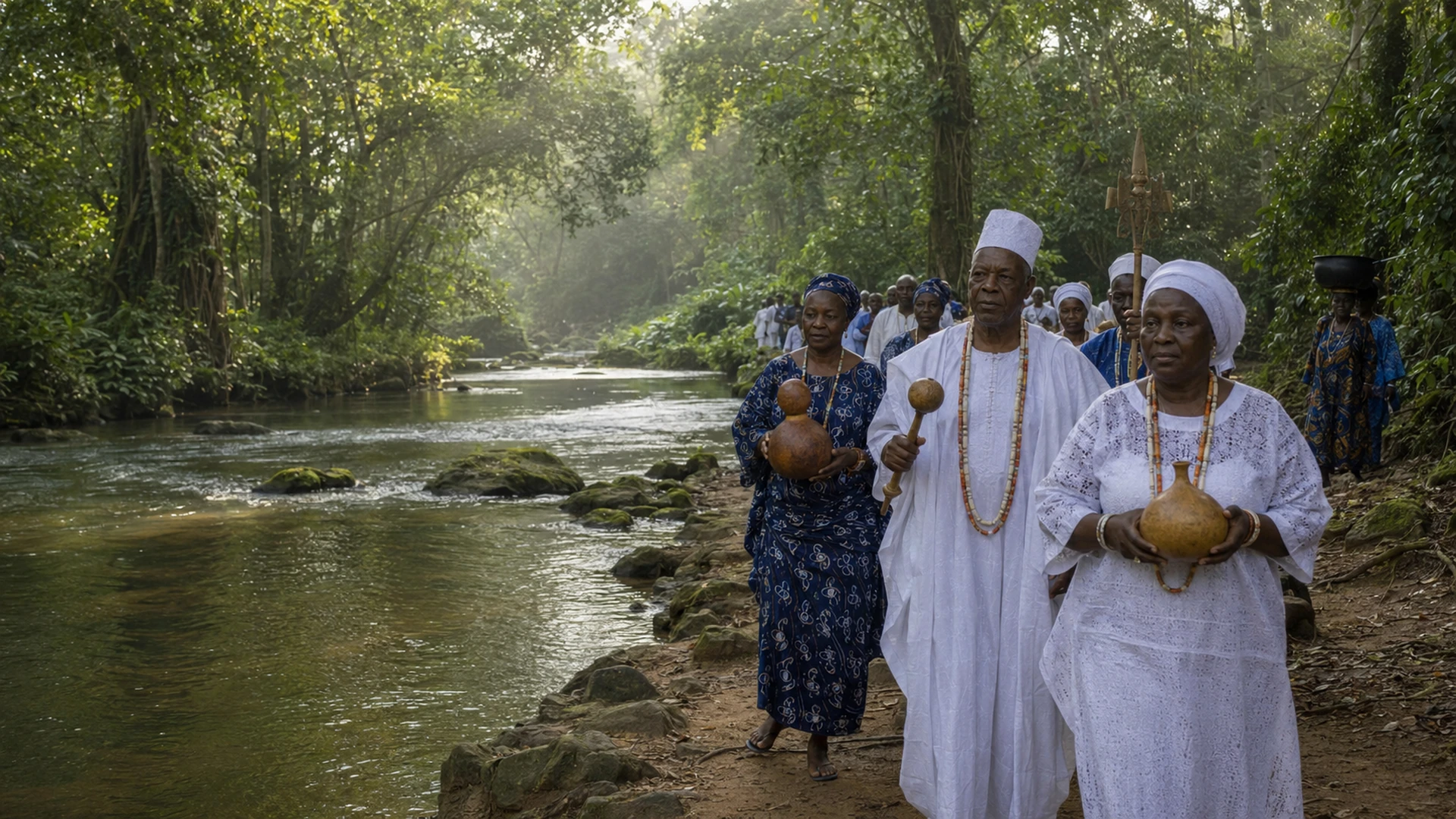
Specific culture or historical context: Contemporary Yoruba living heritage at the Osun-Osogbo Sacred Grove in Osun State, Nigeria.
People shown: Black Yoruba adults of different ages, including recognized-looking cultural custodians and ordinary community participants; no anonymous “tribal” stereotypes.
Location: Forested riverbank within the Osun-Osogbo Sacred Grove, with lush southern Nigerian vegetation.
Clothing: Accurate contemporary Yoruba festival clothing: white and indigo garments, wrappers, head ties and modest ceremonial attire, varied by role.
Architecture: Only distant, context-appropriate grove sculptures or shrine forms; no invented huts or fantasy temples.
Objects: Calabash vessels and modest processional items where appropriate; no random occult symbols.
Lighting: Soft early-morning natural light filtering through the forest canopy.
Composition: Wide 16:9 editorial composition with the river forming a leading line, people arranged naturally across the middle ground and open negative space for website cropping.
SEO-friendly filename: water-ceremonies-osun-river-sacred-grove.webp
Image title: Osun River Ceremony at the Sacred Grove
Alt text: Yoruba cultural custodians and community members gathered respectfully beside the Osun River in the Osun-Osogbo Sacred Grove, Nigeria
Caption: The Osun-Osogbo Sacred Grove is a living Yoruba religious landscape where the river, forest, shrines and annual festival remain connected.
Recommended placement: After the introduction and before the Quick Answer.
Article section supported: Introduction and African cultural context.
Important elements to avoid: Embedded text, logos, watermarks, fantasy lighting, mixed African clothing, invented ritual actions, sensational expressions, excessive crowds, distorted hands, duplicated people and shrine details copied inaccurately.
Quick Answer
A water ceremony is a culturally defined ritual in which water is used or approached as a symbol, sacred medium or living part of the landscape. It may mark purification, initiation, blessing, remembrance, renewal or community identity. Its meaning depends on the specific religion, community, place and authorized tradition; there is no single ceremony shared by all cultures.
What Is a Water Ceremony?
A water ceremony is an organized act in which water has ceremonial significance. The practice may be performed by religious specialists, elders, families, pilgrims, initiated members, congregations or an entire community. Some ceremonies happen at rivers, springs, lakes, waterfalls or the sea. Others use water carried into a church, shrine, home or public gathering place.
The word ceremony usually emphasizes a recognized sequence, occasion and social setting. The broader phrase water ritual can include both major public festivals and small repeated actions such as ablution before prayer, washing an object, sprinkling a gathering, filling a sacred vessel or pouring water during remembrance. In everyday language, the two phrases often overlap.
What makes the action ceremonial is not the chemical composition of the water. Meaning comes from the tradition: who has authority to perform the rite, what words or songs accompany it, when and where it occurs, which stories explain it, what objects are used, and how participants understand the event.
Water Ceremony, Water Ritual and River Blessing: Are They the Same?
| Term | Typical scope | Possible actions | Important caution |
|---|---|---|---|
| Water ceremony | A named or organized ceremonial event | Procession, blessing, immersion, sprinkling, offerings, prayer | The title does not identify one universal practice |
| Water ritual | A broad category from daily rites to annual festivals | Ablution, pouring, bathing, carrying, washing, libation | Small and large rituals may have different authorities and rules |
| River blessing | A ceremony focused on a river or water gathered from it | Prayer, blessing, procession, ecological commitment | Not every sacred-river tradition uses the concept of “blessing” |
| Ritual bathing | Washing or immersion with religious meaning | Full or partial immersion, dipping, washing at a designated place | It is not simply hygiene, although physical washing may also occur |
Why Water Becomes Sacred or Symbolic
Water supports life, moves through landscapes and bodies, changes form, cleans surfaces, reflects light and can both nourish and destroy. These physical qualities make it a powerful source of metaphor. Rivers connect places; rain arrives and disappears; springs emerge from the ground; floods transform settlements; and oceans mark boundaries and routes. The natural water cycle continually moves water through atmosphere, land, rivers, lakes, groundwater and seas.[9] Religious meanings are cultural interpretations of these experienced realities, not scientific properties that can be measured in the water itself.
Across different traditions, several themes recur. Purification may mean preparation for prayer, removal of ritual impurity, repentance or a fresh moral beginning. Rebirth may be expressed through immersion and emergence. Flow can represent time, change, continuity or a journey. A river may carry the memory of ancestors, the identity of a town or the presence of a deity. Rain and springs may symbolize fertility and provision. Deep or turbulent water may also represent danger, uncertainty and powers that demand respect.
Recurring themes do not prove that all traditions originated from one source. Human communities often develop comparable symbols because they encounter the same material element, while their stories, institutions and ritual systems remain distinct.
Common Meanings Associated with Water Ceremonies
| Meaning | How it may function |
|---|---|
| Purification | Preparation, restoration or transition from one ritual state to another. |
| Rebirth and initiation | A marked beginning, entry into a community or transformed identity. |
| Blessing | Consecration, prayer for well-being or recognition of divine grace. |
| Memory and ancestry | Connection to forebears, origin stories, historical migration or sacred geography. |
| Fertility and life | Recognition of water’s role in crops, animals, childbirth symbolism and community survival. |
| Healing | A religious or cultural hope for restoration; not a scientific guarantee of medical treatment. |
| Covenant and belonging | Membership, responsibility and relationship with a religious community or place. |
| Danger and respect | Recognition that water can flood, drown, conceal and exceed human control. |
| Ecological responsibility | Modern and traditional commitments to protect rivers, springs and watersheds. |
What Happens During a Water Ceremony?
There is no fixed universal sequence, but documented water ceremonies often combine several elements. Participants may first prepare themselves through fasting, prayer, special clothing, silence or procession. A recognized leader may address the water, recite scripture, invoke a deity, bless a vessel, explain an origin story or guide a congregation. Water may then be touched, sprinkled, poured, carried, crossed or entered. Songs, drums, bells, incense, flowers, lamps, calabashes, crosses or other culturally specific objects may accompany the action.
The event may conclude with communal prayer, a return procession, a meal, instruction from elders, a commitment to changed conduct or the careful disposal or storage of ritual materials. In some traditions the important action is public and visible. In others, crucial knowledge is restricted to initiated members. A responsible educational article should describe only what communities and reputable sources have made public.
Preparation: prayer, washing, fasting, instruction, clothing or gathering at a designated time.
Approach: movement toward a river, pool, font, spring, waterfall or ceremonial vessel.
Authorization: leadership by clergy, priests, priestesses, elders, custodians or other recognized participants.
Words and sound: prayers, hymns, invocations, oral histories, bells, drums or silence.
Water action: immersion, sprinkling, pouring, washing, dipping, carrying or libation.
Community response: vows, songs, procession, celebration, remembrance or renewed responsibility.
Closure: return procession, blessing, teaching, shared food or ecological care for the site.
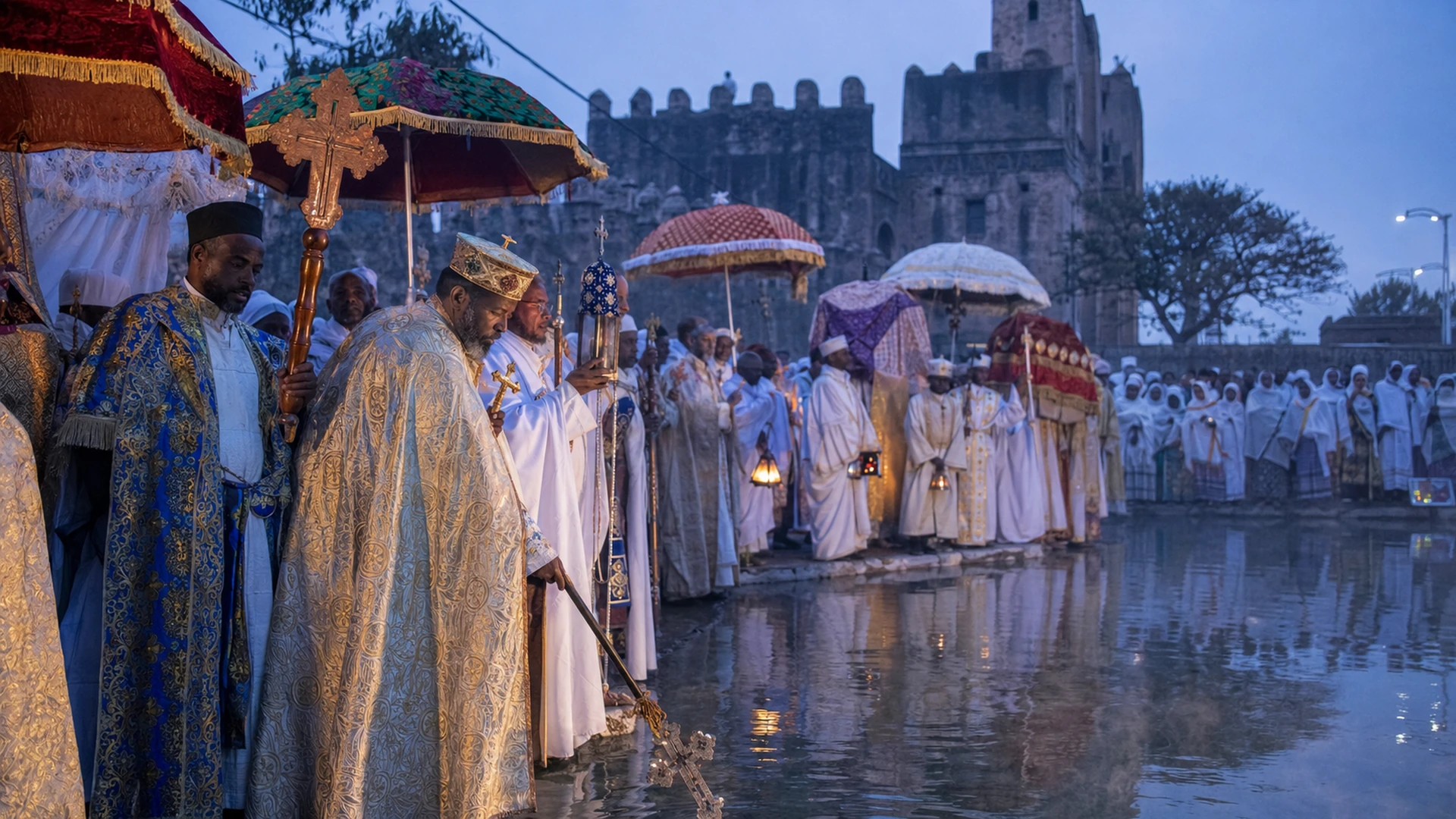
Specific culture or historical context: Contemporary Ethiopian Epiphany (Timkat), a public festival commemorating the baptism of Jesus in the River Jordan.
People shown: Ethiopian Orthodox clergy in front, Ethiopian worshippers and youth choir members in the background.
Location: A large ceremonial pool or reservoir in Gondar or Addis Ababa, Ethiopia.
Clothing: Accurate white liturgical robes, richly patterned ceremonial umbrellas, clergy head coverings and modest white shawls among congregants.
Architecture: Distant Ethiopian church or historic Gondar stone architecture where contextually appropriate; no European cathedral forms.
Objects: Covered tabot carried with reverence, processional crosses, prayer staffs, sistrums, drums and ceremonial umbrellas.
Lighting: Blue-hour pre-sunrise light with warm lantern highlights and realistic mist above the water.
Composition: Wide documentary frame, clergy and water in the foreground, congregation receding into the background, no close-up intrusion into private devotion.
SEO-friendly filename: ethiopian-timkat-water-blessing-ceremony.webp
Image title: Ethiopian Timkat Water Blessing
Alt text: Ethiopian Orthodox priests blessing water at a Timkat ceremony before sunrise as worshippers gather around the ceremonial pool
Caption: During Ethiopian Timkat, blessed water and procession commemorate the baptism of Jesus Christ in the River Jordan.
Recommended placement: Immediately before the section on documented water ceremonies across cultures.
Article section supported: Documented cultural examples; Ethiopian Timkat.
Important elements to avoid: Uncovered tabot, inaccurate vestments, generic medieval costumes, chaotic crowd behavior, fantasy beams of light, text, flags dominating the frame, distorted crosses or hands.
Documented Water Ceremonies and Traditions
The examples below are not variations of one global rite. Each belongs to a particular historical and religious system. They are presented together only to show how differently communities can interpret and use water.
The Osun River and the Osun-Osogbo Sacred Grove, Nigeria
In Yoruba religious tradition, the Osun River at Osogbo is part of a sacred landscape associated with Osun, a Yoruba oriṣa often connected with the river, fertility, well-being and social life. UNESCO describes the Osun-Osogbo Sacred Grove as a living religious site where the river passes through a forest containing shrines, sculptures, sacred places and worship points. The annual festival renews bonds among the goddess, the ruler and the people of Osogbo.[1]
The grove demonstrates why a “spiritual river” cannot be reduced to the claim that water has a universal invisible energy. Here, spiritual meaning emerges from Yoruba cosmology, the history of Osogbo, priestly and royal institutions, the forest environment, annual procession and generations of community practice. The river is not an interchangeable backdrop. It is part of the identity and continuity of a specific place.
UNESCO also records conservation concerns, including tourism pressure and river pollution. This creates an important ethical point: reverence for sacred water must be connected to the physical condition of the river. Cultural respect and environmental protection cannot be separated when pollution threatens a living heritage site.
Water Spirits and Mami Wata in African and Atlantic Traditions
Water-spirit traditions occur in many parts of Africa, but names, stories and ritual relationships differ by community. The Smithsonian’s National Museum of African Art uses the term Mami Wata for a widely recognized and highly adaptable family of water-spirit images and beliefs found in parts of western and central Africa and the African Atlantic world. Museum research emphasizes historical change: modern Mami Wata imagery absorbed an imported nineteenth-century snake-charmer image and combined it with older local water-spirit traditions.[2][3]
This history cautions against presenting Mami Wata as a single ancient goddess worshipped identically everywhere. Among Anang Ibibio communities in southeastern Nigeria, for example, modern figures and masks were interpreted through local histories and earlier aquatic beings. Elsewhere, different priesthoods, visual forms and moral meanings developed. Water spirits may be described as protective, generous, dangerous, alluring or morally ambiguous depending on place and context.
A public article may explain these documented patterns, but it should not invent an altar, mix unrelated communities or provide supposed secret instructions. Visual culture, museum records and published community histories are safer entry points than generic internet claims.
Ethiopian Timkat: Water, Baptism and Public Memory
Ethiopian Timkat, or Ethiopian Epiphany, commemorates the baptism of Jesus Christ in the River Jordan. UNESCO records that the observance begins on 18 January with Ketera, when parish tabots—covered replicas of the Ark of the Covenant—are escorted to a pool, river or reservoir. Night prayers and hymns continue until the following morning, when the water is blessed and sprinkled on the congregation before the tabots return to their churches in procession.[4]
Timkat shows how a water ceremony can be simultaneously theological, historical, social and artistic. The water recalls the Jordan, but the ceremony is unmistakably Ethiopian in its liturgy, tabot processions, music, vestments and community participation. It also contributes to identity and social cohesion across diverse Ethiopian communities, while remaining rooted in the Ethiopian Orthodox Tewahedo Church.
It would therefore be inaccurate to describe Timkat merely as “an African cleansing ritual.” Its central meaning is the Christian commemoration of Christ’s baptism as practiced within a specific Ethiopian church tradition.
Kumbh Mela and Sacred-River Bathing in India
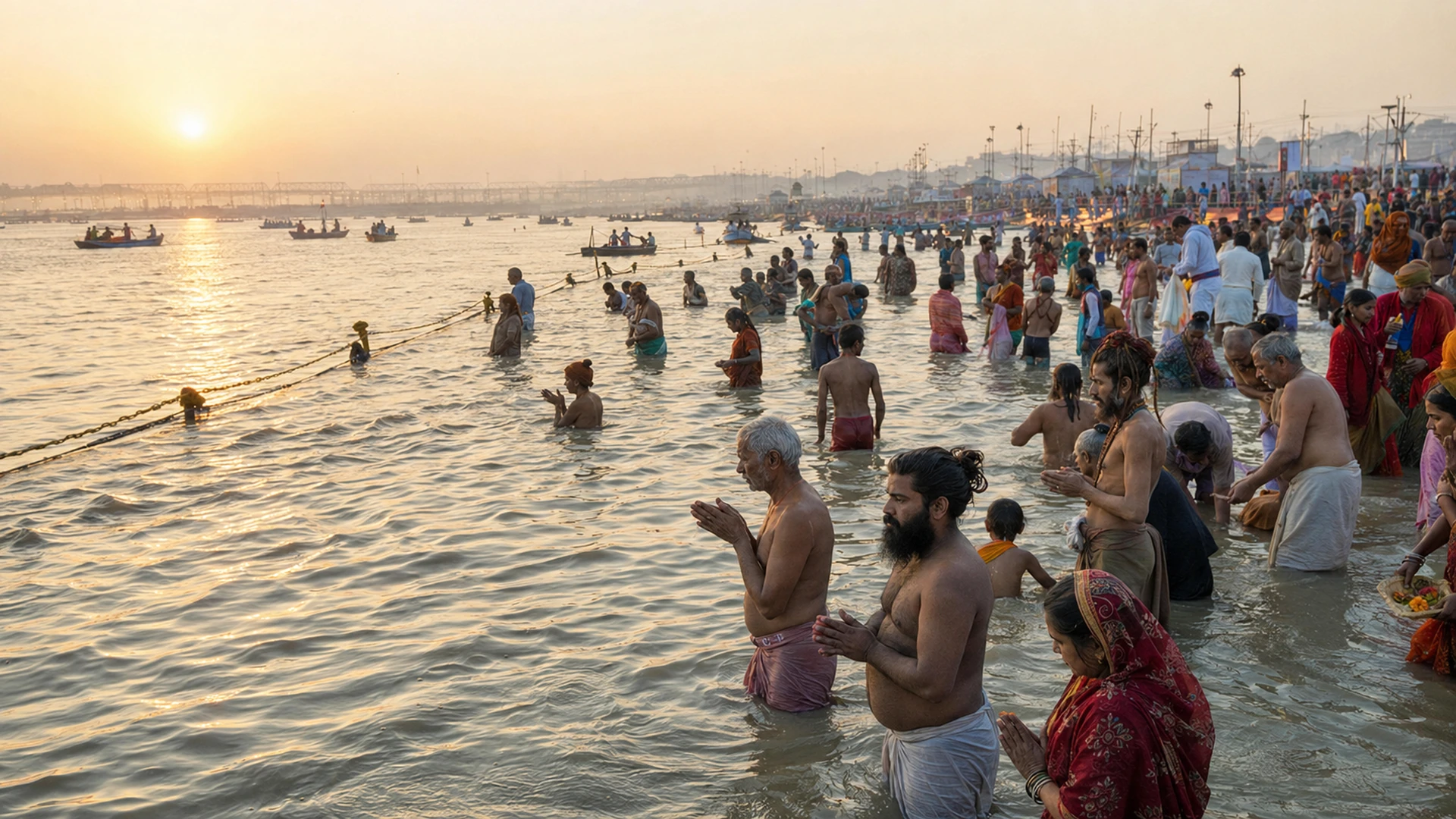
Kumbh Mela is a major Hindu pilgrimage and festival held cyclically at four Indian locations associated with sacred rivers. UNESCO describes it as a vast peaceful gathering where pilgrims bathe or take a dip in a sacred river. Participants understand the act through Hindu teachings concerning merit, purification, liberation, pilgrimage and sacred time.[5]
The English phrase “water ceremony” captures only part of what occurs. Kumbh includes pilgrimage networks, teachers, ascetic communities, family traditions, temporary settlements, public administration and many forms of worship. The river bath is central, but it belongs to a much larger religious event.
The sacred status of a river does not remove environmental risk. Scholarship on the Ganges and Yamuna repeatedly notes the tension between religious reverence and severe pollution. Responsible coverage should neither mock belief nor pretend that symbolic purity guarantees microbiological safety.
Specific culture or historical context: Contemporary Kumbh Mela at Prayagraj, India, where the Ganges, Yamuna and the traditionally understood Saraswati meet.
People shown: Indian pilgrims of varied ages, a small number of identifiable Hindu ascetics, women and men shown modestly and respectfully.
Location: Broad river confluence with temporary ghats, boats and distant festival infrastructure.
Clothing: Accurate saris, shawls, dhotis and simple pilgrimage clothing; wet clothing remains modest and non-exploitative.
Architecture: Temporary riverbank platforms, pontoon structures and distant tents; no invented palace backdrop.
Objects: Small offering baskets where publicly appropriate, ropes and safety structures, boats and cloth bundles.
Lighting: Soft golden sunrise through natural river mist.
Composition: High, wide 16:9 editorial frame emphasizing the scale of the river and organized human movement, with clear foreground water texture.
SEO-friendly filename: kumbh-mela-sacred-river-bathing-prayagraj.webp
Image title: Sacred River Bathing at Kumbh Mela
Alt text: Pilgrims bathing at the river confluence during Kumbh Mela in Prayagraj, India, at sunrise
Caption: At Kumbh Mela, sacred-river bathing belongs to a wider Hindu pilgrimage involving religious teachers, families, ascetics and temporary communities.
Recommended placement: After the Kumbh Mela section.
Article section supported: Kumbh Mela and ritual bathing.
Important elements to avoid: Eroticized wet clothing, crowd panic, extreme telephoto compression, fantasy auras, excessive smoke, random deities in the sky, text, logos, distorted bodies or disrespectful close-ups.
Shinto Misogi in Japan
Misogi is a Shinto purification practice associated with cleansing body and mind, often through contact with flowing water. At Misogi-jinja Shrine in Yamanashi, Japan’s official tourism organization describes a training hall built around a clear stream and waterfall where participants may undertake the rite by advance arrangement.[6]
Although photographs often emphasize the dramatic sight of a person beneath a waterfall, the water action is only one part of disciplined preparation, prayer, instruction and shrine context. It should not be detached from Shinto institutions and marketed as an instant wellness technique.
Misogi also shows that “purification” does not always mean removal of physical dirt. Ritual purity is a religious category shaped by the tradition’s understanding of proper relationship, attention and preparation.
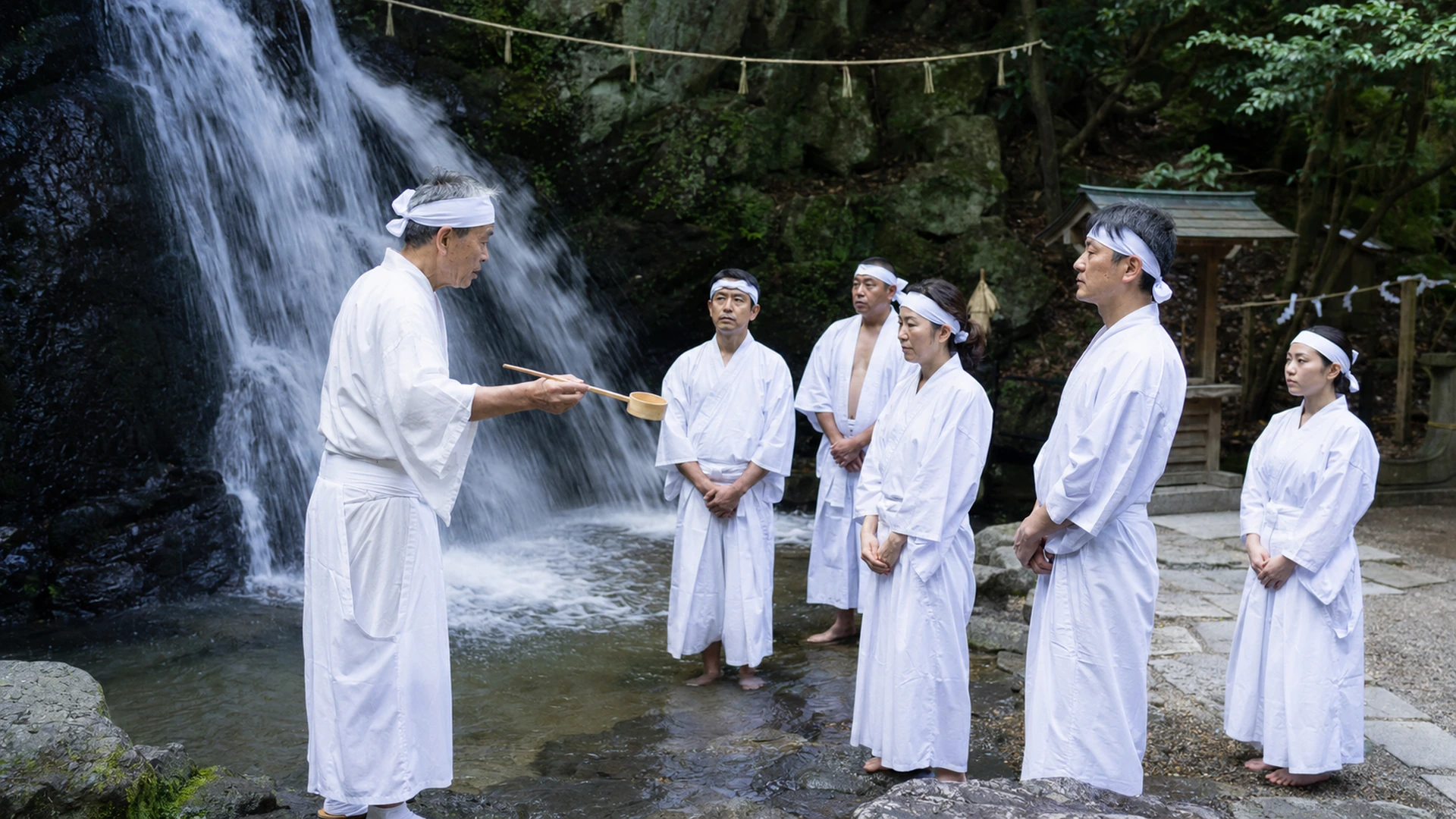
Specific culture or historical context: Contemporary Shinto misogi at a recognized shrine training site in Japan.
People shown: Japanese adult participants and a shrine instructor; small group only.
Location: A clear mountain stream and waterfall within a maintained shrine precinct.
Clothing: Simple white traditional purification garments and headbands where appropriate; modest and accurate.
Architecture: Subtle wooden shrine structures, rope boundary or stone path in the background, all contextually accurate.
Objects: Minimal ritual equipment; natural rock, water, wooden ladle or shrine rope only where appropriate.
Lighting: Cool natural morning light with realistic water spray and forest shade.
Composition: Medium-wide 16:9 frame, waterfall on one side and participants on the other, with crisp water movement and no dramatic low-angle hero pose.
SEO-friendly filename: shinto-misogi-waterfall-purification-japan.webp
Image title: Shinto Misogi Waterfall Purification
Alt text: Japanese Shinto participants practicing supervised misogi purification beside a clear shrine waterfall
Caption: Misogi uses flowing water within a disciplined Shinto context of preparation, prayer and purification.
Recommended placement: After the Shinto misogi section.
Article section supported: Shinto misogi in Japan.
Important elements to avoid: Martial-arts styling, anime aesthetics, frozen or dangerous conditions unless historically required, fantasy spirits, inaccurate robes, exaggerated suffering, tourist selfies, text and logos.
Christian Baptism and Water as New Life
Christian baptism uses water in a rite of initiation and belonging. Practices differ among churches: a candidate may be immersed, have water poured over the head or be sprinkled. The Church of England describes baptismal water as a sign of cleansing, rebirth, participation in Christ’s death and resurrection, and entry into the life of the Church.[7]
Baptism is not simply a general river cleansing. It is performed with particular words, beliefs and ecclesial authority. Some baptisms take place in fonts inside churches; others occur in rivers, lakes, pools or purpose-built baptisteries. When baptism happens in a river, the natural setting may recall the Jordan, but the rite remains Christian rather than becoming a generic “nature ceremony.”
Ethiopian Timkat and an individual baptism both refer to the baptism of Jesus, yet they are not the same event. Timkat is an annual communal commemoration with Ethiopian liturgical forms, while baptism initiates a person into Christian life according to the practice of a particular church.
Other Forms: Ablution, Immersion, Libation and Consecrated Water
Many traditions use water without holding a large public river ceremony. Jewish mikveh immersion is governed by detailed religious law and concepts of ritual status. Islamic wudu and ghusl prepare worshippers for prayer and other religious obligations. In several African communities, water may be poured as part of remembrance, blessing, divination or a life-cycle rite, but the meaning and authorized procedure vary. Ancient ritual vessels also show that ceremonial washing and pouring have long material histories.
These practices should not be collapsed into one “water magic” category. Similar acts—washing hands, entering water, pouring from a vessel—are embedded in different scriptures, legal traditions, oral histories and community institutions.
What Is the Spiritual Meaning of a River?
A river has no single spiritual meaning. In different cultures, rivers may be understood as ancestors, deities, gifts of God, boundaries, routes of migration, sources of fertility, places of revelation, witnesses to history or symbols of impermanence. A river’s meaning often combines its physical role in survival with stories and institutions built around it.
The phrase spiritual river is best used as a description of a relationship: a community regards a particular river as spiritually significant. It should not be treated as a scientific category or as proof that every river possesses the same measurable spiritual force.
Scholarship on the Nile illustrates this specificity. At the sources of the Blue Nile in Ethiopia and White Nile in Uganda, religious cosmologies developed in relation to geography, kingship, pilgrimage and local histories. The same river system can therefore carry multiple meanings at different places and times.[8]
| Possible river meaning | How it can appear |
|---|---|
| Source and origin | The river may be linked to creation, ancestry, a deity or the founding of a settlement. |
| Flow and time | Continuous movement may symbolize life, change, destiny, memory or the passage between stages. |
| Boundary and crossing | A river can divide territories or mark transition, danger, exile, pilgrimage and return. |
| Fertility and provision | River water supports crops, animals, transport and human settlement, shaping ideas of abundance. |
| Purification | Flowing water may symbolize removal, renewal or preparation, though ritual meanings differ. |
| Presence and personhood | Some traditions address a river as deity, ancestor, living being or legal person; others do not. |
| Judgment and danger | Flooding, depth and unpredictability can represent power, consequence or moral warning. |
| Community identity | Festivals, songs, shrines and histories may make a river central to a town or people. |
How Water Ceremony Meanings Change Over Time
Living traditions are not frozen. Communities adapt to migration, urban growth, new religious movements, colonial histories, tourism, media and environmental change. Mami Wata visual culture is a clear example of creative adaptation: modern imagery drew on an imported print while communities interpreted it through older local ideas.[2][3] The twentieth-century sculptures in the Osun-Osogbo Grove likewise show artistic renewal within a continuing sacred landscape.[1]
Change does not automatically make a tradition inauthentic. The key questions are who is making the change, whether cultural custodians consent, whether the practice remains meaningful to participants and whether commercial presentation distorts restricted knowledge. UNESCO’s approach to intangible heritage emphasizes living transmission rather than freezing culture at one historical moment.
Diaspora communities may also carry river traditions into cities far from the original landscape. Water from a local tap, bowl or shoreline can become part of memory and worship, but the meaning remains connected to community history rather than to a universal recipe.
Common Misunderstandings About Water Rituals
| Misunderstanding | More accurate explanation |
|---|---|
| “All water ceremonies are cleansing rituals.” | Some concern initiation, remembrance, covenant, pilgrimage, fertility, kingship, ancestry or public identity rather than cleansing. |
| “African water spirituality is one belief system.” | Africa contains thousands of communities and many religious histories. Yoruba Osun traditions, Ethiopian Christianity and Mami Wata-related practices are not interchangeable. |
| “A sacred river is physically safe.” | Sacred status is religious or cultural. Pollution, currents, parasites and other hazards remain physical realities. |
| “Anyone can recreate a ceremony from online instructions.” | Some public practices welcome visitors; others require permission, initiation, clergy or elders. Copying may be disrespectful or unsafe. |
| “Similar rituals prove a single ancient origin.” | Comparable symbols can develop independently because humans share material experiences of water. |
| “Modern change means a ceremony is fake.” | Living heritage evolves. Authenticity depends on community continuity and authority, not on remaining unchanged forever. |
Cultural Respect and Ethical Boundaries
Water ceremonies may be visually beautiful, but they are not performances created for outsiders. Some are public festivals; others include private or restricted stages. Visitors, writers, photographers and content creators should follow the instructions of custodians, clergy, organizers and local authorities.
Respect begins with accurate naming. Identify the community, country, place, institution and religious tradition. Avoid labels such as “primitive water magic,” “tribal cleansing” or “ancient African ritual” when a specific name exists. Do not combine Yoruba objects, Ethiopian church clothing and central African water-spirit imagery into a fictional scene.
Consent also matters. Do not photograph vulnerable participants, people bathing, children or private devotional moments without permission. Do not remove water, stones, plants or offerings from sacred sites. Do not publish restricted prayers or reproduce ritual objects as commercial decorations without understanding community expectations.
How to Attend or Study a Water Ceremony Responsibly
Learn the correct name of the ceremony and the community that maintains it.
Use official heritage, religious or community sources before relying on travel blogs.
Ask whether visitors are welcome and which areas or actions are restricted.
Dress according to local guidance and avoid obstructing processions or worship.
Request permission before photographing individuals, clergy, ritual objects or bathing.
Do not imitate prayers, offerings or initiation rites without authorization.
Support local custodians, conservation efforts and community-approved interpretation.
Describe beliefs as beliefs and traditions, not as scientifically proven supernatural effects.
Scientific Limits and Water Safety
Water ceremonies can have profound religious, emotional and social meaning. Participation may strengthen belonging, memory, hope and communal identity. These are human and cultural experiences. They do not demonstrate that ceremonial water has scientifically verified supernatural, medical, fertility, financial or protective powers.
Natural water may also contain germs, parasites, harmful algae, sewage, chemicals or physical hazards. The World Health Organization notes that unsafe water and contaminated surface water can harm health, while the CDC advises that rivers, lakes and streams can spread illness through swallowing or contact with contaminated water.[10][11] Fast currents, steep banks, cold water, floods and overcrowding create additional risks.
Organizers and participants should follow local health advisories, avoid swallowing untreated water, protect open wounds, use designated access points, supervise children and avoid entering water when authorities or cultural custodians advise against it. People with weakened immune systems, pregnancy or relevant health conditions should seek medical guidance before immersion. Spiritual respect should include respect for the body and the river’s actual ecological condition.
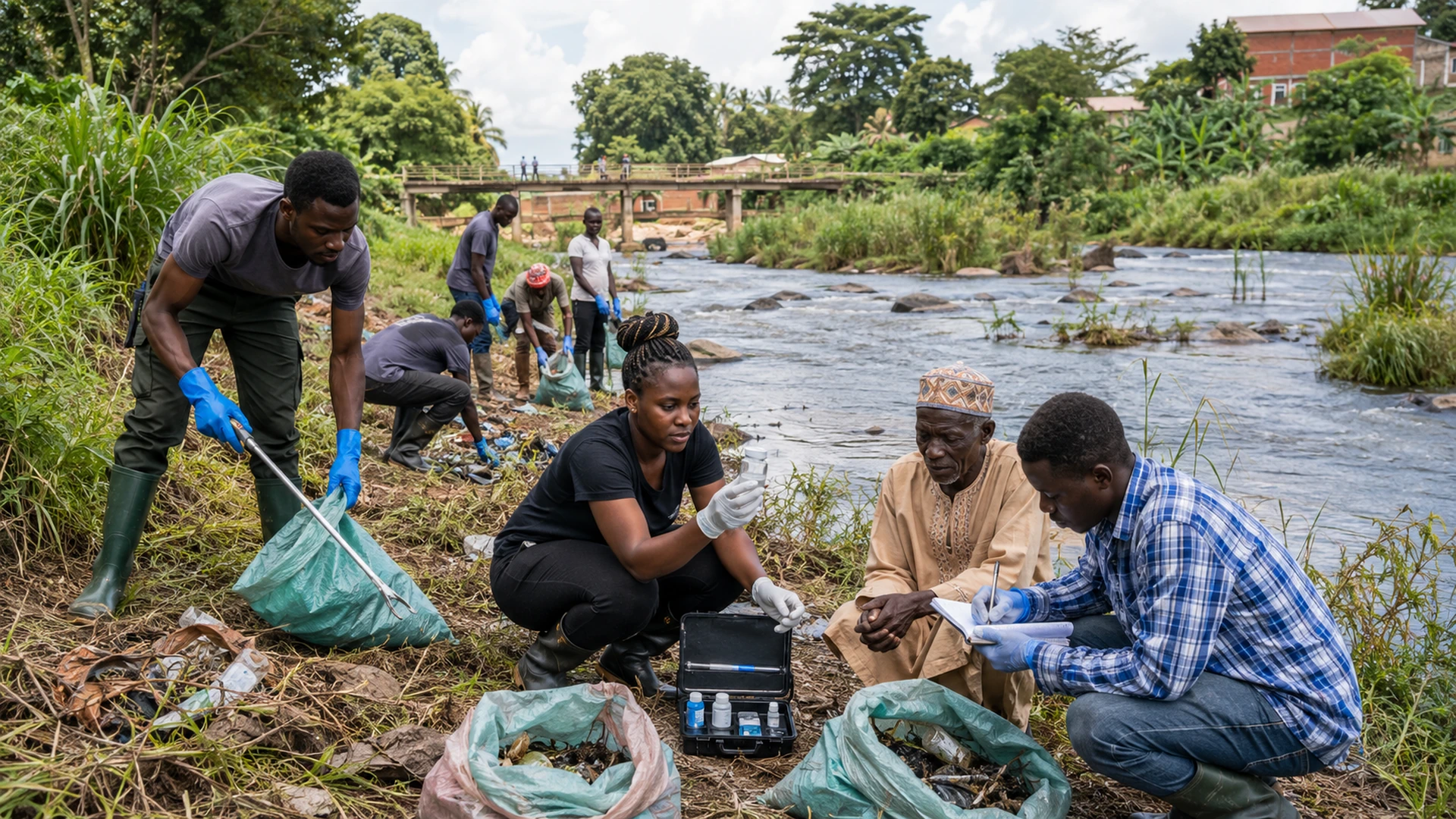
Specific culture or historical context: Contemporary community river stewardship in Uganda, connecting environmental responsibility with cultural value without claiming one specific sacred rite.
People shown: Black Ugandan adults and older youth, including women and men; one elder in ordinary respectful attire, not costume.
Location: Vegetated riverbank in Uganda with flowing water, papyrus or native riverside plants and no identifiable private property.
Clothing: Practical modest clothing, boots or sandals, gloves where appropriate; subtle local fabrics without staged ceremonial dress.
Architecture: None required; a distant footbridge or village edge may appear naturally.
Objects: Reusable sacks, litter pickers, notebook, simple water-testing bottle and gloves; no corporate branding.
Lighting: Bright but soft late-morning natural light after rain, with realistic reflections.
Composition: Wide 16:9 scene with volunteers working in the foreground and the river extending toward the background, visually communicating continuity and responsibility.
SEO-friendly filename: river-cultural-stewardship-uganda-water-traditions.webp
Image title: River Stewardship and Cultural Responsibility
Alt text: Ugandan community volunteers and an elder caring for a riverbank and observing water quality beside a flowing river
Caption: Respect for spiritually and culturally important rivers also requires practical protection from pollution and physical damage.
Recommended placement: After the scientific limits and water-safety section, before People Also Ask.
Article section supported: Scientific limits, ecological responsibility and ethical practice.
Important elements to avoid: Invented ritual gestures, political signage, branded uniforms, piles of hazardous waste handled without protection, fantasy sacred symbols, text, logos, patronizing charity imagery and distorted hands.
People Also Ask
What is a water ceremony?
A water ceremony is a culturally recognized ritual in which water is used or approached as a symbol, sacred medium or meaningful part of a landscape. It may involve immersion, sprinkling, pouring, procession, prayer, remembrance or blessing.
What do water rituals symbolize?
Depending on the tradition, water rituals can symbolize purification, rebirth, initiation, divine grace, fertility, ancestry, transition, community identity or respect for a river. No meaning applies to every culture.
Why are rivers spiritually important?
Rivers sustain life, connect places and shape settlement, agriculture and memory. Communities may interpret these physical relationships through stories of deities, ancestors, revelation, pilgrimage, kingship or sacred geography.
What is the spiritual meaning of flowing water?
Flowing water may represent change, continuity, time, removal, renewal or a journey. The interpretation depends on the specific religious and cultural tradition.
Are water ceremonies African traditions?
Many African communities have water-related ceremonies and beliefs, but Africa has no single water tradition. Yoruba Osun practice, Ethiopian Timkat and Mami Wata-related traditions have different histories and meanings.
Is baptism a water ceremony?
Yes. Baptism is a Christian water ceremony of initiation and belonging. Its theological meaning and method vary among churches.
Can a person create a personal water ceremony?
A person can create a private reflective practice, but it should not be presented as an authentic ceremony from a community they do not belong to. Avoid copying restricted prayers, titles, clothing or ritual objects.
Are sacred rivers safe to enter?
Not necessarily. Sacred or symbolic status does not guarantee clean water or safe currents. Follow local health guidance, site rules and instructions from organizers or custodians.
Frequently Asked Questions
Do all water ceremonies require full immersion?
No. Some use sprinkling, pouring, handwashing, carrying water, blessing a vessel, standing beside a river or making a procession without entering the water.
What objects are used in water rituals?
Objects may include fonts, bowls, calabashes, ritual vessels, crosses, lamps, flowers, prayer staffs, drums or textiles. The correct objects depend entirely on the tradition.
What is a river blessing ceremony?
It is a ceremony in which a community prays for, consecrates, gives thanks for or renews responsibility toward a river. The term fits some traditions better than others.
Is holy water the same as river water?
No. Holy water is water consecrated according to a particular religious tradition. It may come from an ordinary supply. River water is defined by its natural source and may or may not be ritually significant.
Do water ceremonies guarantee healing or fertility?
No scientific evidence shows that ceremonial water guarantees medical, fertility or other material outcomes. Such expectations should be described as religious belief or personal testimony, not medical fact.
Why do people make offerings near water?
In some traditions, offerings express gratitude, reciprocity, remembrance, devotion or a request made within a recognized relationship with a deity, ancestor or sacred place. Practices vary and may be restricted.
What is the difference between purification and hygiene?
Hygiene removes dirt or reduces physical contamination. Ritual purification changes a person’s religious or ceremonial status according to a tradition. One action may involve both, but the concepts are not identical.
Can tourists attend water ceremonies?
Some public festivals welcome visitors, while other ceremonies are private. Tourists should check official guidance, observe photography rules and avoid entering restricted spaces.
How can writers avoid cultural appropriation?
Name the tradition accurately, cite community and scholarly sources, avoid invented instructions, acknowledge authority and variation, and do not market sacred practices as generic products.
Why is river pollution a cultural issue?
Pollution can damage the physical place through which a community maintains worship, memory and identity. At sites such as Osun-Osogbo, conservation of the river is inseparable from safeguarding living heritage.
Are water-spirit traditions all connected to Mami Wata?
No. Mami Wata is an important and adaptable complex of water-spirit imagery and belief, but many African water beings and river deities have distinct names and histories.
What should a person do before entering natural water during a ceremony?
Follow site rules and health advisories, assess currents and depth, avoid swallowing untreated water, cover wounds, supervise children and consult a clinician when health conditions increase risk.
Key Takeaways
A water ceremony is defined by cultural meaning, authority and context—not simply by contact with water.
Water commonly symbolizes purification, renewal, life, memory and transition, but no symbol is universal.
Yoruba Osun traditions, Ethiopian Timkat, Kumbh Mela, Shinto misogi and Christian baptism must be described separately.
A spiritual river is a river regarded as spiritually significant by a particular community; it is not a scientific category.
Public descriptions should respect custodians, privacy, restrictions and regional differences.
Sacred status does not guarantee clean or physically safe water.
Environmental stewardship is essential when a ceremony depends on a living river, spring, lake or coastal site.
Conclusion
Water ceremonies reveal how closely human spiritual life is connected to landscape, memory and community. The same element can mark Christian initiation, Yoruba relationships with the Osun River, Ethiopian remembrance of the Jordan, Hindu pilgrimage, Shinto purification or many other culturally specific practices. Their outward similarities should invite careful comparison, not careless blending.
The most accurate answer to “what is a water ceremony?” is therefore both simple and qualified: it is a ritual in which water carries a recognized meaning, but that meaning comes from a particular people, place and tradition. Understanding requires more than watching the visible action. It requires attention to history, language, authority, belief, ecology and the boundaries communities set around their heritage.
Respectful study also leads to responsibility. A river celebrated in prayer can still be damaged by pollution. A public festival can still contain private knowledge. A powerful personal experience can still be distinguished from scientific proof. Holding these truths together produces a richer, more honest understanding of water rituals and the cultures that sustain them.
Final Summary
Water ceremonies are culturally specific rituals involving water as a symbol, sacred medium or meaningful landscape. They may express purification, rebirth, blessing, pilgrimage, memory, identity or responsibility. Rivers can be spiritually important because communities connect them with deities, ancestors, origin stories and survival. No universal ritual or meaning exists, and responsible participation requires cultural permission, factual care, environmental protection and attention to physical water safety.
Research Sources and Further Reading
[1] Osun-Osogbo Sacred Grove. UNESCO World Heritage Centre. Official description of the Yoruba sacred landscape, river, shrines, festival and conservation responsibilities.
[2] Currents: Water in African Art. Smithsonian National Museum of African Art. Museum interpretation of water in African origin stories, rulership, spiritual beings and visual culture.
[3] Mami Wata: Arts for Water Spirits in Africa and Its Diasporas. Smithsonian Institution / National Museum of African Art. Research-based overview of the diverse and changing visual histories associated with Mami Wata.
[4] Ethiopian Epiphany. UNESCO Intangible Cultural Heritage. Official description of Ketera, tabot processions, water blessing and Timkat celebrations.
[5] Kumbh Mela. UNESCO Intangible Cultural Heritage. Official description of sacred-river bathing and the wider pilgrimage gathering.
[6] Misogi-jinja Shrine. Japan National Tourism Organization. Official account of misogi practice at a recognized shrine setting.
[7] Baptism and Confirmation; Guidance on Baptism Texts. The Church of England. Official descriptions of baptismal water as cleansing, rebirth, new life and Christian initiation.
[8] The Sources of the Nile and Paradoxes of Religious Waters. Open Rivers, University of Minnesota. Academic comparison of religious water cosmologies at the sources of the Blue and White Nile.
[9] The Water Cycle and Freshwater Rivers. U.S. Geological Survey. Scientific background on the physical movement and storage of water.
[10] Water, Sanitation and Hygiene; Recreational Waters. World Health Organization. Public-health guidance on unsafe water, pollution and recreational-water risk.
[11] How to Safely Visit Oceans, Lakes, and Rivers. U.S. Centers for Disease Control and Prevention. Practical guidance on germs and health risks in natural bodies of water.
[12] Le symbolisme de l’eau en Afrique de l’ouest. Smithsonian Libraries and Archives. Bibliographic record summarizing documented symbolic and ritual uses of water in West Africa.
[13] River of Love in an Age of Pollution: The Yamuna River of Northern India. University of California Press. Scholarly study of the Yamuna as sacred river and the tension between devotion and pollution.
[14] Water, Identity, and Baptism in K’iche’an Maya Narratives. History of Religions, University of Chicago Press. Peer-reviewed study showing how water meanings change through cultural contact and colonial history.
Supporting Article Recommendations
Sacred Rivers in African History and Living Traditions — Build a wider African cluster while keeping examples regional and documented.
The Osun River and Osun-Osogbo Sacred Grove Explained — Target high-intent Yoruba heritage and sacred-landscape searches.
Ethiopian Timkat: History, Water Blessing and Cultural Meaning — Develop a focused East African Christian heritage article.
Mami Wata in African Art and the Atlantic World — Address the visual history and regional variation without presenting one universal mythology.
Why Rivers Are Sacred: Symbolism Across Religions — Expand the “river spiritual meaning” query into a distinct comparative article.
Water Purification Rituals: Religion, Symbolism and Safety — Target purification intent while clearly separating ritual meaning from hygiene and medical claims.
How to Visit Living Cultural Heritage Sites Respectfully — Strengthen the site’s ethics and cultural-research cluster.
Suggested Internal Links
Understanding African Spiritual Traditions: A Historical Introduction — Use in the introduction or cultural-caution section.
Ancestor Reverence in African Traditions — Use in the river meaning and memory section.
Cleansing and Blessing Rituals: Meaning and Cultural Context — Use when distinguishing purification from hygiene.
Sacred Groves and Spiritual Landscapes in Africa — Use in the Osun-Osogbo section.
Mami Wata and African Water-Spirit Traditions — Use in the water-spirit section once published.
Traditional Festivals and Living Heritage — Use in the Timkat and Osun festival sections.
Spiritual Practices and Scientific Evidence — Use in the scientific-limitations section.
Post-Publication Optimization Plan
Index the page and request recrawling after publication.
After 28–42 days, compare impressions, clicks, CTR and average position for all five supplied queries.
Test the first alternative SEO title if impressions rise but CTR remains weak.
Add a concise internal link from the African spiritual traditions pillar page and relevant sacred-landscape posts.
Create the supporting “Why Rivers Are Sacred” article only after this page begins ranking, and differentiate its scope clearly.
Update the article when official heritage sources publish material conservation or safeguarding changes.
Add Article, BreadcrumbList and FAQPage structured data only where it accurately reflects visible page content and current search-engine guidelines.
Article Information
- Publisher
- Ancestral Temple
- Editor
- Ancestral Temple
- Last updated
- Jul 26, 2026
- Last reviewed
- Jul 26, 2026
- Content version
- 7b0d33a15a
This educational article should be read as cultural and spiritual information, not as medical, legal, financial, or emergency advice.
Helpful Related Guidance
Explore This Topic
Related Topic Cluster
Dreams & Symbolism
About the Author
 Ancestral Temple
Spiritual guide and practitioner with decades of experience in ancestral wisdom, rituals, and divine guidance.
Related Posts
View All






Leave a Comment
We'd love to hear your thoughts.