
Amulet vs Talisman: Meaning, Differences and Traditional Uses
Quick Summary
An amulet and a talisman are both objects to which people assign protective, spiritual, religious or symbolic power. In everyday English, the words often overlap. A commonly used d...
An amulet and a talisman are both objects to which people assign protective, spiritual, religious or symbolic power. In everyday English, the words often overlap. A commonly used distinction says that an amulet mainly guards against harm, while a talisman is deliberately prepared to bring about a desired benefit, such as courage, good fortune, authority, safe travel or success.
That distinction is useful, but it is not a universal law. Museums, historians and living communities may classify the same kind of object differently. Ancient Egyptian pendants, North African hand-shaped jewelry, Ethiopian healing scrolls, Japanese shrine objects and Islamic inscribed garments cannot be reduced to one formula. Their meanings depend on who made them, what materials or words were used, how they were prepared, where they were placed and what the relevant community believed the object was meant to do.[1][2]
This article therefore compares amulets and talismans without treating all religions or cultures as identical. It explains the usual difference, the historical overlap, major traditional uses and the limits of modern claims.
Quick Answer
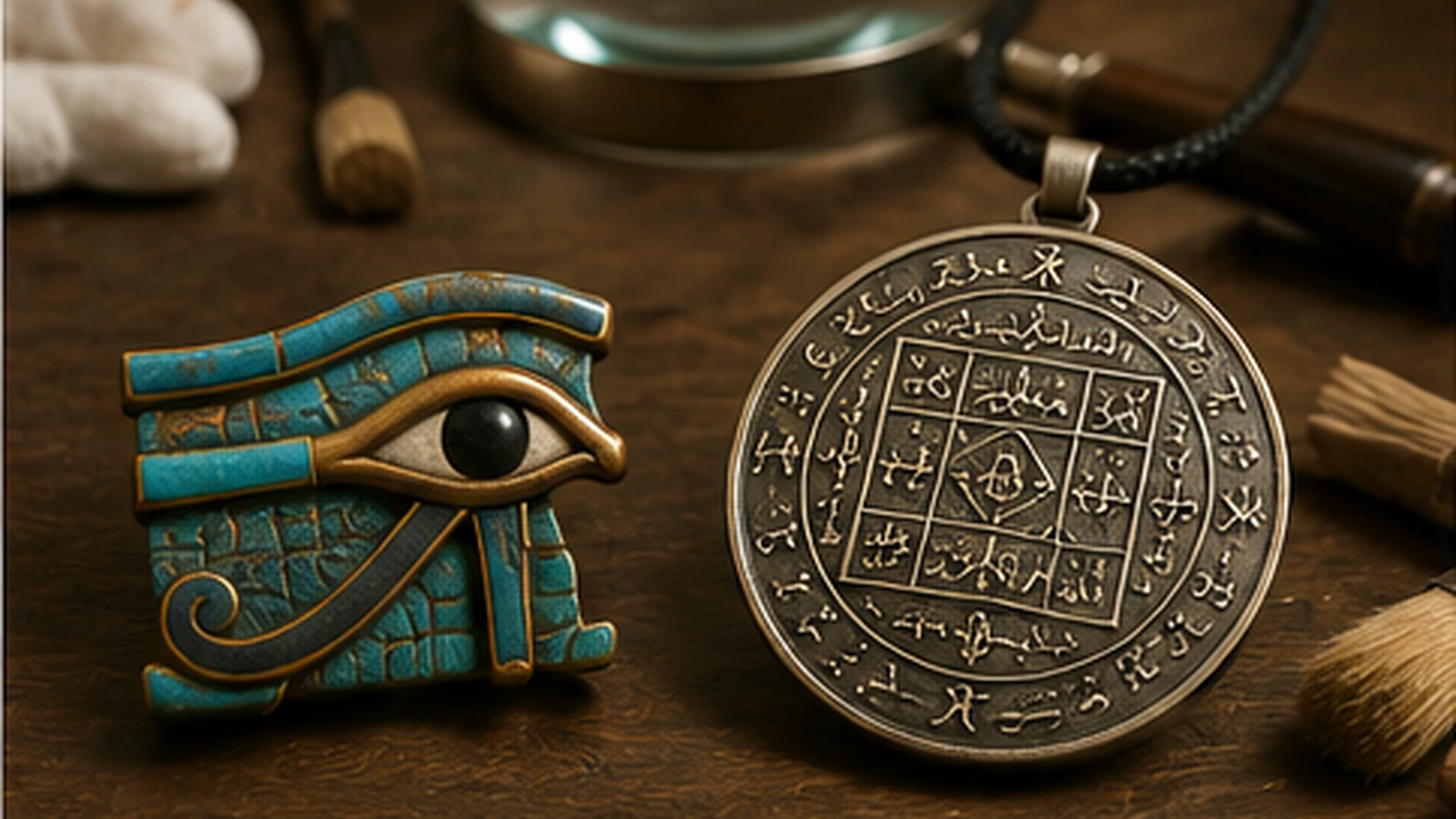
An amulet is usually understood as a portable or placed object intended to protect a person, animal, home or body from danger, illness, misfortune or unwanted influence. A talisman is usually an object intentionally made, selected or consecrated for a particular effect. In practice, the categories overlap, and one object may be described as both.
Specific culture or historical context: Comparative material-culture study; the objects should not be claimed as belonging to one single ritual system.
People shown: No full person; only optional gloved conservator hands at the margins.
Location: Museum conservation or collections-study room.
Clothing: Neutral conservation gloves only.
Architecture: Modern museum work surface with archival storage visible softly in the background.
Objects: Faience eye amulet, inscribed metal disc, magnifying lens, soft brush, archival support pads.
Lighting: Soft controlled daylight with accurate material texture and restrained highlights.
Composition: 16:9 landscape; amulet on the left, talisman on the right, open central space for website cropping; both objects equally important.
SEO-friendly filename: amulet-vs-talisman-meaning-differences-uses.webp
Image title: Amulet and Talisman Compared Through Material Culture
Alt text: Ancient-style protective amulet beside an inscribed talisman on a museum study table
Caption: The words amulet and talisman often overlap, but purpose, preparation and cultural context can help explain how an object was understood.
Recommended placement: Immediately after the Quick Answer.
Article section supported: Core definition and comparison.
Important elements to avoid: Fantasy glow, random occult symbols, pentagrams added without context, readable labels, logos, text, hands touching fragile objects without gloves, or implying both pieces come from one culture.
What Is an Amulet?
An amulet is a small or portable object that a person or community understands as protective, beneficial or spiritually effective. It may be worn on the body, carried in a pouch, placed in a house, attached to an animal, set near a doorway or deposited with the dead. The Metropolitan Museum of Art defines an ancient Egyptian amulet as an object believed to possess positive properties that could be bestowed on its owner.[3]
Protection is the most common feature in modern definitions. An amulet may be intended to avert illness, accident, envy, unwanted spiritual influence, infertility, danger in childbirth, military harm or bad fortune. Yet protection can also include restoration, renewal, identity, blessing and safe passage. An Egyptian scarab, for example, did not have exactly the same meaning as a hand-shaped North African pendant or a European healing object.
The word describes a function, not one universal shape. Amulets have been made from stone, metal, shell, bone, plant material, textile, paper, parchment, glass, ceramic and manufactured materials. Some are plain natural objects. Others are carved, painted, stamped, inscribed, prayed over, blessed, wrapped, sealed or combined with other materials.[4]
Amulet Meaning in Simple Words
An amulet is an object people keep close because they believe it offers protection or beneficial support. It may be jewelry, a written text, a stone, a small figure, a packet, a textile or another meaningful item. Its significance comes from a particular tradition, community or personal history—not from its appearance alone.
What Is a Talisman?
A talisman is usually an object intentionally made, selected, inscribed or consecrated for a specific purpose. That purpose may be protective, but it may also involve victory, authority, fertility, courage, prosperity, healing, safe travel or another desired outcome. The English word ultimately passed through Arabic and European languages from Greek terms connected with completion, ritual performance or consecration.[5]
Talismans are often associated with deliberate preparation. A maker may choose a material, image, sacred name, prayer, number, diagram, astrological timing or ritual procedure because it is considered appropriate to the intended result. Historical talismans include inscribed stones and metals, manuscript pages, textiles, garments, seals, diagrams and portable sacred texts.
The word talismanic can also describe an object’s function without making “talisman” its only correct name. A museum may call a garment talismanic because sacred names and texts were believed to protect its wearer, while another source might describe a small manuscript used in the same setting as an amulet.[6]
Talisman Meaning in Simple Words
A talisman is an object prepared or valued for a particular beneficial purpose. It may be believed to protect, strengthen, attract good fortune, support authority or help a person pursue a goal. Unlike a manufactured product with a scientifically measurable mechanism, its claimed efficacy belongs to religious, spiritual, magical or cultural belief.
Amulet vs Talisman: The Main Difference
The most useful short comparison is this:
| Feature | Amulet | Talisman |
|---|---|---|
| Usual emphasis | Protection, prevention or safeguarding | A specific intended effect or benefit |
| Common action word | Wards off, guards, shields or preserves | Brings, supports, empowers, attracts or accomplishes |
| Preparation | May be naturally meaningful, inherited, blessed or manufactured | Often deliberately designed, inscribed, selected or consecrated |
| Form | Jewelry, packet, stone, figure, text, textile or placed object | Inscribed object, seal, diagram, garment, manuscript, jewelry or prepared object |
| Can it protect? | Usually yes | Yes; many talismans are protective |
| Can it seek a positive benefit? | Sometimes | Commonly |
| Are the labels universal? | No | No |
A modern practitioner may summarize the distinction as “an amulet repels harm; a talisman draws or directs benefit.” This works as a memory aid, not as a rule that can be imposed on every historical object. Dictionary definitions themselves overlap, museum labels vary, and communities may use local words that do not divide neatly into the two English categories.[2][4]
Why the Difference Is Not Absolute
The difference becomes uncertain for three main reasons.
First, protection is itself a positive result. A shirt covered with sacred names may be intended to preserve a warrior from danger. Is that an amulet because it protects, or a talisman because it was deliberately inscribed and prepared? Historical sources may use either description.
Second, many objects have more than one purpose. A pendant may protect against envy, mark religious identity, remember a family member and display skilled craftsmanship. A scroll may combine prayer, image, diagnosis, healing and personal dedication.
Third, English museum vocabulary is translated and inherited. Collectors sometimes classified unfamiliar objects according to European categories. The Science Museum’s research on amulets warns that their status, function and meaning are not fixed; the same object can acquire different interpretations through use, ownership and collection history.[4]
For accurate writing, begin with the community’s own name for the object and then explain why English-language sources call it an amulet, talisman, charm, protective text or ritual object.
Where the Words Come From
Amulet entered English through Latin *amuletum*, whose deeper origin is uncertain. Modern dictionaries usually define it as a charm worn or kept to aid or protect its owner.[7]
Talisman entered English in the seventeenth century through French, Spanish or Italian forms connected with Arabic *ṭilsam* and Greek *telesma*. The Greek history of the word involved completion, performance, initiation or consecration. Historical scholarship shows that the word’s path and meanings changed over time; it did not begin as a simple universal opposite of “amulet.”[5]
The French Search Console wording “talisman versus amulette différences” is most naturally answered as: “Quelle est la différence entre un talisman et une amulette?” In French, as in English, an *amulette* is usually described as protective, while a *talisman* is often associated with a specific beneficial effect. The overlap still needs to be explained.
How Amulets and Talismans Gain Meaning
An object does not become culturally important merely because it resembles a symbol found online. Its status may depend on a combination of factors:
1. Material: A stone, metal, color, plant, shell, textile or animal-derived material may carry inherited associations.
2. Form: The object may depict a deity, body part, animal, sacred sign, hand, eye, cross, geometric pattern or written name.
3. Words and inscriptions: Prayers, sacred names, verses, numbers or formulas may be central.
4. Making: A recognized artisan, cleric, healer, scribe, priest, shrine or family elder may prepare it.
5. Timing and ritual: Some traditions specify a blessing, consecration, astrological calculation, pilgrimage or liturgical occasion.
6. Placement: Meaning changes when an object is worn on the chest, hidden in clothing, hung over a doorway, placed in a grave or kept on an altar.
7. Ownership and biography: Inheritance, pilgrimage, survival, gift exchange and family memory can transform an ordinary object into a personally powerful one.
8. Community recognition: The maker and user must understand what the object is; visual resemblance alone is insufficient.
This material approach is important in the academic study of religion because objects help people enact identity, devotion, protection and memory rather than simply illustrating written doctrines.[1]
Traditional Uses of Amulets and Talismans
Protection and the Averting of Harm
The most widespread use is protection. Objects may be carried against the evil eye, disease, hostile forces, accident, warfare, dangerous travel or spiritual attack. The British Museum records hand-shaped pendants from Morocco and Gaza that were used as amulets against the “eye of envy,” and notes that related forms circulated among both Muslim and Jewish communities in the Middle East and North Africa.[8]
Healing and Bodily Well-Being
Amulets have an important place in the history of healing. They were used alongside prayer, domestic remedies, learned medicine and religious practice. A historical healing object should not be dismissed as irrational, but neither should its traditional claim be confused with scientifically demonstrated treatment. The Science Museum emphasizes that amulets reveal how protection and healing were understood across changing social and medical worlds.[4]
Childbirth, Fertility and Childhood
Many traditions used wearable or household objects during pregnancy, birth and childhood. Specific forms could be connected with maternal deities, saints, protective prayers or family customs. These practices varied by period and region. They should never be used to promise pregnancy, a safe birth or medical recovery.
Travel, Warfare and Authority
Portable texts, inscribed armor and talismanic garments were carried in contexts of danger. The Metropolitan Museum describes a fifteenth- or early-sixteenth-century talismanic shirt from northern India or the Deccan covered with the Qur’an and divine names; it was believed to offer protection and may have been worn under armor.[6] A tiny seventeenth-century Qur’an could likewise be worn or attached to a military standard as an amuletic and devotional object.[9]
Fortune, Success and Desired Outcomes
Some talismans are associated with luck, prosperity, victory, eloquence, love, fertility or social authority. The specific aim may be expressed through material, inscription, planetary symbolism or a consecration process. Historical evidence does not support treating all “success talismans” as interchangeable products.
Memory, Identity and Belonging
An inherited pendant, pilgrimage token or family object may function talismanically because it embodies continuity and emotional security. Its importance can be social and psychological even when the owner does not claim supernatural efficacy.
Historical and Cultural Examples
The examples below show why “amulet versus talisman” cannot be answered without context.
Ancient Egyptian Amulets
Ancient Egyptians produced a vast range of amulets for the living and the dead. Forms included the wedjat eye, scarab, djed pillar, deities, animals, body parts and sacred signs. The object’s form, material, color, inscription and placement contributed to its intended qualities. Faience was especially important because its luminous blue-green appearance could evoke life, regeneration and divine associations.[3]
An amulet might be worn as jewelry, wrapped into a mummy, placed at a vulnerable part of the body or included in a larger necklace. The British Museum’s two-finger funerary amulet, for example, was associated with the embalming incision and may have been intended to protect that vulnerable area.[10]
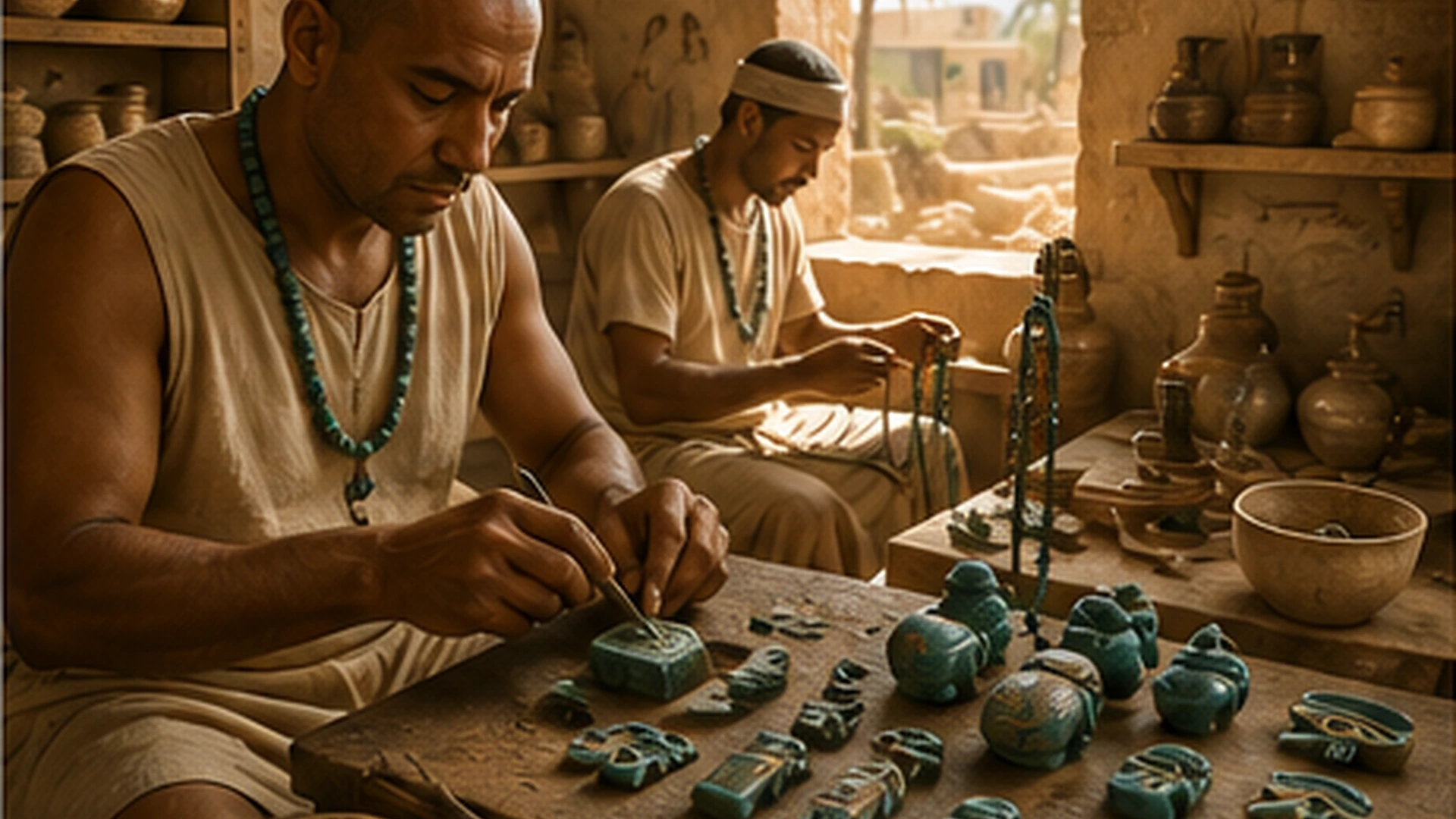
Specific culture or historical context: Ancient Egypt, preferably New Kingdom to Late Period workshop context, represented as a careful reconstruction rather than a documented single event.
People shown: Black/Northeast African Egyptian adults; no stereotyped royal costumes.
Location: Mud-brick workshop near an Egyptian settlement.
Clothing: Historically plausible linen garments and simple sandals.
Architecture: Mud-brick walls, reed shade, ceramic bowls, wooden tools and low work surfaces.
Objects: Faience materials, molds, cords, small amulets, ceramic bowls and hand tools.
Lighting: Warm indirect daylight with realistic workshop shadows.
Composition: Wide documentary view; artisan and workbench in the foreground, workshop context behind.
SEO-friendly filename: ancient-egyptian-amulet-workshop.webp
Image title: Ancient Egyptian Amulet Craft and Materials
Alt text: Ancient Egyptian artisans making blue-green faience amulets in a workshop
Caption: Ancient Egyptian amulets gained meaning through form, color, material, inscriptions, spoken words and placement on the living or the dead.
Recommended placement: After the ancient Egypt example.
Article section supported: Historical use, materials and manufacture.
Important elements to avoid: Pyramids inside the workshop, fantasy magic effects, modern tools, mixed eras, pharaoh cosplay, inaccurate hieroglyphs, text or logos.
North African and Levantine Khamsa Amulets
Hand-shaped pendants are widely recognized in North Africa and the Middle East, but their names, designs and religious associations differ. The Arabic word *khamsa* means “five.” The British Museum describes examples from Morocco and Gaza as amulets connected with protection from the evil eye or “eye of envy,” used across Muslim and Jewish settings.[8]
It is better to identify a particular object by place, date, maker and community than to claim that every hand-shaped symbol has one origin or one fixed meaning. Modern commercial jewelry may borrow the form without preserving the full local history.
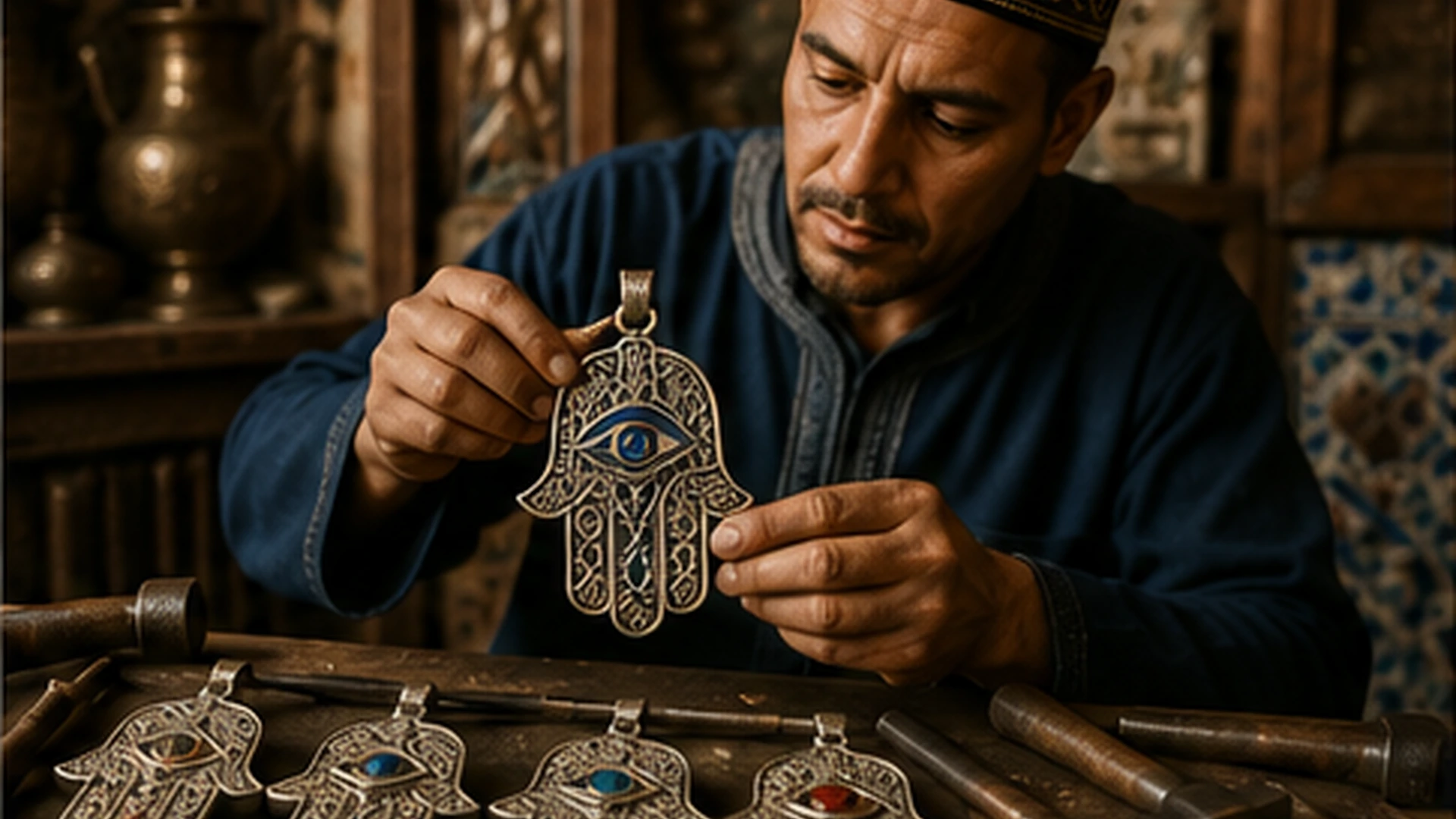
Specific culture or historical context: Moroccan hand-shaped amuletic jewelry associated historically with protection from the evil eye and used in Muslim and Jewish communities, with regional variation.
People shown: One or two Moroccan/North African adults.
Location: Traditional metalworking quarter in Morocco.
Clothing: Contemporary modest artisan clothing with practical apron.
Architecture: Plaster walls, wood shelving, traditional workshop doorway and metalworking bench.
Objects: Silver khamsa pendants, enamel pieces, small hammer, files and cloth pads.
Lighting: Natural side light with warm metal reflections.
Composition: Three-quarter workshop view; artisan on one side, pendant and tools clearly visible in the foreground.
SEO-friendly filename: moroccan-khamsa-hand-amulet-workshop.webp
Image title: Moroccan Khamsa Amulets and Metalwork
Alt text: Moroccan artisan examining a silver khamsa hand amulet in a metalworking shop
Caption: Hand-shaped amulets in North Africa and the Levant have long been associated with protection, but their names and meanings vary across communities.
Recommended placement: After the khamsa example.
Article section supported: Protective amulets, jewelry and cross-community histories.
Important elements to avoid: Calling every hand symbol the same name, invented Arabic text, generic desert scenery, fantasy glow, mixed clothing, tourist staging, logos or readable shop signs.
Islamic Talismanic Shirts and Portable Texts
Islamic art includes many objects described as talismanic, but there is no single Islamic view that all Muslims share. Historical garments could combine Qur’anic text, divine names, number squares, diagrams and prayers. The Met’s talismanic shirt attributed to northern India or the Deccan contains the Qur’an and the ninety-nine names of God and was believed to offer protection.[6]
Portable Qur’an manuscripts could also serve devotional and protective roles. One miniature manuscript in the Met’s collection was designed to fit inside a pendant or pouch and could be worn, attached to a standard or fixed to a ceremonial object.[9] These objects should be interpreted through Islamic art history and the beliefs of their makers and users, not through generic “occult” language.
Ethiopian Healing Scrolls
Ethiopian healing scrolls provide an important African example in which the word talisman appears inside a specific manuscript tradition. Scrolls made among Amhara and Tigrinya communities could combine Ge’ez prayers with images of saints, angels, eyes and geometric “nets.” They were prepared by a *däbtära*, an unordained cleric and learned specialist, for an individual client.[11]
The Met explains that portable scrolls could be rolled into leather cases and worn around the neck or shoulder, while larger examples might be hung in a household. Their design, prayers and dimensions could be customized, and interpretations varied by region and specialist.[11]
This history must be approached carefully. The scrolls belong to complex Ethiopian Christian, medical and manuscript traditions and have also been criticized by political and ecclesiastical authorities. They should not be reduced to “African magic,” copied as decorative motifs or treated as a substitute for medical care.
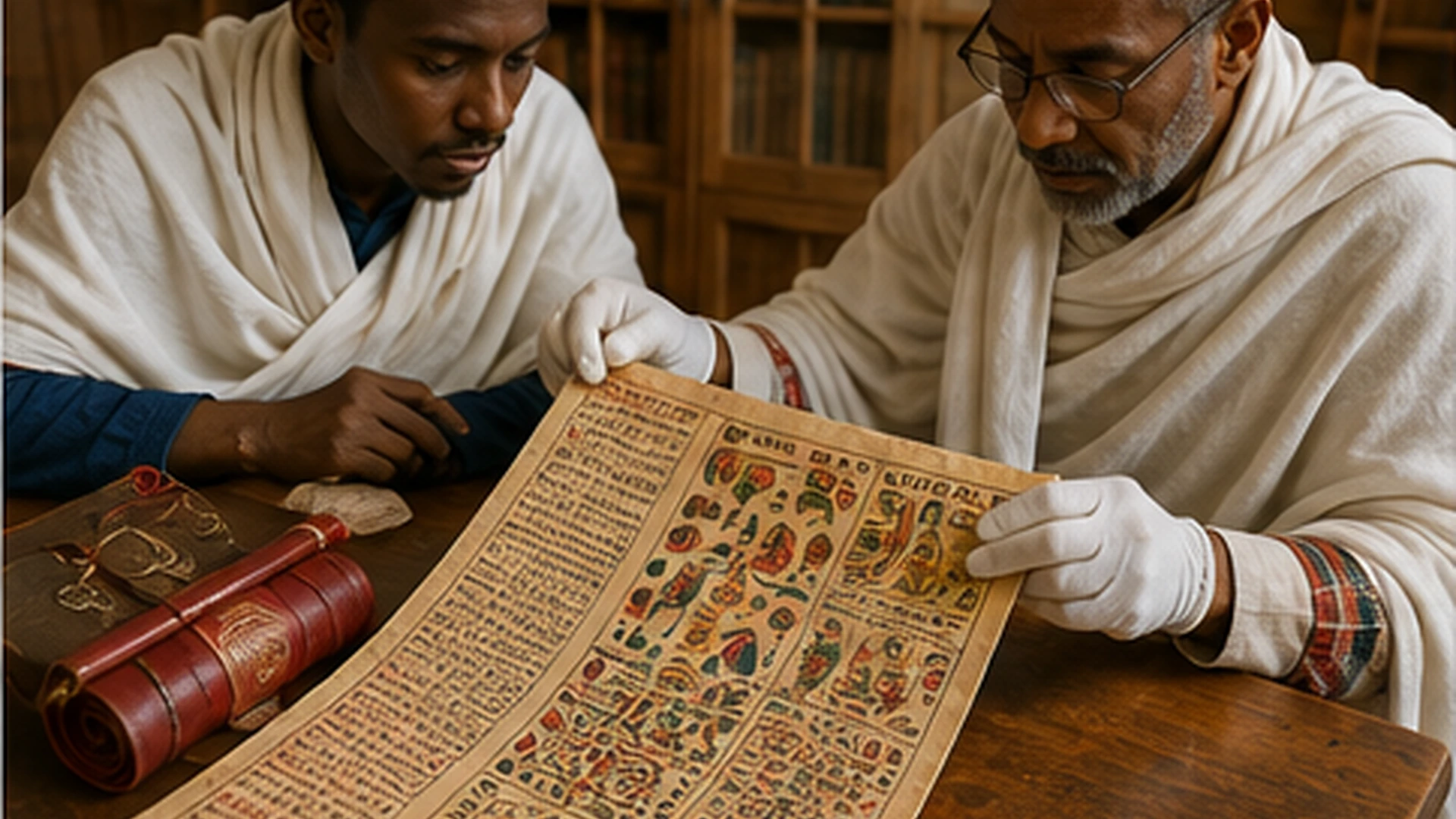
Specific culture or historical context: Ethiopian Amhara or Tigrinya healing-scroll tradition, presented as manuscript heritage with regional and historical variation.
People shown: Two Ethiopian adults, including at least one manuscript or heritage specialist.
Location: Ethiopian museum, monastery library study room or conservation laboratory.
Clothing: Contemporary professional clothing; optional white cotton shawl worn naturally.
Architecture: Simple manuscript-study room with wood shelves and archival materials.
Objects: Parchment scroll, archival supports, red leather case, soft weights, notebook and gloves where appropriate.
Lighting: Soft diffuse indoor light that protects the manuscript and preserves detail.
Composition: Wide table-level scene with the scroll leading across the frame; people shown in thoughtful study, not spectacle.
SEO-friendly filename: ethiopian-healing-scroll-talisman-study.webp
Image title: Ethiopian Healing Scroll as Talismanic Heritage
Alt text: Ethiopian specialists studying a parchment healing scroll with talismanic imagery
Caption: Ethiopian healing scrolls combine prayers, manuscript art, personal dedication and protective purpose within specific Amhara and Tigrinya histories.
Recommended placement: After the Ethiopian healing-scroll example.
Article section supported: African talismanic traditions, inscription and customization.
Important elements to avoid: Invented active ritual, blood, animal sacrifice, demon spectacle, fake readable Ge’ez, generic “African magic” styling, mixed cultures, text or logos.
Japanese Omamori and Ofuda
Japanese shrine and temple objects also demonstrate the limits of English labels. Omamori are small protective packets commonly obtained at Shinto shrines and Buddhist temples. Ofuda are paper or wooden sacred inscriptions generally installed in a home or another appropriate place. English museums and writers may call these objects amulets or talismans, but the Japanese terms identify distinct forms and practices.
A peer-reviewed study of the Náprstek Museum’s Japanese collection describes shrine and temple objects, pilgrimage souvenirs, *omamori*, *ofuda* and related forms under both “amulet” and “talisman.”[12] Responsible explanation should preserve the original terms, identify whether the setting is Shinto, Buddhist or mixed, and avoid opening sealed packets or inventing translations.
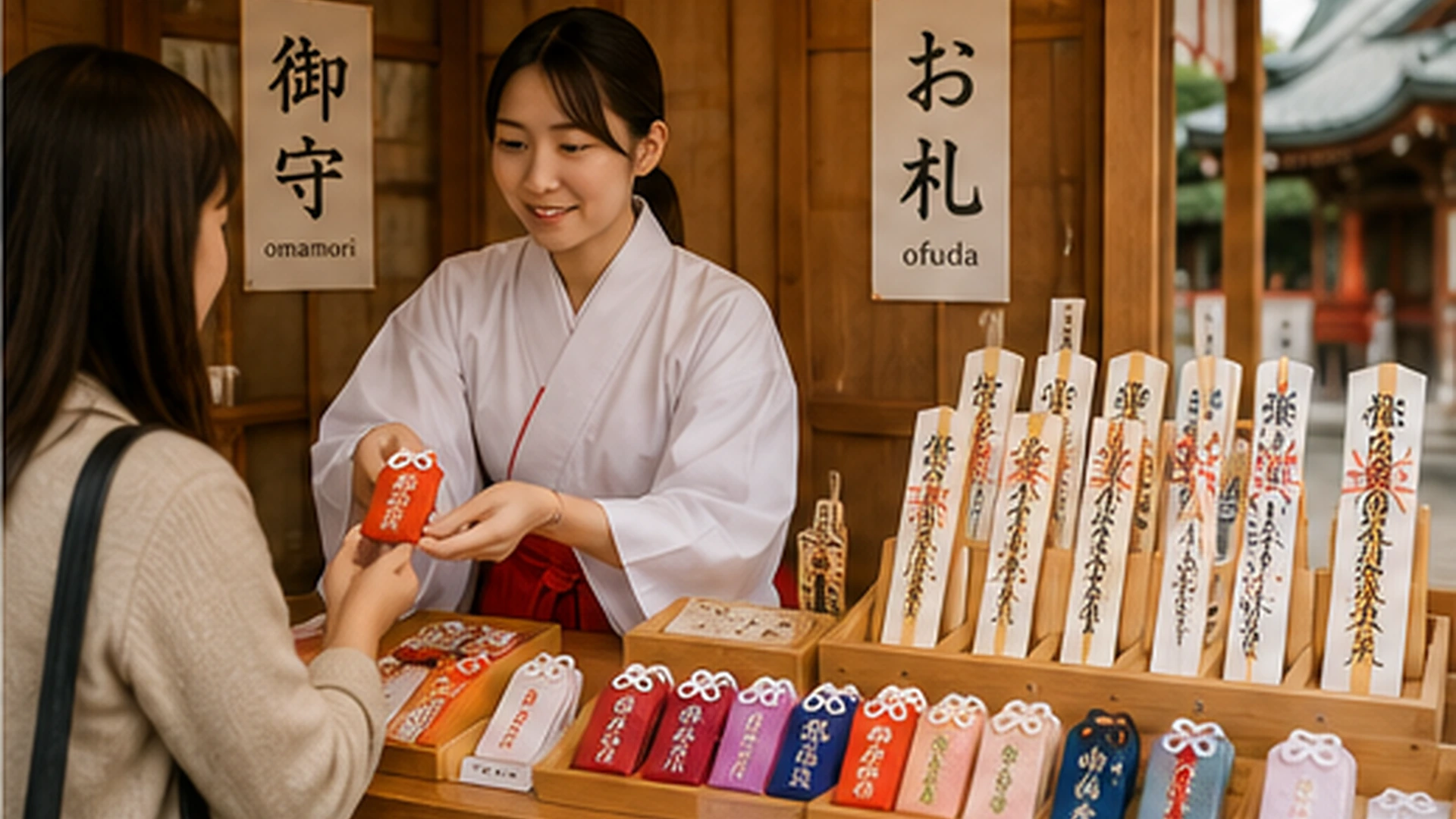
Specific culture or historical context: Contemporary Japanese shrine practice; omamori and ofuda should not be treated as identical objects, and English labels vary.
People shown: Japanese adults only; one attendant and one or two visitors.
Location: Recognizable but non-branded Shinto shrine counter in Japan.
Clothing: Accurate shrine-attendant clothing and modest contemporary visitor clothing.
Architecture: Wooden shrine counter, lattice details and natural courtyard beyond.
Objects: Fabric omamori, paper or wooden ofuda, small trays and wrapping materials; no readable invented Japanese text.
Lighting: Clean natural daylight with soft wood tones.
Composition: Wide counter view with objects in the foreground and human exchange in the middle ground.
SEO-friendly filename: japanese-omamori-ofuda-shrine.webp
Image title: Japanese Omamori and Ofuda at a Shrine
Alt text: Japanese shrine attendant presenting an omamori beside arranged ofuda and protective objects
Caption: Japanese shrine objects show why English words such as amulet and talisman are translations rather than perfect universal categories.
Recommended placement: After the Japanese example.
Article section supported: Cross-cultural terminology and living traditions.
Important elements to avoid: Anime styling, fantasy effects, mixed Buddhist and Shinto architecture without context, fake large characters, tourist selfies, logos or text.
European Healing Amulets
European amulets ranged from stones, animal materials and plants to inscribed metals, printed papers and manufactured objects. They were worn on bodies, attached to buildings or kept in domestic spaces. Some were associated with saints or scripture; others with astrology, luck, vernacular medicine or local custom.
The Science Museum’s study of ten objects stresses that amulets changed meaning through the Reformation, changing medical systems, collecting practices and secular ideas of luck. The category is historically diverse, not a single survival from a supposedly “primitive” past.[4]
Can One Object Be Both an Amulet and a Talisman?
Yes. An inscribed pendant may be amuletic because it protects and talismanic because it was deliberately made for that purpose. A healing scroll can be worn protectively while also containing personalized prayers and diagrams. A talismanic shirt can aim to avert harm and secure courage or victory.
When the evidence is uncertain, use precise wording:
“A pendant used as a protective amulet.”
“An inscribed object with talismanic functions.”
“A manuscript described by the museum as both devotional and amuletic.”
“A local object often translated into English as an amulet.”
This is more accurate than forcing every object into a rigid binary.
Amulet, Talisman, Charm, Relic and Mascot
| Term | Usual meaning | Important caution |
|---|---|---|
| Amulet | Object kept or worn for protection or beneficial support | May also seek healing, renewal or blessing |
| Talisman | Object prepared or valued for a specific intended effect | Protection can be one of those effects |
| Charm | Broad word for a meaningful object or a spoken/written formula | Usage varies widely in popular religion and magic |
| Relic | Physical remains of a holy person or object associated with a sacred figure or event | Authority comes from relationship to holiness, not simply “magic” |
| Votive object | Offering given in fulfillment of a vow, petition or thanksgiving | Not necessarily worn or carried |
| Mascot | Figure or object representing a group and associated with identity or luck | Usually secular in modern use, though histories may overlap |
| Souvenir | Object acquired as a reminder of travel or pilgrimage | It becomes amuletic only if users assign that function |
The same physical item can move between categories during its life. A pilgrimage medal may begin as a devotional souvenir, become a family heirloom and later be treated as a protective amulet.
Common Misunderstandings
“Amulets Only Repel and Talismans Only Attract”
Too rigid. It is a helpful modern summary, but protective talismans and benefit-seeking amulets are historically common.
“Every Culture Has the Same Amulet System”
False. Similar shapes do not prove identical origins, meanings or rituals.
“Any Symbol Printed on Jewelry Becomes an Amulet”
Not automatically. A community’s recognition, the object’s biography and the owner’s use matter.
“Ancient Objects Have One Fixed Meaning”
False. Archaeological context may be incomplete, and one form can change meaning across centuries.
“A Museum Label Is the Community’s Own Word”
Not always. Labels may be translations or classifications developed by collectors and scholars.
“Amulets and Talismans Guarantee Protection, Healing or Wealth”
No. They can hold religious, cultural, emotional or artistic significance, but supernatural, medical and financial outcomes cannot be guaranteed.
Scientific and Ethical Limits
The historical fact that people trusted an object does not scientifically prove the object caused recovery, prevented an accident or produced wealth. Academic religious studies describes beliefs, practices and institutions without deciding that supernatural claims are true.[13]
Amulets and talismans should not replace:
medical diagnosis, vaccination, prescribed treatment or emergency care;
legal advice, safety planning or reporting a threat;
financial planning, risk assessment or lawful business practice;
responsible contraception, fertility care or prenatal care;
practical travel preparation and security precautions.
Ethically, sellers and practitioners should avoid guaranteed outcomes, fear-based sales, false antiquities, stolen sacred objects and claims that a generic product is “authentic” to a community without provenance.
How to Study an Amulet or Talisman Responsibly
1. Record the object’s local name before applying an English category.
2. Identify the maker, user, place, date and religious or cultural setting.
3. Separate archaeological evidence from later folklore or modern marketing.
4. Examine material, inscriptions, wear, repairs, placement and ownership history.
5. Consult community custodians and specialists where living traditions are involved.
6. Do not open sealed objects, photograph restricted contents or reproduce sacred formulas without permission.
7. Check provenance and the possibility of colonial removal, grave looting or illicit trade.
8. Describe claimed effects as beliefs, not guaranteed facts.
9. Avoid mixing Egyptian, Moroccan, Ethiopian, Japanese and other traditions into one invented “universal ritual.”
10. Use respectful comparisons that preserve difference as well as similarity.
Key Takeaways
An amulet is usually associated with protection or safeguarding.
A talisman is usually prepared or valued for a specific intended effect.
The distinction is useful but not universal.
Many objects can be both amuletic and talismanic.
Material, inscription, maker, ritual, placement and ownership shape meaning.
Ancient Egyptian amulets, Moroccan khamsas, Islamic talismanic shirts, Ethiopian healing scrolls and Japanese omamori belong to distinct traditions.
Museum labels are scholarly tools, not perfect translations of every community’s vocabulary.
Cultural importance does not establish scientifically guaranteed protection, healing, fertility or financial success.
People Also Ask
What is the main difference between an amulet and a talisman?
An amulet is usually intended to guard against harm, while a talisman is usually prepared for a specific desired effect. Historical usage overlaps, so one object can be both.
Are amulets and talismans the same thing?
They are closely related categories and are often used as synonyms. The difference depends on the period, language, museum and living tradition.
What does an amulet mean?
An amulet is an object worn, carried or placed because people believe it protects or supports its owner, household, animal or body.
What is a talisman used for?
A talisman may be prepared for protection, courage, success, healing, authority, safe travel, good fortune or another defined aim.
Can jewelry be an amulet or talisman?
Yes. Rings, necklaces, pendants and bracelets can serve those functions, but appearance alone does not establish cultural meaning.
Is a lucky charm an amulet?
Sometimes. “Charm” is a broad everyday term. A lucky object may be called an amulet or talisman depending on its purpose and tradition.
Quelle est la différence entre un talisman et une amulette?
Une amulette est généralement portée pour protéger, tandis qu’un talisman est souvent préparé pour produire un effet bénéfique précis. Cependant, les deux termes peuvent se chevaucher selon la tradition.
Are amulets and talismans scientifically proven?
Their cultural and religious importance is well documented, but claims of supernatural protection or guaranteed material results are not scientifically established.
Frequently Asked Questions
1. Do amulets have to be worn?
No. They may be carried, hidden in clothing, attached to an animal, hung in a house, placed near a doorway or deposited in a burial.
2. Does a talisman have to contain writing?
No. Many are inscribed, but materials, images, shape, making and consecration can also be central.
3. Can a natural stone be an amulet?
Yes, when a community or owner assigns it a protective or beneficial role. The stone’s geological properties alone do not establish that cultural function.
4. Is the evil-eye symbol an amulet or a talisman?
It may be described as an amulet because it is commonly used protectively. Local names and histories should be used rather than assuming every eye-shaped object is identical.
5. Is a cross an amulet?
A cross may be devotional jewelry, a marker of Christian identity, a liturgical object, a relic container or an amulet, depending on context and use.
6. Are scarabs always amulets?
Many ancient Egyptian scarabs had amuletic functions, but scarab-shaped seals and administrative objects also existed. Archaeological context matters.
7. Can an amulet lose its meaning?
Meaning can change when an object is inherited, sold, removed from its ritual setting, placed in a museum or reproduced commercially.
8. Should old amulets be cleaned?
Historic objects should be assessed by a qualified conservator. Cleaning can remove inscriptions, residues, fibers or evidence of use.
9. Can I copy a talismanic inscription from a museum object?
Public visibility does not automatically make a formula appropriate for ritual copying. Check the object’s context, community restrictions and intellectual-property or cultural-property concerns.
10. Can amulets replace medicine?
No. They may provide cultural, devotional or emotional support, but they should not replace qualified medical care.
Conclusion
The clearest answer to amulet vs talisman is that an amulet usually protects, while a talisman is usually prepared for a particular effect. The deeper answer is that the two categories overlap. Historical objects rarely obey a modern dictionary rule without exception.
A careful interpretation asks more than “What symbol is this?” It asks who made the object, what it was called, what materials and words it carried, where it was placed, how it moved through families or institutions and what its community believed it was meant to do. That approach respects ancient Egyptian, North African, Ethiopian, Islamic, Japanese, European and other traditions without flattening them into a single system.
Final Summary
Amulets and talismans are forms of material religion and cultural memory. Amulets are commonly protective; talismans commonly pursue a defined benefit; and many objects do both. Their meanings are historically specific, culturally negotiated and sometimes uncertain. They can be studied as art, archaeology, devotion, healing history, identity and belief, but their claimed supernatural, medical or financial effects should never be presented as guaranteed.
Research Sources and Further Reading
1. Jay Johnston, “Objects and Ancient Religions,” Oxford Research Encyclopedia of Religion, Oxford University Press.
2. Jay Johnston, Amulets in Magical Practice, Cambridge University Press, 2024.
3. Isabel Stünkel, “Ancient Egyptian Amulets,” The Metropolitan Museum of Art.
4. Annie Thwaite, “A History of Amulets in Ten Objects,” Science Museum Group Journal, 2019.
5. Clare Anderson, “The Science of Talismans Today,” History Compass, 2023.
6. “Talismanic Shirt,” The Metropolitan Museum of Art, attributed to Northern India or the Deccan, 15th–early 16th century.
7. Merriam-Webster Dictionary entries for “amulet” and “talisman.”
8. British Museum collection records for hand-shaped amuletic pendants from Morocco and Gaza.
9. “Portable Qur’an Manuscript,” The Metropolitan Museum of Art, 17th century.
10. “Two-finger Amulet,” British Museum, ancient Egypt.
11. Kristen Windmuller-Luna, “Ethiopian Healing Scrolls,” The Metropolitan Museum of Art.
12. Alice Kraemerová, “Talisman and Amulets in the Japanese Collection,” Annals of the Náprstek Museum 35(1), 2014.
13. University of Alabama Department of Religious Studies, “What Is the Academic Study of Religion?”
5. Recommended Internal Links
| Anchor text | Target URL | Best placement | Purpose |
|---|---|---|---|
| Protective Necklaces | https://ancestraltemple.com/blog/protective-necklaces | Use after discussion of wearable amulets and jewelry | Strengthens the wearable-protection cluster without duplicating the comparison intent |
| Spiritual Symbols Shared Worldwide | https://ancestraltemple.com/blog/spiritual-symbols-shared-worldwide | Use in the section on symbols and cultural variation | Supports the warning that similar forms do not always share one meaning |
| Spiritual Traditions of Ancient Egypt | https://ancestraltemple.com/blog/spiritual-traditions-of-ancient-egypt | Use in the ancient Egyptian examples section | Connects amulets to a broader historical and religious context |
| What Is Astrology? | https://ancestraltemple.com/blog/what-is-astrology | Use when discussing astrological timing and talismanic preparation | Explains historical astrology without validating guaranteed outcomes |
| What Is Spiritual Cleansing? A Cultural Overview | https://ancestraltemple.com/blog/what-is-spiritual-cleansing-cultural-overview | Use in the ethics and cultural-context section | Distinguishes portable objects from broader cleansing practices |
6. Glossary
| Term | Definition |
|---|---|
| Amulet | An object worn, carried or placed because it is believed to protect or provide beneficial support. |
| Talisman | An object intentionally made, selected, inscribed or consecrated for a particular effect. |
| Amuletic | Having the function or character of an amulet. |
| Talismanic | Having the function or character of a talisman. |
| Apotropaic | Intended to avert, repel or guard against harm or unwanted influence. |
| Consecration | A ritual act that dedicates an object, place or person to a sacred purpose. |
| Material religion | The study of how objects, bodies, spaces, images and sensory practices participate in religion. |
| Khamsa | A hand-shaped form whose Arabic name means “five,” used in varied North African and Middle Eastern settings. |
| Faience | A glazed non-clay ceramic material widely used for ancient Egyptian amulets and ornaments. |
| Wedjat eye | An ancient Egyptian eye symbol associated with restoration, wholeness and protection. |
| Däbtära | An Ethiopian learned cleric associated historically with church education, manuscript production and traditional healing. |
| Omamori | A Japanese protective packet distributed at Shinto shrines and Buddhist temples. |
| Ofuda | A Japanese paper or wooden sacred inscription installed in a home or appropriate place. |
| Provenance | The documented history of an object’s ownership, excavation, collection and movement. |
| Relic | Physical remains of a holy person or an object associated with a sacred person or event. |
7. Related Articles
What Is an Amulet? Protection, Materials and Cultural Meaning: A dedicated definition page if future Search Console data shows enough distinct demand.
Talismanic Inscriptions: Sacred Names, Seals and Historical Uses: A focused article on writing, diagrams and consecrated objects.
Ancient Egyptian Amulets: Symbols, Materials and Burial Contexts: A deep historical cluster page tied to the Egypt article.
Khamsa Hand Amulets: History, Regional Names and Meanings: A culturally specific North African and Middle Eastern article.
Ethiopian Healing Scrolls: Manuscript Art and Protective Traditions: An Africa-focused heritage article with manuscript scholarship.
Omamori and Ofuda: Protective Objects in Japanese Tradition: A page preserving Japanese terminology rather than forcing English categories.
Charm vs Amulet vs Talisman: How the Terms Overlap: Create only if query demand becomes clearly distinct; otherwise keep as a section on the present page.
How Museums Interpret Sacred and Protective Objects: A methodological article on labels, provenance and cultural authority.
Article Information
- Publisher
- Ancestral Temple
- Editor
- Ancestral Temple
- Last updated
- Jul 26, 2026
- Last reviewed
- Jul 26, 2026
- Content version
- 8ee211126d
This educational article should be read as cultural and spiritual information, not as medical, legal, financial, or emergency advice.
Helpful Related Guidance
Explore This Topic
Related Topic Cluster
Dreams & Symbolism
About the Author
 Ancestral Temple
Spiritual guide and practitioner with decades of experience in ancestral wisdom, rituals, and divine guidance.
Related Posts
View All












Leave a Comment
We'd love to hear your thoughts.