
New-Beginning Rituals
Pillar Article
Quick Summary
New-Beginning Rituals: Spiritual Practices for Change, Renewal and Hope A new-beginning ritual is an intentional action used to mark a transition from one stage of life to another....
New-Beginning Rituals: Spiritual Practices for Change, Renewal and Hope
A new-beginning ritual is an intentional action used to mark a transition from one stage of life to another. It may accompany a new year, baptism, marriage, graduation, relocation, recovery, reconciliation, separation, career change or a private decision to live differently. Depending on the tradition, the ritual may involve water, prayer, light, food, new clothing, public procession, spoken promises, cleaning, planting, music or the support of family and community.
There is no single ritual shared by all cultures, and there is no universal spiritual meaning for every object. Nowruz marks spring and the New Year across communities in parts of Asia and the Middle East. Mangal Shobhajatra in Bangladesh expresses public hope on the Bengali New Year. Ethiopian Timkat commemorates the baptism of Jesus through prayer, procession and blessed water. In Christian teaching more broadly, baptism represents entry into new life. Each practice has its own history, religious meaning and cultural custodians. [1][2][3][4]
A personal ritual can also be created without copying a protected or sacred ceremony. The most responsible form is simple: acknowledge what is changing, choose a value, use a familiar symbol, state an intention, take one practical step and review the commitment later. A ritual can help a person organize emotion and meaning, but it cannot guarantee love, wealth, healing, fertility, protection or success.
Quick Answer
New-beginning rituals are structured symbolic actions that help people acknowledge an ending, cross a life threshold and commit to what comes next. They may use prayer, water, light, writing, cleaning, planting or community witness. Their meanings depend on culture and belief, and they work best when reflection is followed by a realistic action rather than a promise of supernatural results.
What Is a New-Beginning Ritual?
A new-beginning ritual is a deliberately structured act that gives form to change. Ordinary life often moves without a clear dividing line. A person may leave a job on Friday and begin another on Monday, move to a new city without saying goodbye to the old home, or decide to stop a damaging habit without marking the decision. Ritual creates a boundary that says: something has ended, a threshold is being crossed and a new responsibility begins here.
Anthropologists have long studied ceremonies that accompany changes of status. Arnold van Gennep described rites of passage as processes that often involve separation from a previous state, an in-between or transitional stage, and incorporation into a new state. Victor Turner later developed the idea of liminality, the uncertain threshold period in which a person is no longer fully in the old position but has not yet settled into the new one. [5][6]
Not every personal ritual is a formal rite of passage, and not every cultural ceremony follows the same pattern. The model is useful because it explains why beginnings often include three movements:
1. Acknowledging what is ending. This may involve farewell, confession, cleaning, returning an object, removing old clothing or naming a loss.
2. Entering a threshold. The person pauses, prays, waits, fasts, walks, washes, listens or receives instruction.
3. Taking up a new role. This may be expressed through new clothing, a meal, a blessing, a promise, a changed name, community recognition or a concrete responsibility.
The value of a ritual is not determined by how dramatic it looks. A quiet conversation, a written promise and a first action may be more meaningful than an elaborate display copied from social media.
Why People Use Rituals During Change
Change contains uncertainty. Even a desired transition can bring grief, fear and confusion. A new job may require leaving familiar colleagues. Marriage creates joy but also changes obligations. Moving home may open opportunity while breaking daily ties to place. Recovery can involve hope and the loss of a former identity. A ritual can hold these mixed emotions without pretending that the transition is simple.
Ritual Gives Time a Clear Boundary
Calendars provide dates, but dates alone do not always make change emotionally real. A ritual creates a memorable moment: before this action, one condition existed; after it, a new commitment began. This helps explain why communities mark New Year, initiation, marriage, ordination, coronation, graduation and mourning with more than a verbal announcement.
Ritual Makes an Intention Visible
An intention is private until it is expressed through words, objects or action. Washing a doorway, opening a curtain, planting a seed or signing a commitment does not magically cause the desired future. It gives the intention a visible form that can be remembered and discussed.
Ritual Can Involve Witnesses
A transition becomes socially stronger when trusted people recognize it. A family meal, congregation, mentor, elder or close friend can affirm the change and later provide accountability. Community recognition is especially important in formal rites where a person receives a new responsibility or status.
Ritual Can Hold Grief and Hope Together
A beginning is not always a cheerful replacement for what came before. Research on mourning rituals suggests that structured actions may sometimes reduce grief partly by increasing a sense of control, although results from limited studies should not be treated as universal or as a substitute for grief care. [7] A responsible ritual allows the past to be honored instead of demanding instant closure.
New Beginnings Across Cultures: Specific Examples
The examples below show different ways communities mark renewal. They should remain distinct. Combining a spring New Year table, Ethiopian blessed-water rites, Bengali masks and Christian baptism into one invented ceremony would erase their separate histories and meanings.
Nowruz: Spring, New Year and Community Renewal
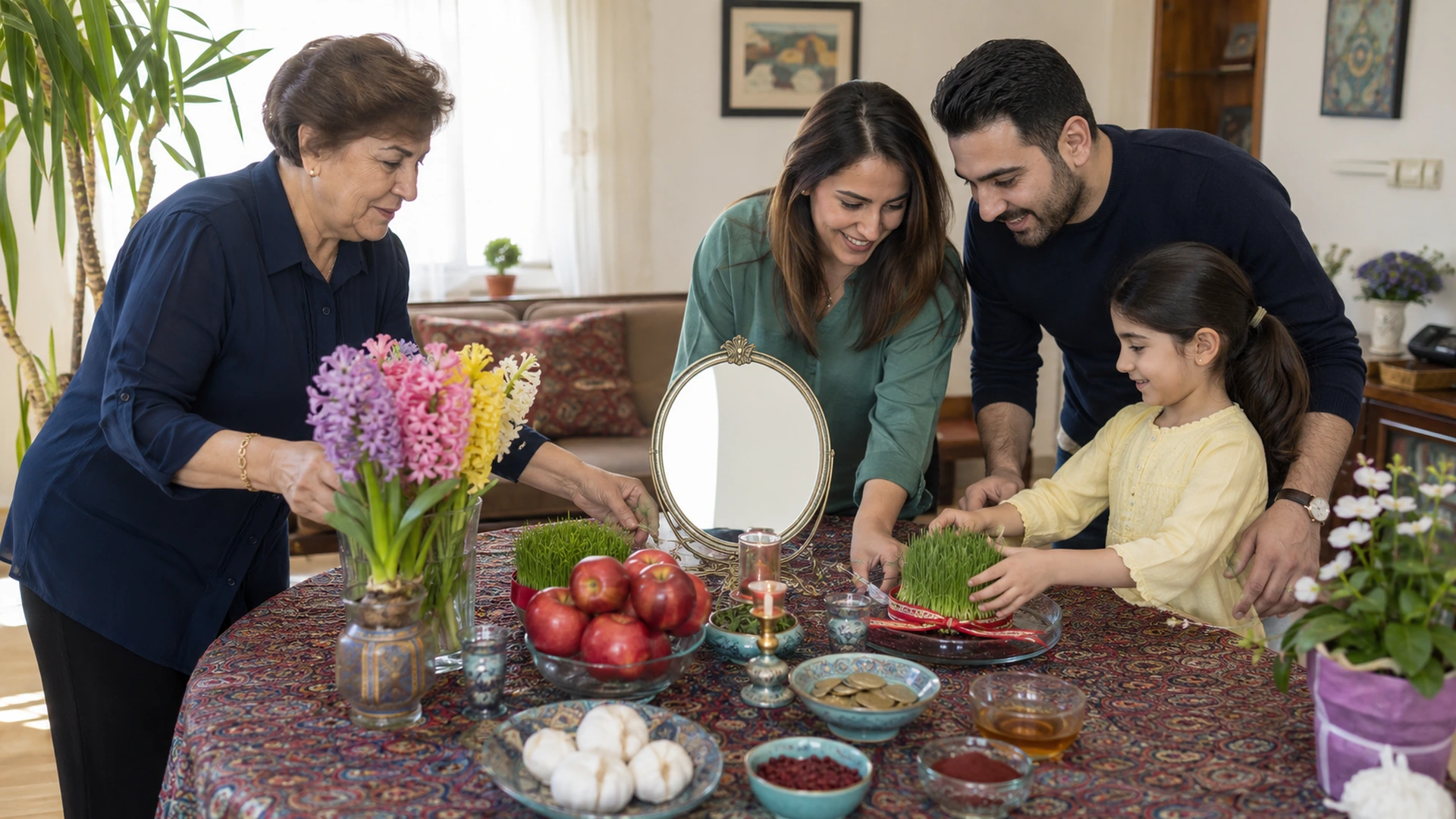
Nowruz is celebrated across a wide geographical area that includes communities in Afghanistan, Azerbaijan, India, Iran, Iraq, Kazakhstan, Kyrgyzstan, Pakistan, Tajikistan, Turkiye, Turkmenistan, Uzbekistan and elsewhere. UNESCO describes it as a New Year and spring celebration associated with the revival of nature, family gatherings, meals, games, music, dance, craftsmanship and the transmission of knowledge between generations. Practices vary substantially from one place to another. [1]
The association with a new beginning comes from several layers: the seasonal return of spring, preparation of the home, family contact, shared food and a renewed social calendar. In some communities, fire, water, decorated eggs, greenery or special tables appear, but no single custom should be presented as mandatory for all Nowruz observers.
Nowruz demonstrates that renewal is not always an individual self-improvement project. It may be agricultural, seasonal, familial and civic. The “new self” is connected to a renewed household and community.
Mangal Shobhajatra: A Public Expression of Hope
Mangal Shobhajatra is a public procession held on Pahela Baishakh, the Bengali New Year, and organized by students and teachers of the Faculty of Fine Art at Dhaka University. UNESCO records that the tradition began in 1989 during military rule as an effort to bring the community hope for a better future. Large artistic forms and masks can symbolize strength, peace and resistance to destructive forces, while the procession promotes solidarity and public participation. [2]
This example is especially important because it shows that a new-beginning ritual can be civic rather than private. Hope is expressed through art, movement and collective presence. It does not deny political difficulty; it answers difficulty with a visible commitment to shared life.
A private reader should not copy the festival’s distinctive masks or claim its history as a personal “manifestation ritual.” The responsible lesson is broader: renewal may involve creating something with others, publicly naming a shared value and choosing solidarity over isolation.
Timkat in Ethiopia: Water, Commemoration and Religious Continuity
Timkat, the Ethiopian Epiphany, commemorates the baptism of Jesus Christ in the River Jordan. UNESCO describes processions in which church tabots are escorted to water, night-long prayer and hymn services, pre-sunrise rites, the sprinkling of blessed water and the return of each tabot to its church. Orthodox clergy and congregations sustain the practice. [3]
It would be inaccurate to describe Timkat simply as a generic “water cleansing ritual.” Its meaning belongs to Ethiopian Orthodox Christianity, and the tabot is sacred. Visitors and image-makers should follow community rules around access and photography.
Within Christian theology, baptism is closely connected to new life, regeneration and entry into the community of faith. The Catholic Catechism, for example, calls baptism the beginning of new life and describes water as signifying purification, death, regeneration and new birth. Other Christian traditions explain baptism through their own theology and forms of practice. [4]

Common Elements in New-Beginning Rituals
No element has one universal meaning, but several patterns appear repeatedly because they help communities express transition.
1. A Threshold in Time or Place
A doorway, riverbank, road, sunrise, first day of a year or first night in a new home can mark the boundary between “before” and “after.” The threshold creates a pause in which the transition can be recognized.
2. Separation or Release
Some rituals begin by removing, returning, washing, confessing, cleaning or saying farewell. Release is not the same as pretending the past never happened. It means deciding what will not be carried forward in the same form.
3. Purification
Water, bathing, clean clothing, swept rooms, fasting or abstention may represent preparation. Purification can be physical, moral, social or religious depending on the tradition. It should not automatically be translated into claims about invisible “toxins” or medical detoxification.
4. Light
Lamps, candles, sunrise and fire can symbolize guidance, sacred presence, memory, vigilance or the defeat of darkness. Meanings differ. Open flame also creates a real fire risk and should never be treated casually.
5. New Clothing or Objects
A garment, ring, book, staff, tool, key or household object may represent a new role. The object often matters because a community recognizes its use, not because the material has an automatic universal vibration.
6. Spoken Words
Prayer, vows, blessings, names, songs, declarations and testimony make the transition audible. Words can define responsibility: what the person is entering, what they promise and who will support them.
7. Food and Hospitality
Shared meals can restore relationships, welcome someone into a group and turn an abstract beginning into social belonging. Seasonal foods may connect a new year with agriculture and place.
8. Witness and Community
A private decision can remain fragile. Witnesses remember the commitment and recognize the person’s new responsibilities. Even a self-created ritual can include one trusted friend who agrees to check in later.
9. A First Action
A ritual becomes more useful when it ends with a behavior that belongs to the new chapter: sending the application, attending the appointment, opening the savings account, making the apology, removing access to a harmful habit or scheduling the first study session.
Symbols of Renewal and What They Can Mean
Symbols communicate by association. Their power is cultural and personal, not automatic.
| Symbol | Common renewal association | Important caution |
|---|---|---|
| Water | Washing, life, crossing, rebirth, blessing | Meaning depends on religion and community; clean water is not a medical cure |
| Sunrise | A new day, hope, awakening, return of light | A useful metaphor, not a guarantee that difficulties have ended |
| Seed or young plant | Potential, patience, growth, stewardship | Growth requires care and time; avoid importing restricted plant traditions |
| Doorway or path | Threshold, choice, departure, entry | The symbol should connect to a real decision, not remain only decorative |
| Candle or lamp | Guidance, prayer, presence, remembrance | Follow fire safety; use a battery light where flame or smoke is unsafe |
| Clean clothing | Readiness, changed status, dignity | Do not imitate sacred garments or uniforms you have not been authorized to wear |
| Written page | Memory, intention, release, planning | Destroying a page is optional; never burn paper indoors or where fire is unsafe |
| Shared meal | Reconciliation, belonging, hospitality | Respect dietary, religious and health requirements |
| Bell, drum or song | Calling attention, gathering, marking time | Do not copy restricted songs, rhythms or instruments without context and permission |
A Simple Personal Ritual for a New Beginning
The following practice is intentionally ordinary. It does not claim to reproduce an African, Indigenous, Asian or religious ceremony. Adapt it to your own faith, family tradition and safety needs.
Step 1: Name the Transition Honestly
Write one sentence describing what is changing. Avoid vague declarations such as “Everything will be different.” A clearer statement is: “I am beginning a period of recovery after leaving this relationship,” or “I am starting a new course of study and changing how I use my evenings.”
Naming the transition includes acknowledging losses. Ask:
What has ended or is ending?
What am I relieved to leave?
What will I miss?
What responsibility comes with the new stage?
Step 2: Choose One Guiding Value
Choose a value rather than only an outcome. Outcomes depend partly on circumstances outside your control. Values guide behavior under changing conditions.
Examples include honesty, patience, courage, service, responsibility, learning, faithfulness, compassion or stability. Write why this value matters in the coming chapter.
Step 3: Prepare a Simple, Safe Space
Clean a small surface or sit outdoors in a safe place. You do not need imported herbs, crystals, smoke or expensive ritual tools. Choose one or two familiar objects:
A bowl of clean water
A notebook and pen
A seedling or locally appropriate plant
A family photograph
A key from a new home
A battery-powered candle
A religious text or object you are entitled to use
The purpose is attention, not display.
Step 4: Mark What You Are Releasing
Write one pattern, expectation or obligation that you are choosing to change. Be precise. “I release negativity” is difficult to act on. “I will stop replying to work messages after 8:00 p.m. unless there is a real emergency” creates a boundary.
You may fold the paper and store it, tear it for recycling or place it in an envelope. Burning is unnecessary and creates avoidable risk.
Step 5: Use Water or Light as a Personal Symbol
Wash your hands slowly, take a normal bath, open the curtains to morning light or switch on a lamp. State what the action means to you. For example: “This water marks my decision to begin with honesty,” or “This light reminds me to ask for guidance when I am uncertain.”
Do not claim that the action removes disease, curses, trauma or harmful substances from the body. It is a symbolic marker.
Step 6: Speak an Intention, Prayer or Commitment
Use words consistent with your belief. A religious person may pray within their tradition. A secular person may speak a commitment such as:
> I acknowledge what has ended. I will carry forward what I have learned, accept support and act with patience. Today I begin by taking one honest step.
The sentence should not promise control over another person or guarantee a result.
Step 7: Create an If-Then Plan
Research on implementation intentions indicates that goals are more likely to become action when people specify a cue and response in advance. The structure is simple: If situation X occurs, then I will do action Y. A major meta-analysis found that such plans can improve goal achievement across many settings, although effects vary and a strong underlying goal still matters. [10]
Examples:
If it is 7:00 p.m. on Monday, then I will study for 20 minutes at the kitchen table.
If I feel tempted to contact the person I am trying to leave, then I will first call my trusted friend and wait 30 minutes.
If I receive my salary, then I will transfer a fixed amount to savings that day.
If I miss one planned action, then I will restart at the next scheduled opportunity rather than abandon the goal.
Step 8: Take the First Action Immediately
End the ritual by doing something measurable that takes less than 15 minutes. Send one email, prepare tomorrow’s clothing, place the appointment in the calendar, remove one unsafe object, write the first paragraph or walk to the place where the new routine will begin.
Hope becomes more durable when attached to behavior.
Step 9: Invite One Witness or Supporter
Tell a trusted person what you are beginning and what support would help. Ask for a specific check-in date. A witness does not control the transition; they help you remember the commitment and notice when additional support is needed.
Step 10: Review After Seven or Thirty Days
A beginning is not completed in one ceremony. Schedule a review and ask:
What action did I repeat?
What obstacle appeared?
What support do I need?
Does the value still guide the plan?
What should be adjusted without abandoning the whole commitment?
What Rituals May Do Psychologically
Scientific research does not confirm that rituals change external events through spiritual force. It does suggest several ways structured action may affect experience.
They Can Increase a Sense of Order
Repetition, sequence and clear rules may make an uncertain moment feel more manageable. In one study of ritual practice among Marathi Hindu women in Mauritius, researchers observed anxiety reduction after habitual temple rituals in an experimentally stressful context. The authors emphasized the need to investigate mechanisms and not assume that every ritual produces the same effect. [8]
They Can Change Attention to Failure
A preregistered laboratory study found that an arbitrary ritual reduced a neural response associated with monitoring errors, without showing that the ritual improved performance. This suggests a possible effect on how failure is processed, not proof that ritual causes success. [9]
They Can Support Meaning and Memory
A ritual creates a story with a beginning, action and conclusion. Objects and witnesses help a person recall the commitment. The meaning may come from faith, cultural inheritance, family memory or personal values.
They Can Create Social Support
Community rites gather people who can teach, witness, celebrate, correct and care. A private ritual lacks some of these functions. When a transition is difficult, trusted human support may matter more than the object used.
Evidence Has Limits
Studies of rituals often examine small groups, specific settings or short-term outcomes. “Ritual” can mean very different things across experiments and cultures. A result involving grief, public speaking or religious practice should not be generalized to fertility, disease, finances or relationships.
One widely cited 2016 study claiming that rituals improve performance by decreasing anxiety was retracted in 2024 after the authors and journal identified data-integrity concerns. That history is a reminder to avoid repeating a simple claim merely because it has become popular online. [11]
Spiritual Meaning and Scientific Evidence Are Different Questions
A ritual can be spiritually meaningful to a believer even when its supernatural claims cannot be tested scientifically. Historical and cultural significance does not require a laboratory explanation. At the same time, spiritual meaning should not be used to make false medical or financial promises.
A careful article distinguishes:
Religious belief: what a faith community teaches about God, blessing, rebirth, sin, prayer or sacred power.
Cultural meaning: what a community understands through inherited symbols and practice.
Personal interpretation: what an individual chooses a private symbol to mean.
Psychological evidence: measurable effects on attention, emotion, perceived control or behavior.
Scientific uncertainty: what has not been established, cannot be generalized or is contradicted by evidence.
The claim “This prayer expresses my hope for a responsible new life” is different from “This prayer guarantees that I will be hired.” The first describes meaning; the second promises an external outcome.
New Beginnings Do Not Erase the Past
The language of a “fresh start” can become harmful when it demands that someone forget grief, trauma, debt, illness, injustice or accountability. Renewal is not amnesia.
A responsible ritual may include:
Remembering people and places that shaped the previous chapter.
Accepting consequences that still require repair.
Apologizing without demanding forgiveness.
Keeping medical, legal or financial obligations.
Carrying forward skills and relationships that remain valuable.
Allowing grief to continue after the ceremonial moment.
After bereavement or a major breakup, do not force yourself to discard every reminder or declare that you are “completely healed.” A ritual can mark willingness to continue living while love and grief remain present.
Cultural Respect and Appropriation
The internet often removes rituals from their communities and sells them as interchangeable “ancient secrets.” This can distort living traditions and expose practices that cultural custodians consider private.
Use Your Own Tradition First
Ask relatives, elders, clergy or knowledgeable community members how your family or faith marks transition. A familiar prayer, meal, song, blessing or visit may be more meaningful than an imported practice.
Learn Before Borrowing
If a practice has a clear cultural or religious identity, learn its history and whether outsiders are invited to participate. Public festivals can still have restricted roles, sacred objects and photography rules.
Do Not Invent “African” Rituals
Africa is not one culture. A practice documented among Ethiopian Orthodox Christians, Lango communities, Baganda families, Yoruba religious traditions or Amazigh communities should not be renamed “an African new beginning ritual” and mixed with unrelated objects.
Avoid Restricted Sacred Materials
Do not copy initiations, priestly actions, medicine knowledge, sacred songs, regalia or private ceremonies. Do not wear sacred clothing as decoration. Do not purchase wildlife, archaeological material or culturally protected objects for personal ritual use.
Credit Communities and Sources
When discussing a named tradition, identify the community, country, historical period and source. Cultural respect begins with specificity.
Practical Safety
A ritual intended to support hope should not create preventable harm.
Fire Safety
The National Fire Protection Association advises never leaving a candle unattended, placing candles on sturdy uncluttered surfaces and keeping them at least 1 foot or 30 centimeters from anything that can burn. A battery-powered light provides the same personal symbolism without an open flame. [12]
Smoke and Ventilation
The U.S. Environmental Protection Agency notes that candles, incense and other combustion sources can produce indoor particulate matter and harmful by-products. Ensure ventilation and avoid smoke if anyone has asthma, respiratory sensitivity, pregnancy concerns or other medical vulnerability. [13]
Water Safety
Use clean water. Do not drink water mixed with ash, oils, herbs, salt or unknown substances. Do not enter rivers, lakes or oceans in dangerous weather, at night or without local safety knowledge.
Plants and Oils
Do not ingest, burn or apply unidentified plants. Essential oils can irritate skin, trigger allergies or harm pets. “Natural” does not mean harmless.
Mental Health and Crisis Support
Ritual and self-help can complement care, but they do not replace healthcare or mental health services. WHO describes evidence-based self-care and psychological self-help as supports that complement, rather than replace, health systems and trained care. Seek professional or emergency support when distress is severe, persistent or linked to self-harm, violence, psychosis, abuse or inability to function safely. [14]
When a Ritual Becomes Unhealthy
A ritual deserves caution when it:
Must be repeated until it feels “perfect.”
Creates panic if one step is missed.
Requires unsafe fire, smoke, blood, fasting or substances.
Is used to control another person without consent.
Demands secrecy from healthcare providers or supportive family.
Requires unaffordable payments or repeated purchases to “complete” the result.
Claims that failure happened because the believer lacked faith.
Replaces medication, legal advice, financial planning or safeguarding.
Involves threats of curses, death or disaster if the person stops paying.
Repetitive actions driven by intrusive fear can be part of obsessive-compulsive symptoms and should not be romanticized as spiritual discipline. Compassionate clinical support can coexist with faith.
People Also Ask
What Is a Ritual for New Beginnings?
It is a structured symbolic action used to recognize an ending and commit to a new stage. It may include prayer, writing, water, light, a shared meal, a witness or a practical first step. Meanings depend on culture and belief.
What Is the Spiritual Meaning of a Fresh Start?
A fresh start may symbolize forgiveness, renewed responsibility, rebirth, hope, purification or recommitment. No single definition applies to every religion or culture.
How Can I Spiritually Prepare for a New Chapter?
Acknowledge what is ending, choose a guiding value, pray or reflect within your tradition, ask for support and take one concrete action that belongs to the new stage.
What Symbols Represent Change and Renewal?
Common symbols include water, sunrise, seeds, young plants, doorways, paths, clean clothing and light. Their meanings are not universal and should be explained within context.
Do Rituals Actually Help People Cope With Change?
Some research suggests rituals can affect perceived control, anxiety, attention and grief in particular settings. Evidence is limited and does not show that rituals guarantee outcomes or replace professional care.
Can I Perform a New-Beginning Ritual Without Candles?
Yes. Use daylight, a battery light, water, writing, cleaning, a plant, prayer, music you are entitled to use or a shared meal. Fire and smoke are optional.
Is It Disrespectful to Copy a Cultural Ceremony?
It can be, especially when a ceremony is sacred, restricted or detached from its community. Learn the context, seek permission where appropriate and create a simple personal practice instead of imitating protected roles or objects.
What Should I Do After Setting an Intention?
Translate the intention into an if-then plan, take a small first action and schedule a review. Symbolism becomes more useful when it supports repeated behavior.
Frequently Asked Questions
1. When Is the Best Time for a New-Beginning Ritual?
Choose a time connected to the actual transition: the day before a move, the first morning of study, after a farewell, at the beginning of a calendar period or when a decision becomes firm. A moon phase or special date is optional unless your own tradition requires it.
2. Do I Need a Spiritual Leader?
A formal sacrament, initiation or community rite may require an authorized leader. A private reflective practice does not. Do not imitate priestly or initiatory roles without permission.
3. Can I Do the Ritual Alone?
Yes, but a trusted witness can provide support and accountability. Do not remain alone if the transition involves danger, abuse, severe mental distress or medical risk.
4. What Color Candle Should I Use?
There is no universal color requirement. White, green, blue or another color may carry meanings in modern systems, but these vary. Use a safe familiar light or no candle at all.
5. Should I Burn the Paper I Write On?
No. Burning is unnecessary. Tear, recycle, store or seal the paper. Open flame increases risk and can produce smoke indoors.
6. Can a Ritual Bring Back a Relationship?
A ritual cannot ethically control another person’s consent. It may help you clarify your own values, prepare an apology or decide on a boundary. Reconciliation requires the willing participation of everyone involved.
7. Can It Remove Bad Luck?
“Bad luck” can describe a feeling, a pattern of difficult events or a cultural belief. A ritual may express hope, but it cannot guarantee control over chance. Review practical risks, decisions and support needs.
8. Is Spiritual Cleansing the Same as a New-Beginning Ritual?
No. Cleansing focuses on purification or removal. A new-beginning ritual may include cleansing, but it also emphasizes transition, commitment, incorporation into a new stage and follow-up action.
9. Can Children Participate?
Children can join safe family traditions with age-appropriate explanation and adult supervision. Do not expose them to flame, smoke, fasting, frightening claims or ceremonies the community restricts by age.
10. How Long Should the Ritual Take?
A personal ritual can take 10 to 30 minutes. Meaning does not depend on length. Community ceremonies follow their own schedule and authority.
11. What if I Fail After the Ritual?
Failure does not make the ritual meaningless. Review what happened, adjust the plan, seek support and begin again. A sustainable commitment includes a method for restarting after interruption.
12. Can I Use This Ritual During Depression or Anxiety?
A gentle ritual may support reflection, but it is not treatment. Pair it with evidence-based care, social support and professional help when symptoms are persistent, severe or dangerous.
Key Takeaways
New-beginning rituals mark a threshold between an ending and a changed responsibility.
Religious sacraments, public festivals, rites of passage and personal practices are not interchangeable.
Nowruz, Mangal Shobhajatra, Timkat and Christian baptism show different cultural and religious meanings of renewal.
Water, light, seeds and doorways are common symbols, but their meanings depend on context.
A safe personal ritual can use reflection, a value, a familiar symbol, an if-then plan and one immediate action.
Research suggests possible psychological effects in specific settings, not supernatural guarantees.
Ritual should never replace medical, mental health, legal, financial or safeguarding support.
Cultural respect requires specificity, permission and avoidance of restricted practices.

Conclusion: Hope Needs Both Meaning and Action
New-beginning rituals help people notice a threshold that might otherwise pass without reflection. They can honor what has ended, gather support, express faith and make a commitment memorable. Their deepest meanings come from context: a community’s inherited tradition, a religious teaching, a family history or a personal value honestly chosen.
The ritual itself is not a machine for controlling the future. Water does not erase consequences. A candle does not guarantee employment. A written intention does not remove another person’s freedom. What ritual can do is create a moment of attention in which hope becomes clear enough to guide action.
Begin simply. Name the change. Respect the past. Choose one value. Use a safe and familiar symbol. Speak a prayer or commitment that fits your belief. Write an if-then plan. Take the first small step. Invite support. Then return to the commitment after the ceremonial moment has passed.
A new chapter becomes real through what is practiced next.
Final Summary
A new-beginning ritual is a culturally or personally meaningful way to mark change, renewal and hope. It may use prayer, water, light, writing, plants, food or witnesses, but no object has a universal guaranteed power. The safest personal approach avoids copying restricted ceremonies and connects symbolism to a realistic plan, an immediate action and continued support.
Article Information
- Publisher
- Ancestral Temple
- Editor
- Ancestral Temple
- Last updated
- Jul 30, 2026
- Last reviewed
- Jul 30, 2026
- Content version
- dcbc4d69e4
This educational article should be read as cultural and spiritual information, not as medical, legal, financial, or emergency advice.
Helpful Related Guidance
About the Author
 Ancestral Temple
Spiritual guide and practitioner with decades of experience in ancestral wisdom, rituals, and divine guidance.
Related Posts
View All







Comments
We'd love to hear your thoughts.