
WATER CLEANSING RITUALS: Spiritual Baths, Purification and Cultural Meaning
Pillar Article
Quick Summary
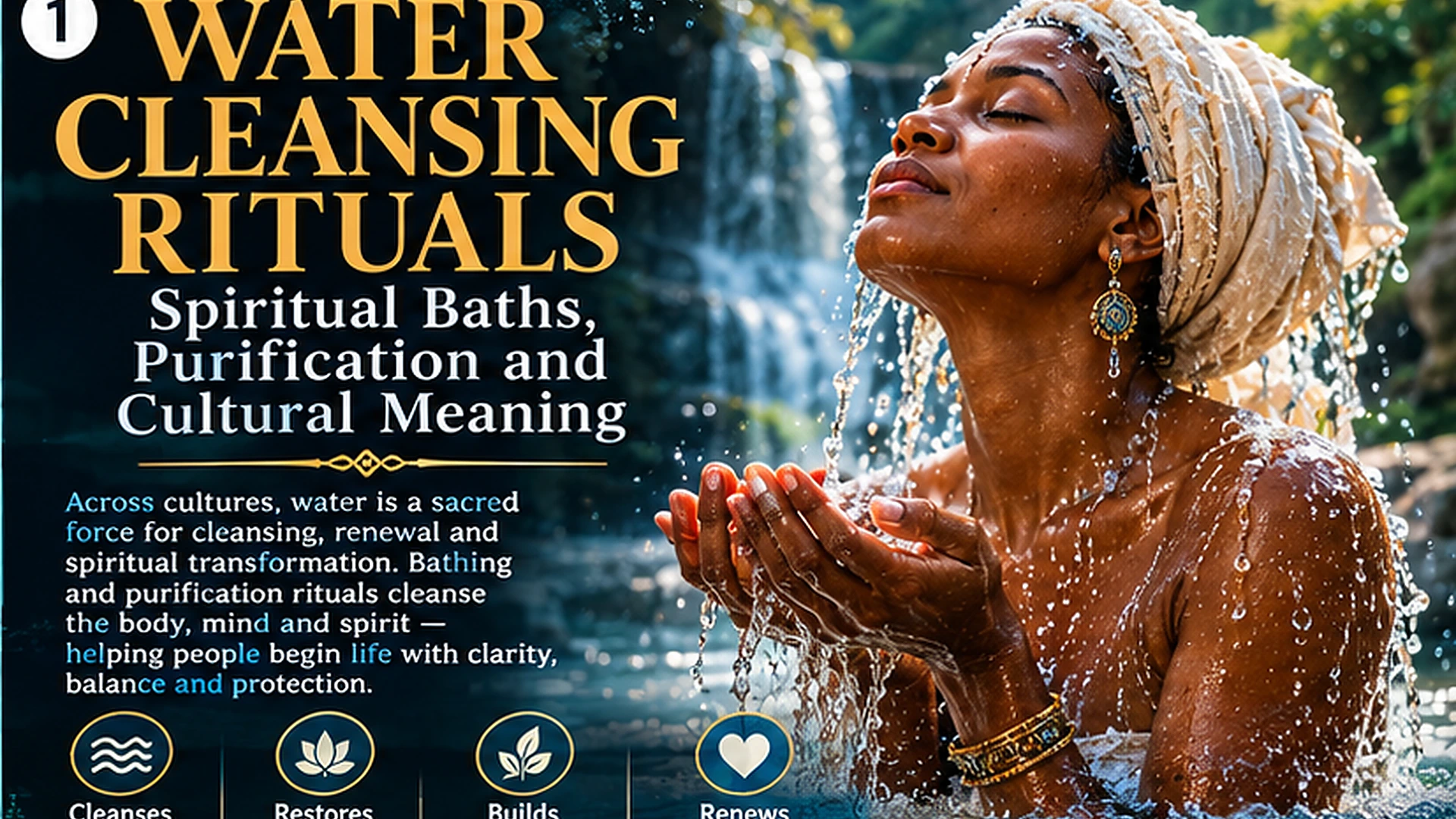
Water cleansing rituals are practices in which washing, immersion, sprinkling or bathing expresses a change in religious, spiritual or social condition. In different communities, w...
Water cleansing rituals are practices in which washing, immersion, sprinkling or bathing expresses a change in religious, spiritual or social condition. In different communities, water can prepare a person for prayer, mark entry into a faith, close a period of mourning, accompany healing, remove ritual impurity, renew a household or connect a pilgrimage to a sacred landscape.
These practices are not versions of one universal ceremony. A Shinto visitor rinsing the hands and mouth before approaching a shrine, a Jewish person immersing in a mikveh, a Muslim performing wudu, an Ethiopian Orthodox congregation receiving blessed water at Timkat, a Hindu pilgrim bathing during Kumbh Mela and an Afro-Caribbean practitioner preparing a plant-infused bath are acting within different systems of meaning and authority.
The phrase “spiritual bath” is also used in modern wellness and commercial settings, where traditions may be blended or simplified. A responsible guide must therefore ask who performs the practice, what the water signifies, whether prayers or plants are involved, how knowledge is transmitted and which claims belong to faith rather than science.
Quick Answer
Water cleansing rituals use washing, immersion, sprinkling or bathing to symbolize purification, preparation, renewal or transition. Examples include Shinto temizu, Jewish mikveh immersion, Christian baptism, Islamic wudu and ghusl, Hindu sacred-river bathing, Ethiopian Timkat and culturally specific spiritual baths. Their meanings are not interchangeable, and no ritual is scientifically proven to remove negative energy or guarantee healing.
What Are Water Cleansing Rituals?
A water cleansing ritual is a structured use of water whose purpose is more than ordinary hygiene. The action may be physically simple—washing the hands, stepping into a pool, receiving sprinkled water or bathing with plants—but the surrounding words, timing, place, authority and shared belief give it ritual meaning.
Religious studies scholars often distinguish ritual purity from visible cleanliness. A person can be physically clean yet still require a religious immersion, and a ritual washing can be valid even when it is not intended to remove dirt. The distinction depends on the tradition. In some systems, water prepares the body for worship. In others, it marks rebirth, restored relationship, mourning, conversion, festival renewal or protection.
Common Forms of Water Purification
| Form | Typical ritual function |
|---|---|
| Partial washing | Hands, face, mouth or feet are washed before worship or entry into sacred space. |
| Full immersion | The whole body enters water to mark ritual status, conversion, renewal or purification. |
| Sprinkling or pouring | Blessed or designated water is applied by a religious specialist or participant. |
| Sacred-river bathing | Pilgrims enter a river or other natural water body understood as religiously significant. |
| Plant-infused baths | Water is combined with flowers, leaves or other materials within specific healing or spiritual traditions. |
| Household or communal washing | Water helps mark seasonal renewal, mourning, initiation or the reordering of domestic space. |
Why Water Symbolizes Purification
Water’s physical ability to wash, cool, dissolve and carry material away makes it a powerful symbol. People can see dust leave the skin, watch a current move downstream and feel the body change temperature. Ritual systems extend these observable qualities into moral, spiritual and social meanings.
Life and renewal
Human life depends on water, and many creation stories place water before land or organized life. Immersion can therefore suggest return to an original state and emergence into a new one. Christian baptism explicitly connects water with new birth, while some modern interpretations of mikveh also emphasize transition and renewal.
Boundaries and transition
Ritual bathing often appears at thresholds: before prayer, after menstruation or childbirth, at conversion, after contact with death, before a festival, during initiation or when a period of grief closes. The water marks movement from one recognized condition to another.
Flow and removal
Running water can symbolize the carrying away of danger, impurity, grief or disorder. This symbolism does not prove that water physically removes a supernatural force; it explains why flowing springs, rivers and poured water are meaningful ritual media.
Community and sacred geography
A river, spring, pool or shrine basin can hold collective memory. Pilgrimage bathing is not only a private cleansing act: it links participants to a place, a calendar, religious teachers and a wider community.
Water Cleansing in Historical Context
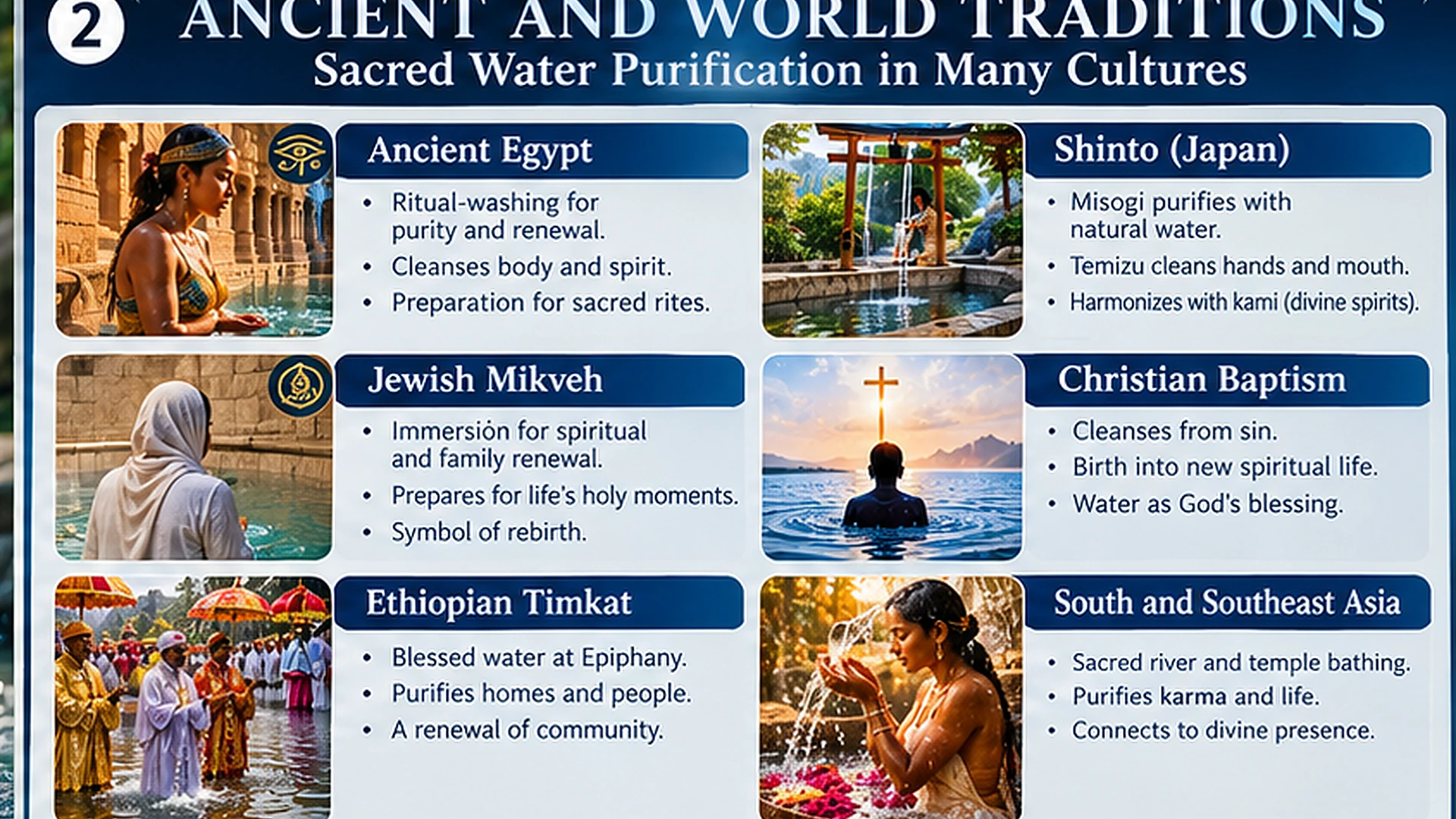
Ritual washing is ancient, but its history should not be written as one straight line from a single origin. Archaeological objects show that ancient Egyptian washing vessels and basins could be connected with ritual purification and funerary practice. The Metropolitan Museum of Art describes ewer-and-basin sets from tomb contexts as likely instruments of ritual purification and identifies scenes in which water was poured over persons or mummies.[1]
Similar material forms—basins, jars and pools—appear across the ancient Mediterranean and Near East, yet identical objects do not automatically carry identical meanings. Later Jewish, Christian and Islamic practices developed through their own scriptures, legal traditions and communities. Modern spiritual baths in the Americas also emerged through colonial encounter, African diaspora religions, Indigenous healing knowledge, Catholic symbolism and local plant traditions.
Shinto Misogi and Temizu in Japan
In Shinto, purification is closely associated with harae, the removal of kegare, a condition often translated as impurity or pollution. Misogi refers to purification through water, historically linked in mythology to the deity Izanagi washing after returning from the land of the dead. Jinja Honcho, the Association of Shinto Shrines, explains that the shrine temizu basin is a simplified form of this water purification.[2]
At a temizuya near a shrine entrance, visitors cleanse the hands and mouth before worship. The action is not an ordinary handwash station and should not be treated as a tourist photo prop. It prepares the visitor to approach the kami and sacred space with appropriate attention. Procedures can be adjusted by individual shrines, especially for public-health or water-conservation reasons.
Misogi can involve more demanding exposure to rivers, waterfalls or the sea under religious guidance. It should not be copied casually because cold water, currents and remote locations can create serious physical risks. The deeper principle is purification and discipline within Shinto practice—not endurance performance for social media.
Jewish Mikveh: Ritual Immersion and Religious Status
A mikveh is a Jewish ritual bath constructed and supplied according to religious requirements. It is used in several contexts, including conversion, family-purity observance and the immersion of certain utensils. Practices vary among Orthodox, Conservative, Reform and other Jewish communities, and contemporary mikvaot may also support voluntary transitions such as recovery, grief or gender affirmation.
The immersion is not a substitute for ordinary bathing. Preparation normally includes physical cleaning so that the ritual water can contact the body without barriers. The Jewish Museum describes mikveh immersion as a practice connected with purification and spiritual renewal, including before marriage and after menstruation or childbirth in traditional observance.[3]
Because mikveh practice can involve privacy, sexuality, conversion and gender, respectful writing should avoid voyeuristic imagery or claims that all Jewish people observe the same rules. The meaning is grounded in Jewish law, community and personal religious life—not in the idea of a generic “detox bath.”
Christian Baptism, Blessed Water and Ethiopian Timkat
Baptism and new life
Christian baptism uses water in the name of the Trinity to mark entry into Christian life. Traditions differ over infant or adult baptism, immersion or pouring, and the relationship between the sacrament, faith and church membership. The Catholic Catechism calls baptism “the sacrament of regeneration through water and in the word” and explains immersion as a sign of dying and rising with Christ.[4]
Holy water is also used in some Christian churches for blessing, remembrance of baptism, the dedication of homes and liturgical preparation. These practices should not be confused with commercial “holy water” products sold with guaranteed results.
Ethiopian Timkat
Timkat, the Ethiopian Orthodox celebration of Epiphany, commemorates the baptism of Jesus in the River Jordan. UNESCO describes the procession of tabots to a pool, river or reservoir, night prayers and the blessing and sprinkling of water on the congregation.[5] The event combines theology, music, procession, collective identity and public celebration.
Timkat is not simply an “African water cleanse.” It is a specific Ethiopian Orthodox festival maintained by clergy and communities. Tourism and image-making should respect the tabot, which is sacred and ordinarily covered, and should not turn blessed-water participation into exotic spectacle.
Islamic Wudu and Ghusl
Islam distinguishes physical cleanliness from states of ritual purity required for prayer and other acts. Wudu is the minor ablution involving prescribed washing and wiping of parts of the body. Ghusl is a full-body purification required in specified circumstances and recommended in others, with details differing among legal schools.
Qur’an 5:6 instructs believers preparing for prayer to wash the face and arms, wipe the head and wash the feet, and it refers to full purification after major impurity. The verse also provides tayammum—purification with clean earth—when water is unavailable or cannot be used, showing that the religious purpose is not reducible to the substance of water alone.[6]
Wudu and ghusl should not be described as “Islamic spiritual baths for removing negativity.” They are acts of worship governed by intention, jurisprudence and preparation for religious duties. Mosque ablution facilities also require practical attention to slip prevention, water conservation and accessibility.
Hindu Sacred Bathing and Kumbh Mela
Water occupies many roles in Hindu traditions, including daily purification, temple practice, pilgrimage, funerary observance and festival bathing. Rivers may be understood as sacred presences rather than merely physical locations, but the meaning and procedure vary by region, deity, lineage and occasion.
UNESCO describes Kumbh Mela as a vast pilgrimage in which participants bathe or dip in a sacred river, believing that the act cleanses sin and supports liberation from rebirth. The festival rotates among Prayagraj, Haridwar, Ujjain and Nashik and is transmitted through religious organizations, texts and teacher-student relationships.[7]
The religious meaning of sacred bathing does not remove environmental or crowd-safety concerns. Sanitation, water quality, currents and emergency management remain essential. Respectful coverage should avoid treating millions of participants as an undifferentiated spectacle or describing belief as scientific fact.
African and Afro-Diasporic Water Traditions
Water symbolism in West Africa
Across West Africa, water can be associated with life, healing, fertility, danger, trade, divination and spiritual beings. Smithsonian bibliographic records on West African water symbolism note the religious importance of river and water spirits such as Oshun, Yemoja, Olokun and Mami Wata in particular traditions.[8] These names do not represent one unified religion, and their meanings vary across Yoruba, Edo, Fon, Ewe, coastal and diaspora communities.
A river offering, priestly washing, healing bath or festival at a sacred water site may involve specialist authority and community rules. Public articles should not invent ingredient lists, expose restricted prayers or assume that every water-associated deity is approached through the same kind of bath.
Afro-Caribbean botánicas and spiritual baths
Spiritual baths are documented in Afro-Caribbean religious and healing networks, including botánicas that serve immigrant communities. An open-access study in Latin American Research Review describes consultations that may combine herbal preparations, cleansing baths and prayer. The article emphasizes a social and spiritual model of distress rather than a single standardized remedy.[9]
The ingredients and prayers can depend on the practitioner, religious house, concern and plant knowledge. Santería/Lukumí, Haitian Vodou, Espiritismo, Obeah, Candomblé and other traditions should never be treated as interchangeable. Some knowledge is private, initiated or commercially protected.
Baños espirituales in curanderismo
The Smithsonian Center for Folklife and Cultural Heritage documents Mexican-American curandera María Cristina Moroles describing baños espirituales for trauma, transition and grief. The water may be infused with flowers or herbs selected for the participant’s needs, and the practice can accompany other forms of cleansing.[10] This is one practitioner’s living tradition, not a universal formula.
What Spiritual Baths Are Believed to Do
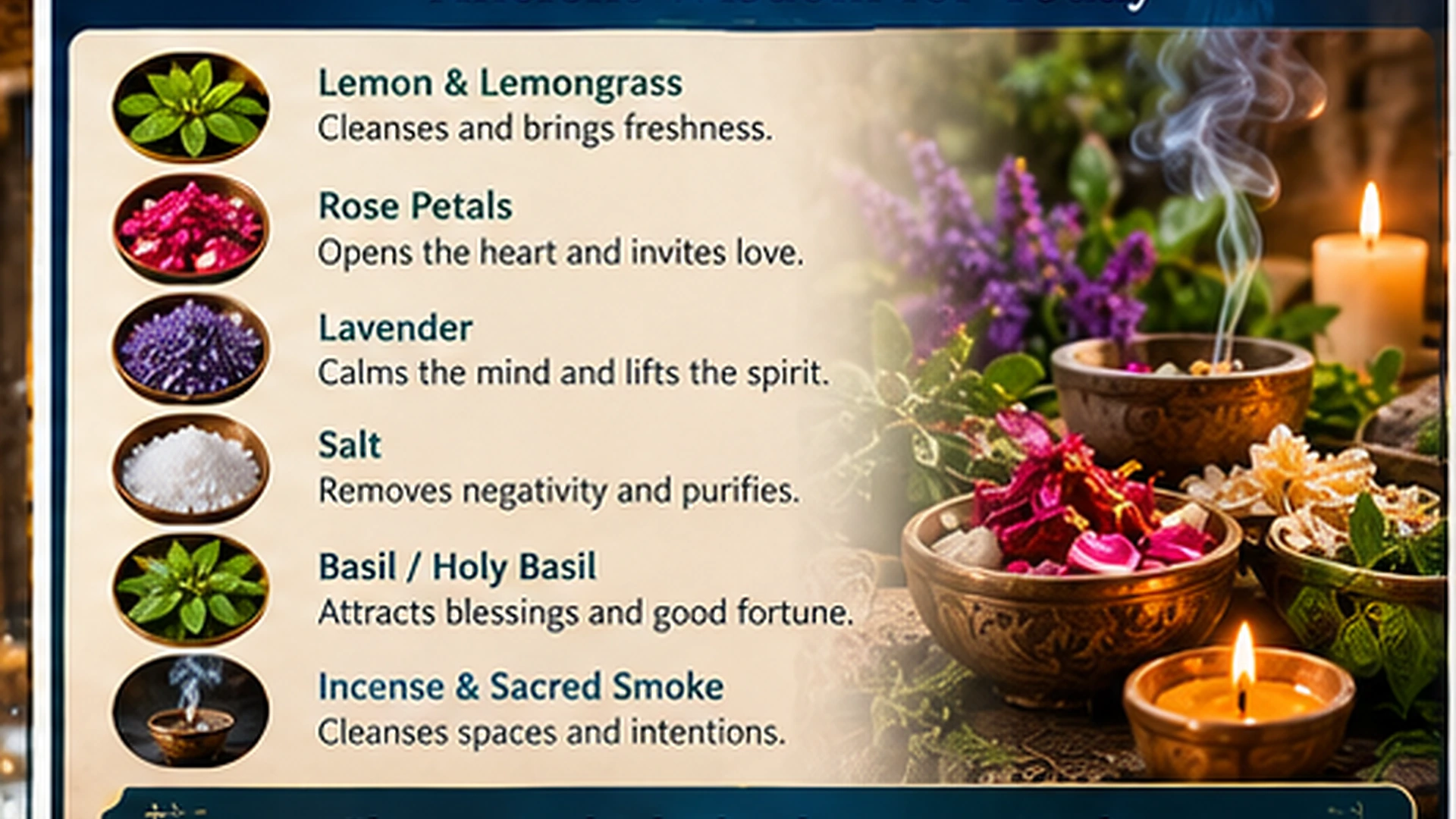
Claims about spiritual baths vary widely. Within a tradition, participants may describe the bath as preparing the body for prayer, closing a difficult period, removing ritual impurity, restoring balance, strengthening protection, supporting grief, marking a new beginning or improving the relationship between a person and sacred powers.
These statements should be reported as beliefs or lived interpretations. Science has not established a measurable substance called “negative energy” that can be washed from the body. A ritual can still have psychological, social or religious importance without proving a supernatural mechanism.
| Recurring meaning | How it may appear |
|---|---|
| Preparation | Washing before worship, shrine entry, prayer or ceremony. |
| Transition | Marking conversion, marriage, menstruation, childbirth, initiation, grief or recovery. |
| Renewal | Symbolizing a new beginning, restored relationship or return to order. |
| Protection | Expressing a request for divine care or defense from perceived spiritual danger. |
| Healing | Supporting religious or community interpretations of well-being; not a substitute for medical care. |
| Belonging | Connecting a person with a faith, lineage, sacred place or festival community. |
Materials Used in Spiritual Baths
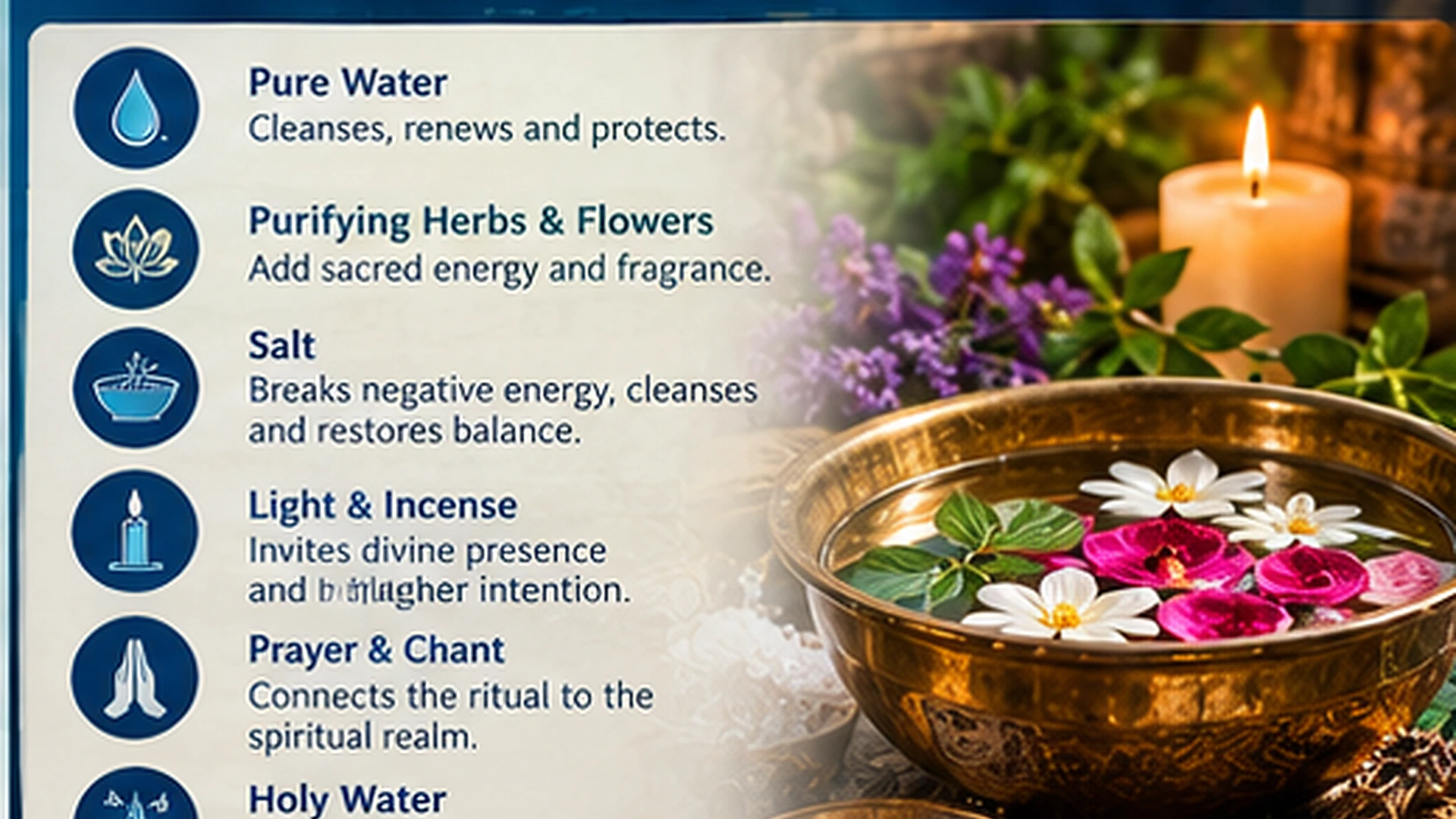
Water is sometimes combined with other materials, but those materials do not have one universal meaning. A flower may signify devotion in one setting, grief in another and beauty in a third. Salt can express purification, preservation, hospitality or boundary-making. Plants may be chosen for fragrance, inherited symbolism, medicinal reputation or association with a deity or saint.
Water source
Some traditions require naturally collected water, flowing water, rainwater or water connected with a sacred site. Others use ordinary clean water that becomes ritually significant through prayer, intention or blessing. The religious requirement and the health safety of the water are separate questions.
Herbs and flowers
Plant-infused baths appear in curanderismo, Afro-Caribbean healing, folk Christianity, South Asian practice and modern wellness. The same plant can have different meanings and risks. Inherited use does not prove that a plant is safe on the skin, during pregnancy or for a person with allergies.
Salt, oils and fragrances
Salt and aromatic substances are common in many household traditions, yet concentrated essential oils can irritate skin and should not be poured directly into bathwater without appropriate formulation. Fragrance can also trigger asthma, migraines or contact dermatitis.
Words, prayer and intention
Sacred words, blessings and intention often matter more than the physical ingredients. Copying a prayer from a living religion without understanding its context can be disrespectful, especially when the text is restricted, initiated or written for a specific person.
Ritual Bathing and Scientific Evidence
Warm bathing can support comfort and relaxation, and meaningful rituals can help people organize emotion, identity and social support. Those effects do not prove that a spiritual bath removes curses, guarantees protection, cures infertility, reverses illness or changes financial outcomes.
Medical and spiritual questions should not be confused. A person can value prayer or ritual while also seeking diagnosis and treatment. Dangerous symptoms, wounds, pregnancy complications, severe anxiety, suspected poisoning or infection require qualified health care rather than repeated cleansing baths.
Water and Ingredient Safety
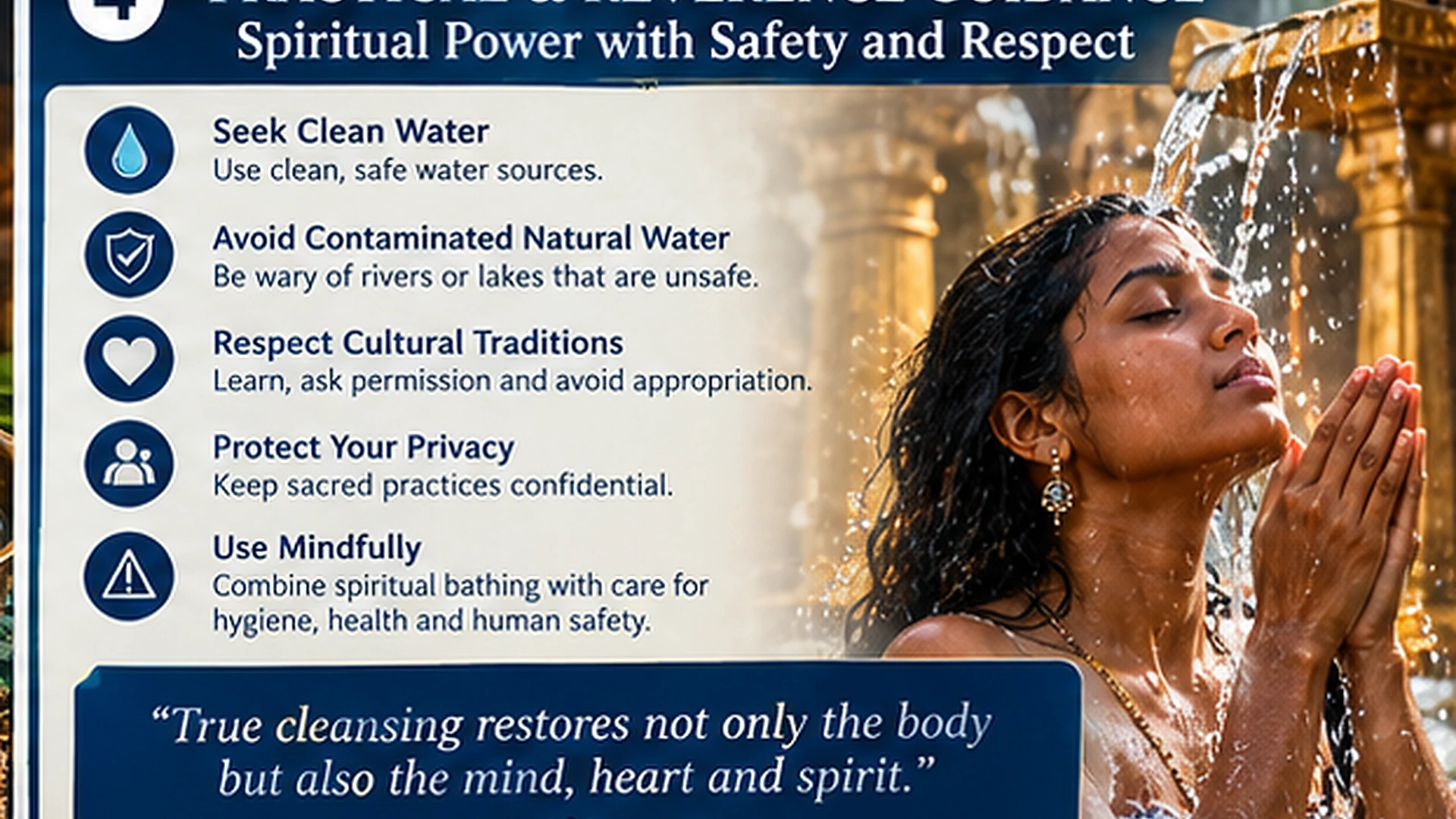
Religious importance does not make contaminated water physically safe. The World Health Organization notes that cultural and religious use of rivers, lakes and coastal waters can provide well-being but may also expose users to microbial pollution, chemicals, injury and drowning.[11]
Use water known to be safe for bathing, and follow local health advisories for rivers, lakes and public pools.
Do not enter natural water after heavy rain, near sewage discharge, during strong currents or where authorities have closed the site.
Keep untreated water out of the nose, eyes and open wounds; ritual nasal rinsing requires appropriately boiled, distilled or otherwise safe water.
Avoid unknown plants, caustic substances and concentrated essential oils. Patch-test non-sensitive products and stop if burning, swelling or breathing difficulty occurs.
Do not perform immersion alone where there is a drowning risk, and supervise children continuously.
People who are pregnant, immunocompromised or living with significant skin or respiratory conditions should seek medical guidance before using herbs or communal water.
Do not drink ritual bathwater unless it is a separately prepared, food-safe item within a tradition and medically safe for the person.
The CDC advises against bathing in water that may be contaminated with sewage or toxic chemicals and warns that natural water can cause illness if swallowed or if it enters open wounds.[12] Safety guidance is not an attack on tradition; it helps communities sustain meaningful practices without preventable harm.
Cultural Respect and Ethical Boundaries
Do not combine unrelated traditions into a universal recipe
A “Shinto-mikveh-Ganges-Vodou cleansing bath” is not a historical tradition. Blending sacred names and objects for marketing removes the authority, theology and community relationships that make the practices meaningful.
Respect privacy and restricted knowledge
Mikveh immersion is private. Initiated Afro-diasporic baths may use confidential prayers or plant knowledge. Timkat tabots are sacred and covered. Responsible content does not expose what practitioners intentionally protect.
Credit living practitioners and communities
When documenting a living bath tradition, obtain informed consent, identify the community accurately, agree on what can be photographed and discuss how the participants benefit from publication.
Avoid guarantees and fear-based selling
Claims that a person is cursed, spiritually dirty or in danger unless they buy a bath can exploit vulnerability. Ethical practitioners explain limits, avoid medical guarantees and do not use escalating fear to demand money.
Common Misunderstandings
“All spiritual baths remove negative energy.”
“Negative energy” is a modern umbrella phrase, not a precise term shared by all traditions. Many ritual baths concern religious status, preparation, covenant, rebirth or community identity rather than an invisible substance.
“If water is sacred, it is physically safe.”
Sacred status and water quality are different categories. A river may remain religiously significant while facing pollution, strong currents or disease risk.
“More ingredients make a bath more powerful.”
Complexity is not proof of authenticity. Adding many herbs, oils, salts and powders increases allergy and irritation risk and may create a mixture unknown to any tradition.
“Ritual purity means a person is dirty or inferior.”
Ritual purity is a religious category, not a judgment about human worth. Translating it as ordinary dirtiness can stigmatize menstruation, childbirth, sexuality, death or conversion and distort the tradition.
“A bath can replace therapy or medical treatment.”
Ritual can accompany care, grief support or personal reflection, but it should not delay evidence-based treatment or emergency help.
Comparison of Selected Water Cleansing Traditions
| Tradition | Context | Water practice | Primary meaning |
|---|---|---|---|
| Shinto temizu | Japan / Shinto | Hands and mouth washed before shrine worship | Purification and preparation for sacred approach |
| Mikveh | Jewish traditions | Full ritual immersion in a religiously constructed bath | Religious status, family purity, conversion and transition |
| Baptism | Christian traditions | Immersion, pouring or sprinkling, depending on church | New life, initiation and incorporation into the church |
| Wudu and ghusl | Islamic traditions | Prescribed partial washing or full-body purification | Readiness for worship and ritual purity |
| Kumbh Mela bathing | Hindu traditions in India | Pilgrimage bathing in sacred rivers | Purification, merit, liberation and communal pilgrimage |
| Timkat | Ethiopian Orthodox Christianity | Blessed water, sprinkling and in some places immersion | Commemoration of Christ’s baptism and communal identity |
| Botánica / curandera baths | Specific Afro-Caribbean and Latin American traditions | Water prepared with selected plants, flowers and prayer | Cleansing, transition, grief, healing and spiritual balance as locally understood |
People Also Ask
What is a spiritual cleansing bath?
It is a bath or washing whose purpose is interpreted spiritually or ritually rather than only hygienically. The water may be accompanied by prayer, plants, flowers, salt or immersion, but the meaning depends on a specific tradition.
Why is water used for purification?
Water visibly washes, flows, cools and sustains life. Religious systems use those qualities to symbolize preparation, renewal, rebirth, transition or the removal of ritual impurity.
Which religions use ritual bathing?
Forms of ritual washing or immersion appear in Shinto, Judaism, Christianity, Islam, Hindu traditions, Ethiopian Orthodox Timkat and many Indigenous, African and diaspora traditions. The practices are not interchangeable.
What is the difference between a mikveh and baptism?
A mikveh is a Jewish ritual bath used in several religious contexts. Baptism is a Christian initiation sacrament or ordinance associated with new life in Christ. Their laws, theology and community roles differ.
What are wudu and ghusl?
Wudu is the Islamic minor ablution performed for prayer and related acts. Ghusl is full-body ritual purification required or recommended in specified circumstances.
Can a spiritual bath remove negative energy?
Some practitioners believe a bath can remove harmful spiritual influence or restore balance. Science has not established negative energy as a measurable substance that bathwater can remove.
Are herbs necessary in a spiritual bath?
No. Many water rituals use only water, while some culturally specific baths include plants, flowers, salt or fragrance. Ingredients should not be copied without context or safety knowledge.
Is sacred river water safe to bathe in?
Not automatically. Sacred meaning does not guarantee safe water quality. Check local advisories, currents, crowd conditions and contamination risks.
What is misogi?
Misogi is a Shinto form of water purification associated with removing impurity and preparing the person spiritually. Shrine temizu is a simplified purification before worship.
What is Timkat?
Timkat is the Ethiopian Orthodox Epiphany festival commemorating Jesus’ baptism. It includes processions, prayer and the blessing or sprinkling of water.
Why are spiritual baths used after grief or transition?
Ritual can give structure to a difficult change, mark a boundary between life stages and provide community recognition. The meaning depends on the tradition and participant.
How can someone study spiritual baths respectfully?
Use named cultural sources, distinguish public from restricted knowledge, credit practitioners, avoid universal recipes and separate religious belief from health claims.
Frequently Asked Questions
Is a spiritual bath the same as a cleansing shower?
Not necessarily. A shower can become personally meaningful, but established ritual baths usually involve recognized timing, words, authority, water requirements or community rules.
Can salt be added to any cleansing bath?
Salt appears in many traditions, but its meaning and safe use vary. It can irritate damaged skin and should not be assumed to make a bath culturally authentic or spiritually stronger.
Can essential oils be poured into bathwater?
Concentrated essential oils do not mix evenly with water and can irritate skin. They require appropriate dilution or formulation, and some are unsuitable during pregnancy or for children and pets.
Are spiritual baths African traditions?
Some African and African-diasporic communities use water or plant baths, but there is no single African bath tradition. Specific practices belong to named peoples, religions, specialists and historical settings.
Do spiritual baths cure illness?
No spiritual bath is proven to cure disease. Bathing may provide comfort or religious support, but symptoms need appropriate medical assessment.
Can a person make a ritual bath from internet ingredients?
A generic recipe may combine unsafe plants and unrelated traditions. Educational sources should explain context and safety rather than promise a universal formula.
Why do some rituals require flowing water?
Flowing water can symbolize movement and removal, and some legal or religious traditions specify naturally gathered or connected water. The exact requirement belongs to that tradition.
Can ritual water be reused?
Rules differ. Some traditions regulate how water is collected, touched or disposed of. Public-health and environmental considerations also matter.
Are communal ritual baths hygienic?
They can be managed safely, but shared facilities require water treatment, cleaning, ventilation and policies for illness or open wounds. Religious meaning does not replace sanitation.
Is ritual cleansing connected with menstruation?
Some traditions regulate immersion or washing around menstruation, while others do not. The subject should be discussed without treating menstruating people as morally inferior or physically dirty.
Can someone photograph a water ritual?
Only with permission and attention to sacred restrictions, privacy and community control. Some objects, participants or moments should not be photographed.
What is the best way to write about spiritual baths?
Name the tradition, state what sources document, distinguish belief from evidence, avoid secret instructions and include safety and cultural limits.
Key Takeaways
Water cleansing rituals use washing, immersion, sprinkling or bathing to express religious and cultural change.
There is no universal spiritual bath: Shinto, Jewish, Christian, Islamic, Hindu, African and diaspora practices have different authorities and meanings.
Water commonly symbolizes life, flow, rebirth, preparation, transition and communal memory.
Herbs, flowers, salt and sacred words are culturally specific and may carry health or ethical risks when copied without knowledge.
Ritual meaning can be psychologically and socially important without proving supernatural or medical claims.
Sacred water must still be physically safe, and immersion requires attention to contamination, drowning, wounds and ingredient reactions.
Respect requires accurate naming, consent, privacy, attribution and refusal to commercialize fear.
Conclusion
Water cleansing rituals reveal how a simple substance can carry complex meanings. Water can prepare a worshipper, welcome a convert, close a period of mourning, commemorate a sacred event, renew a pilgrim’s relationship with place or support a practitioner’s understanding of healing. Yet the similarity of washing should never erase the differences among traditions.
The most responsible approach is both open and disciplined: listen to communities, identify the historical and religious setting, protect private knowledge, report supernatural claims as beliefs and take physical safety seriously. Water’s cultural power lies not in a universal recipe, but in the many ways people have learned to connect body, memory, place and sacred responsibility.
Final Summary
Water cleansing rituals include spiritual baths, immersion, ablution, sprinkling and sacred-river bathing. Their recurring themes include purification, rebirth, preparation, transition, protection and communal renewal. Examples such as Shinto temizu, Jewish mikveh, Christian baptism and Timkat, Islamic wudu and ghusl, Hindu Kumbh Mela and Afro-diasporic plant baths must be understood separately. None is a scientifically guaranteed cure or method for removing negative energy, and safe water, informed consent and cultural respect remain essential.
Article Information
- Publisher
- Ancestral Temple
- Editor
- Ancestral Temple
- Last updated
- Jul 30, 2026
- Last reviewed
- Jul 30, 2026
- Content version
- 0cf1e9afb4
This educational article should be read as cultural and spiritual information, not as medical, legal, financial, or emergency advice.
Helpful Related Guidance
About the Author
 Ancestral Temple
Spiritual guide and practitioner with decades of experience in ancestral wisdom, rituals, and divine guidance.
Related Posts
View All





Comments
We'd love to hear your thoughts.