
Travel Protection Spells and Rituals: Blessings for a Safe Journey
Pillar Article
Quick Summary
Journeys have always involved uncertainty. A traveler leaves familiar people, roads, food, shelter and routines, then enters conditions that may be difficult to predict. Before mod...
Journeys have always involved uncertainty. A traveler leaves familiar people, roads, food, shelter and routines, then enters conditions that may be difficult to predict. Before modern weather forecasts, motorways, vaccines, passports and emergency communications, even a short journey could expose a person to storms, robbery, illness, animals, warfare or separation from family.
It is therefore unsurprising that communities developed prayers, blessings, amulets and departure customs associated with safe travel. Some asked a deity to accompany the traveler. Some carried sacred words or images. Pilgrims bought badges at shrines. Families blessed luggage, vehicles or people at the threshold. Modern spiritual practitioners may write an intention, tie a protective knot or carry a personally meaningful object.
These practices do not form one universal tradition. A Jewish Tefilat HaDerech, an Islamic travel dua, a Saint Christopher pendant, a Japanese omamori and a Somali hersi belong to different religious histories. The word “spell” may fit some modern occult or folk-magic practices, but many believers would not describe prayer or consecrated amulets that way.
A responsible explanation must also separate spiritual meaning from physical safety. Prayer can express trust, calm or hope. An amulet can carry religious identity and memory. Neither can replace a valid passport, safe transport, vaccinations, medication, insurance, emergency contacts or attention to local conditions.
Quick Answer
A travel protection ritual is a culturally defined prayer, blessing, charm or symbolic action used to seek guidance, courage, protection and safe return. Examples include the Jewish traveler’s prayer, Islamic travel supplication, Saint Christopher medals, Japanese safe-travel omamori and African Islamic amulets. Such practices may provide spiritual or emotional support, but they do not guarantee safety or replace practical planning.
What Are Travel Protection Spells and Rituals?
The phrase travel protection ritual covers several different kinds of practice.
A prayer addresses a deity or sacred power. It may ask for guidance, protection, patience, good companions, safe arrival and care for those who remain at home.
A blessing may be spoken by clergy, elders, relatives or the traveler. Some blessings are formal parts of a religious tradition; others are simple family words of goodwill.
An amulet or charm is a portable object believed to carry protection, sacred presence, memory or good fortune. It may contain scripture, an image, a seal, a relic-associated symbol or a temple inscription.
A spell usually refers to words and actions intended to influence an outcome through occult, magical or folk-religious means. Modern travel spells may involve knotting thread, anointing luggage, placing herbs in a sachet, visualizing a safe route or carrying a chosen symbol. These practices are diverse and often highly individualized.
A routine is a repeated sequence that may be spiritual, practical or both: checking documents, praying, calling family, touching a medal, reviewing the route and leaving at a planned time.
The categories should not be collapsed. Many Muslims, Christians and Jews would reject the idea that their prayer is a spell. A Japanese omamori is normally obtained from a temple or shrine and belongs to a living religious institution, not merely to a generic “energy” system. A museum amulet may have been made for a specific client or community and should not be copied without context.
The common thread is not one theology. It is the human need to face uncertainty with meaning, support and preparation.
Why Journeys Inspired Protective Traditions
Travel historically removed people from the protection of household, village and familiar law. Roads could be poorly marked. Rivers changed with the season. Ships depended on weather and navigation. Inns, border zones and wilderness brought unfamiliar people and risks. Pilgrims traveled toward sacred sites, merchants carried valuable goods, soldiers crossed contested land and families moved because of marriage, work, exile or migration.
Portable devotion was especially useful because the traveler could not carry a temple, church or household shrine. A small badge, pendant, written prayer or amulet made sacred protection mobile. The object could also identify the traveler to others. A pilgrim badge showed that a person had visited a shrine; a scriptural amulet linked the wearer to a religious community; a family blessing maintained a relationship across distance.
Ritual also marks a transition. Leaving home is a threshold moment: the traveler is no longer fully within ordinary domestic life but has not yet arrived at the destination. Saying a prayer, touching the doorway, receiving food, tying a thread or checking a bag can give form to that transition.
Psychological research suggests that uncertainty can increase repetitive and ritualized behavior. Laboratory and field studies do not prove supernatural protection, but they help explain why structured actions become attractive before risky or uncontrollable events.[9][10] A predictable routine can narrow attention and create a feeling of readiness. The effect is not always beneficial: if a person believes the ritual must be performed perfectly or disaster will follow, the practice can intensify anxiety rather than relieve it.
Historical Background: Pilgrims, Roads and Portable Devotion
Travel protection traditions often developed alongside pilgrimage. Medieval European pilgrims visited shrines associated with saints, relics and reported miracles. Small lead-alloy badges were sold at major destinations and served as proof of the journey, devotional souvenirs and signs of connection with the shrine.[1]
The scallop shell became associated with pilgrimage to Santiago de Compostela, while Canterbury badges commemorated Thomas Becket. These objects were not all identical in purpose. Some displayed the shrine, saint or local emblem. Some may have been touched to relics or blessed; others were commercial souvenirs. Their meaning depended on place, use and belief.
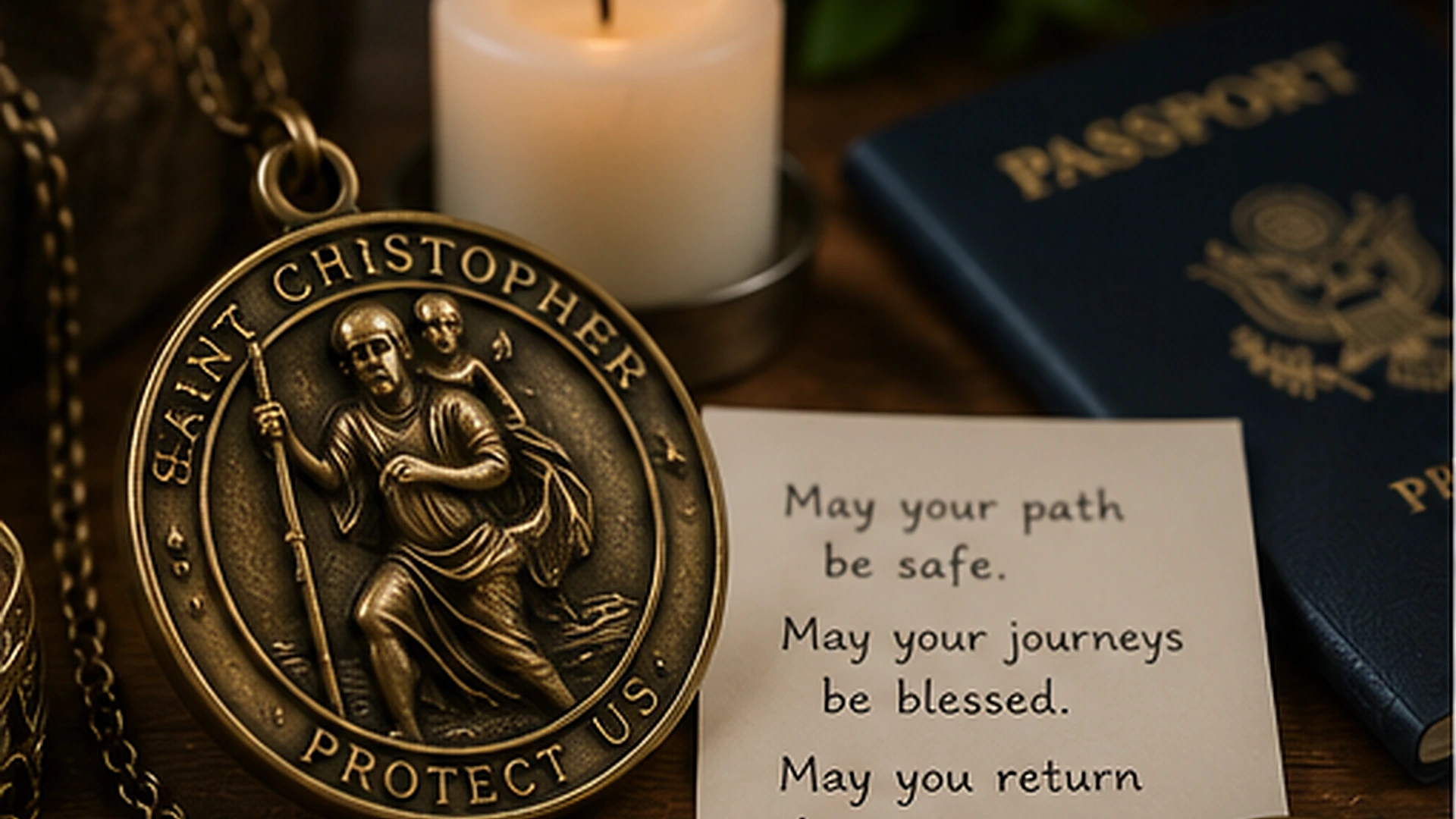
Saint Christopher became particularly associated with travelers. Late-medieval pendants show him carrying the Christ Child across water, and museum records describe such objects as items carried by pilgrims and others seeking protection on journeys.[2] The tradition later expanded into medals placed in wallets, vehicles or luggage.
Older amulet traditions existed long before medieval Christianity. Ancient Egyptian amulets were worn for well-being and protection, drawing power from material, color, shape, inscription and ritual use.[3] However, a general protective amulet should not automatically be labeled a “travel charm” unless its context supports that conclusion.
Modern online content often invents a straight line from ancient amulets to contemporary suitcase spells. History is more complex. Similar needs can produce similar objects without direct continuity. A knot, pendant or written blessing may recur because it is portable and memorable, not because every culture inherited one original ceremony.
Christian Traditions: Journey Blessings and Saint Christopher
Christian travel practices range from informal family prayers to formal blessings, pilgrimages and the use of saint medals. The Church of England presents travel as an opportunity to ask for God’s blessing and suggests a simple family prayer for a journey.[4] Other denominations have their own liturgical forms, scriptures and customs.
A Christian prayer before departure may ask for wise decisions, protection from danger, patience with delays, kindness toward strangers, care for family at home and gratitude on return. The emphasis varies. Some believers understand protection as deliverance from physical harm. Others include moral protection: not exploiting people, becoming reckless, losing compassion or using travel as an excuse to ignore responsibility.
Saint Christopher devotion reflects a long history of traveler protection. His legend describes carrying a child across dangerous water and discovering that the child is Christ. Medieval and later images presented him as a protector against storms and threats encountered on the road.[2]
The medal is not a mechanical guarantee. Catholic and other Christian traditions distinguish sacramental devotion from superstition. A medal may remind the wearer to pray, act responsibly and trust God, but it does not cancel weather, mechanical failure or human error.
Pilgrimage traditions also show that the journey itself can be spiritually significant. Walking, hospitality, hardship and arrival may become part of repentance, thanksgiving or devotion. Yet historical pilgrim routes also required practical networks of roads, hospitals, hostels and local knowledge. Spiritual intention and material infrastructure were always connected.
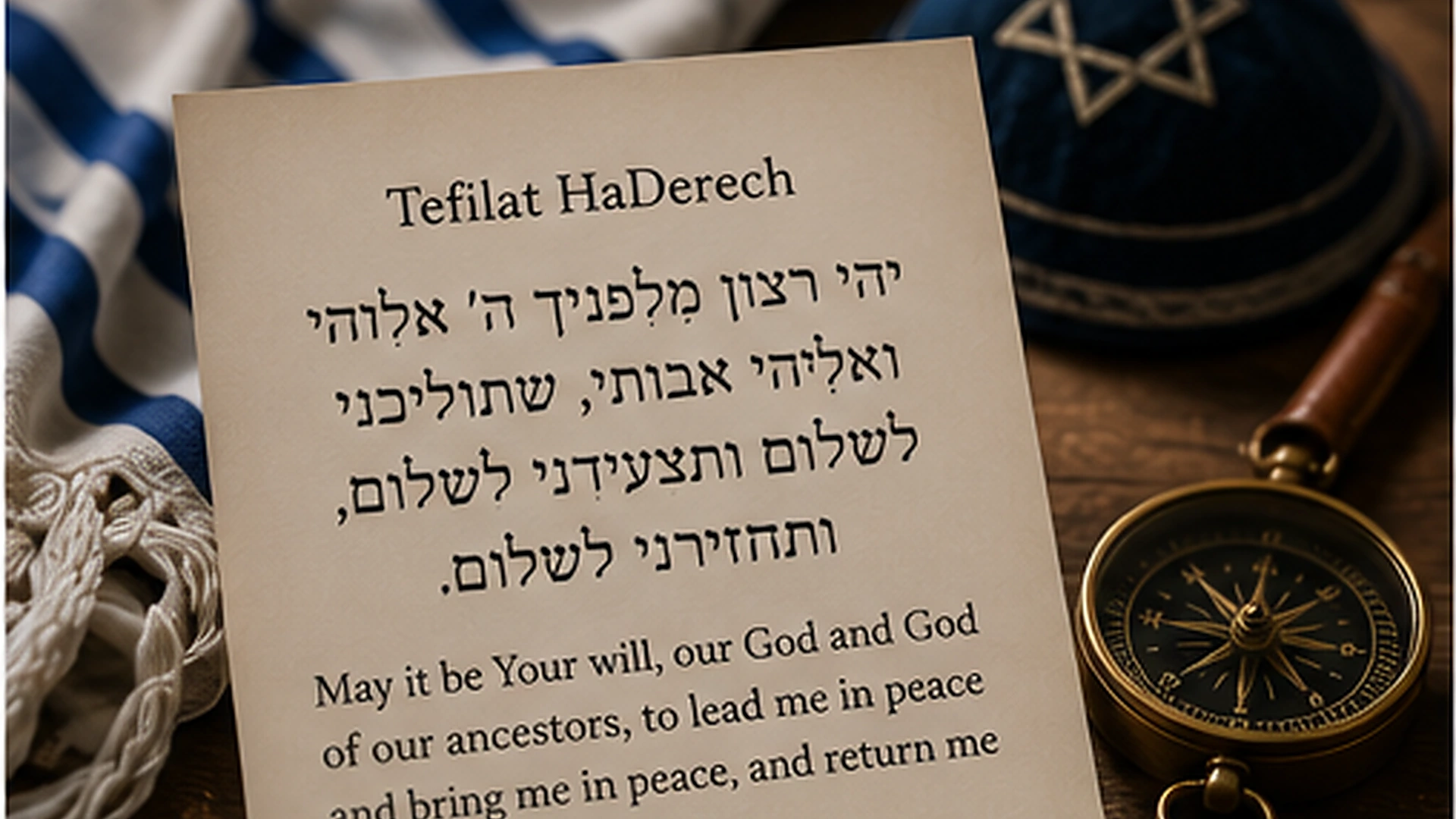
Jewish Tradition: Tefilat HaDerech, the Traveler’s Prayer
Tefilat HaDerech is the Jewish traveler’s prayer. Its classical formulation appears in the Talmudic discussion in Berakhot 29b–30a. The prayer asks to be led in peace, guided in peace, rescued from enemies and ambush, blessed in one’s work and granted grace and compassion.[5]
The text is traditionally phrased in the plural. This associates the individual traveler with the wider community rather than treating safety as a private entitlement. The Talmudic discussion also considers when the prayer should be recited—after setting out on the road rather than before the journey has begun.
Different Jewish communities and prayer books may present variations in wording, pronunciation and practical guidance. Travelers may recite it by car, bus, train or plane, often after leaving the settled area. Some carry a printed card in a wallet or vehicle.
The prayer does not replace pikuach nefesh, the Jewish obligation to protect life. Wearing a seat belt, following safety rules, checking a vehicle and avoiding unnecessary danger are compatible with prayer. A driver should not read from a card while the vehicle is moving.
It is also inappropriate to reproduce the Hebrew text carelessly as decorative “magic writing.” Sacred names and texts carry religious obligations. People unfamiliar with the tradition should use a reliable siddur or consult a Jewish teacher rather than inventing a pseudo-Hebrew travel talisman.

Islamic Tradition: Dua for Travel and Trust in Allah
Islamic sources preserve specific supplications for travel. A widely recited dua al-safar begins with praise of Allah and words from Qur’an 43:13–14 about the One who made transportation subject to human use. It then asks for righteousness, piety, actions pleasing to God, ease in the journey and care for the family left behind.[6]
The prayer’s structure is significant. It does not ask only for physical survival. It asks that conduct during travel remain morally good. It also recognizes two groups at once: the traveler and the household. Travel changes responsibilities on both sides.
Islamic jurisprudence includes practical concessions for travelers, such as rules concerning shortened or combined prayers under defined conditions. The details differ among legal schools and circumstances, so travelers should consult reliable religious guidance rather than a social-media graphic.
Personal dua may be added for a flight, road trip, sea journey, pilgrimage or migration. Muslims may also say Bismillah when entering a vehicle and remember Allah on return. None of these practices makes reckless behavior religiously acceptable. Trust in Allah is paired with taking reasonable means: maintaining a vehicle, obeying safety rules, carrying necessary documents and seeking medical care.
Commercial “travel spell” products that print Qur’anic verses incorrectly, mix them with occult symbols or promise automatic border approval can be offensive and exploitative. Sacred words should not be sold as a shortcut around law, preparation or ethics.
Japan: Omamori for Safe Travel and Traffic Safety
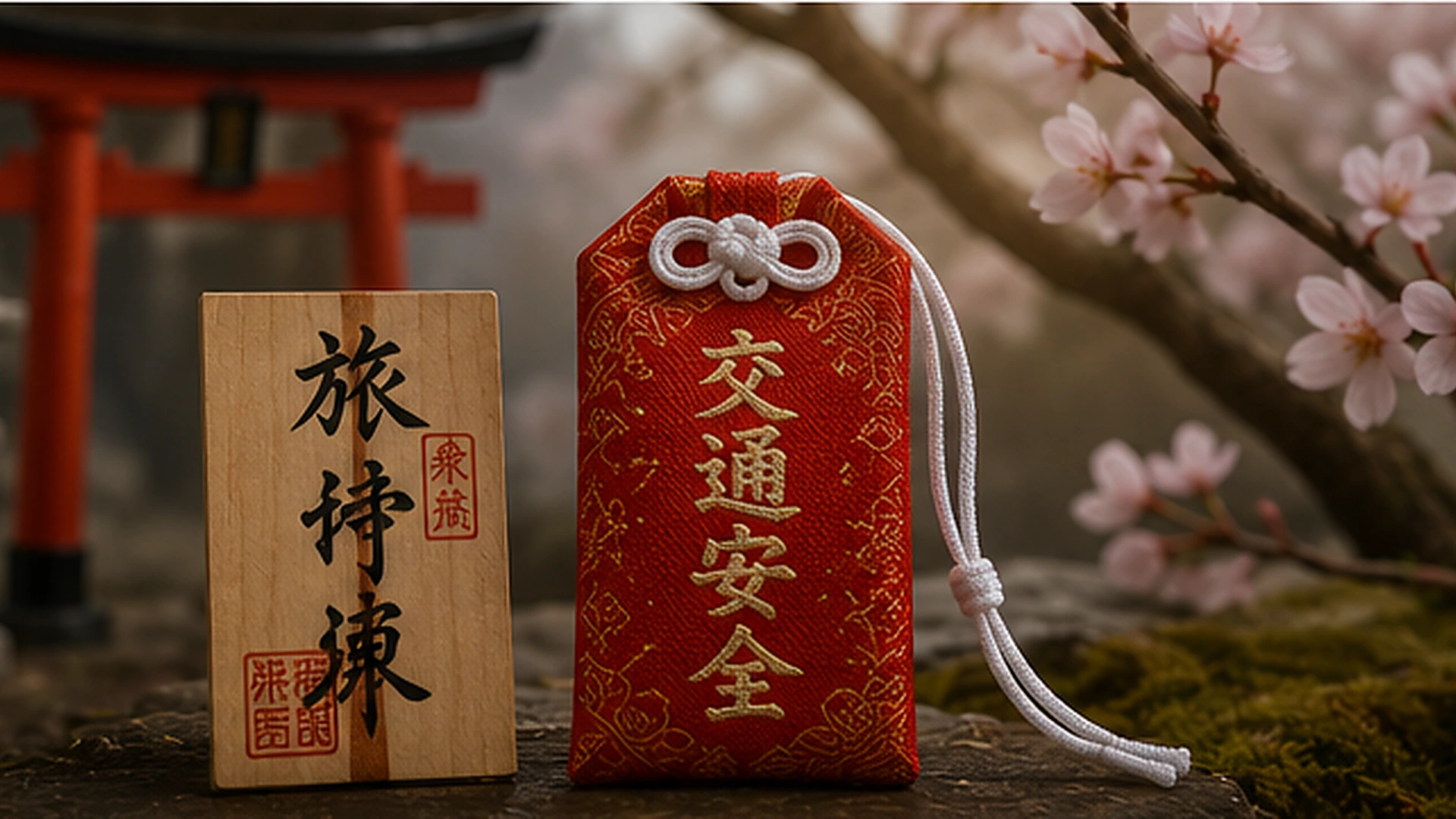
Japanese Buddhist temples and Shinto shrines distribute omamori, small protective amulets enclosed in cloth or another container. Different amulets are associated with health, study, safe childbirth, relationships, traffic safety and travel.
The British Museum records a Japanese omamori whose stated protective function is safe travel. Another example combines safe travel with general improvement and is designed to be attached or hung.[7] These objects show that travel protection remains a living, institutionally grounded practice rather than only an ancient survival.
An omamori is normally received from a particular shrine or temple. The enclosed paper or sacred content is not opened for inspection. Many people carry one in a bag, vehicle or wallet and later return it to the institution for respectful disposal or renewal, though practices vary.
Foreign visitors should not treat every omamori as interchangeable or open it for social-media content. The object may be purchased as a souvenir, but its meaning is connected to the religious site that issued it. Photographs, handling and disposal should follow local guidance.
A traffic-safety amulet does not replace a helmet, seat belt, sober driving, vehicle maintenance or legal licensing. Its religious function and the driver’s practical obligations belong together.
African Islamic Amulets: Somali Hersi and West African Written Protection
African protective amulets must be described with geographic and religious specificity. “African travel charm” is too broad to be meaningful.
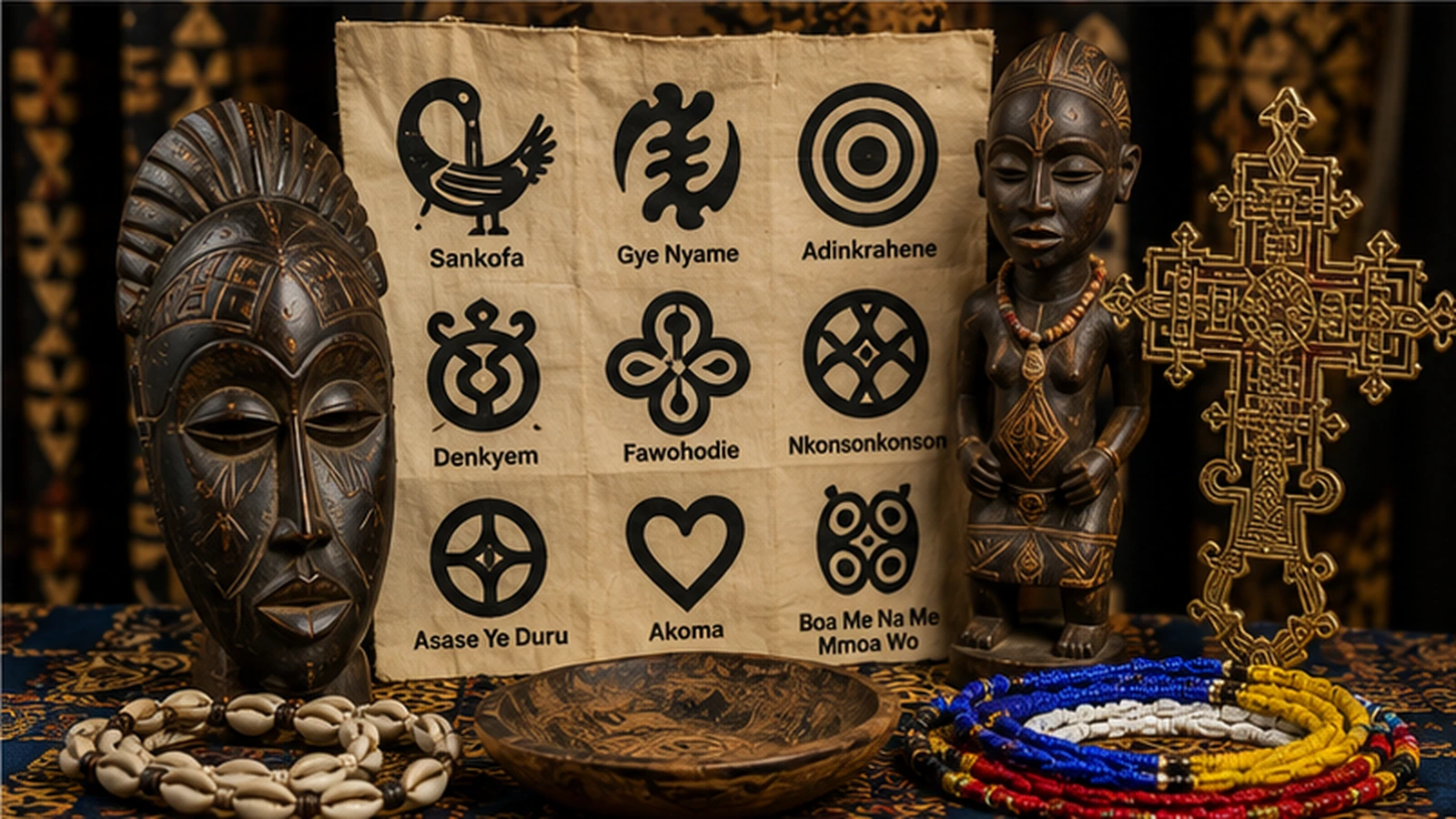
In Somalia, specialists have written Qur’anic verses on paper and placed them inside silver containers known as hersi, a word associated with protection. Smithsonian records describe these amulets as promoting health and well-being and note the importance of silverwork along the East African coast.[8]
In parts of West Africa, written amulets called hatumere have been created by religious specialists using Qur’anic passages, geometric forms and other designs. They may be folded into leather pouches, attached to clothing or carried on the body. Smithsonian documentation emphasizes the protective power attributed to sacred writing and the portable connection it creates with God’s words.[9]
These traditions are not identical to orthodox Islamic practice everywhere. Muslim scholars and communities differ over the permissibility of wearing amulets, especially when contents are unknown, include magic squares or combine Qur’anic passages with other signs. A visitor should not assume that every Muslim uses or approves of such objects.
Museum examples also come through histories of collecting that may have removed objects from their makers and owners. Reproducing the script, opening sealed containers or marketing generic “African travel talismans” can erase religious authority and local meaning.
The careful approach is to name the community, date, material and documented function. When the exact use is unknown, say so rather than inventing a journey ritual.

Modern Travel Spells and Personal Rituals
Contemporary spiritual practitioners may create personal travel rituals outside formal religion. Common elements include writing an intention, blessing luggage, tying a knot, carrying a small pouch, visualizing safe arrival, placing a symbol in a passport wallet or cleaning a vehicle before departure.
These practices are often eclectic. They may draw from modern witchcraft, New Age spirituality, family folklore, social-media aesthetics and therapeutic language. It is more accurate to call them modern spiritual practices than to claim they were performed by “all ancient travelers.”
A responsible personal ritual focuses on the traveler’s own conduct and preparedness. Examples include:
Clarity: Name the route, purpose and responsibilities of the journey.
Protection: Ask for alertness, wise choices, good companions and timely help.
Care for others: Remember drivers, pilots, workers, hosts and people remaining at home.
Practical action: Confirm documents, medication, transport, contacts and weather.
Return: Plan to communicate arrival and give thanks afterward.
Avoid rituals that involve open flames in vehicles or hotel rooms, ingesting unknown herbs, placing powders in public transport, carrying prohibited plant or animal materials across borders, hiding objects from security screening or using another culture’s sacred text without understanding it.
A symbolic object should also be replaceable. Losing a charm during travel should not be interpreted as proof that danger is inevitable. The meaning belongs to the relationship and intention, not to panic about perfect possession.
What Science Can and Cannot Say
Science can study anxiety, uncertainty, attention and repeated behavior. It cannot verify that a spiritual object creates an invisible shield around a traveler.
Experimental research has found that anxiety can increase repetitive and rigid movement patterns.[9] Field research among a Marathi Hindu community in Mauritius reported that familiar religious ritual was associated with reduced anxiety after a stressful task, but the study examined a specific community and ritual context rather than a universal travel spell.[10]
These findings support a limited conclusion: structured, meaningful action may help some people manage uncertainty. They do not prove that a particular charm prevents accidents, illness or crime.
Ritual can also become unhelpful. Warning signs include repeating the action for hours, believing any mistake will cause catastrophe, spending beyond one’s means, refusing to travel without a specific object, or ignoring practical danger because a charm is present. Severe or compulsive anxiety may require professional mental-health support.
The safest framing is that spiritual practice can accompany preparation, community support and responsible decision-making. It is not a replacement for them.
Ethics, Consent and Cultural Respect
Travel protection becomes ethically problematic when it promises control over other people or bypasses responsibility.
A ritual should not claim to force a visa officer, border official, employer, driver or host to ignore rules. It should not be used to justify smuggling, dangerous driving, trespassing, disrespect for sacred sites or evasion of health requirements.
Commercial sellers should not guarantee that an amulet will prevent crashes, secure a visa, stop theft or make an airline overlook documentation. High fees, urgent threats and claims that the traveler is cursed are common forms of spiritual exploitation.
Cultural respect requires more than adding symbols to a pouch. Sacred texts should be copied accurately and handled according to their tradition. Sealed amulets should not be opened for curiosity. Objects connected to a living shrine, mosque, synagogue, church or temple should be described using that institution’s language.
Travel itself creates ethical responsibilities. Visitors should follow local laws, dress expectations, photography rules and environmental guidance. A protection practice that centers only the traveler’s comfort while disregarding hosts, workers or ecosystems is spiritually incomplete.
Respect also includes uncertainty. Museum records may not reveal every private ritual. Oral traditions may be restricted. When evidence is incomplete, say “the object was associated with protection” rather than inventing a formula or ceremony.
A Practical Safe-Journey Checklist
Spiritual preparation is strongest when paired with practical preparation. The CDC’s 2026 Yellow Book recommends destination-specific risk assessment, vaccines or medicines when appropriate, and clear communication about hazards before international travel.[11]
Before Booking
Check passport validity, visa rules, entry requirements, political conditions, weather and transport reliability. Consider accessibility, health conditions and the needs of children or older travelers.
Several Weeks Before Departure
Consult a health professional or travel clinic when the destination or personal health makes that appropriate. Review routine vaccines, destination-specific vaccines, malaria prevention, prescriptions and medical documentation.[11]
Documents and Communication
Keep secure copies of passports, visas, tickets, insurance and prescriptions. Leave an itinerary and emergency contacts with a trusted person. Decide when and how you will check in.
Medication and Health Supplies
Carry needed medication in original packaging, with extra for delays when permitted. Pack a basic health kit suited to the destination and activities. Check whether any medicine is restricted at the destination.
Transportation
Use licensed transport when possible. Wear seat belts and helmets. Avoid impaired drivers, overloaded vehicles and unnecessary night travel. Motor-vehicle crashes are a major risk for travelers.[12]
Money and Digital Security
Use more than one secure payment method. Protect banking access, avoid public Wi-Fi for sensitive transactions, enable device locks and keep emergency funds separate.
Accommodation and Local Conditions
Know the address, emergency exits and transport options. Follow food, water, insect, heat, altitude and animal-safety guidance relevant to the destination.
Medical Care and Insurance
Know how to obtain care and whether your insurance covers treatment abroad. Medical-evacuation coverage may be important for remote travel.[13]
At Departure
Check weather, route changes, delays, fuel or charging, identity documents and emergency numbers. Then pray, receive a blessing or perform a personal ritual if that is meaningful.
The checklist is not spiritually separate from the blessing. Attention, honesty and care are themselves ways of honoring the journey.
A Simple Non-Denominational Departure Ritual
This reflective practice is designed for people who want a symbolic moment without borrowing sacred words from a tradition they do not follow.
1. Stand beside your packed bag. Take three slow breaths and notice the actual conditions: time, weather, transport and how your body feels.
2. Name the journey. Say where you are going, why you are going and who needs to know your plans.
3. State a grounded intention. For example: “May I travel alertly, treat people with respect, accept help wisely and return safely.”
4. Touch three practical items. Confirm your identity document, phone and medication or water. This links the symbolic moment to real preparation.
5. Remember others. Include drivers, pilots, crew, workers, hosts, family and people traveling under more difficult conditions.
6. Close with an action. Send your check-in message, lock the door, fasten the seat belt or begin the route.
No candle, smoke, powder or blade is required. The ritual does not promise control over the road. Its purpose is to gather attention, values and practical readiness into one deliberate departure.
Common Misunderstandings
“Every culture had the same travel spell.” No. Portable protection appears widely, but traditions differ in theology, history and practice.
“Prayer means planning shows weak faith.” Most religious traditions do not treat negligence as trust. Preparation and prayer can coexist.
“A sacred amulet is just jewelry.” It may also be a consecrated object connected with a specific institution, text or community.
“If the charm is lost, danger is certain.” Loss does not prove a prediction. Replace practical essentials and seek support if panic becomes overwhelming.
“A protection ritual can force officials to approve a journey.” Ethical spiritual practice does not override law, consent or fair procedure.
“Any foreign symbol can be added to a travel pouch.” Combining sacred objects without context can become disrespectful, especially when text is copied incorrectly or restricted practices are commercialized.
“Safe travel means nothing difficult will happen.” A blessing may ask for courage, help and wise response as well as avoidance of harm. Delays and changes are not evidence of spiritual failure.
People Also Ask
What is a travel protection ritual?
It is a prayer, blessing, charm or symbolic action used by a particular community or individual to seek guidance, courage, protection and safe return during travel.
What prayer can I say before a journey?
Use the prayer of your own tradition or a simple request for wisdom, alertness, good companions and safe arrival. Avoid copying sacred-language formulas from unreliable graphics.
What does a Saint Christopher medal mean?
Saint Christopher is honored in Christian tradition as a protector of travelers. The medal is a devotional reminder and prayer aid, not a guarantee against accidents.
What is Tefilat HaDerech?
Tefilat HaDerech is the Jewish traveler’s prayer, rooted in Berakhot 29b–30a. It asks for peaceful guidance, protection and blessing during the journey.
What is the Islamic dua for travel?
Islamic sources preserve a supplication praising Allah, asking for righteousness and ease, and entrusting both the traveler and family at home to God’s care.[6]
What is a safe-travel omamori?
It is a Japanese amulet issued by a shrine or temple for a protective purpose such as safe travel or traffic safety. It should be handled according to the issuing institution’s guidance.
Can a travel charm guarantee safety?
No. A charm may carry religious or emotional meaning, but it cannot guarantee protection from mechanical failure, illness, crime, weather or human error.
Is it disrespectful to buy a religious amulet as a souvenir?
Not always, but context matters. Buy from the religious institution when possible, do not open sealed contents and follow guidance about handling or return.
Can prayer be used with travel insurance and medical preparation?
Yes. Spiritual practice and practical risk management address different needs and can support one another.
Are travel protection spells ancient?
Some protective prayers and amulets are ancient or medieval. Many recognizable modern “travel spell” formats are contemporary combinations and should not be marketed as unchanged universal traditions.
Conclusion
Travel protection rituals reveal how communities respond to uncertainty, distance and separation. Medieval Christian pendants, Jewish traveler prayer, Islamic supplication, Japanese omamori and African Islamic amulets all make protection portable, but they do so through different histories and beliefs.
The most respectful approach is to name the tradition, use reliable sources and avoid promises of automatic safety. A prayer may strengthen trust. A blessing may connect family members. An amulet may carry sacred presence and memory. A personal ritual may help focus attention.
A safe journey still depends on documents, health preparation, reliable transport, communication, local knowledge and responsible choices. Spiritual practice is most meaningful when it deepens—not replaces—those forms of care.
Article Information
- Publisher
- Ancestral Temple
- Editor
- Ancestral Temple
- Last updated
- Jul 30, 2026
- Last reviewed
- Jul 30, 2026
- Content version
- 2942bcd9b2
This educational article should be read as cultural and spiritual information, not as medical, legal, financial, or emergency advice.
Helpful Related Guidance
About the Author
 Ancestral Temple
Spiritual guide and practitioner with decades of experience in ancestral wisdom, rituals, and divine guidance.
Related Posts
View All











Comments
We'd love to hear your thoughts.