
Solstices and Equinoxes Explained
Pillar Article
Quick Summary
Discover how Earth’s axial tilt creates the June and December solstices and the March and September equinoxes, changing daylight, seasons, calendars, and cultural traditions around the world.
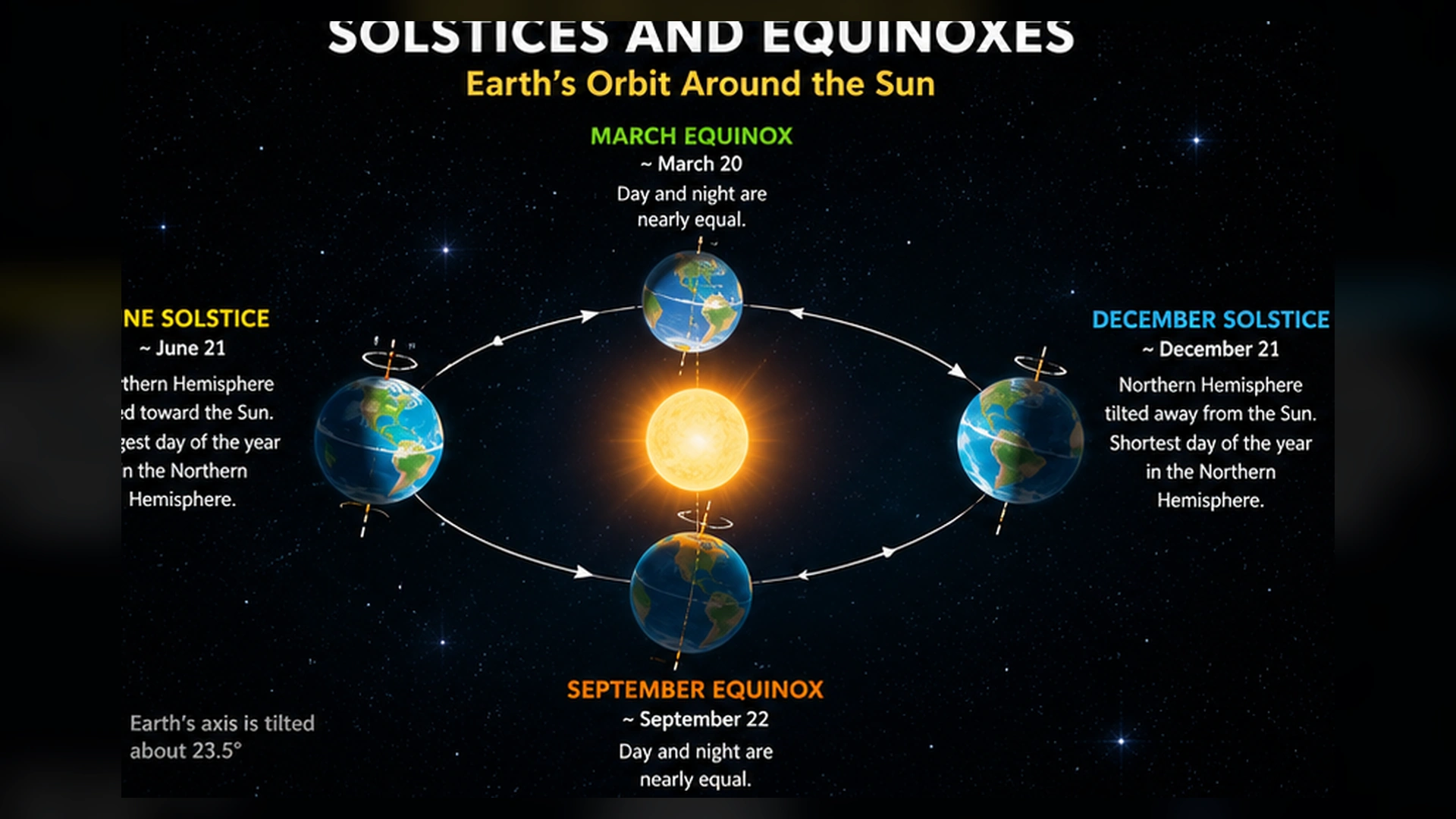
Solstices and equinoxes are four important moments in Earth’s yearly orbit around the Sun. They mark the turning points of the astronomical seasons and help explain why daylight grows longer or shorter during the year.
The two solstices occur in June and December. At a solstice, one of Earth’s hemispheres is tilted most strongly toward the Sun while the other is tilted most strongly away. This creates the longest day of the year in one hemisphere and the shortest in the other.
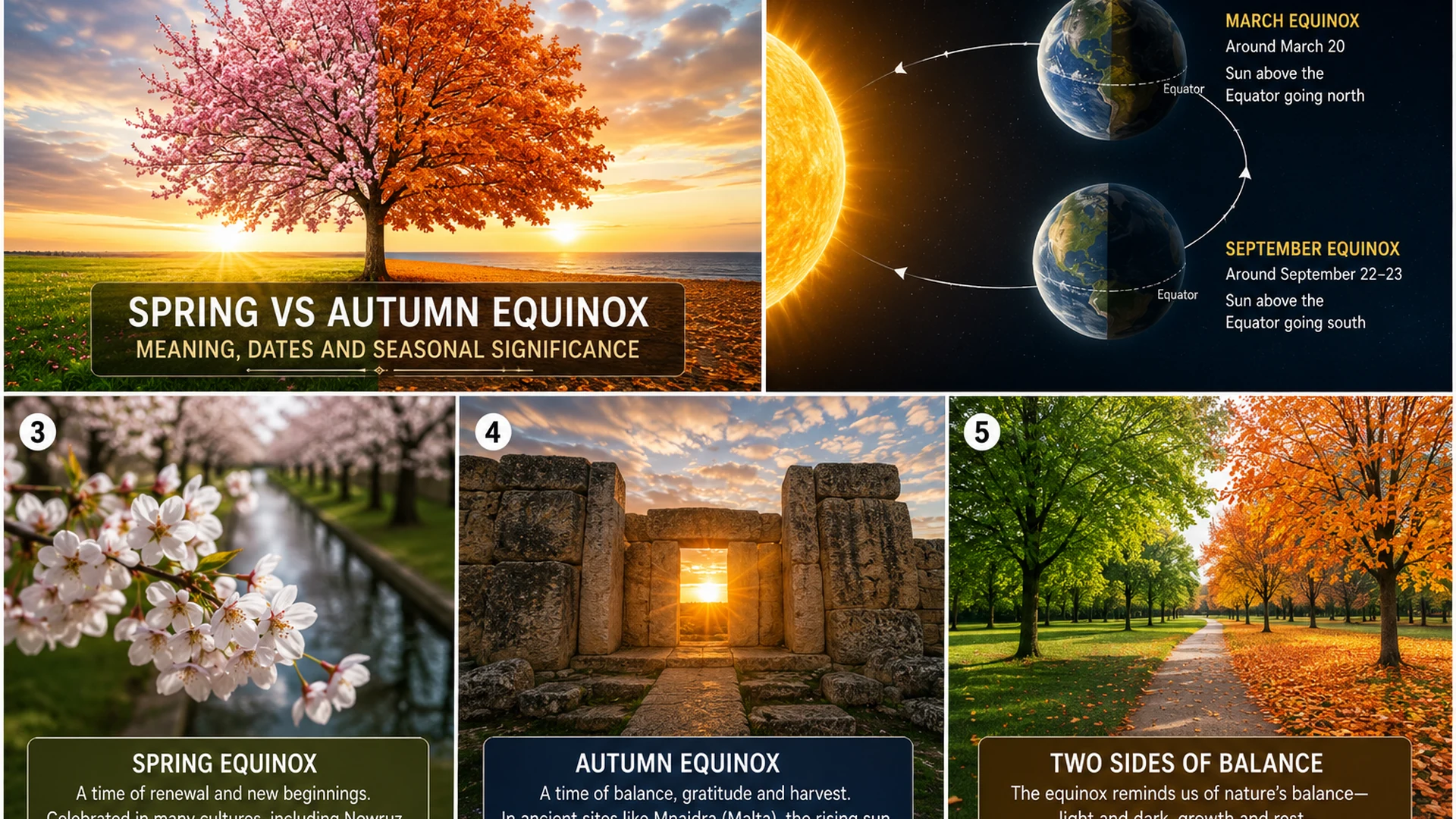
The two equinoxes occur in March and September. At an equinox, the Sun’s center crosses Earth’s equatorial plane, and both hemispheres receive nearly equal amounts of daylight.
These events happen because Earth’s rotational axis is tilted by about 23.5 degrees relative to its orbit. They are not caused by Earth moving dramatically closer to or farther from the Sun. [1]
Key Points
- Earth’s tilted axis creates the seasons.
- A solstice occurs when the Sun reaches its farthest apparent position north or south of the equator.
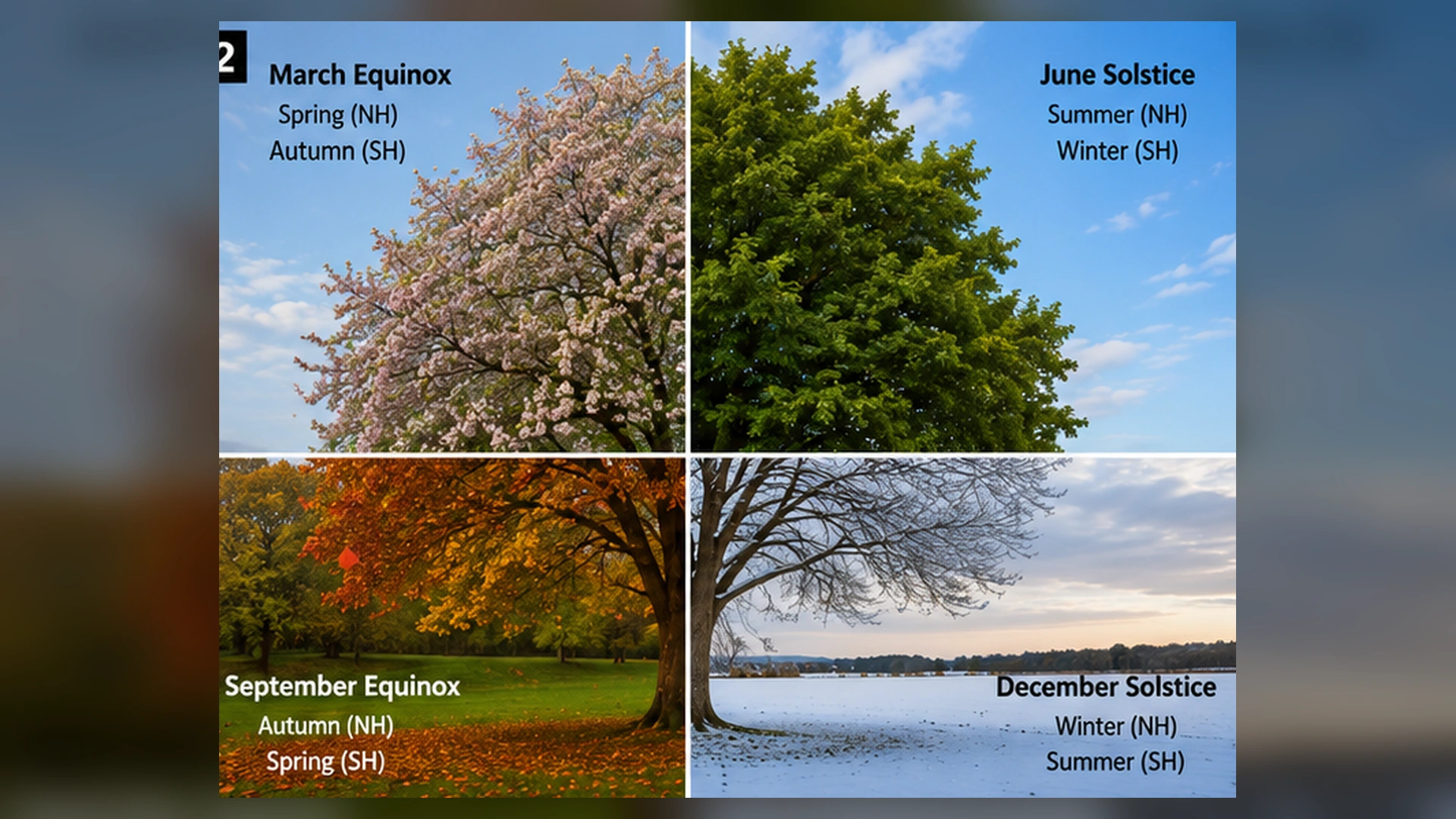
- The June solstice brings astronomical summer north of the equator and winter south of it.
- The December solstice brings astronomical winter north of the equator and summer south of it.
- An equinox occurs when the Sun’s center crosses the celestial equator.
- The March equinox begins astronomical spring in the Northern Hemisphere and autumn in the Southern Hemisphere.
- The September equinox begins astronomical autumn in the Northern Hemisphere and spring in the Southern Hemisphere.
- Day and night are nearly, but not exactly, equal on an equinox.
- The four-season model is not equally useful in every climate.
- Many tropical communities organize seasonal life around rainfall, rivers, crops, grazing, or stars rather than solstice-based seasons.
- Cultural celebrations associated with these dates are diverse and should not be combined into one universal solar religion.
What Causes Earth’s Seasons?
Earth rotates around an axis that is tilted rather than perfectly upright. As Earth orbits the Sun, this axis continues pointing in approximately the same direction in space.
For part of the year, the Northern Hemisphere tilts toward the Sun and receives:
- More direct sunlight
- A higher daily Sun path
- Longer daylight hours
- Shorter nights
At the same time, the Southern Hemisphere tilts away and receives less direct sunlight and shorter days. Six months later, the relationship reverses. [1]
Clear Definition
Solstices and equinoxes are astronomical events created by Earth’s tilted axis and orbit, marking the yearly extremes and crossing points of the Sun’s apparent north-south movement.
Plain-Language Meaning
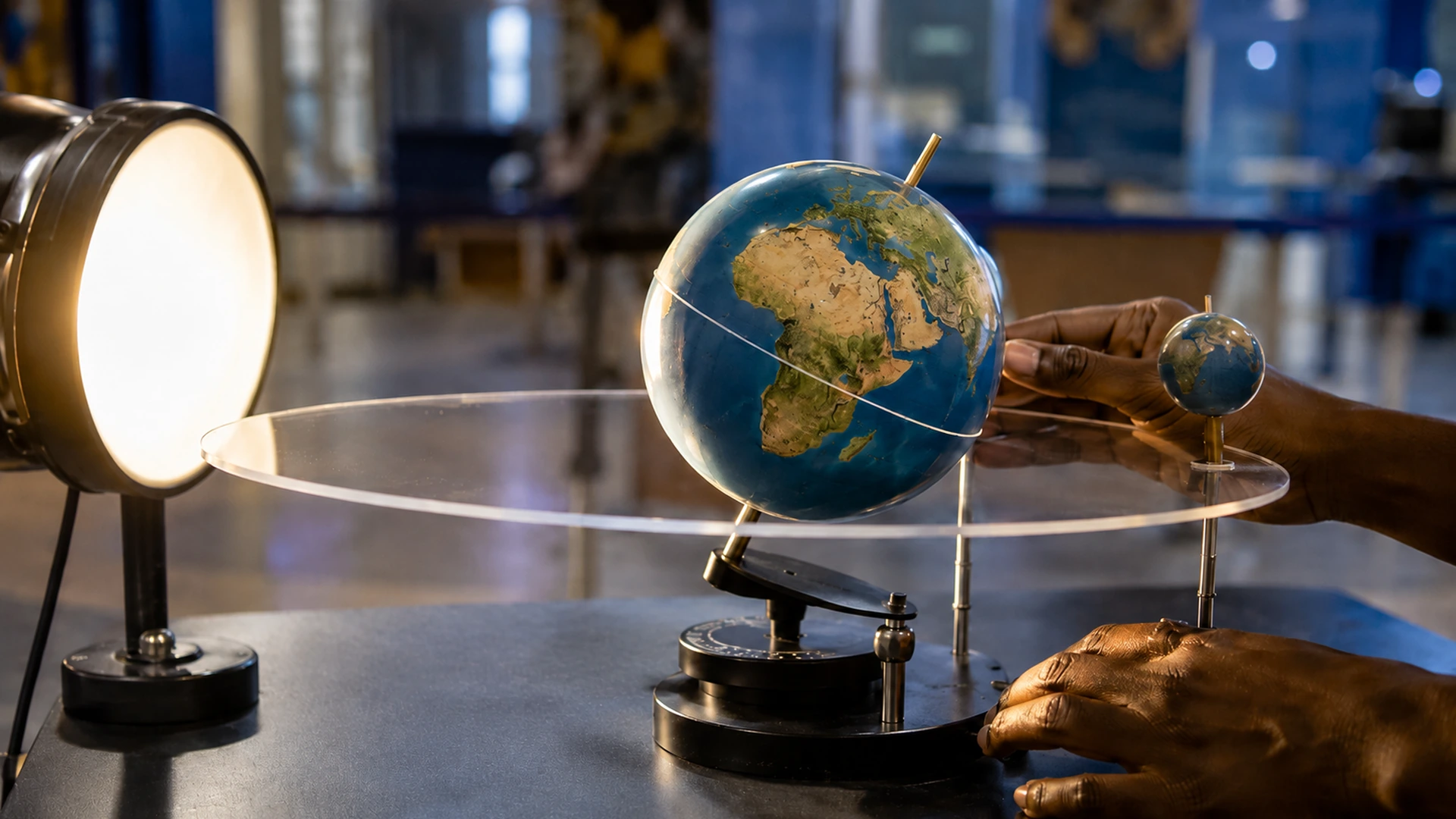
Imagine Earth as a tilted spinning ball moving around a lamp.
The lamp represents the Sun. Because the ball remains tilted as it moves, one half receives longer and more direct sunlight, while the other receives shorter and less direct sunlight. The solstices are the maximum points of that difference. The equinoxes are the crossing points between them.
Seasons Are Not Caused by Earth’s Distance From the Sun
A common misconception says summer occurs because Earth is closer to the Sun.
That explanation cannot be correct because the Northern and Southern Hemispheres experience opposite seasons at the same time. Earth is one distance from the Sun, yet one hemisphere may be in summer while the other is in winter.
The decisive factors are:
- The angle of sunlight
- The length of daylight
- Earth’s axial tilt
- The Sun’s path through the sky
What Is a Solstice?
The word solstice comes from Latin terms commonly translated as “Sun standing still.”
Around each solstice, the Sun’s sunrise and sunset positions along the horizon change very slowly before reversing direction. To a careful observer, the Sun appears to pause at its farthest northern or southern point.
Astronomically, a solstice is the moment when the Sun reaches its greatest declination north or south of Earth’s equator. NOAA describes solar declination as reaching approximately plus 23.44 degrees at the Northern Hemisphere summer solstice and minus 23.44 degrees at its winter solstice. [4]
What Is an Equinox?
The word equinox comes from Latin words meaning “equal night.”
Astronomically, an equinox occurs when the center of the Sun crosses the plane of Earth’s equator. At that moment, the Sun is directly above the equator, and daylight is distributed nearly equally between the hemispheres. [3]
There are two equinoxes each year:
- The March equinox
- The September equinox
The Four Astronomical Turning Points
- Event
- Approximate date
- Northern Hemisphere
- Southern Hemisphere
- March equinox
- March 19–21
- Spring begins
- Autumn begins
- June solstice
- June 20–22
- Summer begins
- Winter begins
- September equinox
- September 21–24
- Autumn begins
- Spring begins
- December solstice
- December 20–23
- Winter begins
- Summer begins
Exact dates and times vary slightly because the calendar year does not perfectly match Earth’s orbital period and because leap-year corrections shift civil dates.
1. The June Solstice
At the June solstice, the Northern Hemisphere reaches its maximum tilt toward the Sun.
For locations north of the equator, this generally produces:
- The longest daylight period of the year
- The shortest night
- The Sun’s highest annual noon position
- The beginning of astronomical summer
South of the equator, the same event produces the shortest day, longest night, lowest annual Sun path, and beginning of astronomical winter. [1]
Is June 21 Always the Solstice?
No.
The June solstice may occur on June 20, 21, or occasionally June 22 depending on the year and time zone. The astronomical event happens at one instant worldwide, but local clocks and calendar dates differ.
What Happens at the Tropic of Cancer?
Near the June solstice, the midday Sun can appear directly overhead at locations near the Tropic of Cancer, approximately 23.5 degrees north latitude.
This is the northernmost latitude where the Sun can be directly overhead at noon.
2. The December Solstice
At the December solstice, the Southern Hemisphere reaches its maximum tilt toward the Sun.
For the Southern Hemisphere, this generally produces:
- The longest daylight period
- The shortest night
- The Sun’s highest annual path
- The beginning of astronomical summer
For the Northern Hemisphere, it produces the shortest day, longest night, lowest annual Sun path, and beginning of astronomical winter.
What Happens at the Tropic of Capricorn?
Near the December solstice, the midday Sun can appear directly overhead at locations near the Tropic of Capricorn, approximately 23.5 degrees south latitude.
Frequently Asked Questions
What should readers know first about Solstices and equinoxes explained?
Solstices and equinoxes explained: Discover how Earth’s axial tilt creates the June and December solstices and the March and September equinoxes, changing day
What causes Solstices and equinoxes explained?
Discover how Earth’s axial tilt creates the June and December solstices and the March and September equinoxes, changing daylight, seasons, calendars, and cultural traditions around the world. The safest next step is to compare the signs, prepare clear details,
How does Solstices and equinoxes explained work?
Discover how Earth’s axial tilt creates the June and December solstices and the March and September equinoxes, changing daylight, seasons, calendars, and cultural traditions around the world. The safest next step is to compare the signs, prepare clear details,
Is it possible to get private guidance for Solstices and equinoxes explained?
Discover how Earth’s axial tilt creates the June and December solstices and the March and September equinoxes, changing daylight, seasons, calendars, and cultural traditions around the world. The safest next step is to compare the signs, prepare clear details,
How long does Solstices and equinoxes explained take to understand?
Discover how Earth’s axial tilt creates the June and December solstices and the March and September equinoxes, changing daylight, seasons, calendars, and cultural traditions around the world. The safest next step is to compare the signs, prepare clear details,
Can Solstices and equinoxes explained affect relationships, family, work, or personal peace?
Discover how Earth’s axial tilt creates the June and December solstices and the March and September equinoxes, changing daylight, seasons, calendars, and cultural traditions around the world. The safest next step is to compare the signs, prepare clear details,
Why do people seek spiritual guidance for Solstices and equinoxes explained?
Discover how Earth’s axial tilt creates the June and December solstices and the March and September equinoxes, changing daylight, seasons, calendars, and cultural traditions around the world. The safest next step is to compare the signs, prepare clear details,
What signs should someone notice before asking about Solstices and equinoxes explained?
Discover how Earth’s axial tilt creates the June and December solstices and the March and September equinoxes, changing daylight, seasons, calendars, and cultural traditions around the world. The safest next step is to compare the signs, prepare clear details,
When should someone contact a private spiritual guide?
Discover how Earth’s axial tilt creates the June and December solstices and the March and September equinoxes, changing daylight, seasons, calendars, and cultural traditions around the world. The safest next step is to compare the signs, prepare clear details,
Article Information
- Publisher
- Ancestral Temple
- Editor
- Ancestral Temple
- Last updated
- Jul 26, 2026
- Last reviewed
- Jul 13, 2026
- Content version
- 19f1e63947
This educational article should be read as cultural and spiritual information, not as medical, legal, financial, or emergency advice.
Helpful Related Guidance
Explore This Topic
Solstices And Equinoxes Explained · Moon, Sun And Seasons
Related Topic Cluster
Solstices And Equinoxes Explained
Complete Guide How African Spiritual Beliefs Have Evolved Through HistoryAbout the Author
 Ancestral Temple
Spiritual guide and practitioner with decades of experience in ancestral wisdom, rituals, and divine guidance.
Related Posts
View All
Leave a Comment
We'd love to hear your thoughts.
This was comprehensive without suggesting that readers need to perform a solstice ceremony.
Are there recommended tools for recording local sunrise and sunset positions?
The article showed why similar solar celebrations do not all have the same meaning.
A future article about sunrise positions across Uganda would be interesting.
I liked the reminder that the solstice is one instant rather than an entire day.
Strong overview connecting Earth science, calendars, monuments, and seasonal traditions.
The misconceptions section corrected several claims I have seen online.
The tone remained neutral while explaining religious and cultural differences.
The noon-shadow activity is something families and schools could try safely.
I appreciated that no invented universal African solstice ritual was included.
More examples from southern African seasonal knowledge would make a valuable follow-up.
A full article about archaeoastronomy and false alignments would be interesting.
The strongest lesson was that the same date produces opposite seasons in the two hemispheres.
The article respected cultural beliefs while rejecting guaranteed spiritual claims.
I liked that families can create a seasonal observation tradition without copying a sacred ceremony.
The climate-change section clearly separated astronomical dates from ecological change.
Could you write next about solar calendars in African communities?
The paragraphs and lists worked well on mobile.
The article was long but easy to navigate because of the short sections.
This is useful for students of astronomy, geography, history, and culture.
Thank you for including eye-safety guidance for observing the Sun.
The section on ecological seasons was important for tropical regions.
I appreciated the warning against calling every old building a solar observatory.
A printable diagram comparing the four events would make a helpful companion resource.
The glossary made terms such as declination and celestial equator easy to follow.
The difference between astronomical and meteorological seasons was very useful.
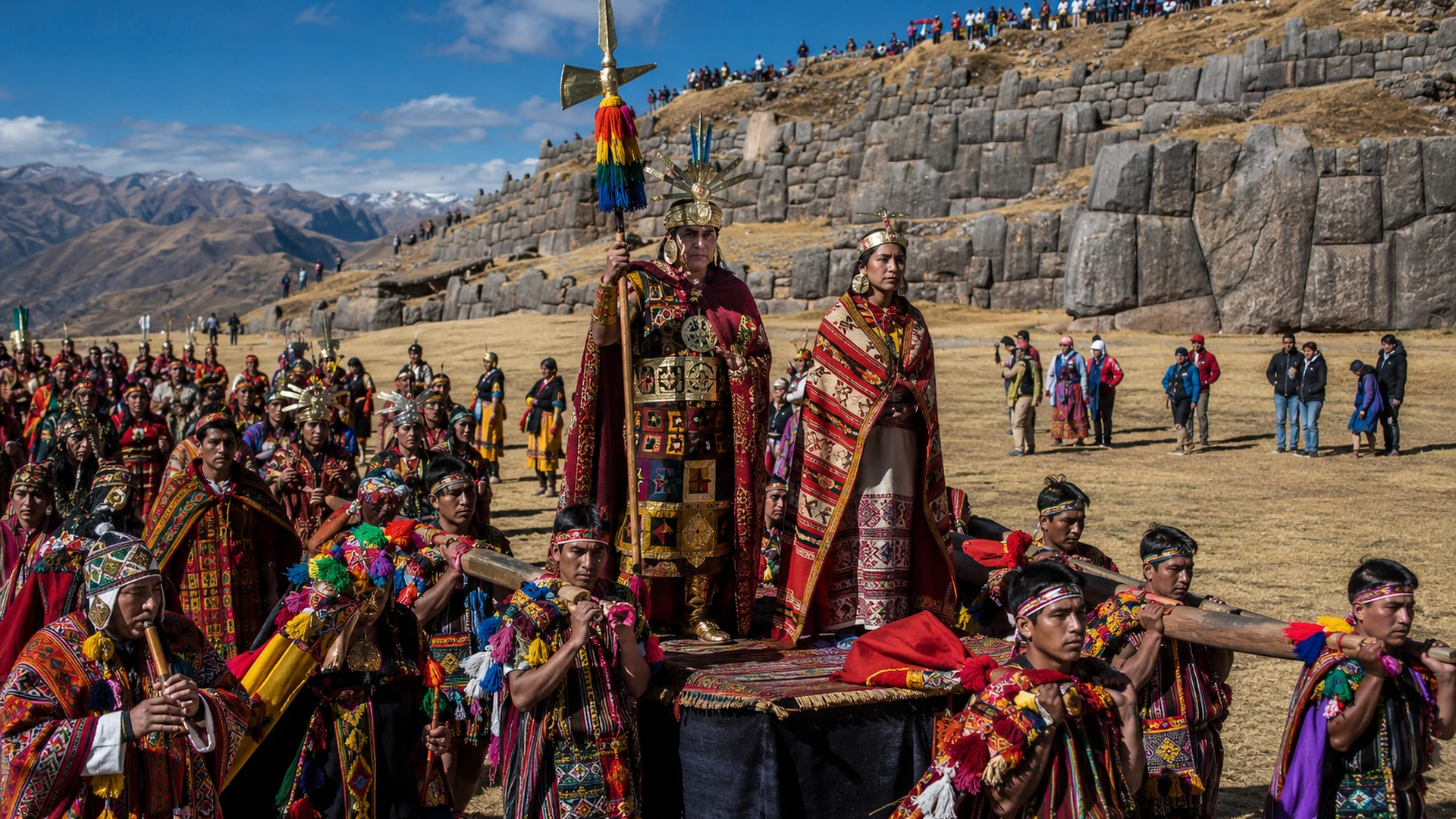
The Inti Raymi section clearly explained the Southern Hemisphere winter solstice.
I did not realize Swedish Midsummer had such strong agricultural roots.
This was scientifically accurate without dismissing cultural traditions.
The polar-region section helped me understand midnight Sun and polar night.
I would like a detailed guide to observing shadow length through the year.
The explanation of exact moments and different local dates was useful.
The Nowruz section showed why one equinox tradition can belong to several cultures.
The Stonehenge section was careful about the difference between alignment and unknown prehistoric beliefs.
I appreciated that modern spiritual practices were described honestly rather than presented as universal ancient traditions.
The table of four astronomical events was simple and clear.
The equilux section answered a question I have had for years.
A separate article about wet and dry seasons near the equator would be useful.
I did not know that day and night are not exactly equal on the equinox.
I appreciated that African seasonal systems were not reduced to the European four-season model.
The explanation of solar declination was detailed without becoming difficult.
I liked that the article used June solstice and December solstice to avoid hemisphere confusion.
The Northern and Southern Hemisphere comparison was especially helpful.
I had always assumed summer happened because Earth was closer to the Sun.
The tilted-Earth explanation made the difference between solstices and equinoxes easy to understand.