
Lost-Item Recovery Rituals: Prayers, Traditions and Cultural Beliefs
Pillar Article
Quick Summary
Losing an object can feel strangely personal. A key, ring, document, phone or family keepsake may be physically small, yet its disappearance can trigger panic, guilt, suspicion or...
Losing an object can feel strangely personal. A key, ring, document, phone or family keepsake may be physically small, yet its disappearance can trigger panic, guilt, suspicion or the fear that something larger has gone wrong. Across religious and cultural traditions, people have responded by praying, asking a saint for intercession, baking and sharing food, consulting community elders, announcing found property or following a moral duty to return what belongs to someone else.
These practices do not all mean the same thing. Catholic devotion to Saint Anthony of Padua differs from Greek Orthodox prayer to Saint Phanourios. Jewish hashavat aveidah is primarily an obligation placed on the finder, while Islamic guidance combines general supplication with rules governing lost property and warnings against fortune-tellers. A modern search using memory cues, digital tracking and lost-and-found systems belongs to another category again.
This guide explains those differences and offers a calm method that can be used alongside prayer. It does not promise supernatural recovery, diagnose theft without evidence or encourage a reader to accuse another person. When a passport, bank card, medication, phone or legal document is missing, practical security steps should begin immediately even while a person prays.
Quick Answer
| In one paragraph Lost-item recovery rituals are prayers, devotional customs and community practices used when something has gone missing. Catholic Christians may ask Saint Anthony for intercession; some Orthodox Christians pray to Saint Phanourios and later share a sweet bread in gratitude. Jewish and Islamic traditions strongly emphasize returning found property. These practices can accompany a systematic search, but they do not guarantee recovery or justify accusing anyone. |
|---|
For personal prayer or ritual guidance, AncestralTemple.com may help readers create a reflective practice compatible with their own beliefs. Such support should never replace urgent security actions or be sold as a guaranteed way to reveal a thief.
Lost-Item Recovery at a Glance
| Tradition or method | Common response | Central meaning | Important boundary |
|---|---|---|---|
| Catholic Christianity | Prayer asking Saint Anthony of Padua to intercede | Devotion and trust in God while searching | Not a magical contract or guaranteed recovery |
| Greek Orthodox Christianity | Prayer to Saint Phanourios; phanouropita may be shared in gratitude | Revelation, intercession, charity and remembrance | Custom varies; the bread is not payment for a miracle |
| Judaism | Hashavat aveidah, the duty to return lost property | Moral responsibility of the finder and community | Primarily an ethical commandment, not a locating spell |
| Islam | General dua, lawful handling of luqatah and publicizing found property | Reliance on God joined to honesty and legal duty | No need to invent fixed formulas or consult fortune-tellers |
| Modern practical recovery | Retracing context, zone search, lost-and-found calls and device tracking | Memory cues, coordination and risk reduction | Memory can be mistaken; verify before accusing anyone |
What Is a Lost-Item Recovery Ritual?
A lost-item recovery ritual is a repeated or meaningful action performed while seeking something that has disappeared. It may involve prayer, a saint, a vow of gratitude, a household custom, a community announcement or a structured search. The word ritual does not automatically imply magic. In many settings, the act organizes attention, expresses dependence on God, reduces panic or invites other people to help.
The same outward action can have different meanings. Lighting a candle in a Catholic church may accompany intercessory prayer. Baking phanouropita in a Greek Orthodox community expresses gratitude and charity. Posting a notice in a synagogue or mosque can support a religious duty to return property. Walking through the last known route of an object is a cognitive search strategy rather than a religious rite.
A responsible article must also distinguish misplacement from theft. When an object cannot be found, there is usually not enough evidence to identify a thief. Stress can make a person overconfident in a mistaken memory, especially when several similar locations or routines are involved. Prayer may support patience, but it should never become a method of naming a suspect.
Why Ritual Can Feel Helpful During a Search
A familiar prayer can interrupt panic and slow impulsive searching.
Naming the object and its last known use can create clearer memory cues.
A religious practice can make an ordinary frustration feel held within a larger moral or spiritual framework.
Community customs encourage people to announce, report and return what they find.
A vow of gratitude or charity may turn relief into generosity rather than private luck.
A fixed sequence prevents repeatedly checking the same obvious place while ignoring other zones.
These benefits are compatible with belief, but they are not proof that a supernatural force moved the item. A person may find the object because attention improved, another person saw the notice, a digital network reported the location or the item was in a place that had not yet been searched.
A 12-Minute Search Method Before You Search Everywhere
1. Pause for one minute. Stop moving objects randomly. Take three slow breaths and say a prayer if that belongs to your tradition. Panic increases repetition and makes it harder to notice what has already been checked.
2. Describe the item precisely. State its size, color, case, attached keyring, contents and any damage or identifying marks. A precise description improves both searching and lost-and-found reports.
3. Identify the last confirmed contact. Ask when you last physically touched, used, charged, wore, paid with or handed over the item. Separate a confirmed memory from an assumption such as “I always put it there.”
4. Reconstruct the route. Return mentally or physically to the room, vehicle, desk, shop or doorway involved. Research on context reinstatement shows that returning to a prior context can support memory, although it can also increase false recognition of similar objects or locations. [10][11]
5. Search by zones, not by anxiety. Check one complete zone at a time: body and clothing, bags, surfaces, floor level, furniture gaps, laundry, vehicle, doorway and outside route. Mark each completed zone.
6. Use sound and light. Ring a phone, use a flashlight along floor edges, shake bedding carefully and listen inside bags or drawers. Do not dismantle appliances or enter unsafe spaces.
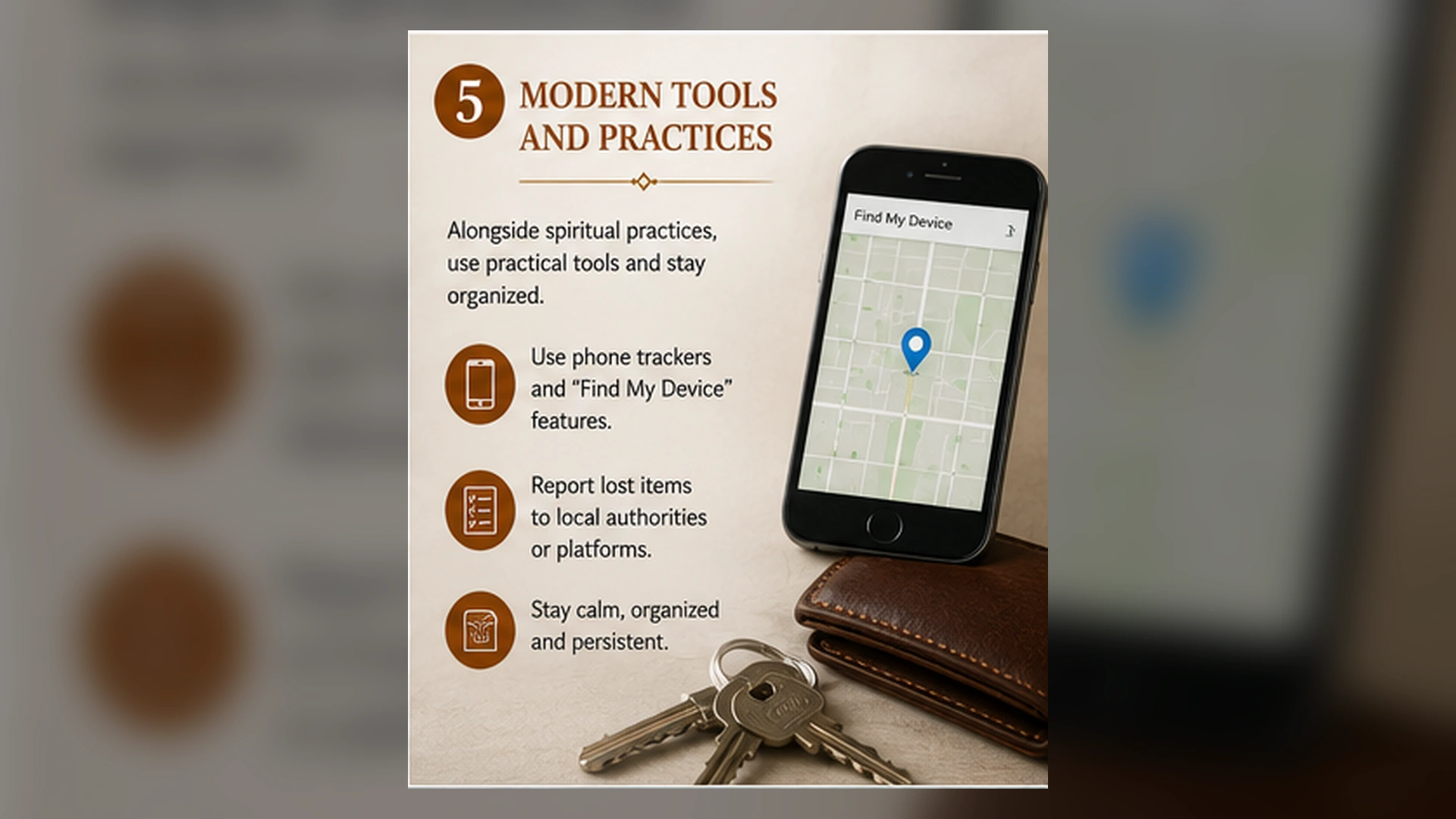
7. Activate digital tools. Apple Find My and Google Find Hub can locate, ring, lock or erase supported devices and tagged items when their conditions are met. [12][13]
8. Contact the handoff points. Call the taxi, school, workplace, restaurant, security desk, place of worship, clinic or shop where the item may have changed hands.
9. Secure high-risk losses immediately. Freeze bank cards, mark a phone as lost, change exposed passwords, report passports or identity documents and contact the relevant authority when theft is possible.
10. Review the search with another person. A calm second searcher often notices assumptions, blind spots and places that the owner mentally excludes.
| Memory caution Retracing the original context can help recall, but context can also make a similar object or location feel familiar. Treat a remembered image as a clue, not proof that another person took the item. |
|---|
Saint Anthony of Padua and Catholic Prayer for Lost Things
Saint Anthony of Padua is the best-known Christian saint associated with lost objects. The Basilica of Saint Anthony in Padua publishes a prayer asking his help in finding what has been lost and connects the request with a wider desire to recover grace, virtue and direction. [1] The tradition is therefore not only about locating keys or documents; it places an everyday need within prayer to God.
Catholic theology understands this as intercession. The person asks a saint to pray with and for them; the saint is not treated as an independent magical power. Local rhymes and household sayings have developed around Saint Anthony, but they should not be presented as official formulas or guaranteed techniques.
A respectful practice may be simple: pause, name the lost object, ask God for calm and ask Saint Anthony to intercede, then begin a systematic search. If the object is recovered, gratitude may be expressed through prayer, honesty, charity or helping someone else recover what they have lost.
Original prayer inspired by the tradition
| Prayer God of wisdom and care, through the prayers of Saint Anthony, calm my mind and guide my search. Help me remember clearly, act honestly and accept help from others. If this item can be recovered, lead me toward it; if it cannot, give me patience and wisdom for the next responsible step. Amen. |
|---|
Saint Phanourios and the Orthodox Tradition of Revealing What Is Lost
In Greek Orthodox tradition, Saint Phanourios is associated with revealing what has been lost or hidden. The Orthodox Church in America explains that his name resembles the Greek verb meaning “to reveal” or “to disclose,” and that people pray to him for help finding lost objects. [2]
The same source describes a custom in which a sweet bread or cake, often called phanouropita, is baked and shared with the poor after the item is recovered, together with prayers associated with the saint’s mother. The custom combines intercession, gratitude, remembrance and almsgiving. It should not be described as payment to force a saint to produce a result.
Historical certainty is limited. Public Orthodox scholarship notes that devotion to Saint Phanourios developed after the discovery of his image on Rhodes and that later popular traditions contain details that are not equally supported by early evidence. [3] A responsible writer can describe the living custom without claiming that every legend is historically verified.
People outside Greek or Cypriot Orthodox communities should avoid turning phanouropita into a viral “manifestation cake.” When participation is appropriate, the tradition is best learned through an Orthodox parish and understood as prayer, charity and thanksgiving.
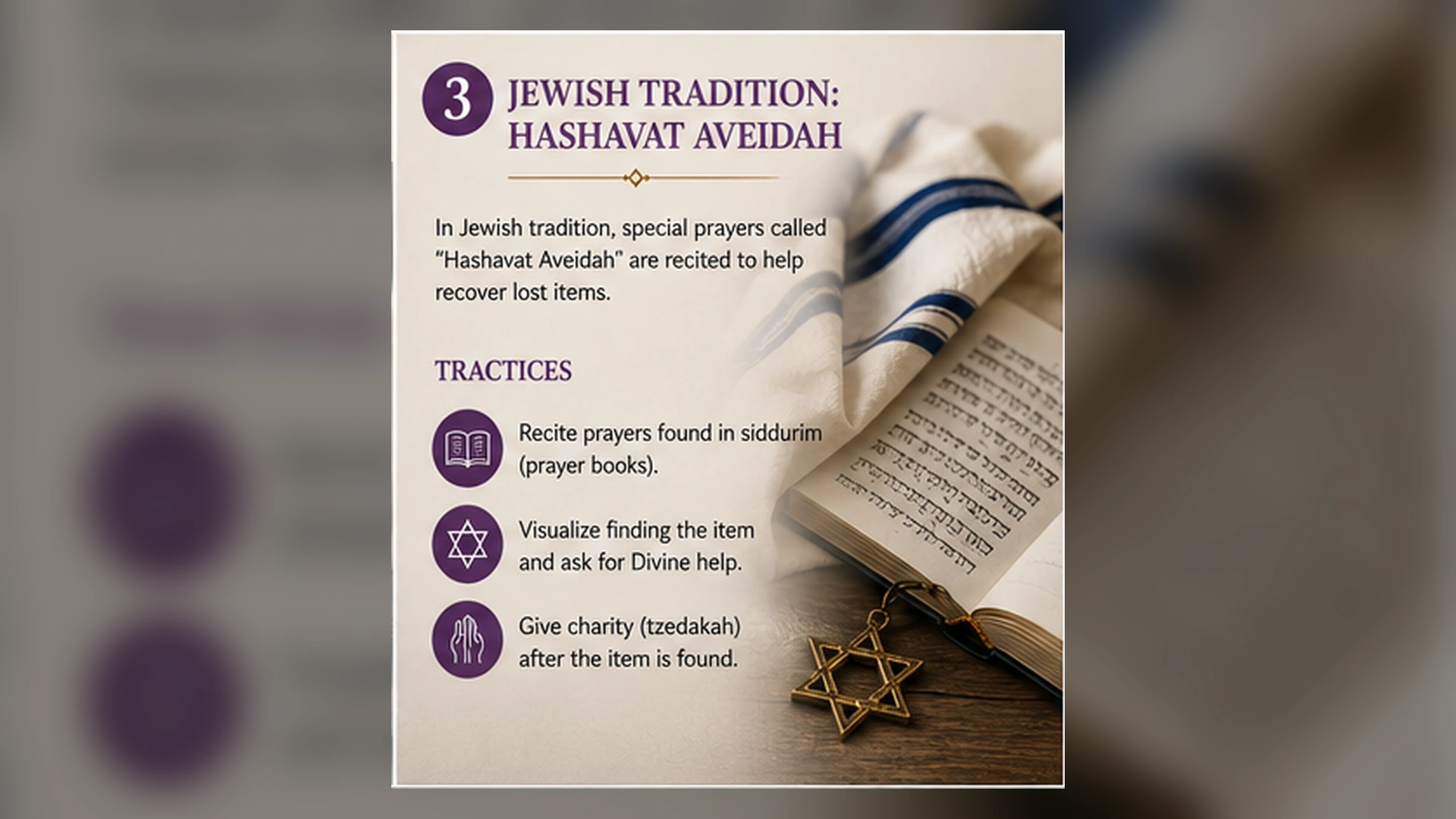
Jewish Hashavat Aveidah: The Duty to Return Lost Property
Jewish tradition offers a different emphasis. Hashavat aveidah means returning a lost object. The Torah-based mitzvah places responsibility on the finder: a person should not simply ignore property that can be restored to its owner. Chabad’s current practical guide explains that the laws consider whether an item was truly lost, whether it has identifying signs, whether the owner has abandoned hope and what responsibilities begin when someone picks it up. [4]
The religious response is therefore not primarily a spell for the owner. It is a moral and legal system that creates a community in which recovery becomes more likely because finders are obligated to act. Lost-and-found notices, identifying marks, careful custody and proof of ownership all belong to this ethical infrastructure.
Detailed halakhic questions can be complex, and a rabbi should be consulted where the item is valuable or ownership is disputed. For a general audience, the core lesson is clear: the recovery of lost things depends not only on the person searching but also on the honesty of whoever finds them.

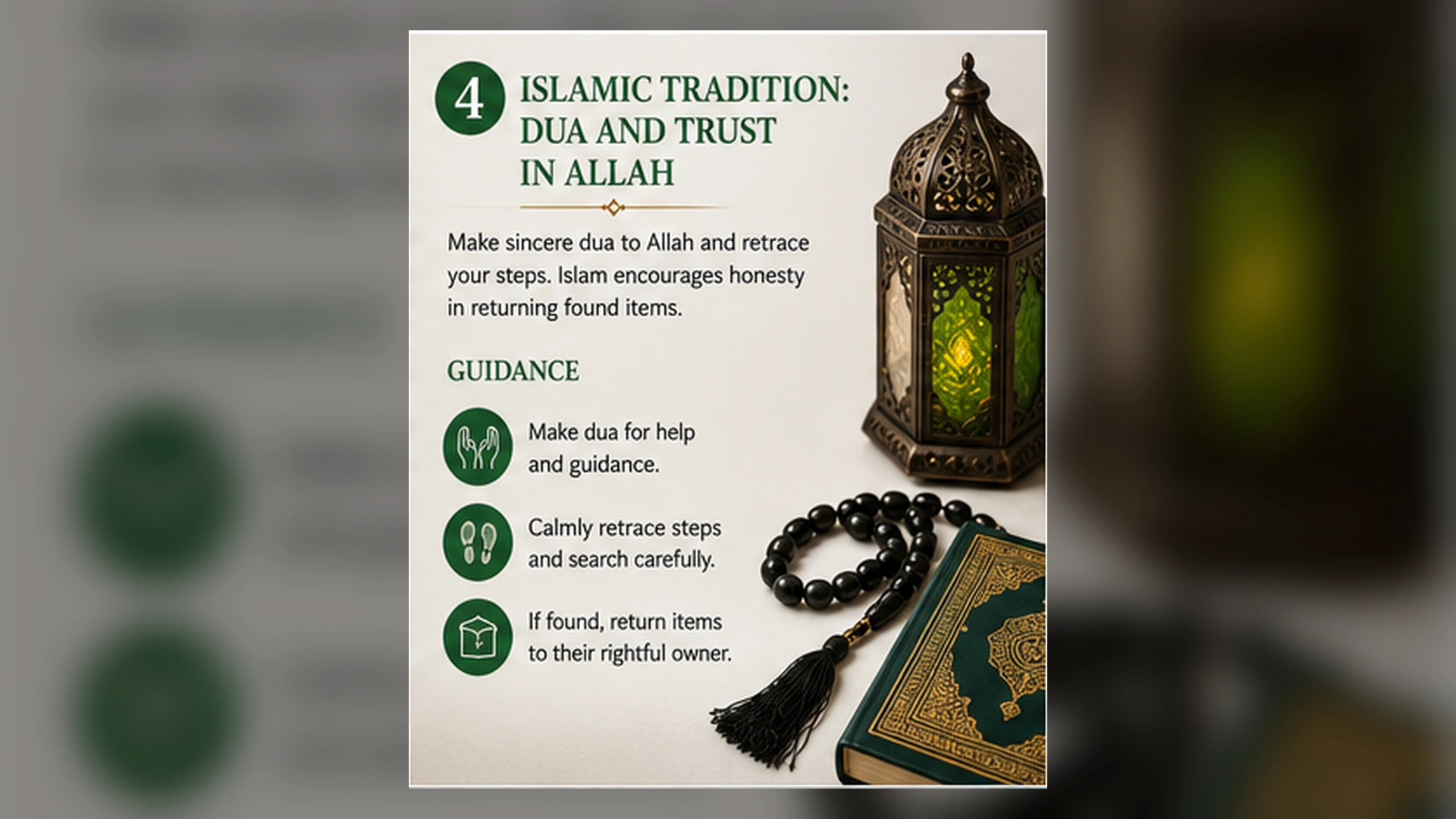
Islamic Guidance: Dua, Lost Property and Avoiding Fortune-Tellers
Islam permits a person to make general dua to Allah for help in difficulty, including the loss of an important object. However, widely circulated claims that a specific surah, verse or repeated number is guaranteed to reveal a lost item require evidence. One contemporary Islamic ruling specifically rejects singling out Surat ad-Duha as a fixed lost-item formula without textual basis. [7]
This does not mean a Muslim cannot pray. A person may ask Allah for ease, clarity, protection from loss and the return of what is beneficial, using ordinary words or established general supplications. The important boundary is not to attribute an invented formula to the Prophet or promise a mechanical result.
Islamic teaching also addresses luqatah, found property. Rules differ according to the item, location, value and legal setting, but valuable property is generally safeguarded and publicized so the owner can identify it. [8] A local scholar or lawful authority should guide complex cases.
Another strong boundary concerns divination. Guidance addressing lost and stolen objects warns against soothsayers or people who claim hidden knowledge through children, eggs, visions or similar techniques. Reciting religious words does not make such fortune-telling reliable or permissible. [6] This also protects innocent people from accusation based on a staged revelation.
Original general dua
| Dua O Allah, Knower of what is hidden and visible, calm my heart and guide me to the responsible means of finding what I have lost. Protect me from false accusation, panic and wrongdoing. If the item is recovered, make me grateful; if it is not, give me wisdom, patience and a lawful way forward. Ameen. |
|---|
Folk Customs and the Problem of a “Universal” Lost-Item Ritual
Families around the world preserve small customs for lost objects: tying a knot, turning a cup, addressing a household spirit, repeating a rhyme, placing an object upside down or promising food or charity after recovery. Such practices may be meaningful within a family, region or religious blend, but they should not be presented as universal or ancient without evidence.
Online articles often combine Saint Anthony, Saint Phanourios, Hindu mantras, Islamic verses, African ancestors and European household magic into one list. That approach erases theological differences and may invent authority. There is no single African, Hindu, Indigenous or “ancestral” ritual for finding lost property.
In an East African household, people may pray through a church or mosque, ask neighbors, call a taxi driver, consult a market association, announce the item in a family group or speak with elders. Those actions reflect the actual relationships of the household. A writer should name the community and source rather than claiming a pan-African ceremony.
Do Lost-Item Prayers and Rituals Work?
No controlled scientific evidence establishes that a prayer, saint, mantra or symbolic act can reveal the physical location of an object through a supernatural mechanism. That question belongs to faith rather than laboratory proof.
Ritual may still have observable effects. Slowing down can reduce chaotic searching. Speaking the sequence of events can improve organization. Returning to the original context can cue memory. Asking a congregation, family or online community increases the number of people who may notice or return the item. Charity after recovery can transform relief into social benefit.
Memory is not a video recording. Context reinstatement can improve recognition, but research also shows that it can increase false recognition of similar objects. [10][11] This is why a vivid memory should not be used to accuse a cleaner, child, relative, employee or stranger. Verify through records, cameras, receipts, device location and neutral witnesses where appropriate.
A Safe Modern Lost-Item Recovery Ceremony
The following is an original, non-denominational framework. It is not an ancient ritual and should not be represented as Catholic, Orthodox, Jewish, Muslim, African or Indigenous. It can be adapted privately when everyone involved consents.
1. Place a notebook, the item’s description and a glass of water on a clear table. Do not use fire, smoke or expensive supplies.
2. Say a prayer from your own tradition or use a simple intention: “May I search calmly, tell the truth and receive help without blaming anyone.”
3. Write the last three confirmed times and places connected with the item. Mark assumptions with a question mark.
4. Draw a route from the last confirmed use to the moment the loss was noticed.
5. Assign search zones to willing helpers. One person checks each zone completely and signs it off.
6. Use digital tracking, call handoff points and create a concise lost-item notice without exposing sensitive information.
7. If the item is valuable or identity-related, complete security reports before continuing the symbolic part.
8. End after one full search cycle. Rest for twenty minutes rather than repeating the same places compulsively.
9. If the item is recovered, thank the finder and correct any suspicion you expressed. Consider returning another person’s lost item or donating to a community lost-and-found effort.
10. If the item remains missing, document the loss, replace what is necessary and choose a prevention habit such as a key tray, tracker tag or daily pocket check.

When the Missing Item Requires Immediate Action
| Missing item | Immediate responsible action |
|---|---|
| Phone or tablet | Use the official location service, play a sound, mark it lost, protect the account and erase only when necessary. Apple Find My and Google Find Hub provide current platform-specific options. [12][13] |
| Bank card or wallet | Freeze cards, review transactions, contact the issuer and document identity items. A prayer should not delay fraud prevention. |
| Passport or national ID | Report the loss to the issuing authority and police where required. Do not publish full document numbers in social media notices. |
| Medication | Contact the pharmacy or healthcare provider promptly, especially for time-sensitive medicine. Do not take an unknown replacement dose. |
| Keys with an identifiable address | Consider changing locks or access codes. Avoid posting a photo that reveals the address or key pattern. |
| Child, vulnerable adult or pet | Treat this as an emergency search, not a devotional waiting period. Contact the relevant emergency, police, safeguarding or animal services immediately. |
| Work equipment or confidential files | Notify the employer, data-protection or security team and follow incident procedures before conducting a wider public search. |
What Not to Do
Do not accuse a specific person because a dream, diviner, child, pendulum, egg, verse or “vision” identified them.
Do not pay escalating fees to someone who guarantees that a ritual will reveal a thief or recover property by a deadline.
Do not burn unknown substances, place candles near papers or search roofs, drains, traffic areas or electrical equipment unsafely.
Do not post bank details, passport numbers, home addresses, tracker screenshots or the identifying feature that only the true owner should know.
Do not repeatedly search for hours without rest; fatigue increases oversight and conflict.
Do not treat every loss as evidence of an evil eye, curse, spirit or family betrayal.
Do not delay blocking cards, reporting theft or seeking healthcare because a spiritual adviser says to wait for a sign.
What to Do When You Find Someone Else’s Property
Recovery depends on finders as much as seekers. Preserve the item, avoid opening private contents unnecessarily and use the venue’s lost-and-found process. Photograph where it was found, record the time and ask the claimant for details that were not made public.
Jewish hashavat aveidah and Islamic rules concerning found property offer detailed religious frameworks, but the broader ethical principle is shared widely: do not exploit another person’s distress. Follow local law and hand valuable items to an appropriate authority when direct return is unsafe or uncertain.
Digital trackers may display a message from the owner. Current Android guidance explains that a marked-lost accessory can show contact information when scanned by a compatible device. [13] Never use a tracker to follow or confront a suspected thief personally.
How to Prevent Future Losses Without Living in Fear
Create one fixed home for keys, wallet, identity documents and chargers.
Use a departure check: phone, wallet, keys, medication and work pass.
Photograph important serial numbers and store them securely.
Enable device-finding tools, screen locks and backup authentication before a loss occurs.
Attach a privacy-safe contact label or approved tracker to frequently misplaced items.
Use one bag compartment for documents and close it immediately after each use.
For family heirlooms, record a photograph, description and storage location.
Teach children how to hand found property to a trusted adult rather than hiding or keeping it.
Key Takeaways
Lost-item recovery rituals are culturally different and should not be merged into one universal formula.
Saint Anthony is widely associated with lost objects in Catholic devotion.
Saint Phanourios is associated with revealing what is lost in Greek Orthodox tradition, often with phanouropita shared in gratitude.
Jewish hashavat aveidah emphasizes the finder’s duty to return property.
Islam permits general dua but warns against invented guaranteed formulas and fortune-tellers; found property carries legal and moral duties.
Retracing context can support memory, but memory can also be confidently mistaken.
Phones, cards, passports, medication and confidential items require immediate practical action.
No prayer or ritual justifies accusing another person without evidence.
People Also Ask
What saint helps you find lost things?
Saint Anthony of Padua is the best-known Catholic saint associated with lost objects. In Greek Orthodox tradition, Saint Phanourios is also asked to help reveal what has been lost.
What is the prayer to Saint Anthony for lost items?
Catholics may ask Saint Anthony to intercede with God for calm, clear memory and recovery of the item. The Basilica of Saint Anthony publishes an official devotional prayer, while many families also use short informal prayers.
Why do people bake phanouropita?
In Greek Orthodox custom, phanouropita is associated with Saint Phanourios. It may be baked and shared in gratitude, often with prayers connected to the saint’s mother. It is a devotional and charitable custom, not payment for a guaranteed result.
Is there an authentic Islamic dua specifically for lost things?
A Muslim may make general dua for help, but claims that a specific surah, verse or exact repetition is guaranteed to recover a lost item require reliable evidence. Guidance from Islamic scholars warns against inventing fixed formulas and consulting fortune-tellers.
What does Judaism teach about lost objects?
Hashavat aveidah is the mitzvah of returning lost property. It emphasizes the finder’s responsibility to protect and restore an item to its owner according to detailed rules.
Do rituals make lost objects appear?
There is no scientific evidence that a ritual physically reveals an object through a supernatural mechanism. Prayer or ritual may calm the searcher, improve organization and bring community help, while practical tools locate the item.
How can I remember where I put something?
Describe the item, identify the last confirmed use, reconstruct the route and revisit the original context. Search one zone at a time. Treat a sudden memory as a clue and verify it.
What should I do first if my phone is missing?
Call or ring it, use the official device-finding service, mark it lost and secure your account. If theft is possible, avoid confrontation and contact the carrier or police as appropriate.
Can I use divination to identify who took my item?
That is unsafe and can lead to false accusation. Religious guidance in multiple traditions emphasizes honesty and responsibility; practical evidence should determine whether theft occurred.
What if I never find the item?
Complete the necessary security and replacement steps, document the loss and allow yourself to grieve if the object was sentimental. A prayer may ask for acceptance and wisdom even when recovery does not happen.
Conclusion
Lost-object traditions reveal more than a desire to recover possessions. They show how communities understand memory, responsibility, intercession, gratitude and honesty. Saint Anthony devotion turns an anxious search into prayer. Saint Phanourios traditions connect revelation with sharing. Hashavat aveidah and Islamic lost-property ethics remind the finder that another person’s recovery may depend on their integrity.
The most responsible approach joins belief with action. Pray if prayer belongs to you. Retrace the last confirmed route. Search systematically. Use current device tools. Protect accounts and documents. Ask the community for help without exposing private details. Above all, refuse to turn uncertainty into an accusation.
Sometimes the object returns through a surprising chain of events. Sometimes it was in an ordinary pocket. Sometimes it remains lost. In every outcome, the search can still be guided by patience, truth and care for the people involved.
Article Information
- Publisher
- Ancestral Temple
- Editor
- Ancestral Temple
- Last updated
- Jul 30, 2026
- Last reviewed
- Jul 30, 2026
- Content version
- 7256aeab0b
This educational article should be read as cultural and spiritual information, not as medical, legal, financial, or emergency advice.
Helpful Related Guidance
Explore This Topic
Related Topic Cluster
Lost Item Recovery Rituals
Complete Guide Job-Opportunity Rituals: Prayers and Spiritual Practices for Urgent EmploymentAbout the Author
 Ancestral Temple
Spiritual guide and practitioner with decades of experience in ancestral wisdom, rituals, and divine guidance.
Related Posts
View All












Leave a Comment
We'd love to hear your thoughts.