
Common Symbols Associated With Ancestor Reverence
Pillar Article
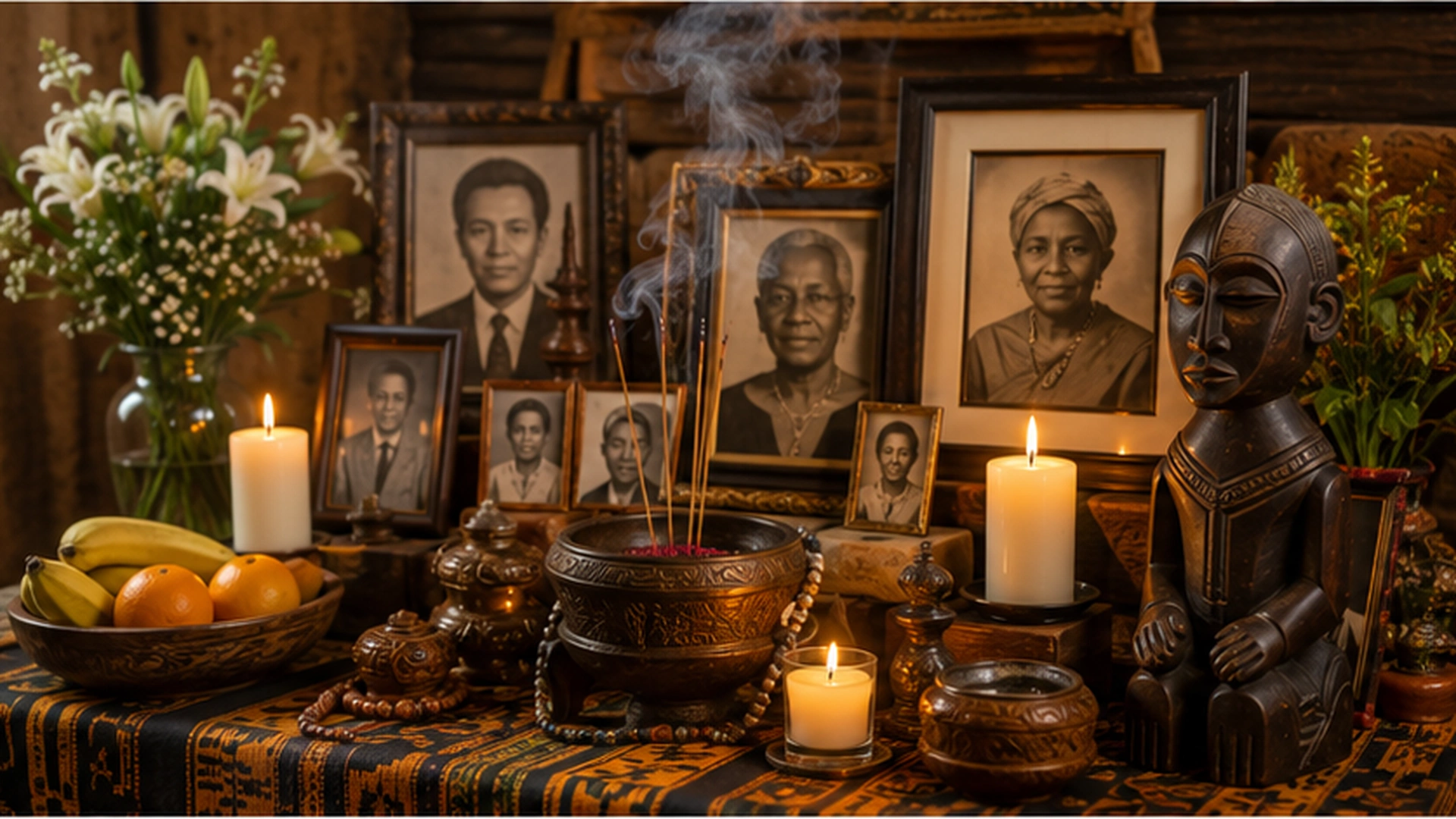
Quick Summary
Explore portraits, graves, offerings, candles, incense, figures, names, genealogy, and other symbols associated with ancestor reverence across culturally distinct traditions.
Common symbols associated with ancestor reverence include portraits, photographs, ancestral tablets, graves, memorial objects, food, water, libations, candles, incense, flowers, carved figures, names, genealogies, sacred land, music, and ceremonial clothing.
These symbols do not have one universal meaning.
A candle used during a Mexican memorial observance may not communicate the same belief as a lamp used during an Asian family ritual or a candle lit during a Christian remembrance service. A carved figure associated with a Fang reliquary tradition should not be interpreted through the beliefs of a Yoruba, Chinese, Māori, Korean, Roman, or Mexican community.
The meaning of an ancestral symbol depends on:
- The culture using it
- The object’s local name
- The occasion
- The family or institution involved
- The person authorized to handle it
- The words and actions performed with it
- Whether it is public or restricted
- The religious beliefs of participants
Ancestor symbols are therefore best understood as culturally recognized ways of preserving memory, identity, spiritual relationships, family history, moral responsibility, and connections between generations.
Key Points
Symbols commonly associated with ancestor reverence may include:
- Portraits and photographs
- Ancestral tablets and written names
- Graves, tombs, and burial markers
- Family altars and memorial spaces
- Food and drink
- Libations and ritual vessels
- Candles, lamps, and lanterns
- Incense and ceremonial smoke
- Flowers, leaves, and plants
- Carved figures and reliquaries
- Personal belongings and heirlooms
- Genealogies and family trees
- Names and titles
- Stools, thrones, staffs, and royal regalia
- Sacred land, rivers, mountains, and family compounds
- Music, song, dance, and oral recitation
- Ceremonial clothing and textiles
No object is automatically sacred merely because it appears on this list. Its meaning comes from its cultural and ceremonial context.
What Is an Ancestral Symbol?
An ancestral symbol is an image, object, material, place, sound, name, or action that represents a relationship between living people and earlier generations.
It may represent:
- A particular deceased relative
- A family lineage
- A founding ancestor
- A royal predecessor
- Collective historical memory
- An inherited responsibility
- A connection with ancestral land
- A spiritual relationship
- A family’s continuity across generations
Clear Definition
An ancestral symbol is a culturally meaningful sign, object, place, or practice that represents deceased relatives, family continuity, historical memory, or inherited responsibility.
Plain-Language Meaning
An ancestral symbol helps make family memory visible, tangible, audible, or repeatable.
A photograph allows descendants to see a face. A grave provides a place to gather. A family name connects generations. A song preserves words and emotions that may otherwise be forgotten.
There Is No Universal Dictionary of Ancestor Symbols
The same object can carry different meanings in different traditions.
For example:
- Symbol
- Possible meanings
- Photograph
- Personal memory, identity, ritual focus, historical record
- Food
- Hospitality, gratitude, family continuity, offering, memorial meal
- Candle
- Remembrance, prayer, guidance, spiritual welcome, mourning
- Water
- Life, peace, purification, hospitality, libation
- Grave
- Resting place, family history, sacred territory, mourning
- Figure
- Portrait, guardian, ancestor representation, political authority
- Tree
- Lineage, continuity, burial site, sacred presence, family meeting place
- Written name
- Identity, genealogy, prayer focus, legal or historical record
The correct interpretation must come from the community involved.
Important Principle
Similar-looking objects do not prove that two traditions hold the same beliefs.
1. Ancestor Portraits and Photographs
Portraits are among the clearest symbols of ancestral memory because they preserve the recognizable appearance of a deceased person.
They may be used to:
- Preserve identity
- Introduce children to deceased relatives
- Provide a focus for remembrance
- Record clothing, status, or family history
- Connect current generations with earlier ones
- Represent a person during a memorial gathering
Chinese commemorative portraits were historically displayed above family altars during annual ceremonies. Families gathered before them and performed ancestral rites, while incense smoke and repeated ceremonial use could leave visible marks on the paintings.
Photographs as Modern Memorial Symbols
In many modern households, photographs have replaced expensive painted portraits.
A photograph may appear:
- On a memorial table
- Near a grave
- In a family album
- At a funeral
- During an anniversary gathering
- Inside a digital family archive
- On a memorial website
The photograph may be religious in one household and purely historical or emotional in another.
What a Portrait Does Not Automatically Mean
Displaying a portrait does not necessarily mean that the person is being worshipped.
It may simply mean:
- “This person belongs to our family.”
- “We remember this person.”
- “Children should know this face.”
- “This person’s story remains important.”
2. Ancestral Tablets and Written Names
Some traditions preserve ancestors through inscribed tablets, plaques, memorial books, scrolls, or written genealogies.
These may contain:
- Personal names
- Family names
- Titles
- Dates
- Generational positions
- Relationships
- Places of origin
- Religious phrases
Why Names Matter
A name can preserve a person’s identity even when no portrait survives.
Written names may provide:
- A focus for family remembrance
- A genealogical record
- A connection with a lineage
- A formal place in household ritual
- Evidence of succession or inheritance
In royal Korean tradition, the Jongmyo ancestral ritual is dedicated to the ancestors of the Joseon dynasty and brings together shrine space, ritual performance, music, dance, and descendants of the royal family.
Names as Living Symbols
A name may also continue through:
- Children named after relatives
- Family titles
- Clan names
- Place names
- Praise names
- Oral genealogies
Correct spelling and pronunciation are therefore important forms of respect.
Frequently Asked Questions
What should readers know first about Common symbols associated with ancestor reverence?
Common symbols associated with ancestor reverence: Explore portraits, graves, offerings, candles, incense, figures, names, genealogy, and other symbols associ
What causes Common symbols associated with ancestor reverence?
Explore portraits, graves, offerings, candles, incense, figures, names, genealogy, and other symbols associated with ancestor reverence across culturally distinct traditions. The safest next step is to compare the signs, prepare clear details, and request priv
How does Common symbols associated with ancestor reverence work?
Explore portraits, graves, offerings, candles, incense, figures, names, genealogy, and other symbols associated with ancestor reverence across culturally distinct traditions. The safest next step is to compare the signs, prepare clear details, and request priv
Is it possible to get private guidance for Common symbols associated with ancestor reverence?
Explore portraits, graves, offerings, candles, incense, figures, names, genealogy, and other symbols associated with ancestor reverence across culturally distinct traditions. The safest next step is to compare the signs, prepare clear details, and request priv
How long does Common symbols associated with ancestor reverence take to understand?
Explore portraits, graves, offerings, candles, incense, figures, names, genealogy, and other symbols associated with ancestor reverence across culturally distinct traditions. The safest next step is to compare the signs, prepare clear details, and request priv
Can Common symbols associated with ancestor reverence affect relationships, family, work, or personal peace?
Explore portraits, graves, offerings, candles, incense, figures, names, genealogy, and other symbols associated with ancestor reverence across culturally distinct traditions. The safest next step is to compare the signs, prepare clear details, and request priv
Why do people seek spiritual guidance for Common symbols associated with ancestor reverence?
Explore portraits, graves, offerings, candles, incense, figures, names, genealogy, and other symbols associated with ancestor reverence across culturally distinct traditions. The safest next step is to compare the signs, prepare clear details, and request priv
What signs should someone notice before asking about Common symbols associated with ancestor reverence?
Explore portraits, graves, offerings, candles, incense, figures, names, genealogy, and other symbols associated with ancestor reverence across culturally distinct traditions. The safest next step is to compare the signs, prepare clear details, and request priv
When should someone contact a private spiritual guide?
Explore portraits, graves, offerings, candles, incense, figures, names, genealogy, and other symbols associated with ancestor reverence across culturally distinct traditions. The safest next step is to compare the signs, prepare clear details, and request priv
Article Information
- Publisher
- Ancestral Temple
- Editor
- Ancestral Temple
- Last updated
- Jul 26, 2026
- Last reviewed
- Jul 13, 2026
- Content version
- 0a80a46495
This educational article should be read as cultural and spiritual information, not as medical, legal, financial, or emergency advice.
Helpful Related Guidance
Explore This Topic
Ancestor Reverence In African Cultures · Ancestor Reverence Around The World
Related Topic Cluster
Common Symbols Associated With Ancestor Reverence
Complete Guide How Different African Communities Remember Their AncestorsAbout the Author
 Ancestral Temple
Spiritual guide and practitioner with decades of experience in ancestral wisdom, rituals, and divine guidance.
Related Posts
View All

Leave a Comment
We'd love to hear your thoughts.
This was comprehensive without suggesting that every family needs an altar or formal ceremony.
Are there recommended museum collections for studying African reliquary figures responsibly?
The explanation of paths and doorways in memorial traditions was interesting.
I would like more information about royal stools, staffs, and ancestral leadership symbols.
I liked the point that an ancestor symbol may be a song or name rather than a decorative object.
Strong guide. It connected symbols with family, memory, place, responsibility, and cultural context.
The misconceptions section answered several false claims I have seen online.
The tone remained neutral and culturally respectful throughout.
The section on personal belongings encouraged me to document who originally owned our family objects.
I liked that the article corrected the idea that every carved figure is an idol or ancestor.
More guidance on labeling and preserving family heirlooms would make a useful follow-up.
The African reliquary section deserves a full article with examples from several communities.
The biggest lesson for me was that context gives the symbol its meaning.
The article respected spiritual beliefs while remaining careful about unsupported claims.
I appreciated the reminder that colors do not have one meaning across every culture.
The distinction between public and restricted ancestral symbols deserves more attention.
Could you write a detailed article about the meaning of food and drink in ancestor ceremonies?
The numbered sections made the article easy to read on mobile.
The article covered many symbols without presenting them as one universal tradition.
This is useful for students of religion, art history, anthropology, and cultural heritage.
Thank you for stating clearly that ancestral symbols do not guarantee protection or healing.
The section about music showed that symbols do not always have to be physical objects.
I liked that portraits were explained as both historical records and possible ceremonial objects.
A future comparison of graves, shrines, temples, and family memorial spaces would be interesting.
The glossary made the difference between reliquary, memorial, altar, and offering easier to understand.
The ancestral-land section was one of the strongest parts of the article.
My family has several objects from grandparents, but we need to document the stories connected with them.
The genealogy section helped me understand why a family tree can represent rights and responsibilities, not only names.
This was educational without turning ancestral objects into something frightening or mysterious.
I appreciated that the health and safety concerns around candles and incense were included.
The discussion of flowers reminded me that even plants can carry culturally specific meanings.
The article showed why the full ceremony matters more than the object alone.
I would like to learn more about ancestral tablets and how different families use them.
The section about written names and correct pronunciation was meaningful.
The article explained candles and incense without assuming that every religion interprets them the same way.
I liked the idea that an ordinary family heirloom can become a strong symbol through its history.
The warning about photographing graves and sacred objects without permission was important.
A separate article about ancestor portraits in different cultures would be useful.
The section about food helped me understand the difference between an offering and a memorial meal.
The explanation of Fang and Kota reliquary figures was detailed without generalizing the whole continent.
I liked that the article did not treat every African sculpture as an ancestor figure.
The section about portraits explained why family photographs can carry so much meaning.
I had not considered a correctly written family name to be an ancestral symbol before reading this.
The distinction between a family memorial space and a religious altar was very helpful.
I appreciated the reminder that similar symbols can have very different meanings in different cultures.