
Doorway Protection Traditions
Pillar Article
Quick Summary
Discover how societies around the world have protected doorways with guardian figures, sacred texts, painted gods, hand symbols, carved marks, religious blessings, and practical household traditions.
Doorway protection traditions are cultural, religious, and architectural practices intended to guard the entrance to a home, palace, temple, tomb, business, or community space.
Throughout history, people have placed protective objects:
- Above doors
- Beside gateways
- On doorposts
- Across lintels
- On door panels
- Beneath thresholds
- Inside entrance halls
- Near locks and handles
These objects have included guardian figures, written prayers, divine names, hand-shaped symbols, crosses, eyes, animals, carved marks, plants, bells, and household blessings.
There is no universal doorway protection tradition.
An Assyrian lamassu beside a palace gate did not have the same meaning as a Chinese door-god print, a Jewish mezuzah, a North African khamsa, an English apotropaic mark, or a Christian Epiphany inscription.
The practices resemble one another because doorways are important boundaries.
A doorway separates:
- Inside from outside
- Family from stranger
- Sacred space from ordinary space
- Political authority from public space
- Safety from uncertainty
- Welcome from exclusion
- One stage of life from another
In ancient Near Eastern belief, doorways were understood as transitions between separate spaces and therefore as places requiring special protection. Guardian figures were positioned at these boundaries to prevent threatening forces from entering.
Key Points
Doorway protection traditions have included:
- Assyrian lamassu guarding palace entrances
- Ancient Egyptian lions protecting sacred spaces
- Greek Gorgon images placed on buildings and tombs
- Chinese door gods displayed during Lunar New Year
- Auspicious Chinese couplets attached to doors
- Khamsa or hamsa hand symbols
- Jewish mezuzot fixed to doorposts
- Qur’anic inscriptions and Islamic amuletic imagery
- Christian house blessings
- Epiphany chalk markings
- European apotropaic or “witch” marks
- Horseshoes and iron objects
- Protective plants and branches
- Bells and metal door ornaments
- Family prayers offered at a new doorway
Similar-looking symbols do not necessarily express the same belief.
A doorway object may represent religious identity, prayer, political authority, cultural heritage, hospitality, remembrance, or protection.
Why Doorways Are Symbolically Important
A doorway is both an opening and a boundary.
It allows:
- Family members to return
- Guests to enter
- Goods to move
- Religious processions to pass
- Leaders to appear publicly
- Communities to control access
It may also be viewed as a place through which unwanted influences could enter.
Historically, people feared:
- Thieves
- Enemies
- Disease
- Fire
- Envy
- Harmful spirits
- Misfortune
- Political threats
- Dangerous animals
- Unwelcome visitors
Protective doorway traditions gave visible form to the desire to control what crossed the threshold.
What Is a Threshold?
A threshold is the lower part of a doorway that a person crosses when entering or leaving.
The word may also describe the entire symbolic boundary between two places or conditions.
A threshold can represent movement between:
- Public and private life
- Childhood and adulthood
- Single and married life
- Ordinary and sacred activity
- Life and death
- Safety and danger
- One year and the next
This helps explain why many ceremonies involve entering, crossing, standing beside, or marking a doorway.
What Does Apotropaic Mean?
Apotropaic describes an object, image, mark, or action intended to turn away or repel harmful influence.
An apotropaic doorway symbol may be:
- Frightening
- Sacred
- Geometric
- Written
- Animal-shaped
- Human-shaped
- Nearly invisible
A protective image does not need to look peaceful.
A fierce guardian may be positioned at an entrance because its power is directed outward against danger.
1. Assyrian Lamassu
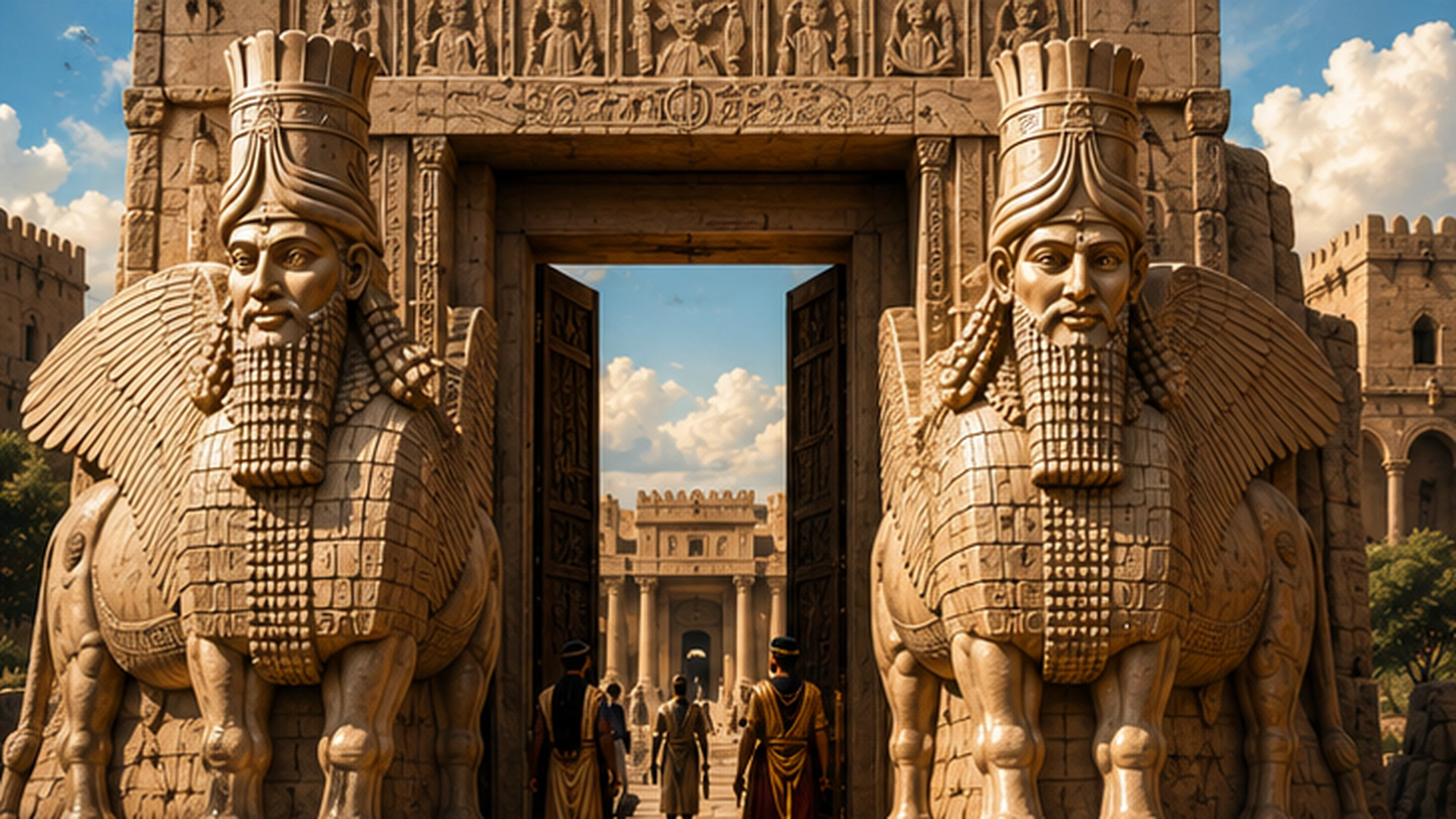
Among the best-known ancient doorway guardians are the monumental Assyrian figures commonly called lamassu.
They combine:
- A human head
- A bull or lion body
- Wings
- A divine horned headdress
Lamassu were installed beside important entrances in Assyrian palaces.
They represented:
- Intelligence
- Physical power
- Divine authority
- Royal protection
- Watchfulness
- Political order
The Metropolitan Museum of Art explains that lamassu protected and physically supported important doorways in Assyrian palaces. Their five legs allowed them to appear firmly stationary from the front and moving forward when viewed from the side.
Protection and Royal Authority
Lamassu did more than guard a building.
They communicated that the ruler’s palace stood within a divinely supported political order.
Anyone passing between them entered a controlled royal space.
Why They Were Placed in Pairs
A pair created a guarded passage.
The visitor did not merely look at a statue. The visitor physically moved between two powerful beings.
This made protection part of the architectural experience.
2. Ancient Egyptian Lions at Entrances
Ancient Egyptian lion imagery could protect temples and sacred spaces.
Lions represented:
- Royal power
- Strength
- Solar force
- Vigilance
- Defense
Metropolitan Museum documentation notes that images of lions were positioned near sacred entrances to prevent threatening forces from passing inside. Full-sized lion figures or sculpted lion forms could guard a doorway symbolically.
Bes and Household Protection
The Egyptian deity Bes was also connected with household protection, childbirth, mothers, children, music, and daily family life.
Bes was often shown frontally, confronting the viewer directly.
Although a Bes image was not necessarily placed on every doorway, his protective imagery could appear in domestic objects and spaces.
Ancient Egypt Was Not One Unchanging Tradition
Egyptian religious practices changed across thousands of years.
A lion at a temple entrance, a Bes household image, and an amulet worn by an individual should not be described as the same form of protection.
Frequently Asked Questions
What should readers know first about Doorway protection traditions?
Doorway protection traditions: Discover how societies around the world have protected doorways with guardian figures, sacred texts, painted gods, hand symbols
What causes Doorway protection traditions?
Discover how societies around the world have protected doorways with guardian figures, sacred texts, painted gods, hand symbols, carved marks, religious blessings, and practical household traditions. The safest next step is to compare the signs, prepare clear
How does Doorway protection traditions work?
Discover how societies around the world have protected doorways with guardian figures, sacred texts, painted gods, hand symbols, carved marks, religious blessings, and practical household traditions. The safest next step is to compare the signs, prepare clear
Is it possible to get private guidance for Doorway protection traditions?
Discover how societies around the world have protected doorways with guardian figures, sacred texts, painted gods, hand symbols, carved marks, religious blessings, and practical household traditions. The safest next step is to compare the signs, prepare clear
How long does Doorway protection traditions take to understand?
Discover how societies around the world have protected doorways with guardian figures, sacred texts, painted gods, hand symbols, carved marks, religious blessings, and practical household traditions. The safest next step is to compare the signs, prepare clear
Can Doorway protection traditions affect relationships, family, work, or personal peace?
Discover how societies around the world have protected doorways with guardian figures, sacred texts, painted gods, hand symbols, carved marks, religious blessings, and practical household traditions. The safest next step is to compare the signs, prepare clear
Why do people seek spiritual guidance for Doorway protection traditions?
Discover how societies around the world have protected doorways with guardian figures, sacred texts, painted gods, hand symbols, carved marks, religious blessings, and practical household traditions. The safest next step is to compare the signs, prepare clear
What signs should someone notice before asking about Doorway protection traditions?
Discover how societies around the world have protected doorways with guardian figures, sacred texts, painted gods, hand symbols, carved marks, religious blessings, and practical household traditions. The safest next step is to compare the signs, prepare clear
When should someone contact a private spiritual guide?
Discover how societies around the world have protected doorways with guardian figures, sacred texts, painted gods, hand symbols, carved marks, religious blessings, and practical household traditions. The safest next step is to compare the signs, prepare clear
Article Information
- Publisher
- Ancestral Temple
- Editor
- Ancestral Temple
- Last updated
- Jul 26, 2026
- Last reviewed
- Jul 13, 2026
- Content version
- 6f47ee4da7
This educational article should be read as cultural and spiritual information, not as medical, legal, financial, or emergency advice.
Helpful Related Guidance
Explore This Topic
Doorway Protection Traditions · Urgent Child Protection Rituals
Related Topic Cluster
Doorway Protection Traditions
Complete Guide Understanding African Spiritual Traditions: A Historical IntroductionAbout the Author
 Ancestral Temple
Spiritual guide and practitioner with decades of experience in ancestral wisdom, rituals, and divine guidance.
Related Posts
View All






Leave a Comment
We'd love to hear your thoughts.
This was detailed without suggesting that every household needs a spiritual protection symbol.
Are there recommended museum collections for viewing doorway guardians online?
The commercialization section will help readers avoid mixing unrelated traditions.
A future article about African palace and compound entrances would be interesting.
I liked that paired guardians were explained as part of the architecture.
Strong overview connecting doorways with protection, welcome, identity, and transition.
The misconceptions section corrected several claims commonly shared online.
The tone remained neutral while explaining why these traditions matter.
The section about new-home blessings was practical and respectful.
I appreciated that African doorway traditions were not reduced to masks and herbs.
More information about women’s roles in household blessing traditions would be useful.
The European apotropaic-mark section deserves a full article.
The strongest lesson was that each doorway symbol must be studied in context.
The article respected religious beliefs without making guaranteed claims.
I liked that families can create new traditions without pretending they are ancient.
The explanation of threshold deposits was very interesting.
Could you write next about protective symbols placed above windows?
The headings and short paragraphs worked well on mobile.
The regional examples made the article easy to follow.
This is useful for students of religion, architecture, history, and anthropology.
Thank you for explaining that house blessings do not replace emergency services.
I appreciated the discussion of thresholds as places of transition.
The section about plants warned readers not to assume every doorway herb has one meaning.
A future comparison of the khamsa and mezuzah would be useful.
The glossary clarified the difference between a lintel, threshold, and doorpost.
I liked the practical security table.
The article reminded me that a doorway can represent family identity as well as safety.
The ancient Egyptian lion section was an important African example.
This was educational without promising supernatural protection.
The section about fierce guardians explained why frightening images may be protective.
I would like a detailed guide to Chinese door gods and their different identities.
I appreciated the distinction between decorative and religious doorway objects.
The Epiphany door-chalking tradition was new to me.
The warning that spiritual protection does not replace locks was important.
The discussion of Islamic inscriptions was balanced and avoided universal claims.
I liked that the article did not treat every old marking as a witch mark.
The khamsa section showed why one symbol can belong to several cultural histories.
A complete article about lamassu and ancient gateways would be interesting.
The distinction between a mezuzah and a general protective charm was helpful.
The African section correctly avoided inventing one universal doorway ritual.
I did not know that Chinese couplets could express wishes for the whole household.
The article clearly separated Chinese door gods from other guardian figures.
I liked that protection and hospitality were discussed together.
The lamassu section made their placement beside palace entrances easy to understand.
I appreciated the explanation of why doorways are treated as important boundaries.