
What Is Pilgrimage? Meaning, Purpose and Traditions
Cornerstone Content
Quick Summary
Pilgrimage turns movement into meaning. This guide explores how communities travel to sacred places for worship, remembrance, renewal, identity, and connection while preserving the differences among living traditions.
What Is Pilgrimage?
Pilgrimage means an intentional journey to a place, route, landscape, shrine or event understood as sacred or spiritually meaningful. It differs from ordinary travel because the journey is shaped by devotion, memory, repentance, thanksgiving, healing, communal identity or religious obligation. Pilgrimage traditions vary widely, so each route must be understood through its own community and faith context.
A pilgrimage is more than a trip to a famous religious place. It is a journey shaped by intention, sacred geography, inherited stories, bodily effort, community rules, and the expectation that travel can change the pilgrim's relationship with faith, memory, identity, or responsibility.
Pilgrimage traditions appear in many religions and cultures, but they are not one universal ceremony. A Muslim performing Hajj, an Ethiopian Orthodox Christian walking among the rock-hewn churches of Lalibela, a Mouride disciple travelling to Touba, a Hindu pilgrim bathing during Kumbh Mela, and a Wixárika community following a ceremonial route to Wirikuta participate in distinct spiritual worlds. Similarities such as walking, prayer, fasting, gathering, or visiting sacred places do not erase those differences.
This article explains the history and meanings of selected pilgrimage traditions, with particular attention to African examples. It does not provide instructions for restricted rites or imply that sacred journeys can be reproduced without community authority.
Pilgrimage Meaning: Sacred Journey and Purpose
A pilgrimage is an intentional journey toward a place, route, person, object, landscape, or event understood as sacred or spiritually significant. The destination may be a shrine, city, river, mountain, grave, temple, church, mosque, grove, or network of sites.
Some pilgrimages are religious obligations. Others are voluntary acts of devotion, thanksgiving, mourning, healing, repentance, initiation, ancestral remembrance, or communal identity. The journey may be completed once in a lifetime, every year, during a festival season, after a vow, or at a particular stage of life.
Pilgrimage can also include an inward dimension. The University of York's Pilgrimage Studies project notes that the word can describe physical travel as well as an inner spiritual journey through prayer, meditation, or withdrawal. The essential point is not distance alone but purposeful movement toward transformation, encounter, or renewed commitment. [1]
How Pilgrimage Turns Travel Into Sacred Practice
Ordinary travel becomes pilgrimage when a community gives the journey a recognized spiritual structure. The traveler may prepare through prayer, fasting, special clothing, confession, blessing, teaching, or the settlement of responsibilities at home.
The route may include prescribed stops, songs, prayers, offerings, hospitality networks, or acts of service. At the destination, pilgrims may circumambulate, bathe, kneel, keep vigil, visit a tomb, attend worship, touch or view a sacred object, make a vow, or join a procession. The return home may also matter because the pilgrim carries memories, obligations, blessings, or testimony back into everyday life.
Academic study emphasizes both movement and social formation. Pilgrimage creates temporary communities, reinforces identity, and brings together people who may differ in class, age, occupation, nationality, or language. It can also generate debate over access, authority, tourism, commerce, and the proper use of sacred space. [2]
Why People Make Pilgrimages
Pilgrimage traditions often express several meanings at once. Their interpretation must always begin with the community's own language and teachings.
Devotion and worship: A pilgrim may travel to obey a religious command, honour a deity, remember a sacred event, visit a saint's shrine, or deepen prayer.
Repentance and renewal: Physical hardship, fasting, simplicity, or separation from ordinary routines may symbolize moral change and renewed commitment.
Healing and hope: Some pilgrims seek spiritual comfort, reconciliation, fertility, health, protection, or strength during crisis. Responsible education should describe these beliefs without guaranteeing outcomes.
Ancestral and historical memory: Routes can preserve stories of founders, martyrs, migration, exile, resistance, revelation, or covenant.
Community identity: Large gatherings make a dispersed religious or cultural community visible to itself. Hospitality, shared food, song, clothing, and collective prayer can strengthen belonging.
Relationship with land: Mountains, rivers, deserts, forests, and roads may form part of a sacred geography. The route is not merely the space between home and destination; it may itself be a teacher, witness, or ceremonial sequence.
Pilgrimage Traditions in Africa
Africa contains Christian, Muslim, Indigenous, and blended pilgrimage traditions shaped by specific peoples, languages, histories, sacred landscapes, and religious institutions. There is no single African pilgrimage system.
Some journeys centre on martyrdom or biblical memory. Others honour a Sufi teacher, visit a sacred river, gather at an ancestral site, or renew a community's relationship with a living landscape. Writers should name the precise tradition rather than describing all such journeys as generic African spirituality.
Namugongo and the Uganda Martyrs Pilgrimage
Every year, Christians travel to Namugongo in Uganda to commemorate the Uganda Martyrs. Many pilgrims walk long distances and arrive for worship connected with Uganda Martyrs Day on 3 June.
The official Catholic shrine records twenty-four Catholic martyrs, including twenty-two killed between 1885 and 1887 during the reign of Kabaka Mwanga II. The pilgrimage is also connected with Anglican remembrance, reflecting the fact that both Catholic and Anglican converts were killed during the period. [3]
Namugongo demonstrates how pilgrimage can join national history, East African Christian identity, bodily endurance, prayer, song, and hospitality. Pilgrims may carry intentions from families and congregations, while parishes and communities organize food, accommodation, medical help, and transport.
The event should not be presented only as a crowd or tourism attraction. For participants, walking can become an act of witness, sacrifice, gratitude, and identification with the martyrs' faith.
Lalibela: A Living Ethiopian Christian Pilgrimage Centre
The rock-hewn churches of Lalibela are among the most important centres of Ethiopian Christianity. UNESCO describes the eleven medieval churches as a 'New Jerusalem' and states that Lalibela remains a place of pilgrimage and devotion. [4]
Large numbers of pilgrims gather particularly for major Ethiopian Orthodox celebrations such as Christmas, Epiphany, and Easter. The churches, trenches, tunnels, crosses, liturgy, chanting, white prayer garments, and surrounding landscape form one connected sacred environment rather than a collection of isolated monuments. [5]
Lalibela illustrates why heritage protection must serve living worship. Conservation decisions affect priests, monks, local residents, church schools, pilgrims, and the physical survival of the rock structures. Visitors should follow local guidance, respect worship, and avoid treating prayer as a staged performance.
The Grand Magal of Touba in Senegal
The Grand Magal of Touba is an annual pilgrimage of the Mouride Sufi community in Senegal. Pilgrims gather in Touba to honour the life and teachings of Cheikh Ahmadou Bamba and to commemorate the beginning of his colonial exile in 1895.
Academic research describes the Magal as a major religious gathering rooted in Mouride memory, discipline, service, migration, and devotion. The pilgrimage also depends on extensive networks of hospitality, including associations and households that receive, feed, and guide visitors. [6]
Touba shows how pilgrimage can organize an entire sacred city. Prayer, recitation, visits to significant places, charitable service, food distribution, transport, public health, and community leadership all become part of the pilgrimage system.
Because the Magal belongs to a living Sufi tradition, it should not be reduced to statistics or spectacle. Its meaning is interpreted through Mouride teachings and community authority.
Osun-Osogbo: Procession, River, and Sacred Grove
The Osun-Osogbo Sacred Grove in Nigeria is a living Yoruba sacred landscape. UNESCO describes the annual festival as an expression of the relationship among the people of Osogbo, their ruler, and Osun. [7]
The festival includes movement from the town toward the grove and river, creating a pilgrimage-like pattern of procession, offering, prayer, remembrance, and communal renewal. The route joins palace, town, forest, shrines, river, priestly authority, and the history of Osogbo.
This tradition should not be copied as a generic river pilgrimage. Its meaning belongs to the Yoruba religious and civic institutions that safeguard the grove. Environmental protection is also essential because damage to the forest or river affects both heritage and worship.
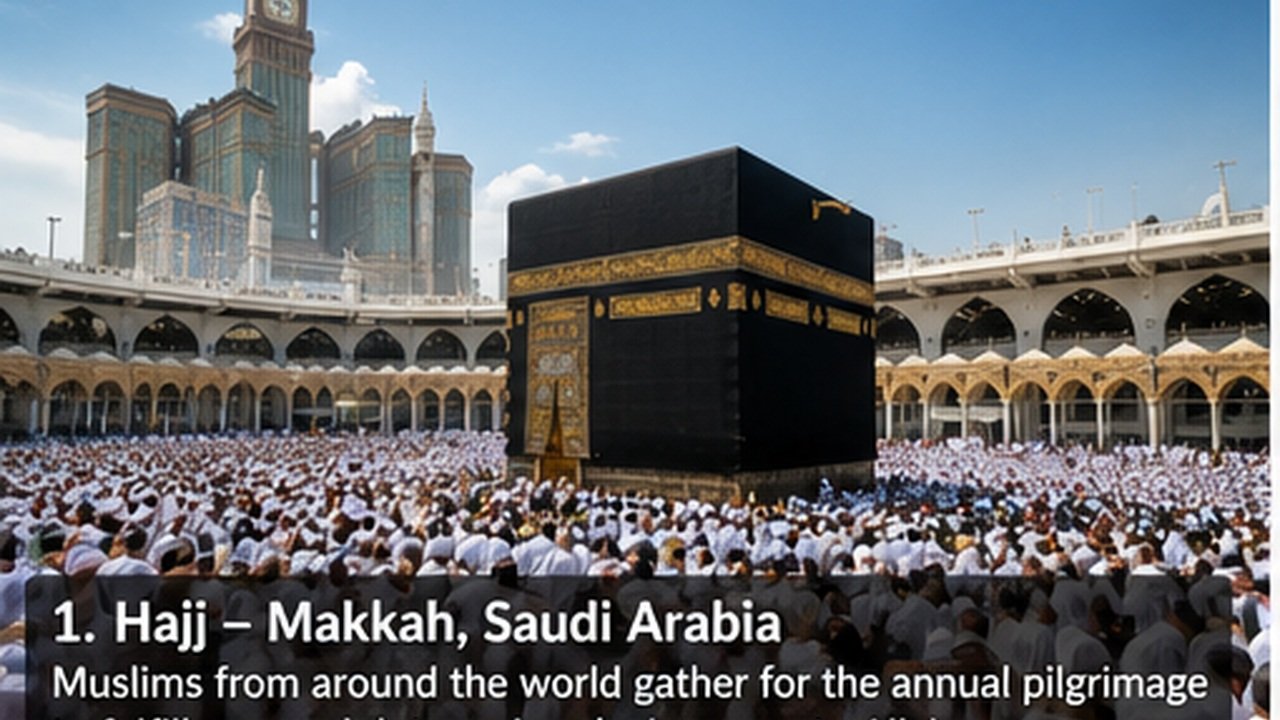
Hajj: Pilgrimage as an Islamic Obligation
Hajj is the annual Islamic pilgrimage to Makkah and one of the pillars of Islam. It is required once in a lifetime for Muslims who are physically and financially able to undertake it. The Saudi Ministry of Hajj and Umrah maintains official information and services for pilgrims. [8]
Hajj includes a sequence of rites connected with Makkah, Mina, Arafat, and Muzdalifah. Pilgrims enter a state of ihram, perform tawaf around the Kaaba, undertake other prescribed acts, stand at Arafat in prayer, and participate in rites that remember obedience to God and events associated with Ibrahim, Hajar, and Ismail.
The pilgrimage expresses worship, equality before God, repentance, discipline, and the unity of Muslims across nations and languages. Its rites must be described through reliable Islamic sources rather than reconstructed from tourist observation.
Hajj also requires major systems of crowd management, health care, transport, accommodation, and heat protection. Prospective pilgrims should rely on current official regulations because permits, health requirements, and services can change.
Kumbh Mela and Sacred River Pilgrimage in India
Kumbh Mela is a major Hindu pilgrimage gathering held at four locations associated with sacred rivers. UNESCO describes it as the largest peaceful congregation of pilgrims on earth and notes that bathing or taking a dip in the sacred river is central to the event. [9]
The gathering includes ritual bathing, prayer, teaching, meetings among religious communities, devotional practices, processions, temporary settlements, and extensive systems of service and food distribution.
Kumbh Mela cannot be understood only as a mass bath. It belongs to Hindu cosmology, sacred geography, calendrical knowledge, monastic and ascetic traditions, and local systems of hospitality and organization.
Respectful coverage should avoid intrusive photography, especially during bathing, and should not treat ascetics or pilgrims as exotic objects.
The Camino de Santiago
The Camino de Santiago is a network of Christian pilgrimage routes leading toward Santiago de Compostela in north-western Spain, associated with the tomb of the apostle James.
UNESCO notes that the routes supported an extensive heritage of cathedrals, churches, hospitals, hostels, bridges, and roadside structures created to serve pilgrims. The northern Spanish network now recognized by UNESCO extends across approximately 1,500 kilometres. [10]
Contemporary walkers include devout Christians, heritage travellers, people in mourning, seekers of personal reflection, and those attracted by community and long-distance walking. Their motives may overlap, but the route remains rooted in a specific Christian history.
The Camino demonstrates how hospitality becomes part of pilgrimage heritage. Lodging, shared meals, waymarkers, credentials, blessings, and the repeated greeting among pilgrims help turn a long route into a social and spiritual world.
Japanese Pilgrimage Routes: Kii Mountains and Shikoku
Japan preserves several important pilgrimage landscapes. UNESCO's Sacred Sites and Pilgrimage Routes in the Kii Mountain Range connect Yoshino and Omine, Kumano Sanzan, and Koyasan through forest routes shaped by Shinto and Buddhist traditions. [11]
The Shikoku Henro is a circular pilgrimage connecting eighty-eight temples associated with Kukai, also known as Kobo Daishi. The official regional tourism organization describes a walking circuit of about 1,200 kilometres and emphasizes the relationship among temples, natural landscapes, and encounters with local people. [12]
Pilgrims may wear recognizable clothing and carry a staff, while local residents may offer osettai, gifts or assistance extended to pilgrims. These practices should be approached as living religious and social traditions, not costume opportunities for visitors.
Walking only part of a route can still be meaningful, but visitors should distinguish personal hiking from formally claiming religious authority or completion.
The Wixárika Route to Wirikuta
In 2025, UNESCO inscribed the Wixárika Route through Sacred Sites to Wirikuta on the World Heritage List. The serial property includes twenty components and spans more than 500 kilometres across north-central Mexico. [13]
UNESCO describes the annual pilgrimages as a continuing spiritual tradition that connects people, ancestors, sacred places, plants, animals, weather, and different ecological regions. The route is not simply a trail to one destination; it is a ceremonial landscape with specific meanings at multiple sites. [14]
The inscription is significant because it recognizes an Indigenous pilgrimage route still used by the community whose worldview gives it meaning. Protection must therefore include cultural authority, land access, biodiversity, and the right of the Wixárika people to determine how sacred knowledge is represented.
Visitors and publishers should avoid revealing restricted locations or practices and should follow community-led guidance.
Pilgrimage, Hospitality, and Temporary Community
Pilgrimage routes depend on more than pilgrims. Local households, religious institutions, volunteers, transport workers, cooks, health teams, guides, and donors often sustain the journey.
Hospitality can itself become a sacred duty. Feeding strangers, offering water, providing a sleeping place, helping an elderly walker, or guiding someone who is lost may be understood as service to the pilgrimage and its spiritual purpose.
These temporary communities can reduce ordinary social distance, but they do not automatically eliminate inequality. Cost, disability, citizenship, gender, language, and access to documents or transport may determine who can participate safely.
The Body, Hardship, and Transformation
Walking, heat, cold, altitude, fasting, crowds, sleeplessness, and repetitive prayer can make pilgrimage physically demanding. In many traditions, difficulty is not accidental; endurance may express devotion, repentance, solidarity, or separation from normal comfort.
Hardship should never be romanticized when it becomes preventable danger. A pilgrim's spiritual intention does not remove the need for medical preparation, safe transport, hydration, accessibility planning, weather awareness, and obedience to local authorities.
People with disabilities, chronic illness, advanced age, pregnancy, or limited finances may participate through adapted routes, delegated acts, community support, or other forms recognized by their tradition. Authenticity should not be measured only by physical suffering.
Pilgrimage and the Natural Environment
Sacred routes frequently cross fragile forests, deserts, mountains, riverbanks, and historic towns. Large gatherings can strain water, sanitation, waste systems, wildlife habitats, and local communities.
Environmental care is not separate from spiritual respect. Pilgrims and visitors should follow waste rules, avoid damaging plants or sacred landforms, use recognized paths, respect water restrictions, and support community-led conservation.
For traditions such as the Wixárika route, Osun-Osogbo, and the Kii Mountain routes, culture and landscape cannot be separated. Destroying the environment would also damage the ceremonial knowledge and relationships carried by the route.
Modern Transport, Digital Media, and Changing Practice
Modern pilgrimage may involve aircraft, buses, railways, mobile applications, online registration, GPS, live broadcasts, and digital payment systems. These tools can expand access and improve safety while changing older experiences of distance and dependence.
Some people complete routes in sections over several years. Diaspora communities organize group journeys. Others participate through livestreamed worship when illness, cost, conflict, or visa restrictions prevent travel.
Digital participation is not automatically equivalent to physical pilgrimage, and communities differ in how they understand it. The important question is who has authority to define valid participation within the tradition.
Pilgrimage, Tourism, and Commercialization
Pilgrimage and tourism often overlap. Pilgrims need transport, accommodation, food, clothing, guides, and souvenirs. Sacred places may also attract visitors motivated by architecture, history, landscape, or personal wellness.
Commerce is not necessarily opposed to spirituality. Historic routes developed markets, hostels, hospitals, and crafts because travellers needed support. Problems arise when profit displaces worshippers, exploits sacred imagery, raises local housing costs, damages the environment, or turns private ritual into entertainment.
Responsible tourism follows local rules, pays fairly, supports community businesses, avoids counterfeit sacred objects, and does not demand access to ceremonies that are closed.
How to Approach Pilgrimage Traditions Respectfully
Name the exact tradition. Use Hajj, Namugongo, Lalibela, Grand Magal, Kumbh Mela, Camino, Shikoku Henro, or Wixárika route rather than treating every journey as the same spiritual practice.
Learn from recognized sources. Prioritize community institutions, religious authorities, Indigenous custodians, museums, universities, and heritage organizations.
Ask before photographing. Prayer, bathing, grief, vows, healing, and initiation can be private even when they occur in public space.
Do not imitate restricted practices. Wearing sacred clothing, collecting materials, entering closed spaces, or repeating ceremonies without permission can be disrespectful.
Protect the route. Follow safety rules, respect the environment, carry out waste, avoid removing stones or plants, and comply with permits and access restrictions.
Avoid guaranteed claims. A respectful educational article may explain beliefs about healing, forgiveness, protection, or blessing without promising results.
Recognize living authority. Communities have the right to adapt their traditions, protect knowledge, regulate visitors, and correct outside descriptions.
Conclusion
Pilgrimage traditions turn geography into relationship. A road becomes a remembered path. A river becomes a place of encounter. A shrine becomes a meeting point between past and present. A difficult journey becomes a language of devotion, repentance, identity, or hope.
The value of comparative study lies not in claiming that all pilgrimages are secretly the same, but in seeing how different communities use movement to renew what they consider sacred.
From Namugongo, Lalibela, Touba, and Osogbo to Makkah, Kumbh Mela, Santiago, Shikoku, and Wirikuta, pilgrimage remains a living practice because people continue to walk, gather, remember, serve, pray, and return home changed by the journey.
Frequently Asked Questions
What should readers know first about african spirituality and cultural history?
African spirituality and cultural history: Read clear guidance, key signs, practical steps, and private support from Ancestral Temple.
What causes pilgrimage-traditions?
The safest next step is to compare the signs, prepare clear details, and request private guidance when the matter feels personal.
How does pilgrimage-traditions work?
The safest next step is to compare the signs, prepare clear details, and request private guidance when the matter feels personal.
Is it possible to get private guidance for pilgrimage-traditions?
The safest next step is to compare the signs, prepare clear details, and request private guidance when the matter feels personal.
How long does pilgrimage-traditions take to understand?
The safest next step is to compare the signs, prepare clear details, and request private guidance when the matter feels personal.
Can pilgrimage-traditions affect relationships, family, work, or personal peace?
The safest next step is to compare the signs, prepare clear details, and request private guidance when the matter feels personal.
Why do people seek spiritual guidance for pilgrimage-traditions?
The safest next step is to compare the signs, prepare clear details, and request private guidance when the matter feels personal.
What signs should someone notice before asking about pilgrimage-traditions?
The safest next step is to compare the signs, prepare clear details, and request private guidance when the matter feels personal.
When should someone contact a private spiritual guide?
The safest next step is to compare the signs, prepare clear details, and request private guidance when the matter feels personal.
What causes african spirituality and cultural history?
African spirituality and cultural history: Read clear guidance, key signs, practical steps, and private support from Ancestral Temple. The safest next step is to compare the signs, prepare clear details, and request private guidance when the matter feels perso
Article Information
- Publisher
- Ancestral Temple
- Editor
- Ancestral Temple
- Last updated
- Jul 26, 2026
- Last reviewed
- Jul 13, 2026
- Content version
- 0dbccc4867
This educational article should be read as cultural and spiritual information, not as medical, legal, financial, or emergency advice.
Helpful Related Guidance
Explore This Topic
Sacred Natural Places In African Spirituality · Travel Protection Spells And Rituals
Related Topic Cluster
African Spirituality And Cultural History
Complete Guide Why Homes Have Been Blessed Throughout HistoryAbout the Author
 Ancestral Temple
Spiritual guide and practitioner with decades of experience in ancestral wisdom, rituals, and divine guidance.
Related Posts
View All
Leave a Comment
We'd love to hear your thoughts.
The final message about returning home with renewed responsibility is memorable.
The article respects Islamic, Christian, Hindu, Buddhist, Yoruba, and Indigenous traditions without blending them.
The explanation of pilgrims carrying intentions from their communities is powerful.
The SEO package, FAQ schema, and glossary are ready for publication.
The article is informative without providing instructions for restricted rites.
The discussion of digital pilgrimage raises thoughtful questions about authority and participation.
The article reminds visitors that public ceremonies can still contain private moments.
I liked the distinction between community-defined sacred travel and personal hiking.
The article has a global scope while still giving African traditions substantial attention.
The safety note about using current official regulations for Hajj is responsible.
The Namugongo history is presented carefully without sensationalizing martyrdom.
The article shows why the route can be as meaningful as the destination.
The conclusion explains the relationship between movement and sacred memory beautifully.
The Wixárika section clearly connects spiritual tradition with land and biodiversity.
The suggested internal links create a strong topic cluster for the website.
The section on temporary community explains why large gatherings can feel transformative.
The article avoids treating pilgrims as exotic subjects for photography.
The Camino section shows how roads, bridges, hostels, and churches form one pilgrimage system.
I appreciated the explanation that inner journeys and physical journeys can both matter.
The article would work well for students of religion, history, and cultural heritage.
The environmental section is especially important for sacred rivers and forests.
The article recognizes that disability and health can require adapted forms of participation.
The FAQ section answers the main questions clearly.
The Uganda example gives this global article a strong East African connection.
I liked the point that pilgrimage communities include cooks, volunteers, health workers, and local households.
The Hajj section is concise and avoids turning sacred rites into tourist instructions.
The article makes cultural specificity a practical rule throughout.
The Lalibela section respects both the churches as heritage and as active places of worship.
The glossary will help readers understand unfamiliar religious terms.
This is a useful introduction to pilgrimage traditions for readers from different faiths.
The section on commercialization is balanced and avoids suggesting that all trade is disrespectful.
I appreciate that the article does not promise healing or supernatural outcomes.
The discussion of route, destination, and return gives a complete picture of pilgrimage.
The article explains Touba as a sacred city supported by networks of hospitality.
The section on living heritage makes clear that communities still define these practices today.
The structure makes it easy to compare traditions without confusing them.
The article balances spiritual meaning with practical safety and environmental responsibility.
I liked the reminder that hardship should never be romanticized into preventable danger.
The explanation of hospitality as part of pilgrimage was especially meaningful.
The Grand Magal discussion respectfully centres Mouride memory and service.
The Osun-Osogbo section connects procession, river, community, and sacred landscape very well.
The African examples are treated as separate living traditions rather than one generic practice.
The article explains sacred geography in a way that is easy to understand.
I appreciated the distinction between pilgrimage and ordinary tourism.
The Namugongo section presents walking as faith and remembrance, not simply as a large public event.