
Abundance Rituals Explained: Cultural Beliefs, Offerings and Spiritual Meaning
Pillar Article
Quick Summary
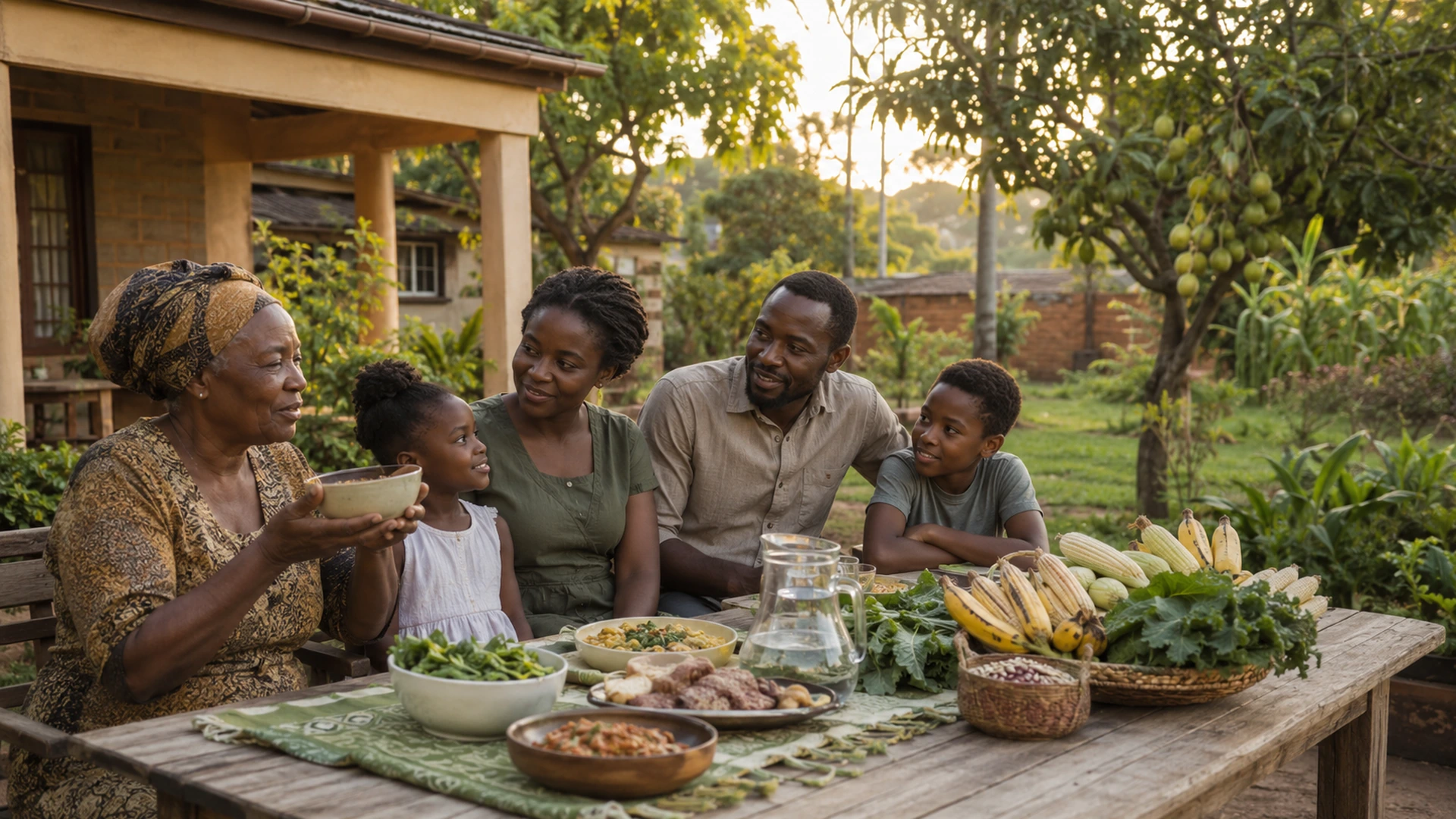
Abundance rituals are structured acts of gratitude, offering, prayer, remembrance or generosity connected with hopes for a flourishing life. Some are tied to harvests, ancestors, d...
Abundance rituals are structured acts of gratitude, offering, prayer, remembrance or generosity connected with hopes for a flourishing life. Some are tied to harvests, ancestors, deities, sacred places or the renewal of relationships. Others are modern personal practices built around intention-setting, charity, budgeting or acknowledging what is already present.
The word abundance can be misleading when it is reduced to sudden money. In many cultural settings, abundance is broader: enough food after a difficult season, healthy children, fertile land, rain, peace within a household, protection of livestock, success in work, continuity between generations or the ability to share with guests. A ritual may express hope for these conditions, but it does not mechanically produce them.
There is no single African abundance ritual and no universal list of prosperity offerings. Yoruba practices in southwestern Nigeria, Mahi harvest observances in central Benin, Dogon millet ceremonies in Mali and Malagasy gift traditions developed in different histories and should not be blended into one invented ceremony. The most respectful approach is to learn the specific context, follow community authority where applicable and separate spiritual belief from guaranteed financial claims.
Quick Answer
| Quick Answer An abundance ritual is a meaningful sequence of actions—such as giving thanks, presenting first fruits, sharing food, making a libation, praying, donating or remembering ancestors—connected with hopes for well-being and continuity. Its meaning depends on the culture. Rituals can organize attention and strengthen values, but they cannot scientifically guarantee money, fertility, protection or success. |
|---|
What Is an Abundance Ritual?
An abundance ritual is best understood as a symbolic practice through which people express gratitude, ask for support, renew obligations or align themselves with values believed to sustain life. The practice may be public or private, inherited or newly created, religious or non-denominational.
The phrase itself is a modern umbrella term. Historical communities have more often spoken of harvest festivals, first-fruits ceremonies, thanksgiving, libation, ancestral remembrance, vows, almsgiving, offerings to a deity, household blessing or seasonal renewal. Treating all of these as “abundance rituals” can help readers compare themes, but it must not erase their different names, authorities and meanings.
Three features commonly appear: something valuable is acknowledged, something is given or shared, and a relationship is renewed. The relationship may be with God, a deity, ancestors, the land, a household, neighbors or one’s own commitments. In many cases, the offering is less a payment for a miracle than a sign of respect, reciprocity or responsibility.
Abundance Is More Than Money
Online spiritual content often treats abundance as a synonym for cash. Cultural traditions frequently use a much wider frame. A prosperous year may mean rain arriving at the right time, grain stores lasting until the next harvest, children growing safely, animals surviving disease, family disputes being repaired, guests being fed and knowledge passing to the next generation.
| Form of abundance | What it may mean in lived experience | Possible ritual expression |
|---|---|---|
| Material sufficiency | Food, shelter, tools, savings and reliable work | First fruits, shared meals, saving a portion, blessing tools or workplace |
| Family continuity | Children, elders, memory, inheritance and repaired relationships | Ancestor remembrance, family storytelling, naming ceremonies, reconciliation |
| Agricultural well-being | Rain, fertile soil, healthy seed, livestock and successful harvest | Seasonal prayers, harvest festivals, grain offerings, communal labor |
| Social abundance | Trust, hospitality, cooperation and generosity | Feasts, gifts, charity, mutual-aid contributions, welcoming guests |
| Inner abundance | Hope, clarity, gratitude, resilience and a sense of enoughness | Prayer, journaling, song, silence, candle lighting or meditation |
| Opportunity | Education, contracts, customers, promotion or a new beginning | Blessing a new venture, setting intentions, seeking advice and taking practical steps |
Why Offerings Appear in Abundance Traditions
Offerings make an invisible value visible. Food can represent life and labor. Water can represent refreshment, purity or continuity. Cloth can represent dignity, relationship and protection. Money can become charity or communal support. Grain can embody both the previous harvest and the seed of the next one.
Anthropologists often discuss religious gifts through reciprocity: giving creates, acknowledges or renews a relationship. That relationship is not always a commercial exchange. In many traditions, an offering says, “I remember,” “I am grateful,” “I belong,” or “I accept responsibility.” It may also distribute resources to priests, elders, visitors, relatives or people in need.
Problems begin when reciprocity is reduced to a guaranteed transaction—“pay this amount and wealth must arrive.” Cultural evidence shows a far more complex picture. Offerings can express devotion, obligation, hospitality, humility, identity, grief, gratitude or community membership. Their meaning depends on who gives, to whom, where, when and under whose authority.
Common Elements of Abundance Rituals
Gratitude: The ritual begins by recognizing what has already sustained life: land, labor, family, health, knowledge, rain, customers or community.
First fruits: A first portion of a harvest may be presented, blessed, shared or withheld from ordinary use until a ceremony marks the new season.
Reciprocity: The participant gives something valued—food, cloth, drink, money, time or service—to renew a relationship rather than merely request a reward.
Remembrance: Ancestors or previous generations may be named because present livelihood is understood as connected to inherited land, skills, sacrifice and identity.
Prayer, song or spoken intention: Words frame the act, identify its purpose and connect material offerings with moral commitments.
Communal sharing: A feast, gift distribution or mutual-aid contribution transforms abundance from private accumulation into social well-being.
Practical commitment: A meaningful ritual is often followed by planting, saving, repairing, applying, learning, working or giving—actions that embody the stated hope.
Cultural Examples: Similar Themes, Different Traditions
The following examples illustrate recurring themes without implying that they are interchangeable. They are living or historically documented traditions with their own custodians. Reading about them does not authorize a person to reproduce restricted rites, sacred formulas or priestly roles.
Mahi Yam Festival in Savalou, Benin
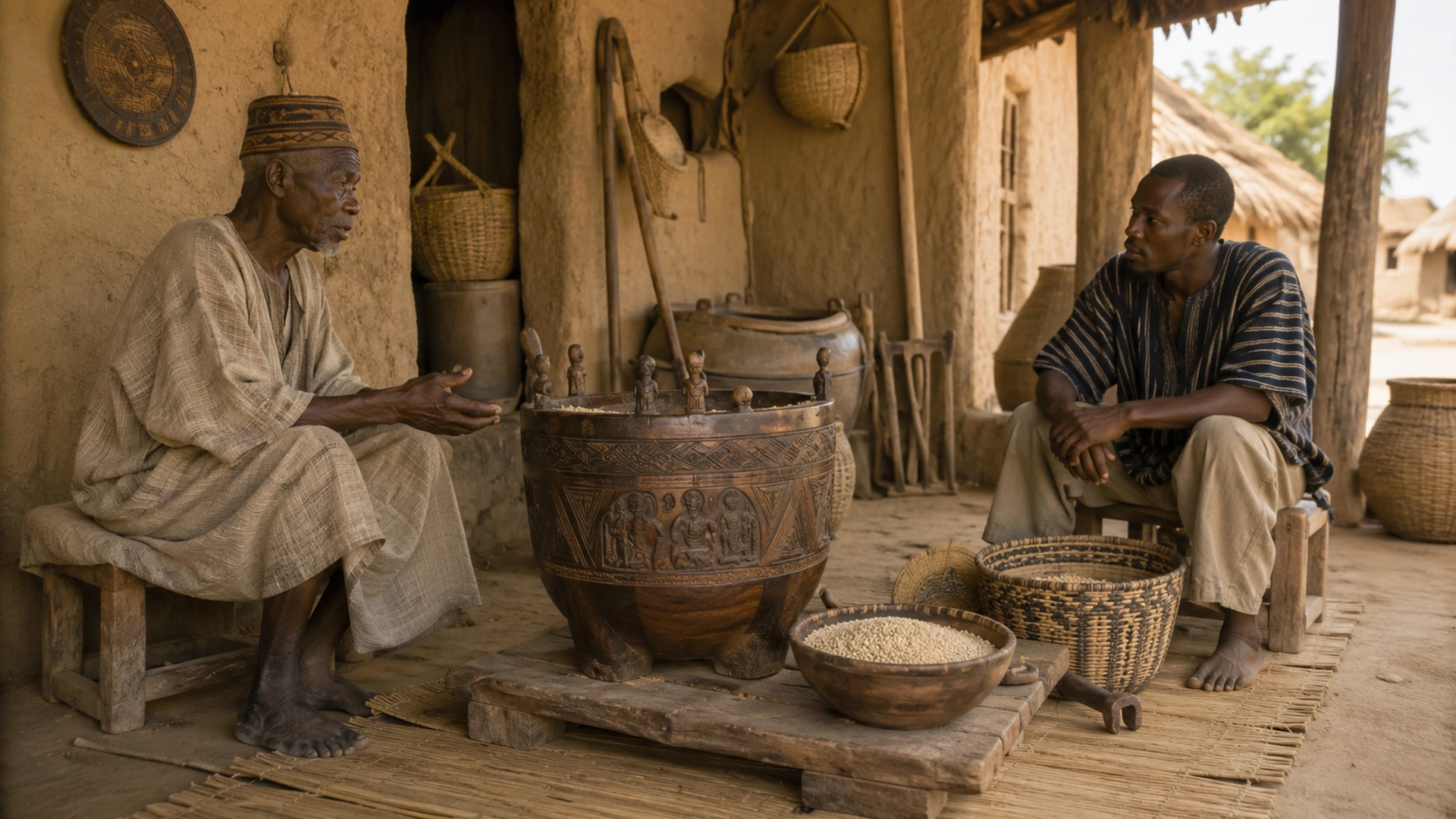
For the Mahi people of Savalou in central Benin, the new-yam festival connects food, identity, religion and the beginning of a harvest season. Smithsonian Folklife documentation explains that consumption of the new crop is ritualized and that the festival offers an occasion to honor ancestors understood to have favored the season that produced the harvest. Divination and the honoring of Vodun deities form part of the local context; the festival is not simply a generic “yam abundance ritual.” [1]
The abundance theme here is concrete. Yams represent months of agricultural knowledge and labor. The ceremony marks permission to move from anticipation to communal consumption. It also turns a successful crop into a statement about ancestry, social cohesion and regional identity.
Yoruba Osun-Osogbo and the Meaning of Fertility
The Osun-Osogbo Sacred Grove in southwestern Nigeria is an active Yoruba religious landscape associated with Osun, a river deity connected with fertility. UNESCO describes the grove as a place where shrines, sculptures, worship points and an annual festival sustain the relationship between the people of Osogbo, their ruler and Osun. [2]
Fertility in this context is not limited to money or even childbirth. It can include the generative capacity of water, community, land, art and social continuity. The grove’s meaning belongs to Yoruba cosmology and living religious authority. A person should not copy offerings from photographs or social media and call the result an “Osun abundance ritual.” Respect begins with recognizing the site, tradition and custodians as specific.
Dogon Millet, Offerings and the Harvest Year
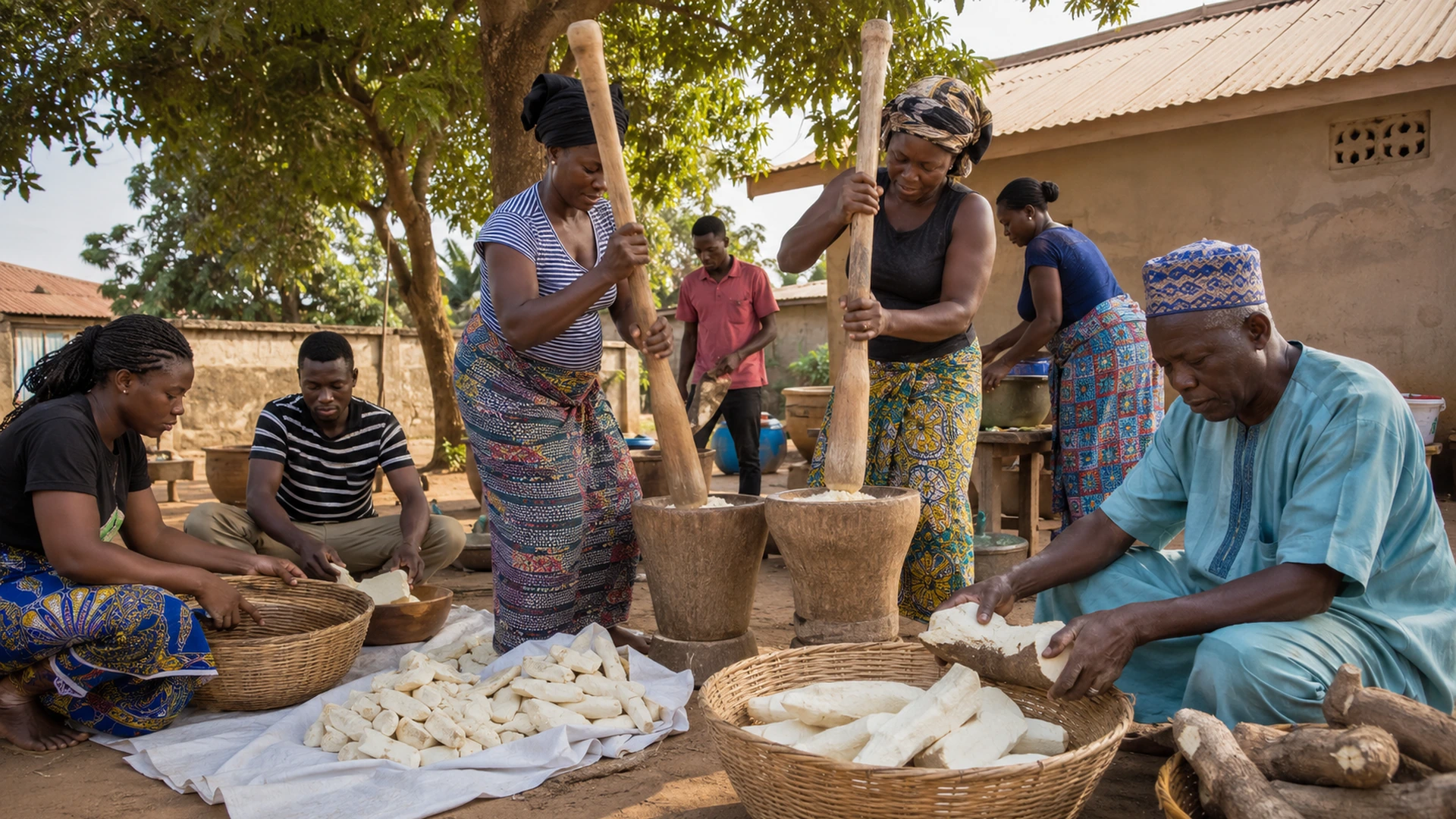
The Metropolitan Museum of Art documents a monumental Dogon vessel used during an annual goru ceremony to hold offerings dedicated to Amma the Creator and the ancestors. The ceremony marked the culmination of rituals celebrating the millet harvest, whose abundance would support the family in the coming year. [3]
Another Met interpretation describes porridge encrusted on a Dogon or Tellem figure as a return of grain to the ancestors after a good harvest. [4] These museum records show a relationship among agriculture, ancestry and reciprocity. They do not provide permission to reconstruct the ceremony from an object label; they show why grain can carry spiritual meaning beyond its nutritional value.

Gelede After the Harvest
UNESCO describes Gelede as an annual Yoruba-Nago performance tradition found in Benin, Nigeria and Togo. It pays tribute to the primordial mother Iyà Nlà and to women’s roles in social organization. Performances may occur after harvests and at times of drought or epidemic. [5] The tradition connects abundance with social balance, women’s authority, memory, dance and collective responsibility—not merely with acquiring possessions.
Malagasy Cloth as Gift and Blessing
In Madagascar, handwoven lamba can function as clothing, inheritance, status and ceremonial gift. Smithsonian documentation explains that cloth may be offered to rulers, ancestors and spirits in return for blessings, and that the idea of hasina connects sacred force with relationships and authority. [6]
This example broadens the idea of an abundance offering. The meaningful object is not always food or money. Cloth can represent labor, dignity, kinship and continuity. It may be valuable because of who made it, who receives it and how it situates the giver within a family or community.
Kwanzaa and Modern Diaspora Harvest Symbolism
Kwanzaa was created in the United States in 1966 as an African American cultural celebration. Its table symbols include mazao, or fruits and vegetables representing the harvest, corn representing children and gifts connected with principle and achievement. The Smithsonian National Museum of African American History and Culture emphasizes family, community, culture and the seven principles. [7]
Kwanzaa is not an ancient African ritual and should not be described as one. It is a modern African diaspora tradition that deliberately uses harvest imagery to discuss collective work, purpose, creativity, cooperative economics and responsibility.
What Offerings Can Represent Abundance?
An offering gains meaning from context, not from an online correspondence list. Rice does not symbolize exactly the same thing everywhere. Coins do not automatically “attract money.” Water may be a libation in one tradition, a purification medium in another and an inappropriate addition at a protected heritage site. The following table presents broad interpretive possibilities, not universal ritual rules.
| Offering | Possible meanings | Responsible use |
|---|---|---|
| Grain, yam or fruit | Harvest, nourishment, labor, continuity and first fruits | Use foods meaningful to your household or tradition. Do not copy a sacred recipe or leave food outdoors where it harms wildlife. |
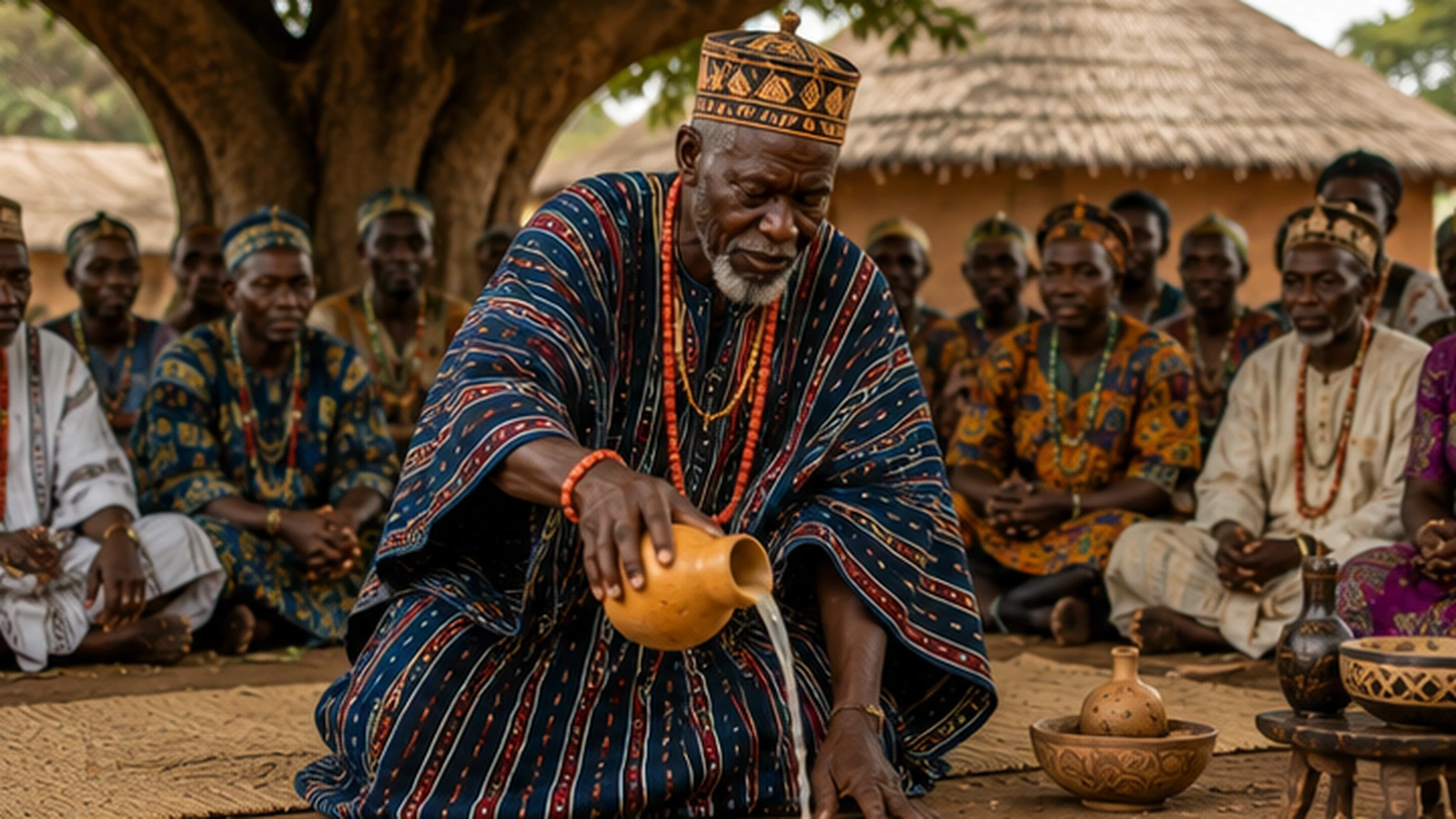
| Water or another drink | Life, refreshment, hospitality, cleansing, continuity or remembrance | Use a small amount in an appropriate vessel. Ask local custodians before pouring anything at a grave, shrine, river or heritage site. |
| Flowers or leaves | Beauty, seasonality, life, mourning, respect or renewal | Choose non-invasive plants. Avoid protected species and remove wrappings, wire or plastic. |
| Cloth | Dignity, protection, kinship, status, ancestral continuity or gift | Use cloth respectfully; do not imitate restricted colors, patterns or regalia from a community you do not belong to. |
| Candle or lamp | Attention, remembrance, prayer, hope or continuity | Use a stable fire-resistant holder, ventilation and constant supervision. An LED candle is a valid safer alternative. |
| Incense or resin | Fragrance, sacred atmosphere, welcome, purification or prayer | Smoke is not harmless. Use small amounts, ventilation and a heat-safe method; avoid use around respiratory sensitivity. |
| Coins or money | Value, livelihood, exchange, charity or communal responsibility | Donation to a person, family fund, mutual-aid group or transparent charity is often more responsible than leaving cash at an unsecured site. |
| Food shared with others | Hospitality, generosity, equality and circulation of blessing | Prioritize safe food handling and the dignity of recipients. Sharing should not be used for public display or coercion. |
| Seeds or tools | Future growth, work, skill, land and responsibility | Plant only suitable species and respect land ownership. A tool blessing should be paired with maintenance and safe use. |
| Time and service | Commitment, reciprocity, community care and gratitude | Volunteer, teach a skill, repair something, visit an elder or support a cooperative. Service is often the most practical abundance offering. |
What Is the Spiritual Meaning of Abundance?
Spiritual abundance can mean living in right relationship with what sustains life. The idea does not require rejecting material needs. Food, housing, money and healthcare matter. The spiritual question is how those resources are received, used, shared and connected to values.
Enoughness: The capacity to recognize sufficiency without denying legitimate needs or ambition.
Reciprocity: The understanding that receiving creates responsibilities—to family, land, community, workers, customers or future generations.
Gratitude: Attention to support that is easily overlooked, including inherited knowledge, ordinary labor and relationships.
Generativity: The ability to produce, nourish, teach, mentor or create something that continues beyond the individual.
Stewardship: Using resources in ways that protect rather than exhaust the conditions that made them possible.
Circulation: Allowing food, knowledge, money or opportunity to move through hospitality, fair payment, charity or mutual support.
Hope with responsibility: Holding a vision for improvement while accepting the practical work, uncertainty and ethical limits involved.
| A balanced definition Abundance is not proof of moral superiority, and hardship is not proof of spiritual failure. Drought, illness, unemployment and poverty have social, environmental, political and economic causes. A respectful spiritual practice must never blame people for suffering. |
|---|
How to Create a Respectful Personal Abundance Practice
A personal practice can be meaningful without pretending to reproduce a ceremony from a culture you do not know. The following approach is intentionally simple and non-denominational. Adapt it to your own faith, family and legal environment.
Name the purpose clearly. Choose one area such as gratitude for food, preparation for a business launch, family cooperation, saving, a new job search or recovery after loss. Avoid vague promises of “unlimited wealth.”
Identify your source of authority. Use prayers and symbols from your own religion or family when possible. When learning from another tradition, rely on public educational sources and community teachers rather than anonymous viral content.
Choose a modest offering. Select water, fruit, grain, flowers, a candle, a donation or an act of service. The offering should not create debt, waste or fear.
Prepare a clean, safe space. Use a table, cloth and stable bowl or candle holder. Keep flames away from curtains, children and pets. Outdoor sites may prohibit offerings.
Acknowledge what already sustains you. Name people, skills, land, customers, health, lessons or opportunities for which you are grateful.
State the hope without a guarantee. Ask for wisdom, discipline, good relationships, opportunity or strength. Avoid declaring that a specific person or spiritual being is forced to deliver money.
Make one practical commitment. Transfer savings, apply for work, follow up with a customer, repair equipment, study, plant, apologize, seek professional advice or support someone else.
Share or circulate something. Offer food to family, donate, pay fairly, mentor, thank a worker or contribute to mutual aid. Generosity turns abundance into relationship.
Close the practice responsibly. Extinguish flames, clean the space and decide how the offering will be eaten, donated, composted or disposed of without harming people, animals or the environment.
Review the outcome honestly. Notice emotional clarity and actions taken, not supernatural “signs” alone. Adjust your plan based on evidence and changing circumstances.

A Simple Non-Denominational Abundance Reflection
| Example wording “I give thanks for the people, knowledge and resources that sustain this household. May I recognize opportunities clearly, use what I receive responsibly and contribute to the well-being of others. I commit today to one practical action: __________.” |
|---|
Place a glass of water, a piece of fruit or a small bowl of grain on a clean table while you speak. Afterward, drink the water or share the food rather than leaving it to spoil. Make the practical commitment specific and measurable.
What Rituals Can and Cannot Do
Rituals can focus attention, give structure to uncertainty, reinforce identity and help people move from emotion to action. A field study among Marathi Hindu participants in Mauritius found lower self-reported and physiological anxiety after familiar temple rituals compared with quiet rest in an anxiety-inducing situation. The authors were careful not to claim that ritual solves the external problem itself. [8]
A later preregistered experiment found that predictable ritualized actions could contribute to anxiety reduction, but differences from control conditions were small and depended partly on how strongly participants responded to the anxiety induction. [9] These findings support modest psychological claims: ritual may help some people regulate uncertainty or prepare for action. They do not show that a candle, offering or spoken formula causes money to appear.
| Ritual may help with | Ritual cannot reliably guarantee |
|---|---|
| Clarifying intentions | A specific income, customer, marriage, pregnancy or court outcome |
| Reducing anxiety for some people | Protection from all loss, illness, conflict or bad decisions |
| Strengthening family or community identity | Control over another person’s choices |
| Remembering values and commitments | Scientific proof of supernatural causation |
| Marking a beginning, harvest or transition | A substitute for medical, legal, financial or agricultural advice |
| Encouraging generosity and practical action | Wealth without work, risk, timing, skill or wider economic conditions |
Abundance Rituals and Financial Exploitation
The desire for relief makes people vulnerable to anyone who promises guaranteed wealth. The Federal Trade Commission warns that guaranteed income and rapid-success claims are major signs of money-making scams. [10] The same principle should be applied to spiritual services.
No ethical practitioner can guarantee a lottery win, inheritance, customer, promotion or exact amount of money.
Pressure to pay immediately because a “portal is closing” or a curse will worsen is a serious warning sign.
Repeated demands for larger payments to “complete” a ritual can create debt and dependency.
A practitioner should not tell a client to stop medical care, ignore legal deadlines or invest money based only on a spiritual message.
Prices, materials, scope and refund terms should be clear before any service begins.
Spiritual guidance should support informed choice, not secrecy from family, coercion or fear.
Safety and Environmental Responsibility
A meaningful practice should not create a fire, smoke exposure, wildlife problem or damaged heritage site. Fire services advise that candles, incense and oil burners should never be left unattended and should be kept in stable, fire-resistant holders away from combustible materials. [11]
Food left outdoors can attract animals, alter their behavior and become litter even when it is biodegradable. National Park Service guidance emphasizes respecting wildlife, leaving cultural sites unchanged and carrying food waste away. [12]
Ask permission before leaving any object at a grave, river, shrine, tree, crossroads, monument or protected site.
Use LED candles where open flames are unsafe or prohibited.
Do not pour alcohol, oil, milk, salt, wax or colored liquids into natural water without local authorization.
Do not release balloons, glitter, plastic ribbons, coins or non-native seeds into nature.
Do not improvise animal sacrifice. Such practices, where they exist, involve specific religious authority, animal-welfare duties, law, sanitation and community rules.
Do not burn unknown powders, plastics, treated wood or large quantities of herbs indoors.
Compost or consume food offerings when appropriate, and remove all packaging.
Common Misunderstandings About Abundance Rituals
“The more expensive the offering, the stronger the result.” Cost does not prove sincerity, cultural legitimacy or effectiveness. Debt can undermine the well-being the ritual is meant to support.
“Every African tradition uses ancestor offerings for money.” Africa contains thousands of communities and religious histories. Ancestors, offerings and prosperity are understood differently, and many Africans do not practice ancestral religion.
“If nothing changes, I performed it incorrectly.” Outcomes depend on practical conditions and chance. A ritual’s value may lie in meaning, discipline or relationship rather than a promised external event.
“Coins, cinnamon or green candles universally attract wealth.” These are modern correspondences in some spiritual communities, not universal historical rules.
“A harvest offering is just superstition.” Harvest ceremonies can organize calendars, distribute food, affirm identity, honor labor and renew community relationships whether or not an observer shares the religious belief.
“All offerings must be left untouched.” Some traditions dedicate food and then share or consume it; others dispose of it in prescribed ways. Follow the relevant tradition and safety requirements.
“Abundance means having more than everyone else.” Many traditions connect prosperity with sufficiency, generosity, continuity and the ability to support others.
Key Takeaways
Abundance rituals are practices of gratitude, offering, remembrance, reciprocity or generosity connected with hopes for well-being.
Abundance can include food, health, continuity, opportunity, peace and communal support—not only money.
There is no single African abundance ritual; specific communities have distinct histories and authorities.
Offerings communicate relationship and responsibility, not a guaranteed purchase of supernatural results.
Harvest examples from Savalou, Osun-Osogbo and Dogon contexts show different links among land, ancestors, fertility and community.
A respectful modern practice can use simple symbols while emphasizing work, saving, learning, generosity and ethical action.
Ritual may help some people manage anxiety or focus attention, but it does not scientifically guarantee wealth or protection.
Safety, cultural permission, environmental care and freedom from financial pressure are essential.
People Also Ask
What is an abundance ritual?
It is a structured practice of gratitude, offering, prayer, remembrance or generosity associated with hopes for well-being. The form and meaning depend on the culture or personal tradition.
What offerings represent abundance?
Grain, fruit, water, cloth, flowers, money, seeds, shared meals and service can represent abundance in different settings. No object has one universal meaning.
Do abundance rituals attract money?
There is no scientific evidence that a ritual directly causes money to arrive. A ritual may improve focus, reduce anxiety or reinforce practical commitments, but financial results depend on work, opportunity, risk and wider conditions.
What is the spiritual meaning of abundance?
Spiritual abundance often refers to sufficiency, gratitude, generativity, relationship and responsible use of resources rather than unlimited accumulation.
Can I honor ancestors for abundance?
You can remember ancestors through names, stories, food, prayer, charity or family care when these acts fit your tradition. Avoid claiming that every ancestor practice controls money or copying restricted rites.
What should I do with a food offering?
Follow your own tradition. When no rule applies, consume, share or compost it safely. Do not leave food in nature or at a public site without permission.
Is an abundance altar necessary?
No. A clean table, journal, donation, shared meal or practical commitment can serve the purpose. Altars are tradition-specific and should not be treated as compulsory.
Can Christians, Muslims or nonreligious people use abundance rituals?
People can use faith-consistent thanksgiving, charity, prayer, budgeting or family meals. Nonreligious people may use reflection and generosity without making supernatural claims.
Frequently Asked Questions
Is abundance the same as prosperity?
They overlap. Prosperity often emphasizes favorable material conditions, while abundance can also include relationships, meaning, creativity, food security and shared well-being.
What is a first-fruits offering?
It is the dedication, blessing, sharing or ceremonial presentation of the earliest portion of a harvest. Its rules differ widely by religion and community.
Can I use rice, salt or coins?
You may use ordinary objects in a personal reflection, but do not claim they have universal power. Consider food waste, wildlife, corrosion, litter and local rules.
Should an offering be expensive?
No. A modest, honest and sustainable offering is safer than one that creates debt or is used to impress others.
Can I perform a ritual from a culture I admire?
Learn whether the practice is public, private, initiated or restricted. Appreciation does not automatically grant authority to reproduce sacred roles or formulas.
Are candles required?
No. A candle is only one symbol of attention or remembrance. LED candles, daylight, prayer, music or silence can be safer alternatives.
Can abundance rituals remove poverty?
No ritual by itself resolves low wages, unemployment, discrimination, illness, debt or unequal access to resources. Personal practice should accompany practical support and structural solutions.
Can I ask for business success?
You can pray or reflect on business goals, but pair the practice with research, budgeting, customer service, legal compliance and honest accounting.
What if I feel anxious when I stop the ritual?
A spiritual practice should not become a compulsion or source of fear. If anxiety is persistent or interferes with daily life, speak with a qualified mental-health professional and a trusted religious advisor.
Are animal offerings part of abundance rituals?
Some communities have sacrificial traditions, but they are governed by specific religious authority, law, welfare and sanitation rules. They should never be improvised from internet instructions.
How often should I do a personal practice?
Use a schedule that supports reflection without creating compulsion—such as at a harvest, new month, business review or family gathering. There is no universal required frequency.
What is the best sign that a practice is healthy?
It leaves you clearer, safer, more responsible and more connected to practical action—not frightened, indebted or dependent on repeated paid interventions.
Conclusion
Abundance rituals make most sense when abundance is understood as a relationship rather than a prize. Harvest, water, grain, cloth, prayer, memory and generosity can all carry spiritual meaning, but they do so inside particular histories. The responsible reader asks not only, “What can I receive?” but also, “What sustains me, what do I owe, and how will I use what comes?”
A modern personal practice does not need to imitate an unfamiliar ceremony. It can begin with gratitude, a modest symbol, a truthful hope and one practical commitment. That combination respects spiritual meaning without pretending that ritual overrides economics, health, law, ecology or another person’s freedom.
Final Summary
| Final Summary Abundance rituals are culturally varied practices that express gratitude, reciprocity, remembrance and hope. Their offerings may include food, water, cloth, fragrance, money or service, but no object guarantees wealth. The most respectful practice honors specific traditions, avoids exploitation, protects people and nature, and connects spiritual reflection with realistic action. |
|---|
Article Information
- Publisher
- Ancestral Temple
- Editor
- Ancestral Temple
- Last updated
- Jul 30, 2026
- Last reviewed
- Jul 30, 2026
- Content version
- bfe607c9d2
This educational article should be read as cultural and spiritual information, not as medical, legal, financial, or emergency advice.
Helpful Related Guidance
About the Author
 Ancestral Temple
Spiritual guide and practitioner with decades of experience in ancestral wisdom, rituals, and divine guidance.
Related Posts
View All







Comments
We'd love to hear your thoughts.