
Olive Oil Symbolism: Spiritual Meaning Across Different Cultures
Quick Summary
Olive oil has been more than food for thousands of years. Across parts of the Mediterranean and the religions that developed around it, oil illuminated homes and sanctuaries, prese...
Olive oil has been more than food for thousands of years. Across parts of the Mediterranean and the religions that developed around it, oil illuminated homes and sanctuaries, preserved perfume, softened skin, rewarded athletes, marked honored guests and set people or objects apart for sacred purposes. Those practical uses helped olive oil acquire powerful symbolic meanings: light, blessing, consecration, abundance, joy, strength, healing, hospitality and continuity.
The meaning is not identical everywhere. In Jewish tradition, pure olive oil is associated with sacred light and the biblical language of anointing. In Christianity, anointing with oil can signify the Holy Spirit, consecration, strengthening, healing and comfort. In Islam, the Qur’an’s celebrated Light Verse describes a lamp kindled from the oil of a blessed olive tree. In ancient Athens, the olive was connected with Athena, civic identity, valuable prizes and athletic excellence. Across Mediterranean communities, the harvest and shared table can express hospitality, family continuity, cooperation and attachment to the land. [1–13]
It is also important to separate three related symbols. Olive oil often represents light, anointing and abundance. The olive tree commonly represents endurance, wisdom, rootedness and long life. The olive branch is the best-known emblem of peace and reconciliation. The symbols overlap, but they should not be treated as interchangeable in every historical or religious setting.
Quick Answer
Olive oil commonly symbolizes light, divine guidance, blessing, consecration, healing or comfort, abundance, hospitality, strength and continuity. In Jewish and Christian traditions it is strongly linked with sacred lamps and anointing; in Islam it appears in the Qur’anic image of a blessed olive tree whose oil illuminates a lamp. Meanings vary by community and context.
| Field | Specification |
|---|---|
| Image number | 1 (featured image) |
| Purpose | Introduce the topic through separate, museum-based cultural contexts rather than blending several religions into one fictional ritual. |
| Detailed scene | A contemporary Mediterranean and African heritage museum gallery with five clearly separated display areas: an ancient Greek prize amphora and small oil vessel; a Levantine clay lamp with olive-oil pressing tools; a Christian chrism vessel and liturgical cloth; an Islamic manuscript display opened to an illuminated lamp motif without legible sacred text; and a North African olive-harvest basket with ceramic oil cruets. Three Black African adult visitors study the displays while a Black African curator explains the material history. |
| Specific culture or historical context | Modern educational presentation of ancient Greek, Jewish/Levantine, Christian, Islamic and North African Mediterranean traditions, with each tradition kept visually distinct. |
| People shown | Three Black African adult visitors and one Black African curator in natural, respectful poses. |
| Location | Contemporary heritage museum with professional glass cases and clear separation between collections. |
| Clothing | Modern smart-casual clothing with subtle African and Mediterranean textile details; no costumes. |
| Architecture | Neutral stone walls, dark wood cases, clean museum lighting and generous circulation space. |
| Objects | Prize amphora, aryballos, clay lamp, olive press replica, chrism vessel, manuscript case, harvest basket, ceramic oil cruets and olive branches used only as botanical context. |
| Lighting | Soft museum spotlights and balanced daylight; no supernatural glow. |
| Composition | 16:9 landscape; one continuous gallery scene, main oil vessels in the foreground, visitors centered, separated displays receding into the background, negative space for website crops. |
| SEO-friendly filename | olive-oil-symbolism-spiritual-meaning.webp |
| Image title | Olive Oil Symbolism Across Religious and Mediterranean Traditions |
| Alt text | Museum display presenting olive oil lamps, anointing vessels and harvest traditions in separate cultural contexts |
| Caption | Olive oil acquired different meanings through its use in lamps, anointing, athletics, hospitality, worship and communal harvests. |
| Recommended placement | Immediately after the Quick Answer. |
| Article section supported | Introduction and Quick Answer. |
| Important elements to avoid | No collage, split screen, embedded text, combined altar, invented interfaith ritual, fantasy magic, glowing symbols, logos, watermarks or stereotyped costumes. |
What Is Olive Oil Symbolism?
Olive oil symbolism is the network of religious, social and cultural meanings attached to oil pressed from the fruit of the olive tree. A symbol does not have one fixed definition. Its meaning depends on who uses it, what object contains it, where it appears, what words accompany it and whether it is food, lamp fuel, medicine, perfume, cosmetic oil, athletic equipment or a substance used in worship.
The same physical quality can produce several symbolic meanings. Oil feeds a flame, so it can represent light, knowledge or divine guidance. It softens and perfumes the skin, so it can represent welcome, joy, beauty or restoration. It was valuable and stored carefully, so it can represent abundance and blessing. It is spread over a person or object, so it can mark consecration, authority, belonging or preparation for a new role.
This is why responsible interpretation begins with context. A clay lamp in an archaeological site, a bottle of chrism in a church, an olive-oil prize amphora in Athens and a family jug placed on a Moroccan table may all involve olive oil while carrying different meanings.
| Symbolic meaning | Why olive oil became associated with it | Examples of context |
|---|---|---|
| Light and guidance | Olive oil was widely used as lamp fuel. | Biblical sacred lamps; the Qur’anic Light Verse; household and sanctuary lamps. |
| Consecration and authority | Anointing visibly marked a person or object as set apart. | Biblical anointing; Christian chrismation, confirmation and ordination. |
| Blessing and abundance | Oil was valuable food, trade material and stored wealth. | Hospitality, harvest gifts, festive meals and scriptural images of plenty. |
| Healing and comfort | Oil was used on the body and as a base for ointments. | Christian anointing symbolism; hospitality and bodily care. |
| Joy, beauty and welcome | Perfumed oil refreshed the skin and honored guests. | Household hospitality, poetry, celebration and personal grooming. |
| Victory and excellence | Sacred olive oil was awarded at Athenian games; athletes used oil on the body. | Panathenaic prize amphorae and athletic culture. |
| Peace and reconciliation | This meaning primarily belongs to the olive branch and tree, then extends broadly to olive imagery. | Flood narrative, classical emblems and modern international symbolism. |
| Continuity and resilience | Olive trees can live for centuries and regenerate after damage. | Mediterranean heritage, family groves and communal harvest traditions. |
Why Olive Oil Became Spiritually Important
Olive symbolism did not begin as an abstract idea detached from daily life. It developed because the olive tree and its oil were central to economies, homes and religious institutions across the Mediterranean. Archaeological and historical evidence shows long-standing cultivation and trade from the eastern Mediterranean through Greece, North Africa, Italy and the Iberian Peninsula. The International Olive Council describes olive history as deeply intertwined with Mediterranean civilizations and notes that cultivation spread through Phoenician, Greek, Roman, North African and later Arab networks. [1]
The oil was unusually versatile. It could be eaten, burned in lamps, blended with aromatics, applied to skin, used in athletic preparation and stored as a valuable commodity. The Metropolitan Museum of Art records narrow-necked Greek containers for scented oil and bronze strigils used to scrape oil from athletes’ skin after exercise. [5–6] A substance that nourished, illuminated, refreshed and carried fragrance naturally became a compelling vehicle for ideas about life, strength, purity, honor and sacred presence.
The olive tree itself added another layer. Its long lifespan, ability to grow in dry landscapes and capacity to regrow from old wood encouraged associations with endurance, continuity and hope. UNESCO now describes the olive tree and branch as international symbols of peace, wisdom and harmony, but those modern summaries draw on many older traditions rather than proving that every ancient community understood the symbol identically. [2]
Olive Oil, Olive Tree and Olive Branch: The Difference
Online explanations often treat the oil, tree, fruit, leaf and branch as if they were one symbol. They are related, yet each has a different history.
| Form | Most common symbolic associations | Important caution |
|---|---|---|
| Olive oil | Light, anointing, blessing, abundance, bodily care, hospitality, healing or comfort. | The meaning depends on whether the oil is food, lamp fuel, perfume, medicine or sacred oil. |
| Olive tree | Wisdom, rootedness, longevity, resilience, land, livelihood and cultural continuity. | Not every community calls the tree sacred or gives it the same religious status. |
| Olive branch or leaf | Peace, reconciliation, hope and the end of danger. | The peace meaning is more directly tied to branch imagery than to a bottle of oil. |
| Olive fruit | Harvest, fertility, nourishment, wealth and seasonal abundance. | Food symbolism should not automatically be turned into a ritual claim. |
Ancient Greece: Athena, Civic Identity and Victory
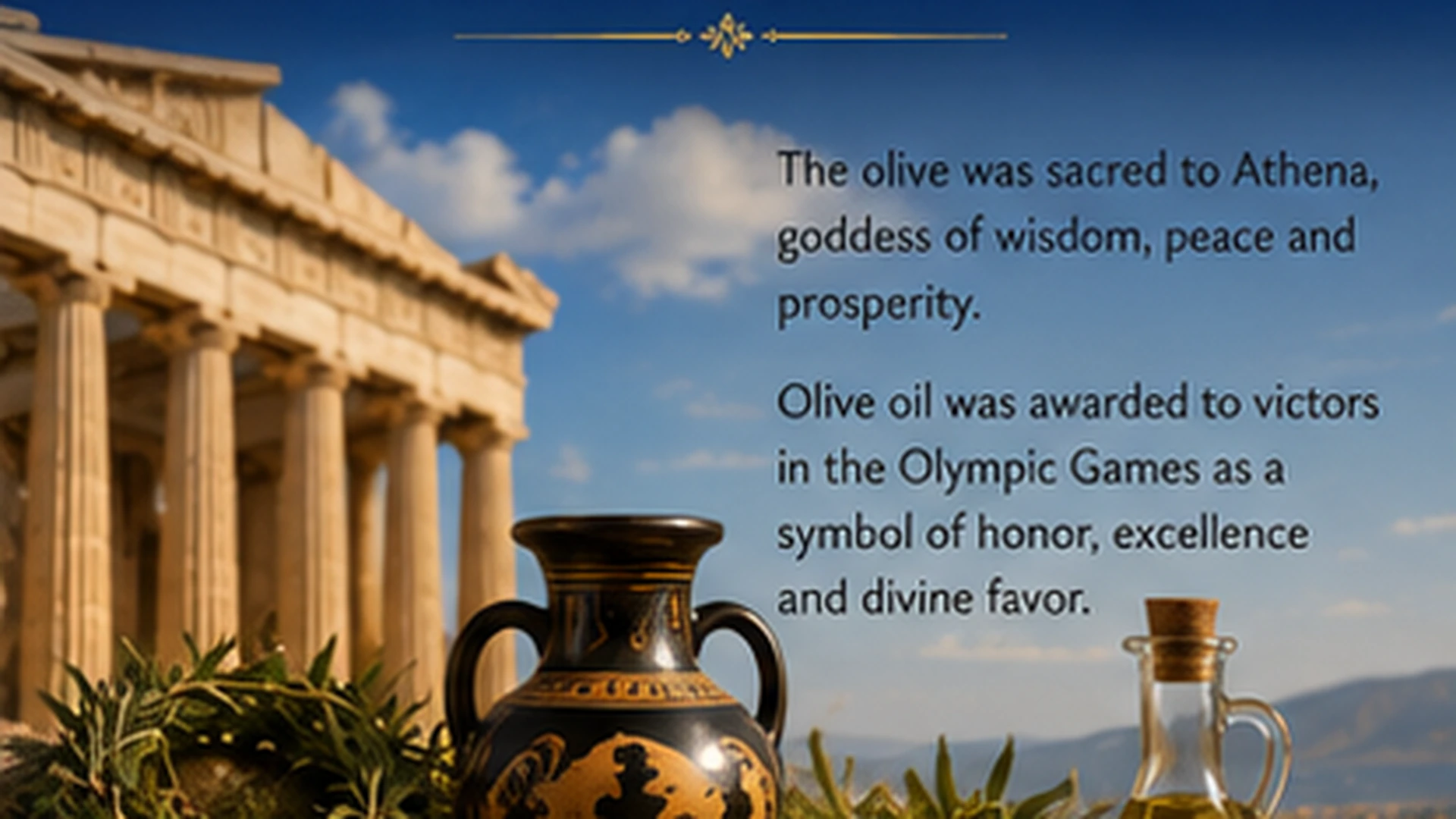
In Athenian tradition, the olive tree was closely associated with Athena. The Acropolis Museum explains that the contest between Athena and Poseidon for the protection of Athens was decided in Athena’s favor because the city preferred her gift of the olive tree. The tree therefore became part of the city’s sacred landscape and civic identity, while Athena herself was associated with wisdom, arts, prudent warfare and the protection of Athens. [4]
Olive oil also carried material prestige. At the Panathenaic Games, victors received large decorated amphorae filled with oil from Athena’s sacred groves. The prize joined divine patronage, civic generosity, economic value and athletic excellence. [5] The oil was not simply a mystical substance; it was an expensive and useful reward that could be sold, traded or consumed.
Athletes applied oil to their bodies and removed it with a strigil after exercise. This practice connected oil with bodily preparation, discipline, beauty and strength, although it would be inaccurate to call every athletic use a religious rite. [6] In Greek symbolism, the olive tree could represent Athena and the city, the wreath could represent victory, and the oil could represent valuable reward, preparation and honor.
| Field | Specification |
|---|---|
| Image number | 2 |
| Purpose | Show why olive oil represented civic value, skill and victory in ancient Greece. |
| Detailed scene | Museum-quality historical reconstruction of an ancient Athenian olive-oil workshop before the Panathenaic Games. Two adult Greek artisans carefully fill a large painted prize amphora with measured olive oil while another worker seals smaller narrow-necked oil vessels. Olive branches and harvested fruit rest in baskets; an athlete waits in the courtyard with a strigil and folded garment, not participating in a ritual. |
| Specific culture or historical context | Classical Athens, approximately fifth century BCE, highlighting sacred olive oil prizes, trade and athletic use. |
| People shown | Two adult artisans, one assistant and one adult athlete, with anatomically accurate hands and restrained expressions. |
| Location | Stone-and-mudbrick workshop courtyard in ancient Athens. |
| Clothing | Simple linen and wool garments appropriate to Classical Greece; no theatrical armor or fantasy robes. |
| Architecture | Plain workshop, pottery shelves, wooden beams and courtyard opening. |
| Objects | Panathenaic-style amphora, narrow-necked oil vessels, measuring jugs, olives, woven baskets, wooden stoppers, strigil and folded cloth. |
| Lighting | Warm morning daylight with realistic ceramic and oil reflections. |
| Composition | 16:9 documentary view focused on the filling of the amphora, with athlete and workshop context behind. |
| SEO-friendly filename | ancient-greek-olive-oil-athena-victory.webp |
| Image title | Ancient Greek Olive Oil, Athletic Victory and Civic Honor |
| Alt text | Historical reconstruction of Athenian artisans filling a prize amphora with olive oil for athletic games |
| Caption | In ancient Athens, valuable olive oil from sacred groves could be awarded to athletic victors in decorated prize amphorae. |
| Recommended placement | After the ancient Greek section. |
| Article section supported | Ancient Greece: Athena, Civic Identity and Victory. |
| Important elements to avoid | No modern Olympics branding, no laurel mistaken for olive, no fantasy gods appearing physically, no text, logos, watermarks or exaggerated palace setting. |
Jewish Tradition: Sacred Light, Anointing and Blessing
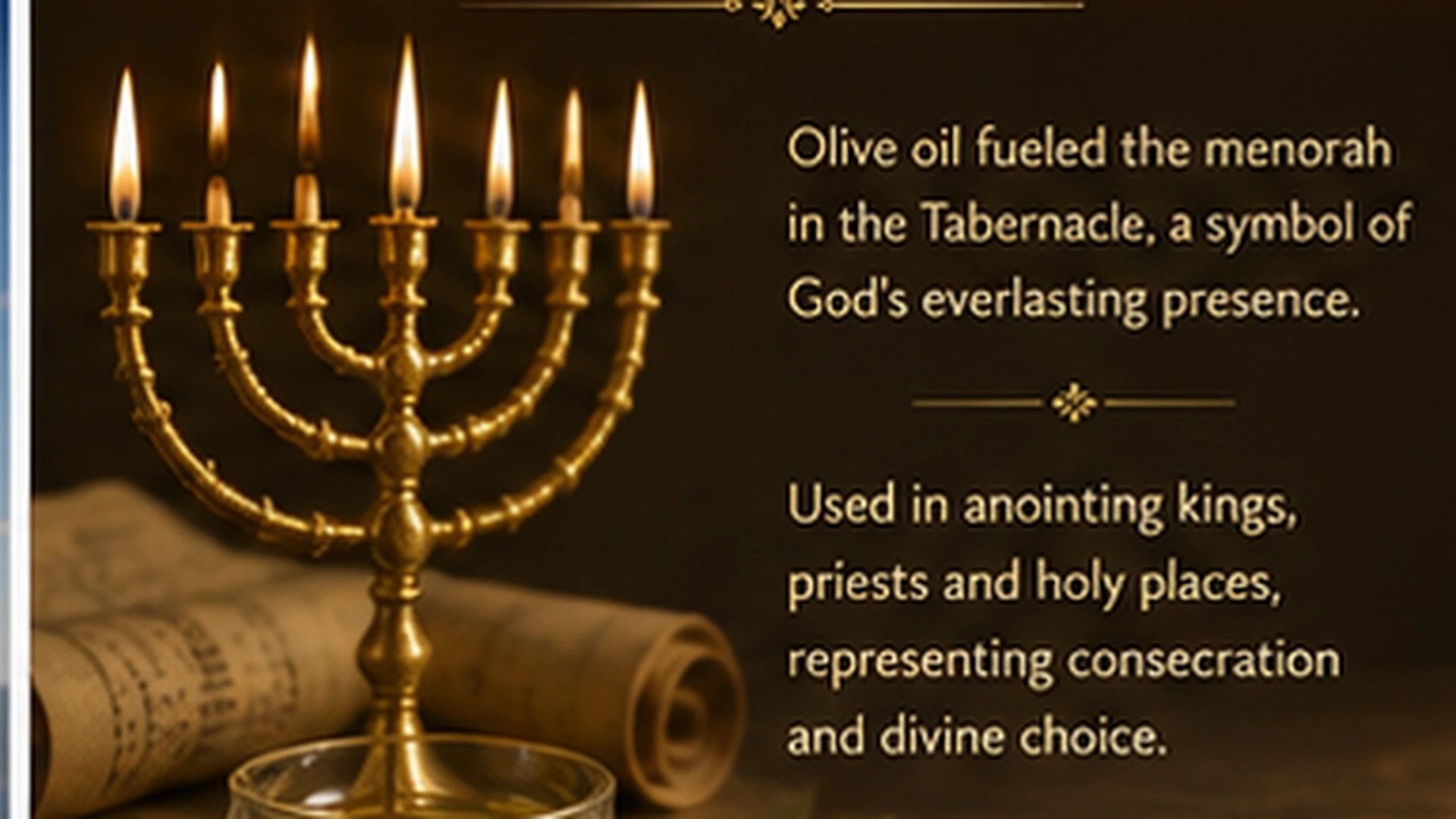
Olive oil has several important roles in the Hebrew Bible and later Jewish interpretation. Exodus 27:20 instructs the Israelites to bring clear or pure pressed olive oil for the light so that a lamp may be kept burning. The text gives olive oil a direct relationship with sacred illumination, disciplined preparation and continuing service. [8]
Exodus 30 describes a holy anointing oil made with olive oil and aromatic ingredients. In biblical settings, anointing could mark priests, kings or sacred objects as set apart for a particular role. The symbolism therefore includes consecration, authority, responsibility and belonging—not merely personal luck or material prosperity. [9]
Other biblical passages widen the symbolic field. Psalm 23 describes the honored guest whose head is anointed with oil, an image often read through hospitality, refreshment and abundance. In the flood narrative, a dove returns to Noah with an olive leaf, showing that the waters had receded. That scene later became foundational to peace symbolism, although the object in the story is a leaf, not olive oil. [7]
Jewish traditions are internally diverse and developed over many centuries. The meaning of olive oil in a biblical lamp, a Hanukkah discussion, a food blessing, anointing imagery or modern Israeli and diaspora culture should not be compressed into one statement. The most reliable broad themes are sacred light, dedication, abundance, joy and continuity.
| Field | Specification |
|---|---|
| Image number | 3 |
| Purpose | Present sacred light and anointing in ancient Jewish material context without staging a restricted Temple ceremony. |
| Detailed scene | A respectful archaeological reconstruction of a Levantine household workshop in the late Iron Age. An adult woman and man strain freshly pressed olive oil into a clean storage jar while a small clay lamp burns on a separate stone shelf. A scribe records inventory on a small tablet at another table. The scene emphasizes purity, careful preparation and light rather than reenacting priestly ritual. |
| Specific culture or historical context | Ancient Israel and Judah, first millennium BCE; domestic and community preparation of olive oil connected to biblical lamp and anointing traditions. |
| People shown | Three adult Levantine people engaged in practical work; natural skin tones and accurate anatomy. |
| Location | Stone courtyard house with an adjoining storage room. |
| Clothing | Historically plausible undyed linen and wool garments. |
| Architecture | Levantine stone masonry, timber beams, plastered storage area and simple shelves. |
| Objects | Olive press basket, settling jars, clean linen filter, clay oil lamp, storage jar, wooden ladle and writing tablet. |
| Lighting | Late-afternoon daylight plus one small realistic lamp flame. |
| Composition | 16:9 landscape; oil preparation in foreground, lamp clearly separated in the background, no altar or sanctuary reconstruction. |
| SEO-friendly filename | jewish-olive-oil-sacred-light-anointing.webp |
| Image title | Olive Oil for Sacred Light in Ancient Jewish Tradition |
| Alt text | Historical reconstruction of Levantine workers preparing olive oil beside a small clay lamp |
| Caption | Biblical texts connect pure olive oil with continuing light and include olive oil in sacred anointing preparations. |
| Recommended placement | After the Jewish tradition section. |
| Article section supported | Jewish Tradition: Sacred Light, Anointing and Blessing. |
| Important elements to avoid | No modern menorah, no depiction of the Holy of Holies, no invented priestly rite, no pseudo-Hebrew text, no fantasy glow, logos or watermarks. |
Christianity: Holy Spirit, Consecration, Healing and Comfort
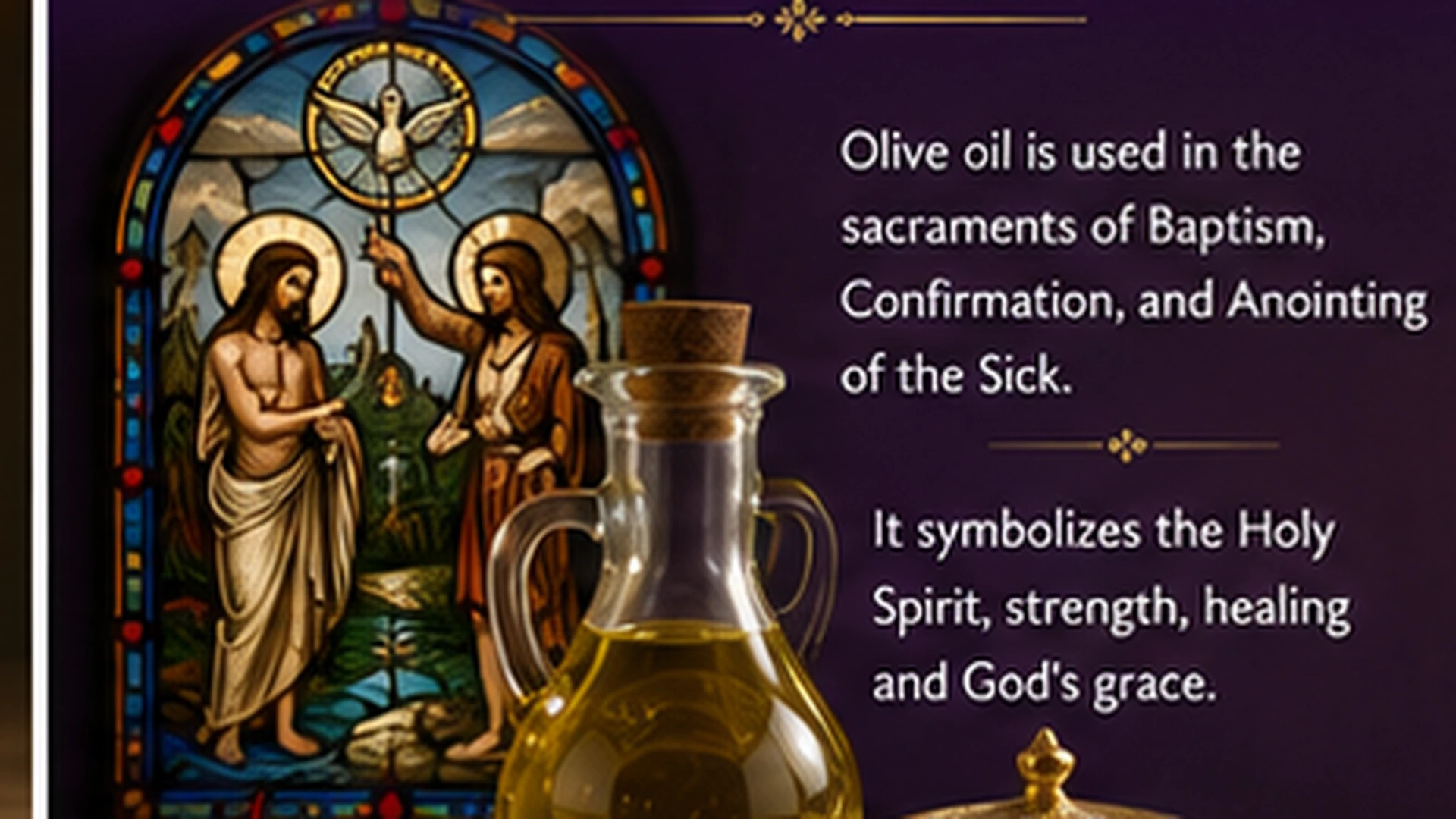
Christian uses of oil emerged in continuity with biblical and ancient Mediterranean practices while developing distinct sacramental meanings. The Catholic Catechism describes oil as a sign of abundance and joy, cleansing and strengthening, healing, beauty and radiant strength. It explains that anointing with sacred chrism signifies consecration and that the name Christ means “the anointed one.” [10]
In baptism, confirmation or chrismation, ordination and the anointing of the sick, oil can signify the gift of the Holy Spirit, incorporation into Christ, strengthening for service, consecration, healing and comfort. The precise rite varies. In the Roman Catholic tradition, chrism is a mixture of olive oil and aromatic substances blessed by a bishop. Eastern Christian churches use holy myron, whose composition and preparation follow their own traditions. Many Protestant churches use anointing oil in prayer, while others emphasize the biblical metaphor without treating oil as a sacrament.
Because the meanings are ecclesial, a bottle marketed as “Christian anointing oil” does not automatically acquire sacred status. In traditions that consecrate oil liturgically, the blessing, authorized minister, communal rite and intended use matter. A commercial fragrance cannot substitute for those relationships.
Christian language about healing should also be handled carefully. Sacramental anointing expresses prayer, care, comfort and trust in God; it is not a guarantee of physical cure and should not replace professional medical treatment.
| Field | Specification |
|---|---|
| Image number | 4 |
| Purpose | Show Christian sacramental oil in an authentic communal worship context. |
| Detailed scene | A realistic editorial photograph of a contemporary African Catholic cathedral during the preparation for a Chrism Mass. A Black African bishop stands at a side table blessing three covered vessels of sacred oil while priests and lay representatives observe at a respectful distance. The vessels are labeled only through shape and placement, with no readable text. The focus is on oil, prayer and community, not spectacle. |
| Specific culture or historical context | Contemporary Roman Catholic Chrism Mass in Africa, while acknowledging that Christian rites and oil formulations vary across denominations and regions. |
| People shown | Black African bishop, priests, women and men from the congregation, all adults; restrained, documentary expressions. |
| Location | African cathedral with local stone, timber and stained glass. |
| Clothing | Accurate Catholic liturgical vestments and modest contemporary church attire. |
| Architecture | Spacious cathedral interior combining universal liturgical structure with regionally appropriate African craftsmanship. |
| Objects | Three sacred-oil vessels, linen cloth, processional cross in background, lectionary, candles in stable holders and olive branches as modest decoration. |
| Lighting | Natural window light and warm ambient church lighting. |
| Composition | 16:9 landscape; oil vessels and bishop in foreground, community softly visible behind; one continuous scene. |
| SEO-friendly filename | christian-chrism-olive-oil-anointing.webp |
| Image title | Christian Sacred Chrism and the Symbolism of Anointing |
| Alt text | African bishop blessing sacred oil vessels during a church Chrism Mass |
| Caption | Christian anointing can signify the Holy Spirit, consecration, strengthening, healing and comfort, with details varying by church tradition. |
| Recommended placement | After the Christianity section. |
| Article section supported | Christianity: Holy Spirit, Consecration, Healing and Comfort. |
| Important elements to avoid | No miracle claim, no theatrical rays of light, no mixed denominational vestments, no readable fabricated liturgical text, logos or watermarks. |
Islam: The Blessed Olive Tree and “Light upon Light”
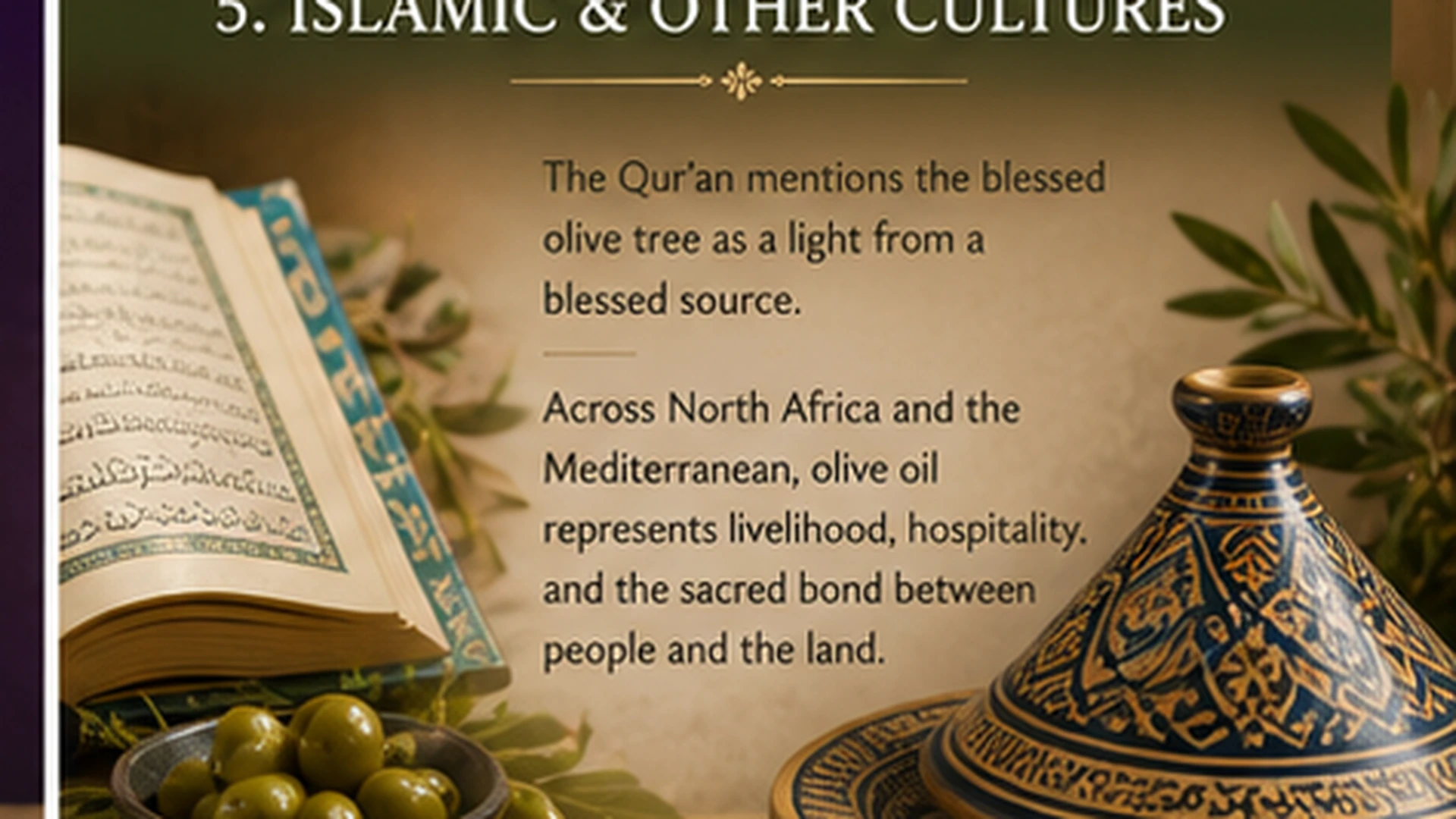
The best-known Islamic olive image appears in Qur’an 24:35, often called the Light Verse. The verse compares divine light to a niche containing a lamp in glass, kindled from the oil of a blessed olive tree. The oil is described as almost luminous even before fire touches it, culminating in the phrase “light upon light.” [11]
This is a layered religious metaphor, not a claim that ordinary olive oil possesses automatic magical power. Muslim commentators have interpreted the lamp, glass, tree and oil in relation to divine guidance, revelation, faith, clarity and the receptivity of the heart. Interpretations vary among scholars and schools, so the verse should be quoted and discussed with respect rather than reduced to a decorative “manifestation” symbol.
Olive cultivation also shapes the social life of Muslim-majority Mediterranean communities. UNESCO records traditional olive practices in Türkiye and Jordan that involve family transmission, communal harvesting, generosity, cooperation and festivals. In Jordan’s Al-Mihrass tradition, old olive trees serve as gathering places and olive oil may be exchanged as a gift expressing solidarity and social cohesion. [12–13]
These living practices show that the olive’s meaning can be religious, agricultural and social at the same time. Blessing may refer to a scriptural description, gratitude for food, continuity of family land or the moral value of sharing—not necessarily a specialized ritual use of oil.
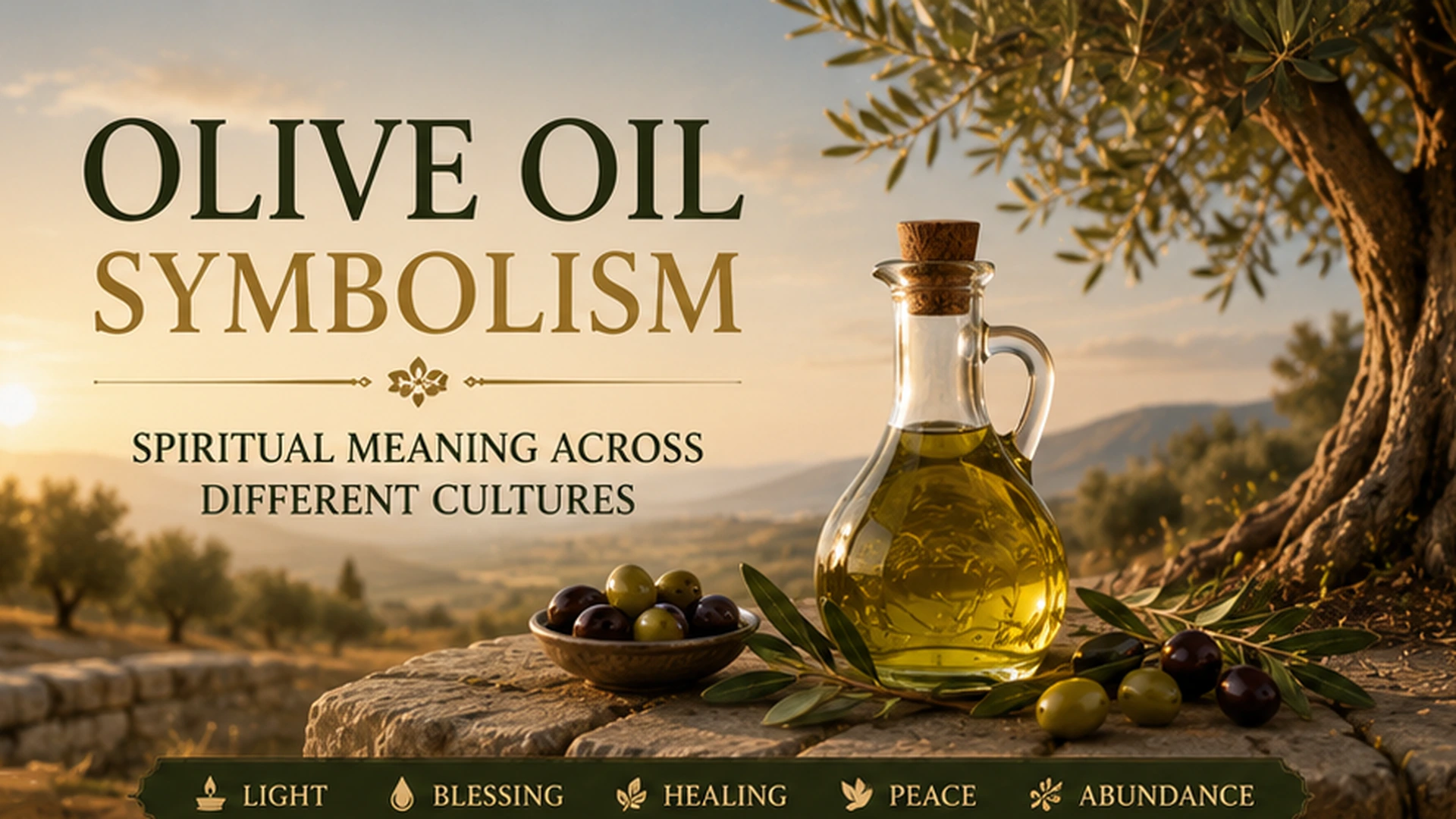
| Field | Specification |
|---|---|
| Image number | 5 |
| Purpose | Connect the Qur’anic lamp image with living olive heritage without turning the verse into a magical object. |
| Detailed scene | A documentary scene in a historic courtyard library in Jordan at dusk. A Muslim scholar and two adult community members sit near a traditional glass-covered oil lamp whose small flame is fueled by olive oil. On another table are freshly harvested olives, a ceramic oil jug and a closed Qur’an on a wooden stand. An old olive tree grows in the courtyard and younger family members carry harvest baskets in the background. |
| Specific culture or historical context | Contemporary Jordanian Muslim and communal olive context inspired by the Qur’anic Light Verse and living harvest traditions; not a reenactment of a single prescribed ritual. |
| People shown | Middle Eastern adults and two younger adults participating in the harvest; respectful distance from sacred text. |
| Location | Stone courtyard library or community heritage house in Jordan. |
| Clothing | Modest contemporary Jordanian clothing with regionally appropriate textiles. |
| Architecture | Levantine stone arches, wooden shelves, courtyard olive tree and tiled floor. |
| Objects | Protected oil lamp, ceramic jug, olives, harvest baskets, closed Qur’an, wooden book stand and pruning tools kept away from the lamp. |
| Lighting | Blue-hour courtyard light with one modest, realistic lamp flame. |
| Composition | 16:9 landscape; lamp and oil jug in foreground, scholar and community centered, olive tree and harvest activity behind. |
| SEO-friendly filename | islamic-olive-oil-blessed-tree-light.webp |
| Image title | The Blessed Olive Tree and Light in Islamic Tradition |
| Alt text | Jordanian community members beside an olive oil lamp and harvest baskets in a historic courtyard |
| Caption | In the Qur’anic Light Verse, a lamp kindled from the oil of a blessed olive tree forms part of a profound metaphor for divine light and guidance. |
| Recommended placement | After the Islam and communal heritage sections. |
| Article section supported | Islam: The Blessed Olive Tree and Light upon Light. |
| Important elements to avoid | No readable invented Qur’anic calligraphy, no magical aura, no claim that the lamp is a universal Islamic ritual, no stereotypes, logos or watermarks. |
North African and Mediterranean Meanings: Hospitality, Land and Community
Across the Mediterranean, olive oil is part of a wider cultural system that includes cultivation, harvesting, pressing, cooking, storage, hospitality and communal meals. UNESCO’s description of the Mediterranean diet emphasizes shared eating, family and community identity, hospitality, neighborliness, intercultural dialogue and the transmission of knowledge between generations. Morocco is one of the communities represented in the UNESCO inscription. [3]
In North Africa, olive culture has ancient roots and many regional forms. The International Olive Council notes that Berber communities were already skilled in grafting wild olives when Roman expansion reached North Africa. [1] Today, households in Morocco, Tunisia, Algeria, Libya and Egypt may connect olive oil with food security, family land, hospitality, memory and blessing, but customs differ by region, religion, class and household.
It is therefore safer to say that olive oil can express generosity, welcome and continuity in Mediterranean life than to claim that all North African cultures use it in the same purification ritual. A bowl of oil shared with bread at a family table has a cultural meaning rooted in hospitality even when no formal religious ceremony occurs.
The Symbolism of Light
Light is one of the strongest recurring meanings of olive oil because the oil literally fueled lamps. In Jewish scripture, pure oil sustains sacred light. In the Qur’anic Light Verse, luminous olive oil forms part of a metaphor for divine guidance. In Christian interpretation, oil and flame can be associated with the Holy Spirit, vigilance and the light of faith. These traditions are related historically but not interchangeable theologically.
A flame also requires care. Oil must be prepared, the wick trimmed and the lamp protected from wind. This practical dependence encouraged moral interpretations involving attentiveness, readiness and the maintenance of spiritual life. Such interpretations should be identified as theological or devotional readings rather than scientific properties of the oil.
Anointing: What Does It Mean?
To anoint is to apply oil to a person or object. In ancient settings, the action could be ordinary—refreshing skin, honoring a guest or preparing an athlete—or formal and religious. Symbolically, anointing can mean:
Setting a person or object apart for sacred service.
Recognizing authority, vocation or responsibility.
Welcoming and honoring a guest.
Praying for healing, comfort or strength.
Marking initiation or membership in a religious community.
Expressing joy, abundance or festive preparation.
The action does not have one universal formula. The identity of the minister, the words spoken, the oil’s preparation and the community’s teachings determine the meaning. A private act of applying food-grade olive oil while praying may be personally meaningful, but it should not be described as identical to a Jewish biblical anointing, Catholic sacrament, Orthodox chrismation or Muslim devotional practice.
Does Olive Oil Symbolize the Holy Spirit?
In many Christian teachings, oil is used as a symbol of the Holy Spirit because Jesus is understood as the Christ—the Anointed One—and because sacramental anointing signifies the Spirit’s gift and strengthening. The Vatican’s Catechism explicitly develops this symbolism in its explanation of confirmation. [10]
That statement belongs to Christian theology. Judaism and Islam do not teach that olive oil symbolizes the Holy Spirit in the same doctrinal way. A culturally respectful article should state whose interpretation is being described rather than presenting one religion’s symbolism as a universal fact.
Is Olive Oil a Symbol of Peace?
Olive imagery is strongly associated with peace, but the olive branch is the clearest emblem. Genesis tells of the dove returning with an olive leaf after the flood, signaling the return of habitable land. Later Greek, Roman, Christian and modern political art repeatedly used olive branches in images of peace and reconciliation. UNESCO describes the olive branch as a long-standing symbol of peace, wisdom and harmony. [2,7]
Olive oil can share that wider symbolism because it comes from the same tree and supports social practices of hospitality and communal life. Still, a bottle of oil did not historically function as the standard peace emblem in the same way as a branch carried by a dove or personification of Peace.
Abundance, Joy and Hospitality
Olive oil was a valuable staple. A household with enough oil could cook, light lamps, care for the body, prepare perfume and offer hospitality. Scriptural and poetic images therefore use oil to express abundance, gladness and honor. The symbolism is grounded in material reality: oil required trees, labor, harvest, pressing, storage and protection from spoilage.
Hospitality symbolism remains visible in Mediterranean food culture. Shared bread, oil and seasonal foods can affirm relationship, welcome and community identity. UNESCO’s Mediterranean diet inscription stresses that eating together is a social exchange and a renewal of family or group identity. [3] The spiritual meaning here may be gratitude and fellowship rather than a formal ritual.
Healing, Cleansing and Protection: What Can Be Claimed?
Historical sources connect olive oil with bodily care, ointments and soothing applications. Christian sacramental language also associates anointing with healing and comfort. These facts explain why modern spiritual writers may describe olive oil as cleansing, protective or restorative.
However, three limits are important. First, symbolic or religious healing is not the same as a scientifically guaranteed medical cure. Second, there is no evidence that ordinary olive oil automatically removes curses, spirits or “negative energy.” Third, purification practices vary: some communities use oil, others use water, smoke, prayer, fasting, confession, incense or no material substance at all.
A responsible description is: olive oil may be used within some prayers, blessings or anointing practices to symbolize cleansing, protection, comfort or dedication. The meaning comes from the tradition and action, not from a universally proven supernatural property of the oil.
Modern Personal and Spiritual Uses
Outside formal religious institutions, people may use olive oil in home prayer, memorials, blessing rituals, ancestor remembrance, meditation or symbolic new beginnings. These uses may combine inherited family customs, biblical language, African Christian practice, contemporary spirituality and personal creativity.
Modern use should be labeled honestly. A practice created recently should not be advertised as an “ancient African ritual” without evidence. A Christian-inspired home blessing should not be presented as a universal African tradition. Qur’anic imagery should not be turned into a commercial spell or guarantee. Cultural respect depends on naming the source, avoiding false antiquity and allowing communities to define their own practices.
How to Use Olive Oil Respectfully in Prayer or Reflection
People who choose a simple personal practice can keep it modest and transparent:
1. Clarify the tradition. Decide whether the act is part of your church, family custom or personal reflection.
2. Use a small amount. A drop on the hands or a small lamp can carry meaning without waste.
3. Choose words that fit your belief. Prayer, gratitude, dedication or remembrance is more honest than promising guaranteed results.
4. Do not imitate restricted rites. Sacraments, consecrated oils and community ceremonies may require authorized religious leaders.
5. Avoid claiming cultural ownership. Credit the specific scripture, church or community that informs the practice.
6. Separate symbolic action from medical treatment. Seek qualified care for illness, injury or mental-health concerns.
Safety: Food, Skin and Flame
Olive oil is familiar, but a ritual context can introduce extra risks. Use the following precautions:
Only ingest oil clearly sold as food-grade. Decorative, perfumed, consecrated or lamp oils may contain additives and may not be suitable for eating.
Check every ingredient in blended anointing oils. Essential oils and fragrances can irritate skin or trigger allergic reactions in some people. FDA guidance advises reading ingredient labels and recognizing that “natural” or “hypoallergenic” does not guarantee safety. [15]
Patch-test a small amount before wider skin use, avoid eyes and broken skin, and stop if redness, itching or swelling occurs.
Never leave an oil lamp, candle or burner unattended. Place it on a stable heat-resistant surface, away from cloth, paper, children and pets. Fire services recommend the same precautions for candles, religious lamps and oil burners. [16]
Clean spills immediately. Olive oil on floors, steps or fabric can create a slipping or fire risk.
Do not use ritual oil as a substitute for prescribed medicine or professional care.
Common Misunderstandings
| Claim | More accurate explanation |
|---|---|
| “Olive oil means peace everywhere.” | Peace is most directly represented by the olive branch. Oil more commonly represents light, blessing, anointing and abundance. |
| “All sacred oils are pure olive oil.” | Some are olive-based, but formulas vary and may include balsam, perfumes, other vegetable oils or ingredients prescribed by a particular rite. |
| “Biblical oil and Christian chrism are the same.” | Christian chrism develops from biblical anointing traditions but belongs to distinct sacramental systems. |
| “The Qur’an says olive oil is magical.” | The Light Verse uses a profound metaphor involving a blessed olive tree and luminous oil; it does not establish a commercial magic formula. |
| “Ancient Greeks used olive oil only for religion.” | They also used it for food, athletics, grooming, perfume, trade and prizes. |
| “Any home ritual is an ancient African practice.” | Modern personal spirituality should not be mislabeled as ancient or pan-African without specific evidence. |
| “Natural oil cannot cause a reaction.” | Skin products and fragrances can cause irritation or allergy in some people. |
Olive Oil Meanings Across Traditions at a Glance
| Tradition or setting | Primary olive-oil meanings | Typical material context | Caution |
|---|---|---|---|
| Ancient Athens | Athena’s patronage, civic wealth, athletic honor, preparation and victory. | Sacred groves, prize amphorae, body oil and strigils. | The olive wreath or tree is not identical to the oil. |
| Jewish biblical tradition | Sacred light, dedication, anointing, abundance and welcome. | Lamp oil, holy anointing mixture, hospitality imagery. | Jewish practice is diverse and developed beyond the biblical period. |
| Christian traditions | Holy Spirit, consecration, strengthening, healing and comfort. | Chrism, baptism, confirmation, ordination and anointing of the sick. | Rites and ingredients differ by denomination. |
| Islamic tradition | Blessing, luminous guidance and divine light in Qur’anic imagery. | The lamp and blessed olive tree in Qur’an 24:35. | The verse is theological metaphor, not proof of automatic magical power. |
| Mediterranean community life | Hospitality, abundance, family continuity, land and cooperation. | Harvest, pressing, shared meals, gifts and festivals. | Practices vary between regions and households. |
| Modern global symbolism | Peace, resilience, sustainability and cultural heritage. | Olive branches, trees, public art and heritage campaigns. | Modern universal symbolism may simplify older local meanings. |
People Also Ask
What does olive oil symbolize spiritually?
Olive oil can symbolize light, blessing, consecration, abundance, welcome, healing or comfort and continuity. The strongest meaning depends on the tradition: sacred light in Jewish scripture, the Holy Spirit and sacramental anointing in Christianity, and luminous divine guidance in the Qur’anic Light Verse.
Why is olive oil considered sacred?
It became sacred in some traditions because it was used in lamps, offerings and anointing, and because religious texts assigned it specific roles. Sacredness comes from the community’s teaching, blessing and use—not simply from the chemical substance.
What does olive oil represent in the Bible?
Biblical olive oil is connected with light, holy anointing, consecration, abundance, joy and hospitality. The olive leaf in the flood story also contributes to later peace symbolism, although that image is a leaf rather than oil.
What does the olive symbolize in Islam?
The Qur’an describes a blessed olive tree in the Light Verse, where luminous oil feeds a lamp used in a metaphor for divine light and guidance. Olive cultivation also carries meanings of gratitude, food, family livelihood and communal heritage in many Muslim societies.
Why did ancient Greeks value olive oil?
Olive oil was food, lamp fuel, perfume base, body oil, trade wealth and an athletic prize. In Athens it was also linked with Athena and sacred groves, joining practical value with civic and religious identity.
Does olive oil symbolize the Holy Spirit?
It does in many Christian interpretations, especially in sacramental anointing. That meaning is Christian theology and should not be treated as the universal meaning of oil in every religion.
Is olive oil a symbol of peace?
Olive imagery symbolizes peace, but the olive branch is the clearest emblem. Olive oil shares the tree’s wider associations but is more directly linked with light, blessing and anointing.
Can olive oil be used for anointing today?
Yes, within many churches and personal prayer practices, but formal sacraments may require blessed oil and an authorized minister. A private symbolic act should not be presented as identical to an official religious rite.
Frequently Asked Questions
Is extra virgin olive oil more spiritual than regular olive oil?
No spiritual meaning is guaranteed by a commercial grade. Extra virgin describes production and quality characteristics. A religion may specify purity or preparation, but symbolic meaning comes from context, teaching and use.
Can I bless olive oil myself?
That depends on your belief and community. A personal prayer of gratitude is different from a formal church blessing or consecration that requires clergy. Use accurate language for what you are doing.
Is olive oil used for protection?
Some people use it in prayers for protection or dedication, especially in Christian-influenced settings. This is a religious or symbolic practice, not scientific proof that oil prevents harm.
Does olive oil remove negative energy?
There is no scientific evidence that olive oil removes an invisible energy. It may serve as a symbol within a personal or community cleansing practice, but the claim should be presented as belief rather than established fact.
What does anointing the forehead with oil mean?
Depending on the tradition, it may signify blessing, consecration, healing prayer, membership, the Holy Spirit or preparation for service. The words and authority of the community define the act.
Why was olive oil used in lamps?
It burns with a steady flame when used with a suitable wick and was available in olive-growing regions. Its practical role in illumination helped create symbolism of light and guidance.
Is the olive branch mentioned in the flood story?
Genesis describes a dove returning with a freshly plucked olive leaf. Later art often depicts a full branch, and the image became associated with hope and peace after disaster.
What did olive oil symbolize to ancient Greek athletes?
It was part of bodily preparation and cleaning, and valuable oil from sacred groves was awarded at Athenian games. It could therefore signal discipline, honor, excellence and civic reward.
What is chrism?
Chrism is a consecrated perfumed oil used in several Christian sacraments. In the Roman Catholic tradition it is normally olive oil mixed with aromatic balsam, while Eastern Christian myron follows other traditional formulas.
Is olive oil mentioned in the Qur’an?
Yes. Qur’an 24:35 describes a lamp kindled from a blessed olive tree whose oil is almost luminous, within the famous metaphor of divine light.
Can ritual olive oil be eaten?
Do not assume so. Only consume oil labeled food-grade. Ritual, perfumed or lamp oils may contain non-food ingredients or contaminants.
How should olive oil be stored?
For food quality, protect it from excessive heat, air and light. For ritual use, also label containers clearly and keep lamp oil or perfumed blends separate from edible oil.
Key Takeaways
Olive oil has no single universal spiritual meaning.
Its most recurring meanings are light, blessing, anointing, abundance, welcome, comfort and continuity.
The olive tree often represents wisdom, endurance and rooted cultural identity.
The olive branch is the clearer symbol of peace and reconciliation.
Jewish, Christian, Islamic, Greek and Mediterranean meanings overlap historically but must remain distinct.
Modern personal rituals should be labeled honestly and should not promise guaranteed supernatural or medical outcomes.
Food, skin and flame safety still apply in spiritual settings.
Conclusion
Olive oil became spiritually meaningful because it was woven into ordinary and sacred life. It fed lamps, nourished families, carried fragrance, prepared athletes, honored guests and marked people or objects for special service. From the sacred light of biblical tradition to Christian chrism, the Qur’anic blessed olive tree, Athenian prize oil and Mediterranean harvest hospitality, the same substance entered different systems of meaning.
The most respectful interpretation does not flatten those traditions into one claim. It asks who used the oil, for what purpose, with what words and within which community. Seen in context, olive oil is not a universal magic ingredient. It is a powerful cultural material through which people have expressed light, blessing, responsibility, belonging, abundance, hope and care.
Final Summary
Olive oil symbolizes light and divine guidance because it fueled lamps; consecration because it was used in anointing; abundance and hospitality because it was valuable food; and comfort because it was applied to the body. The olive tree adds meanings of wisdom, resilience and continuity, while the branch is the clearest emblem of peace. Every interpretation should be tied to its specific culture or religion.
Research Sources and Further Reading
1. International Olive Council — “The Olive Tree: History of the Olive Tree.” Open source
2. UNESCO — “World Olive Tree Day.” Open source
3. UNESCO Intangible Cultural Heritage — “Mediterranean Diet.” Open source
4. Acropolis Museum — “The Erechtheion” and the Athena–Poseidon olive-tree tradition. Open source
5. The Metropolitan Museum of Art — “The Ancient Olympics and Other Athletic Games.” Open source
6. The Metropolitan Museum of Art — “Bronze Strigil” and Greek athletic use of olive oil. Open source
7. Sefaria — Genesis 8:11 and Psalms 23:5. Open source
8. Sefaria — Exodus 27:20–21, pure olive oil for the light. Open source
9. Bible Gateway — Exodus 30:24–25, olive oil in the holy anointing mixture. Open source
10. Vatican — Catechism of the Catholic Church, “The Signs and the Rite of Confirmation.” Open source
11. Quranic Arabic Corpus — Qur’an 24:35, parallel translations of the Light Verse. Open source
12. UNESCO Intangible Cultural Heritage — Traditional knowledge and practices concerning olive cultivation in Türkiye. Open source
13. UNESCO Intangible Cultural Heritage — Al-Mihrass tree knowledge, skills and rituals in Jordan. Open source
14. The Metropolitan Museum of Art — “Light and Life,” medieval and Christian uses of holy oils. Open source
15. U.S. Food and Drug Administration — “Allergens in Cosmetics.” Open source
16. U.S. Fire Administration — “Candle Fire Safety.” Open source
5. Internal Linking Plan
| Anchor text | Target page or cluster | Recommended placement | Purpose |
|---|---|---|---|
| African spiritual symbols | /blog/african-spiritual-symbols | Introduction or cultural caution section | Connect to symbol interpretation cluster. |
| purification herbs across cultures | /blog/purification-herbs-across-cultures | Healing, cleansing and protection section | Connect material symbolism with safety-focused herb content. |
| ancient protection symbols | /blog/ancient-protection-symbols-egyptian-african | Common misunderstandings or related reading | Build topical authority around historical symbols. |
| spiritual cleansing and blessing | /services/cleansing | Responsible modern use section | Connect carefully to service content without promising outcomes. |
| religious lamps and sacred light | /blog/sacred-lamps-symbolism | The symbolism of light section | Future supporting article. |
| frankincense and myrrh symbolism | /blog/frankincense-myrrh-spiritual-meaning | Christian and Mediterranean sections | Future aromatic-material cluster. |
6. Supporting Article Recommendations
| Recommended title | Primary intent | Relationship to this page | Cannibalization guardrail |
|---|---|---|---|
| Biblical Anointing Oil: Meaning, Ingredients and Context | Religious-historical | Deepen Jewish and Christian scriptural material. | Focus on texts and historical mixtures; link back for cross-cultural overview. |
| Olive Branch Symbolism: Peace, Hope and Reconciliation | Symbol definition | Separate branch symbolism from oil symbolism. | Do not repeat anointing and lamp sections. |
| Sacred Lamps Across Religions: Light, Prayer and Safety | Comparative religious | Expand Jewish, Christian, Islamic and other lamp traditions. | Center lamp forms and flame symbolism, not olive oil generally. |
| Frankincense and Myrrh: History, Spiritual Meaning and Safety | Cultural material | Build aromatic-resin cluster. | Avoid repeating olive oil history. |
| Mediterranean Harvest Traditions: Olives, Community and Heritage | Cultural heritage | Expand UNESCO and regional community material. | Focus on living harvest practices and local voices. |
| What Is Chrism? Christian Sacred Oils Explained | Christian informational | Answer denomination-specific questions. | Keep this page broad and use the new page for detailed rites. |
Article Information
- Publisher
- Ancestral Temple
- Editor
- Ancestral Temple
- Last updated
- Jul 26, 2026
- Last reviewed
- Jul 26, 2026
- Content version
- af204f4ff7
This educational article should be read as cultural and spiritual information, not as medical, legal, financial, or emergency advice.
Helpful Related Guidance
Explore This Topic
Related Topic Cluster
Dreams & Symbolism
About the Author
 Ancestral Temple
Spiritual guide and practitioner with decades of experience in ancestral wisdom, rituals, and divine guidance.
Related Posts
View All











Leave a Comment
We'd love to hear your thoughts.