
Spiritual Protection After a Nightmare: Rituals, Prayers and Cultural Beliefs
Pillar Article
Quick Summary
A nightmare can leave the body awake while fear still feels present. The heart may race, the room may seem unfamiliar, and a dream image can continue to feel spiritually threatenin...
A nightmare can leave the body awake while fear still feels present. The heart may race, the room may seem unfamiliar, and a dream image can continue to feel spiritually threatening even after the sleeper knows it was a dream. Across cultures, people have answered this experience with prayer, protective objects, changes in sleeping position, ritual speech, storytelling, or consultation with a religious specialist.
There is no single spiritual meaning of a nightmare. A frightening dream may be interpreted as stress, memory, warning, spiritual danger, moral instruction, ordinary dream activity, or a mixture of these. This article explains documented cultural responses while keeping a clear boundary: a nightmare by itself is not proof of a curse, demon, prophecy, or attack.
Quick Answer
After a nightmare, first reorient to the waking room: sit up safely, turn on a low light, notice where you are, slow your breathing, and drink water if helpful. Then use a prayer or ritual from your own tradition if it brings calm. Repeated nightmares that disrupt sleep or daily life deserve medical or mental-health attention, especially when connected with trauma, medicine changes, alcohol withdrawal, sleep apnea, or fear of sleeping.
What to Do Immediately After a Nightmare
1. Confirm that you are awake. Name the room, date, and time of night. Look at three ordinary objects.
2. Check physical safety. Make sure you are not near stairs, glass, candles, weapons, or anything knocked over during sleep.
3. Calm the stress response. Breathe slowly without forcing very deep breaths. Relax the jaw, hands, and shoulders.
4. Change the scene. Sit up, turn on a low light, change sleeping position, or briefly move to a safe chair.
5. Choose a meaningful practice. Pray, recite a familiar verse, hold a permitted religious object, or ask a trusted person for reassurance.
6. Do not make an urgent interpretation. Wait until daylight before deciding that the dream predicts an event or proves spiritual harm.
7. Record only what is useful. A brief note can help identify patterns, but detailed recording is optional if it increases fear.
Relaxation practices can help activate the body's relaxation response, although evidence for specific sleep problems varies. They should not replace medical care. A short sequence is most useful when it reduces arousal and leads back toward ordinary sleep rather than becoming a compulsory ritual.[1][2]
What Science Says About Nightmares
A nightmare is a disturbing dream that produces fear, terror, distress, or anxiety. Nightmares often occur during rapid eye movement sleep, although trauma-related dreams can appear across sleep stages. They may follow stress, illness, major life events, frightening media, a new medicine, alcohol withdrawal, or disrupted sleep.[3][4]
Repeated nightmares can also occur with post-traumatic stress disorder, anxiety, depression, sleep apnea, narcolepsy, and other sleep conditions. A single nightmare is usually not a medical emergency. The concern grows when nightmares occur frequently, create fear of sleeping, cause daytime exhaustion, or interfere with work, school, relationships, and safety.[3][5]
The American Academy of Sleep Medicine identifies imagery rehearsal therapy as a recommended treatment for nightmare disorder and PTSD-associated nightmares. In this therapy, a person rewrites the nightmare while awake with a less threatening outcome and rehearses the new version. The method is different from claiming that dream symbols have one fixed hidden meaning.[6]
Nightmare, Night Terror, Sleep Paralysis, or Dream-Enactment?
| Experience | Typical features | Why the distinction matters |
|---|---|---|
| Nightmare | Vivid distressing dream, awakening with recall | Recurring nightmares may respond to nightmare-focused therapy |
| Night terror | Partial arousal, intense behavior, limited recall, often early in the night | The sleeping person may not fully recognize others |
| Sleep paralysis | Awake or nearly awake but temporarily unable to move or speak; possible sensed presence or pressure | It has a recognized sleep-state explanation and is usually short-lived |
| REM sleep behavior disorder | Movement or vocalization while acting out dreams | Can cause injury and may require medical evaluation |
Sleep paralysis is especially important because it has inspired spiritual explanations in many cultures. During an episode, the brain may be awake while normal REM-related muscle paralysis briefly continues. People can feel pressure or sense a presence in the room. The experience is frightening but usually harmless; frequent episodes, severe sleep anxiety, or daytime sleepiness should be discussed with a clinician.[7]
Explaining sleep paralysis medically does not require insulting someone's religious worldview. A person may still pray or seek pastoral support. The safety boundary is that spiritual interpretation should not delay treatment for insomnia, PTSD, narcolepsy, sleep apnea, medication effects, or other conditions.
Why Cultures Developed Nightmare-Protection Traditions
Sleep makes the body still, reduces awareness of the surroundings, and fills the mind with images that are not under ordinary control. Before modern sleep medicine, a nightmare could reasonably seem like an encounter with an external being or hidden world. Even today, the emotional realism of a dream can make an invisible danger feel physically close.
Protective traditions commonly restore boundaries. A person turns to the other side, speaks sacred words, covers or opens part of the body, changes the room's light, places a protective object near the bed, or tells the dream to a trusted specialist. These actions separate dream from waking life and place fear inside a shared cultural explanation.
The similarities do not prove that every tradition has one origin. A prayer to God, a carved mythical creature, a talismanic manuscript, and an ancient headrest belong to different systems. They should not be mixed into a universal anti-nightmare altar.
Islamic Teachings After a Bad Dream
Hadith collections distinguish pleasing dreams from disliked or frightening dreams. In Sahih Muslim, a person who sees a dream they dislike is instructed to make a light dry spitting or blowing action toward the left three times, seek refuge with God from Satan, and turn over from the side on which they were sleeping. Other narrations advise not spreading the disturbing dream.[8]
The response is brief and controlled. It does not require paying an interpreter, constructing an altar, or assuming that every frightening image predicts harm. The action redirects the sleeper toward God and away from obsessive retelling.
Muslim practice and interpretation vary. Some people may also recite familiar supplications, perform prayer, or seek guidance from a trusted scholar. The dry-spitting instruction should not be performed in a way that creates saliva, dirt, or disrespect toward another person. Non-Muslims should not market the hadith as a generic spell.
Jewish Bedtime Prayer and Hatavat Chalom
The Bedtime Shema, or Kriat Shema al Hamitah, developed as a prayer before sleep that combines praise, self-examination, peace, and protection. Jewish sources connect nighttime with vulnerability and describe reciting the Shema before bed as a request for divine protection.[9]
Rabbinic literature also records hatavat chalom, commonly translated as making a dream good or improving a dream. In Berakhot 55b, a person distressed by a dream may bring it before three people, who answer with words directing it toward goodness, redemption, and peace.[10]
Hatavat chalom is not a general online exercise for anyone frightened by a dream. Its wording, setting, and legal interpretation belong to Jewish tradition. Contemporary Jewish communities differ in how often the practice is used. A Jewish reader who wants to perform it should consult a knowledgeable rabbi or reliable prayerbook rather than improvise sacred formulas.
The broader pattern is significant: fear is not left alone with the dreamer. Prayer and the response of other people transform a private nightmare into a request for peace within a community of language and tradition.
Christian Compline and Protection Through the Night
Many Christian communities use night prayer to prepare for sleep. In the Church of England's Compline, the service is described as quiet reflection before rest and concludes by calling on God for protection through the coming night. Its hymn explicitly asks for defense from evil dreams and night terrors, while Psalm 4 and Psalm 91 emphasize safety and trust.[11]
A Christian who wakes from a nightmare may repeat a short familiar prayer, read a psalm, make the sign of the cross according to their tradition, or ask another Christian to pray with them. The purpose is not necessarily to decode the dream. It may be to place fear within trust, remembrance, confession, or hope.
Christian traditions differ. Some emphasize spiritual warfare language; others focus on pastoral reassurance, trauma care, or ordinary sleep disturbance. Responsible ministry should not intensify fear, diagnose possession from a nightmare, or demand payment for deliverance. Recurrent nightmares still deserve medical and psychological assessment.
Ancient Egyptian Protection Around Sleep
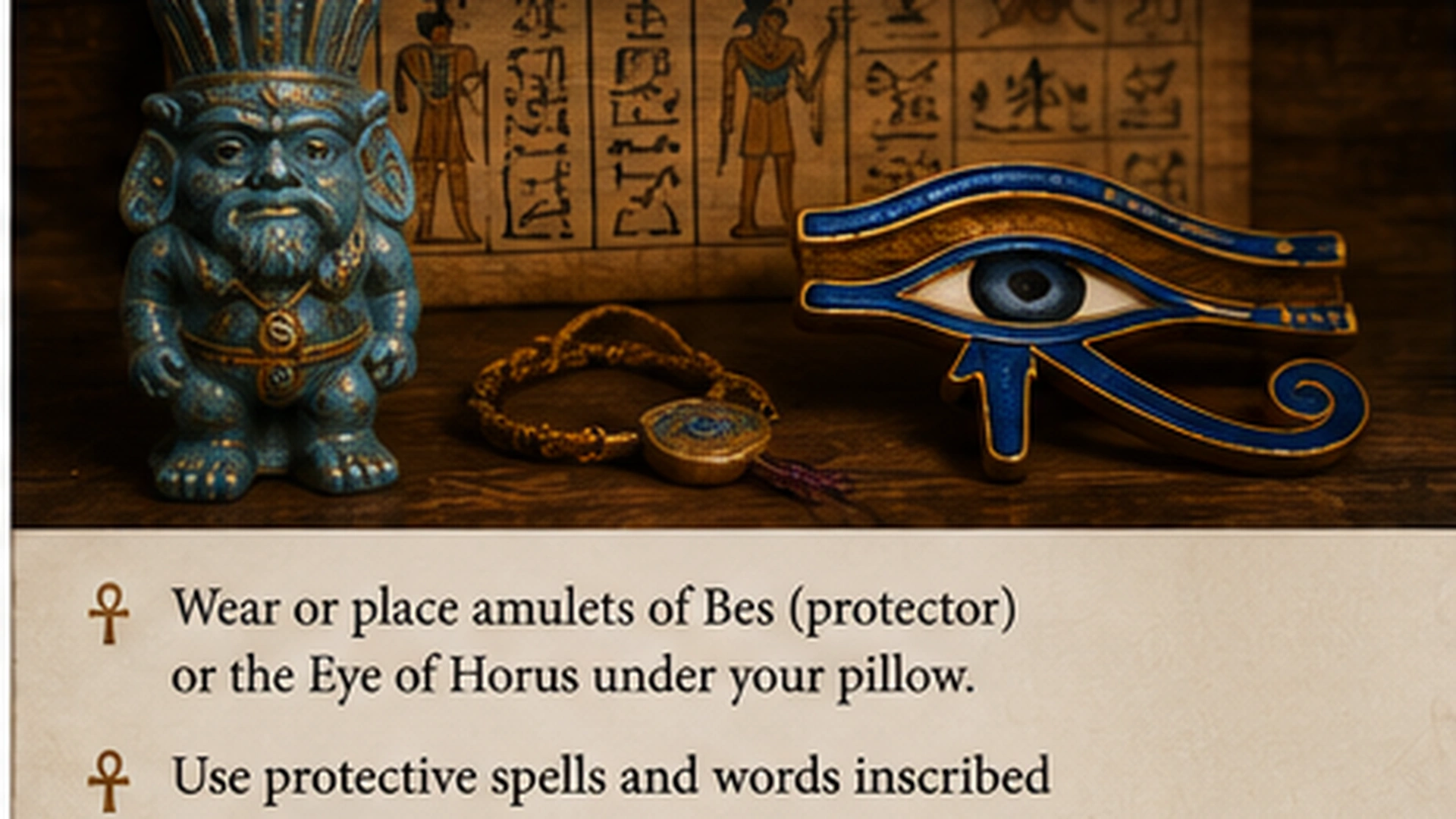
Ancient Egyptian headrests had a practical function: they supported the neck and elevated the head during sleep. Museum records also show that headrests could be decorated with protective symbols, placed in tombs, and represented as amulets. The curved form could evoke the sun rising between hills, connecting the lifted head with awakening, rebirth, and protection.[12][13]
Protective figures such as Bes also appeared in domestic and sleep-related contexts, especially around vulnerable moments such as childbirth and night. Ancient Egyptian religion did not divide practical furniture, spiritual protection, bodily safety, and funerary symbolism in the same way a modern product catalogue might.
A museum headrest should not be copied as a guaranteed nightmare device. The historical object belongs to a particular material and religious world. Its value for modern readers is evidence that sleep protection has long included both physical design and sacred meaning.

Ethiopian Healing Scrolls and Spiritual Protection
In the northern Ethiopian highlands, Amhara and Tigrinya healing scrolls combined written prayers, sacred names, saints, angels, geometric seals, and large protective eyes. They were made by a däbtära for a specific client and could be carried on the body or hung in a home.[14][15]
The Metropolitan Museum of Art describes the scrolls as part of a ritual healing system aimed at illnesses and malevolent spirits. The eyes in talismanic figures were understood as protective forces that confronted harmful beings. The scrolls drew from Ethiopian Christian, local healing, and wider regional traditions, while church authorities did not always approve of their magical use.[14]
It would be inaccurate to say that every Ethiopian Christian used a scroll after a nightmare. The objects address a wider range of illness, danger, evil-eye beliefs, and spiritual affliction. Their relevance here is the way sleep, vulnerability, prayer, and household protection could become part of a personalized visual manuscript tradition.
These scrolls often contain the client's name and intimate concerns. Museums, researchers, and designers should avoid publishing private dedications, inventing Ge'ez writing, or turning protective eyes into generic tattoo motifs.
Japanese Baku: The Dream-Eating Creature
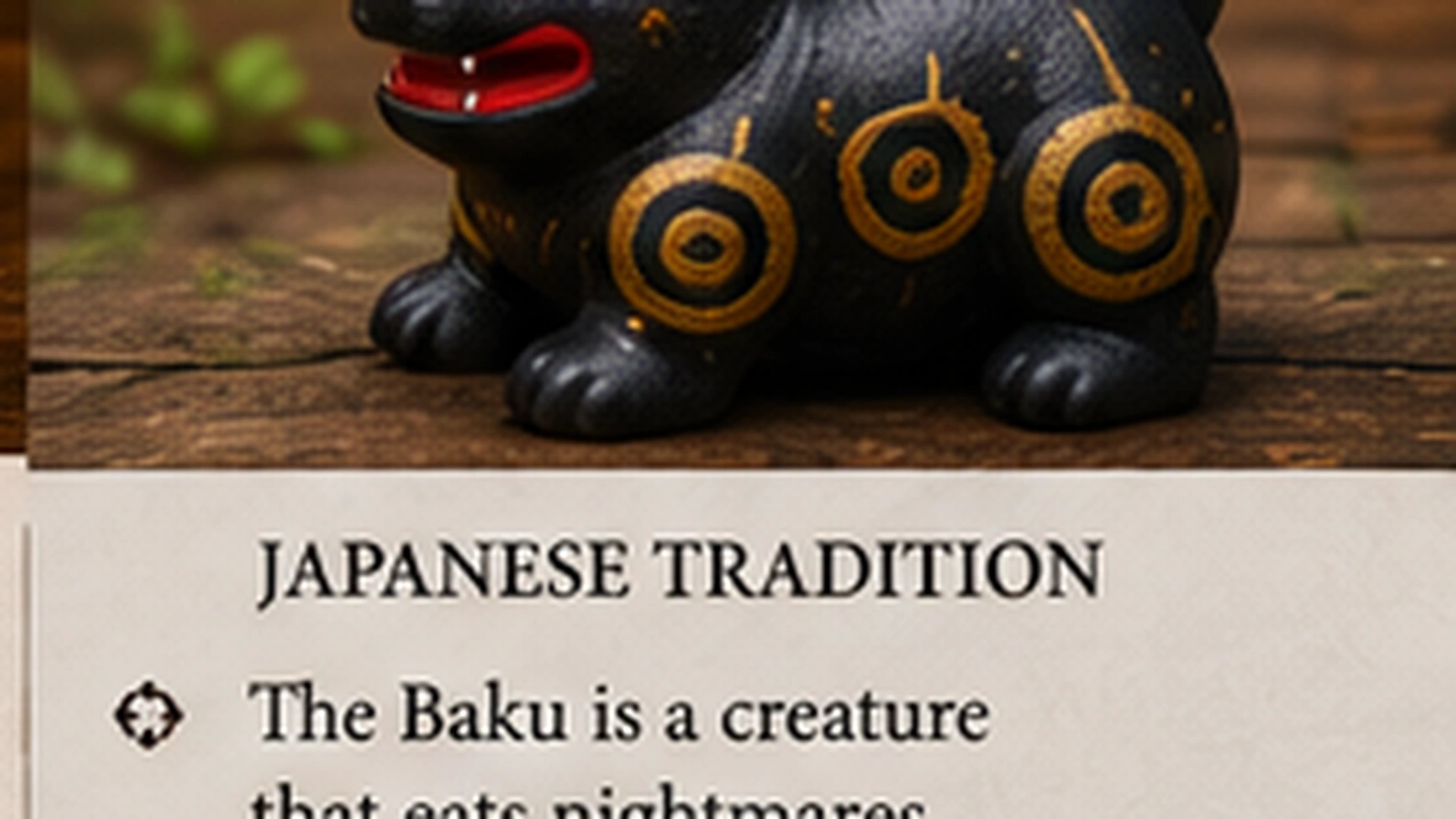
Japanese folklore includes the baku, a mythical creature known for devouring dreams and nightmares. Edo-period netsuke depict a composite animal with an elephant-like trunk, an ox-like tail, and tiger-like paws. Museum records identify the creature specifically with dream and nightmare eating.[16][17]
In popular tradition, a frightened dreamer might call on the baku to consume a bad dream. The baku also appeared in carving, architecture, and decorative objects. Its role is folklore, not zoology or medical treatment.
Modern anime, games, and commercial characters often reinvent the baku. Those versions should not be treated as direct evidence of Edo-period practice. A museum object shows how an old belief became material culture: the frightening dream is imagined as something that can be consumed and removed.
Are Nightmares a Spiritual Attack?
Some religious and cultural systems interpret particular dreams as spiritual danger. That belief should be reported as belief rather than mocked or presented as scientific fact. A person may find prayer meaningful while also recognizing stress, trauma, medicine, alcohol, fever, or disrupted sleep as possible causes.
The greatest risk is certainty. A nightmare alone cannot identify a demon, witch, curse, ancestor, enemy, or future event. Treating dream imagery as evidence against a real person can lead to accusation, violence, family conflict, financial exploitation, or delayed health care.
Distress can increase when people believe nightmares reveal certain disaster or predict the future. Psychological research indicates that beliefs about nightmares can influence how frightening and impairing they become.[18] A safer interpretation is: “This dream frightened me. I will calm my body, consider possible waking stress, use my tradition responsibly, and look for patterns before drawing conclusions.”
A Safe Non-Denominational Protection Ritual
A person who does not belong to one of the traditions above can create a simple modern practice without copying sacred formulas.
1. Turn on a low light and orient. Say your name, location, and that the dream has ended.
2. Place both feet on the floor. Notice pressure, temperature, and the support beneath you.
3. Take five slow breaths. Do not continue if focused breathing increases panic.
4. Use one neutral phrase. For example: “I am awake, this room is present, and I can choose my next step.”
5. Change one physical condition. Turn the pillow, change position, open a window safely, or wash your face.
6. Choose support. Message or wake a trusted person if being alone feels unsafe.
7. Return to sleep only when ready. Quiet reading or calm audio may help; avoid frightening media and urgent dream searches.
This is a grounding routine, not an ancient ritual and not a guarantee against another nightmare. It should remain flexible. If the exact sequence starts to feel compulsory, simplify it and discuss the anxiety with a health professional.
Protective Objects, Candles, Incense, and Herbs
A permitted religious object may bring comfort because it connects the sleeper with belief, memory, and community. Its meaning comes from the tradition, not from a universal energy. Do not sleep with hard, sharp, breakable, strangulation-risk, or choking-risk objects in the bed.
Candles and charcoal incense should never be left burning while someone sleeps. Smoke can worsen asthma, irritate the lungs, trigger alarms, or create fire risk. Avoid burning unknown herbs, synthetic materials, photographs, oils, or powders. Children should not be exposed to smoke-based rituals in closed bedrooms.
Herbal teas and supplements can interact with medicines or cause side effects. A product marketed as spiritual sleep protection is not automatically safe. Discuss persistent sleep problems and supplement use with a qualified clinician.
Should You Tell Someone the Nightmare?
Traditions disagree. Some Islamic narrations advise not relating a disliked dream. Jewish hatavat chalom brings a distressing dream into a carefully structured communal response. Psychotherapy may examine a nightmare when doing so is clinically useful. No single rule fits every context.
Telling may help when the listener is calm, trustworthy, and does not turn the dream into gossip or accusation. It may hurt when listeners make frightening predictions, blame the dreamer, demand money, or insist that the dream identifies an enemy.
Children need reassurance more than elaborate interpretation. Adults can say that dreams can feel real, the child is awake and safe, and frightening dreams sometimes happen when the brain is sleeping. Avoid telling a child that a monster or spirit is definitely present.
When Recurring Nightmares Need Professional Help
Contact a health professional when nightmares occur regularly, disturb sleep for a prolonged period, cause fear of going to bed, or impair daily functioning. Medical review is also important when nightmares began after a medicine change, occur with loud snoring or breathing pauses, follow trauma, accompany severe anxiety or depression, or involve acting out dreams and possible injury.[3][4]
Do not abruptly stop prescription medicine, alcohol, sedatives, or opioids because of nightmares. Withdrawal can be medically dangerous. A clinician can help determine whether the cause may be medication, substance use, a sleep disorder, PTSD, or another condition.
Evidence-based approaches include imagery rehearsal therapy and other cognitive-behavioral treatments. Trauma-related nightmares may improve when the underlying trauma is treated. Prayer and pastoral care can accompany treatment when the person wants them; they do not need to compete with care.[5][6]
Scams, Fear, and Ethical Boundaries
No one can prove a curse from one nightmare. Images in dreams are not reliable evidence against a person.
Avoid escalating payments. Repeated claims that a stronger cleansing is needed are a common exploitation pattern.
Do not surrender medicine or legal documents. A spiritual practitioner should not control prescriptions, money, housing, or identity papers.
Protect privacy. Do not publish another person's dream, trauma, or religious consultation without consent.
Do not imitate restricted rites. Personalized manuscripts, sacred texts, and specialist practices require cultural authority.
Reject violent instructions. No nightmare justifies harming a person, animal, or suspected spiritual enemy.
Dream Interpretation, Warning, and Prediction
Many traditions distinguish among ordinary dreams, meaningful dreams, and disturbing dreams. The existence of those categories does not produce one universal interpretation system. A dream of water, death, pursuit, or an animal can mean different things to different people and may have no special meaning at all.
The safest approach is to separate experience from conclusion. The experience may be certain: the dream was vivid, fear continued after waking, and a particular image remained memorable. The conclusion is less certain: the image predicts an event, identifies an enemy, or carries a command. A person can take the emotional experience seriously without treating the conclusion as fact.
Dream discussion may be useful when it explores waking concerns, trauma, grief, or recurring themes. Psychotherapy research supports several structured approaches to working with dreams and nightmares, particularly rescripting methods for recurrent nightmares. This is different from a practitioner announcing a fixed prophecy or demanding action based on a symbol.[6][18]
A frightening dream should never be used as evidence to accuse a spouse, neighbor, relative, religious minority, or suspected witch. Historical and contemporary communities have sometimes harmed people through dream-based accusation. Spiritual counsel should reduce fear, preserve consent, and require real-world evidence before any interpersonal decision.
Children, Caregivers, and Nighttime Reassurance
Nightmares are common in childhood. A child who wakes from one usually benefits from calm reassurance, familiar surroundings, and a predictable return-to-sleep routine. Adults can acknowledge the fear without confirming that the dream creature exists.
Useful phrases include: “That was frightening,” “You are awake now,” and “I am here.” The caregiver can check the room once, offer water, and use the family’s ordinary bedtime prayer. Repeated checking, elaborate monster hunts, or introducing new protective objects every night can unintentionally strengthen the belief that the bedroom is dangerous.
Night terrors are different from nightmares. During a night terror, a child may appear terrified but remain partly asleep and have little memory afterward. The NHS advises staying calm and avoiding attempts to fully wake the person unless there is a risk of injury.[4]
Professional advice is appropriate when nightmares are frequent, follow a frightening event, continue to disrupt the child’s sleep, or cause significant daytime distress. Caregivers should also consider bullying, family conflict, illness, medicines, frightening media, and changes in routine.
How Protective Practices Change Across Time
Nightmare protection traditions are not frozen in the past. Sacred prayers move from oral recitation into printed prayerbooks and phone applications. Protective manuscripts enter museums. Mythical creatures appear in toys and animation. People migrate and carry bedtime practices into new languages, bedrooms, and medical systems.
Change can preserve meaning, but it can also produce distortion. A family may responsibly use a digital prayerbook because the words remain part of its tradition. A commercial seller may copy an Ethiopian talismanic eye, add invented script, and market it as a universal dream catcher. The first is adaptation within community life; the second removes authority and context.
Museums also influence modern understanding. An ancient headrest or baku carving becomes visible to millions who would never encounter the object in its original setting. Museum labels can document material evidence, but they cannot reconstruct every private prayer, local interpretation, or emotional experience of the original users.
Responsible contemporary practice should therefore state what is historical, what is living religious practice, what is folklore, and what is a newly created personal routine.
Comparing Protection Traditions Without Mixing Them
| Tradition or evidence | Primary response | Main interpretive frame | Important caution |
|---|---|---|---|
| Islamic hadith | Seek refuge with God, light dry spitting to the left, turn over, limit retelling | Religious etiquette for disliked dreams | Practice details belong to Islam; avoid visible saliva and superstition marketing |
| Jewish Bedtime Shema and Hatavat Chalom | Prayer before sleep; structured communal redirection of a troubling dream | Divine protection, peace, and rabbinic dream practice | Community and legal interpretation vary |
| Christian Compline | Night prayer, psalms, reflection, blessing | Trust, protection, penitence, and peaceful rest | Denominational beliefs differ; avoid diagnosing possession |
| Ancient Egyptian headrests | Protective sleeping furniture and funerary amulets | Physical support, protection, awakening, and rebirth | Museum evidence does not provide a modern ritual recipe |
| Ethiopian healing scrolls | Personalized prayer and talismanic imagery | Healing and protection within a specific manuscript tradition | Protect privacy and avoid generalized 'African magic' |
| Japanese baku folklore | Calling on or depicting a dream-eating creature | Folkloric removal of nightmares | Folklore is not medical evidence or a universal Japanese practice |
The comparison reveals recurring human needs—reassurance, separation of dream from waking, protection of the sleeper, and restoration of order. It does not reveal one hidden original ritual. Similar needs can produce different responses.
Building a Sustainable Nighttime Plan
A one-time ritual may help after a single nightmare. Repeated nightmares need a broader plan. Begin with a consistent sleep and wake schedule, reduced alcohol and caffeine near bedtime, a quiet and dark sleeping environment, and review of medicines with a clinician when appropriate.[2][3]
Keep spiritual practice stable rather than escalating it. One familiar prayer is usually safer than adding new charms after every dream. If a religious leader is involved, choose someone who respects medical care, confidentiality, financial boundaries, and the dreamer’s consent.
A short sleep diary can record bedtime, awakenings, medicine or alcohol changes, stress, snoring, dream enactment, and next-day effects. The diary is for patterns, not obsessive symbol analysis. Stop detailed recording if it increases rumination.
The goal is not perfect control of dreaming. Healthy sleep includes mental activity that cannot be fully directed. A sustainable plan reduces fear of sleep, protects the body, and makes professional treatment easier to access when needed.
Key Takeaways
The immediate priority after a nightmare is waking orientation, physical safety, and calming the stress response.
Islamic, Jewish, Christian, ancient Egyptian, Ethiopian, and Japanese traditions respond to frightening dreams in different ways.
Prayer and ritual may support meaning and reassurance, but a nightmare is not proof of spiritual attack or prophecy.
Sleep paralysis can include a sensed presence or pressure but has a recognized sleep-state explanation.
Recurring nightmares may be related to trauma, medicine, alcohol withdrawal, sleep apnea, anxiety, or other conditions.
Evidence-based treatments such as imagery rehearsal therapy are available.
Safe spiritual care can coexist with medical and mental-health treatment.
People Also Ask
What should I do immediately after a nightmare?
Sit up safely, turn on a low light, notice where you are, slow your breathing, and remind yourself that the dream has ended. Use a familiar prayer if it helps.
What prayer can I say after a bad dream?
Use a prayer from your own tradition. Muslims may seek refuge with God; Christians may use Compline or a psalm; Jews may recite the Bedtime Shema. There is no universal prayer.
What does Islam teach about bad dreams?
Hadith traditions advise a light dry spitting or blowing action to the left three times, seeking refuge with God, turning to the other side, and not spreading the disliked dream.
What is the Bedtime Shema?
It is a Jewish prayer recited before sleep that includes praise, reflection, peace, and requests for protection.
What is Christian Compline?
Compline is a traditional service of night prayer that includes reflection, scripture, prayer, and a blessing for protection during the night.
What is a Japanese baku?
The baku is a mythical Japanese creature believed in folklore to devour dreams and nightmares.
Are nightmares a sign of spiritual attack?
Some traditions interpret certain dreams spiritually, but a nightmare alone is not evidence of an attack, curse, or demon.
Is sleep paralysis dangerous?
It is usually harmless and short-lived, although it can be frightening. Frequent episodes or severe sleep anxiety should be discussed with a clinician.
Frequently Asked Questions
Can nightmares predict the future?
There is no reliable method for treating a nightmare as a certain prediction. Dreams may reflect stress, memory, fear, or current concerns.
Should I search every dream symbol online?
No. Generic symbol dictionaries often ignore personal and cultural context and can increase anxiety.
Can I place a protective object under my pillow?
Only if it is soft, clean, non-toxic, non-breakable, and permitted by your tradition. Hard or sharp objects can cause injury.
Should I wake a child after a nightmare?
A child who has awakened from a nightmare can be comforted and reoriented. Night terrors are different; the child may not be fully awake.
Can prayer cure nightmare disorder?
Prayer may provide comfort and meaning, but recurring nightmare disorder may require evidence-based clinical treatment.
What if breathing exercises make me more anxious?
Stop and use another grounding method, such as naming objects, touching a cool surface, or speaking with a trusted person.
Conclusion
Nightmares sit at a meeting point between body, memory, imagination, culture, and belief. A disliked dream may be answered with Islamic refuge prayer, Jewish bedtime liturgy, Christian Compline, an Ethiopian protective manuscript, an ancient Egyptian object, or the folklore of the Japanese baku. None of these should be flattened into one anti-nightmare spell.
The most responsible response combines respect and proportion. Calm the waking body. Use a trusted tradition without inventing claims. Do not accuse others or buy guaranteed protection. When nightmares repeat or damage daily life, seek effective care. Spiritual protection is safest when it restores peace without increasing fear.
Article Information
- Publisher
- Ancestral Temple
- Editor
- Ancestral Temple
- Last updated
- Jul 30, 2026
- Last reviewed
- Jul 30, 2026
- Content version
- 99a4c915c9
This educational article should be read as cultural and spiritual information, not as medical, legal, financial, or emergency advice.
Helpful Related Guidance
Explore This Topic
Related Topic Cluster
Spiritual Protection After A Nightmare
Complete Guide Property Protection Rituals: Spiritual Beliefs, Boundaries and Family TraditionsAbout the Author
 Ancestral Temple
Spiritual guide and practitioner with decades of experience in ancestral wisdom, rituals, and divine guidance.
Related Posts
View All






Leave a Comment
We'd love to hear your thoughts.