
Protection Spells and Rituals: History, Symbols and Traditional Practices
Pillar Article
Quick Summary
Protection spells and rituals are structured words, objects, gestures, or ceremonies used to seek safety from danger, illness, envy, misfortune, hostile spirits, or social conflict...
Protection spells and rituals are structured words, objects, gestures, or ceremonies used to seek safety from danger, illness, envy, misfortune, hostile spirits, or social conflict. They appear in many historical societies, but they do not form one universal system. A wedjat-eye amulet from ancient Egypt, a Neo-Assyrian protective figurine, an Ethiopian healing scroll, an Islamic talismanic shirt, and a daisy wheel carved into an English doorway belong to different religious, political, and material worlds.
This article examines protection practices as history, cultural belief, and material evidence. It does not claim that supernatural protection has been scientifically demonstrated, and it does not treat living traditions as raw material for invented “ancient spells.” Instead, it asks what people feared, who performed the ritual, which words or objects carried authority, where the practice took place, and how meanings changed over time.
Quick Answer
Protection spells and rituals are culturally specific practices intended to avert harm or strengthen safety. They may use prayers, incantations, amulets, sacred texts, protective images, boundary marks, smoke, water, clothing, or community ceremony. Historical evidence shows that people performed them; it does not prove supernatural effects. Their social value may include reassurance, identity, memory, and collective support.
What Protection Spells and Rituals Are
A spell is usually a spoken, written, or performed formula believed to produce an effect. A ritual is a structured sequence of actions whose meaning depends on repetition, authority, setting, and shared expectations. In practice, the boundary between spell, prayer, blessing, charm, medicine, and ceremony is often unclear. A written verse may be prayer in one context, a talisman in another, and a historical artifact in a museum.
The adjective apotropaic comes from a Greek root meaning to turn away or avert. Archaeologists and art historians use it for images, objects, and marks intended to repel danger. A frightening face on a roof tile, a protective animal under a floor, or a geometric mark beside a fireplace can all be described as apotropaic when evidence supports that interpretation.
Protection practices usually involve several layers at once: a feared threat, an authorized person, a material object, a meaningful location, and a story about why the practice works. Removing one layer can distort the whole tradition. Copying a symbol without its language, custodians, and historical setting may produce a modern personal design, but it does not automatically reproduce the original practice.
| Term | Basic meaning | Typical form | Important caution |
|---|---|---|---|
| Spell | A formula intended to influence an outcome | Spoken words, written signs, recitation, gesture | The category may be imposed by outsiders on prayer or medicine |
| Ritual | A structured, meaningful sequence of actions | Repetition, movement, offering, blessing, boundary-making | Not every ritual is magical or protective |
| Amulet | An object worn or carried for protection | Pendant, bead, shell, inscribed case | Functions vary by culture and owner |
| Talisman | An object prepared or inscribed for a desired effect | Textile, scroll, metal object, diagram | The amulet/talisman distinction is not universal |
| Charm | A small protective object or verbal formula | Jewelry, packet, spoken phrase | “Charm” can be a broad modern label |
| Apotropaic mark | A sign intended to avert harm | Carving, burn mark, painted face, threshold symbol | Some marks have disputed interpretations |
Why People Developed Protective Rituals
Protective rituals often emerge where ordinary control is limited. Illness, childbirth, warfare, storms, crop failure, travel, envy, and unexplained misfortune create uncertainty. A ritual can turn an invisible danger into a sequence of visible actions: speak the words, place the object, mark the threshold, gather the family, or consult a specialist.
Psychological research does not show that ritual changes supernatural forces. It does suggest that threat and uncertainty can increase repetitive or ritualized behavior. A preregistered experiment found that stress increased repetitive behavior and that repetition could reduce physiological arousal, although the study did not support every proposed anxiety-reduction mechanism.[12] Research on Marathi religious practice in Mauritius likewise situates protective ritual within responses to unpredictable threat and uncertainty, while emphasizing that effects vary and remain difficult to isolate.[13]
That distinction matters. A ritual may produce calm, solidarity, attention, or a sense of order without proving the supernatural explanation attached to it. It can also become harmful when fear escalates, when practitioners demand money or obedience, when medical care is delayed, or when repetitive actions become compulsive.
Ancient Mesopotamia: Protecting Houses and Bodies
In ancient Mesopotamia, protection could be built into architecture. Figurines representing gods, hybrid beings, animals, or protective spirits were placed in buildings or deposited beneath floors and thresholds. Their location was part of their function: the structure itself became defended by hidden guardians.
A Neo-Assyrian bronze group in the British Museum shows a dog with a male figure who may represent a deity, an offerer, or a protective spirit. The museum notes that such figures could guard houses against demons and may relate to sets of protective dogs or apkallu spirits.[3] These objects were not decorative pets. They belonged to a ritual system involving placement, divine identity, and the perceived vulnerability of domestic space.
Mesopotamian protection also used incantation texts and specialist knowledge. Modern readers should resist extracting one translated line and presenting it as a free-floating “Sumerian protection spell.” Cuneiform rituals were embedded in language, temple scholarship, diagnosis, divination, and professional authority.
Ancient Egyptian Protection: Amulets, Images, and Recitations
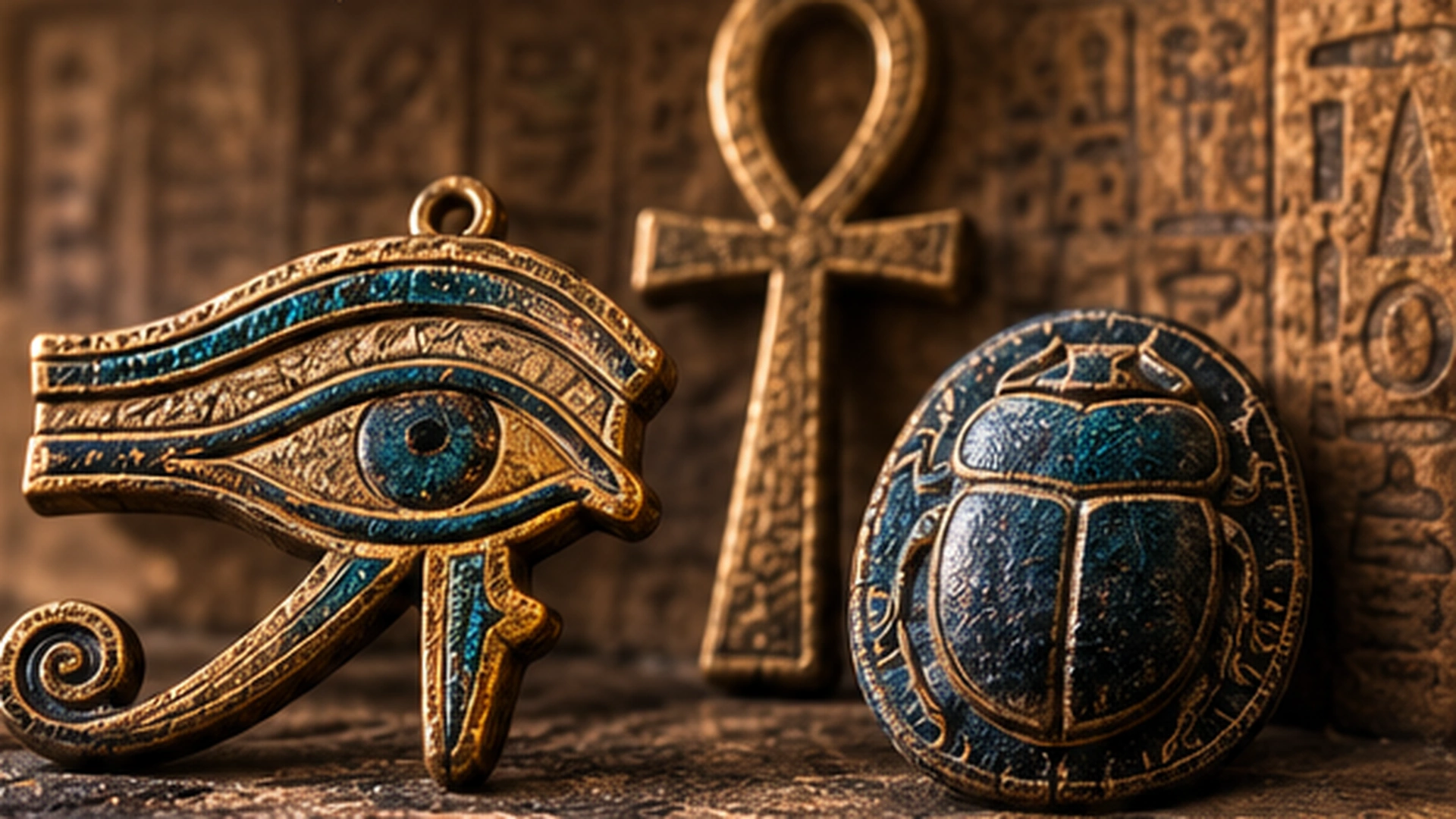
Ancient Egyptian protective practice combined divine images, materials, colors, placement, and recited words. Amulets were worn by the living, placed on the dead, or used in rites connected with health, birth, travel, and the afterlife. The Metropolitan Museum of Art notes that a deity amulet could invoke several powers at once, which makes modern one-word interpretations unreliable.[1]
The wedjat eye—representing the restored eye of Horus—became one of the most common protective forms. Its mythology connected injury, restoration, soundness, recovery, and regeneration. In museum records, wedjat amulets are described as objects believed to protect wearers and transfer regenerative power.[1]
Middle Kingdom apotropaic rods and wands carried images of crocodiles, felines, toads, turtles, baboons, wedjat eyes, Bes-like figures, and hippopotamus goddesses. The Met describes one complete rod as an implement used to ward off harmful spirits, possibly in relation to protecting mothers and children.[2] The images created a defensive company of powerful beings rather than a single abstract symbol.
Ancient Egyptian sources also show that spoken recitations could activate or direct an object’s role. Shape, material, color, placement, and words were often mutually reinforcing. Modern replicas can reproduce a silhouette, but they do not automatically reproduce ancient language, consecration, ownership, or ritual authority.

Mediterranean Protection: The Evil Eye and Frightening Faces
In Greek and Roman contexts, danger could be repelled by confronting it with an even more dangerous image. The face of Medusa, or gorgoneion, appeared on architecture, armor, pottery, and personal objects. The Met describes Medusa’s face as an apotropaic symbol—an image of threat used to deter other threats.[4] A painted gorgoneion roof tile from South Italy likewise placed a protective face high on sacred architecture.
The evil eye was understood as harm caused through envy or a hostile gaze. Responses varied widely and included eye motifs, gestures, phallic images, animal forms, and noisy or grotesque objects. A Roman bronze amulet in the Met combines several devices intended to ward off the evil eye.[5] The object reminds us that protective symbolism can be humorous, aggressive, sexual, or deliberately shocking.
Similar eye-related beliefs occur beyond the Mediterranean, but visual similarity does not prove one unchanged tradition. The blue eye bead used today in Türkiye, Greece, the Balkans, the Middle East, and tourist markets has multiple local histories and modern commercial meanings. It should not be described as a universal symbol with one ancient definition.
Protective Texts and Talismans in Islamic Societies
Across different Islamic societies, some people used Qur’anic passages, divine names, prayers, letter-number arrangements, astrological signs, and stories of prophets on amulets, scrolls, weapons, shirts, and cases. The Met’s survey of Islamic amulets emphasizes that such objects could be carried, worn, placed in cases, or incorporated into military equipment.[6]
A fifteenth- or early-sixteenth-century talismanic shirt attributed to northern India or the Deccan is covered with painted compartments, medallions, the Qur’an, and the ninety-nine names of God. It was believed to carry protective power and may have been worn beneath armor.[7] Similar material demonstrates how sacred writing, bodily proximity, political danger, and textile labor could converge in one object.
This history must be described carefully. Islamic theology and law contain major debates about amulets, astrology, occult sciences, and the acceptable use of Qur’anic text. Practices differed by period, school, region, court, household, and religious authority. It is inaccurate to say either that “Islam teaches talismanic magic” or that historical Muslim societies never used it.

Ethiopian Healing Scrolls: Prayer, Image, and Personal Protection
In the northern Ethiopian highlands, Amhara and Tigrinya healing scrolls combined parchment, written prayer, sacred names, saints, angels, geometric seals, and large eyes. They were made for particular individuals, often by a däbtära, a learned religious specialist. The client’s identity, bodily dimensions, concerns, and astrological associations could shape the scroll.
The Met explains that these scrolls participated in a broader healing process rather than functioning as isolated pictures. They were unrolled, viewed, recited, and carried. Their imagery could include guardian figures, equestrian saints, interlocking nets, faces, and eyes believed to confront harmful forces.[8][9]
There is no fixed dictionary for every design. Meanings could vary by region and interpreter, and the same motif might receive different explanations. The tradition also developed through Christian, Jewish, Muslim, local, medical, and historical interactions. Calling the scrolls simply “African witchcraft” erases their manuscript culture, theology, specialist learning, and regional specificity.
Museums preserve many scrolls, but ethical interpretation requires attention to the fact that they were made for named people and intimate concerns. Researchers should avoid exposing private dedications, turning protective figures into generic tattoo designs, or publishing ritual claims without consulting Ethiopian scholarship and custodians.
Witch Marks, Concealed Objects, and Household Protection in England
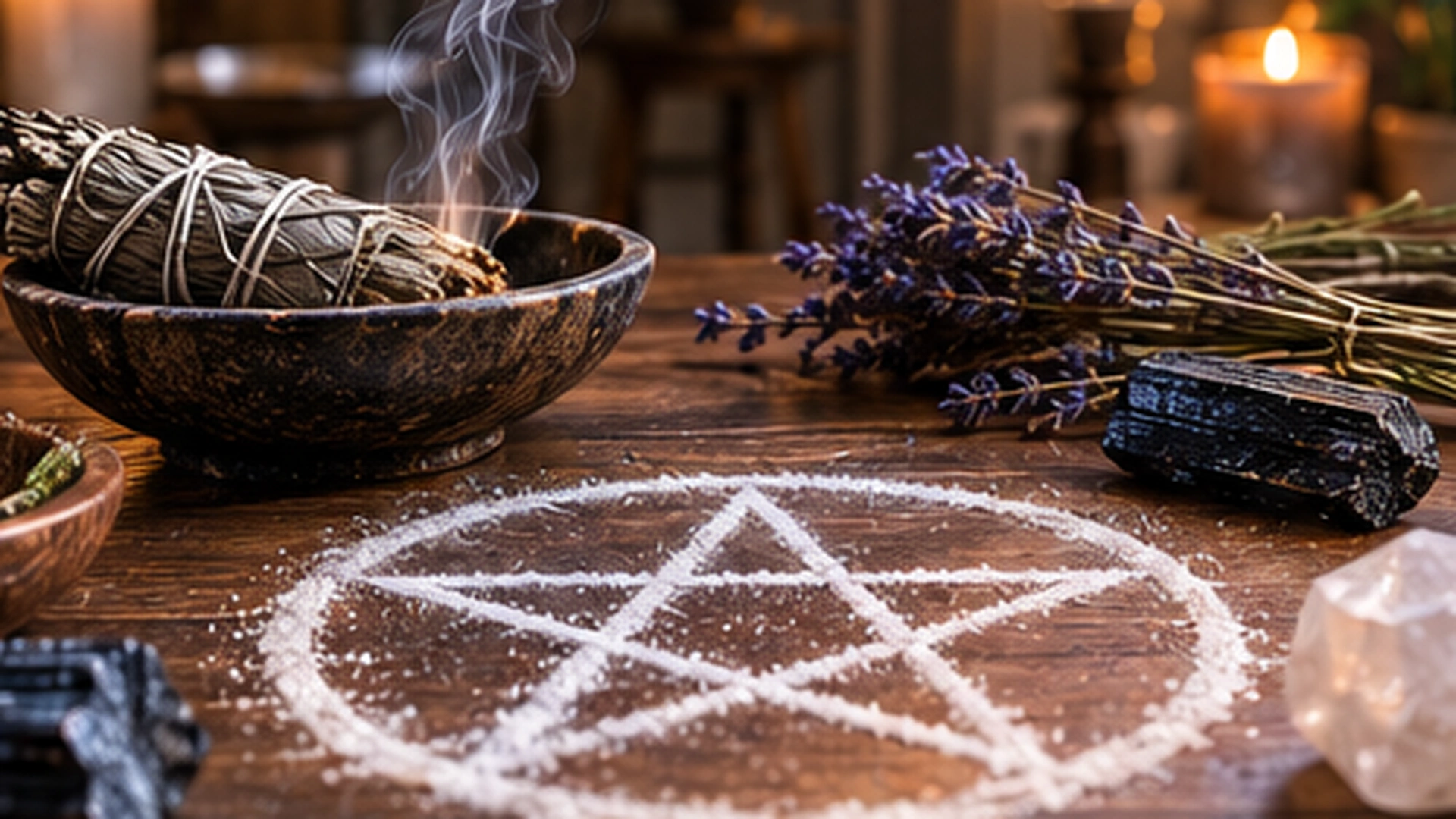
In England, ritual protection marks appear on churches, houses, barns, caves, and official buildings. Historic England describes these apotropaic marks as signs placed especially near entrances, windows, and fireplaces—points where danger was believed to enter. Common forms include hexafoils or daisy wheels, intersecting circles, Marian letters, and pentangles.[10]
Interpretation remains cautious. A geometric figure may be a protective mark, a carpenter’s layout, a devotional sign, or a later scratch. Context matters: repeated placement near thresholds, hidden surfaces, hearths, and vulnerable openings strengthens an apotropaic interpretation, but not every circle in old timber is a “witch mark.”
Early-modern households also concealed objects. Archaeological projects led by Museum of London Archaeology document so-called witch bottles—seventeenth-century glass or stoneware vessels believed to have been prepared against witchcraft or as ritual cures. Known examples may contain pins, nails, thorns, hair, nail clippings, or liquid and were placed beneath floors, beside hearths, or under thresholds.[11]
These finds should not be opened, recreated casually, or treated as spooky entertainment. A concealed object in a historic building is archaeological evidence. MOLA advises recording the position, avoiding cleaning or unsealing it, and contacting appropriate heritage professionals.
How Protective Practices Changed Over Time
Protection traditions are not fossils. Objects and words move through trade, conquest, migration, pilgrimage, translation, and intermarriage. A symbol may retain a protective function while its name, material, owner, or theology changes. It may also move from ritual object to jewelry, souvenir, museum artifact, political emblem, or fashion motif.
Ancient objects were often made inside systems of specialist production. Egyptian faience workers, scribes, priests, and embalmers; Mesopotamian scholars and ritual experts; Ethiopian manuscript makers; metalworkers; textile painters; and household craftspeople all contributed different knowledge. Modern mass production can preserve a recognizable shape while removing the object from those networks of labor and authority.
Colonial rule and missionary activity also changed how protection practices were recorded. European observers frequently classified unfamiliar healing, divination, and protective systems as superstition or witchcraft, while treating their own blessings, relics, and devotional objects as religion. Modern scholarship increasingly examines that unequal vocabulary and asks whose categories were preserved in archives.
Museums create another transformation. A protective object that was once worn, hidden, recited over, buried, or made for one person becomes visible to a general audience. Conservation protects the material but may separate it from voice, touch, scent, movement, and community knowledge. Responsible interpretation should therefore explain both what survives and what the display cannot reproduce.
Digital culture has introduced further changes. Protective symbols circulate as emojis, wallpapers, printable sigils, tattoo references, and online “spell” recipes. This circulation can support cultural interest, but it can also erase provenance. A high-resolution image of a talismanic shirt or healing scroll is not permission to copy sacred writing, invent a translation, or sell the design as a universal charm.
Protection, Authority, and Social Power
Protective ritual is not only about fear. It can establish who has authority to name danger and prescribe a response. A priest, healer, elder, diviner, ruler, parent, or craft specialist may gain trust because the community recognizes particular knowledge. In some societies, rulers used protective images and inscriptions to present political order as part of cosmic order.
That authority can support care and continuity, but it can also be abused. Accusations of witchcraft have historically endangered vulnerable people, and modern curse-removal scams exploit anxiety. A responsible article must distinguish the study of protective belief from endorsing accusations against neighbors, relatives, children, older people, or people with illness or disability.
The safest ethical standard is to focus on the documented object or practice rather than claiming to identify a hidden attacker. Protective traditions can be discussed without telling readers that misfortune proves they were cursed, watched, or spiritually targeted.
Common Protection Symbols and What They Can Mean
Protective symbols work through culturally learned associations. Their meaning may come from a myth, material, visual effect, sacred text, social rank, or the place where they are installed. The same form can change meaning across time.
| Symbol or form | Documented protective logic | Examples | Caution |
|---|---|---|---|
| Eye | A watchful or reciprocal gaze confronts hostile sight | Wedjat eye; evil-eye counter-symbols; Ethiopian talismanic eyes | Not every eye symbol is the “Eye of Horus” or evil-eye charm |
| Frightening face | A dangerous image repels danger | Gorgoneion; grotesque masks; guardian figures | Protective imagery can also carry political or artistic meanings |
| Hand | Gesture or open palm averts envy and harm | Khamsa or hamsa forms in regional Jewish and Muslim contexts | Names, meanings, and acceptance vary by community |
| Circle or endless line | A continuous path encloses, confuses, or traps threat | Daisy wheels, hexafoils, knots, interlaced seals | Some geometric marks are construction or decorative marks |
| Animal guardian | Animal strength or divine association protects a place | Mesopotamian dogs; Egyptian crocodiles, felines, hippos | Animal symbolism is tradition-specific |
| Sacred writing | Divine names or authorized text surround the body or place | Talismanic shirts, scrolls, amulet cases | Do not fabricate, damage, or casually wear sacred text |
| Metal, stone, color | Material qualities carry solar, lunar, royal, medical, or divine associations | Gold, silver, faience, carnelian, coral | Color meanings are not universal |
| Threshold placement | The boundary is treated as a vulnerable point | Doorposts, windows, fireplaces, foundations | Placement may be more important than the symbol alone |
Traditional Protective Practices Beyond Symbols
Spoken Words and Recitations
Protective speech can include prayer, incantation, divine names, scriptural passages, praise, commands, or inherited formulas. Authority may depend on correct pronunciation, lineage, initiation, literacy, or ritual office. Publishing a translated phrase does not recreate the social conditions that made it meaningful.
Wearing or Carrying Objects
Amulets and talismans place protection close to the body. Pendants, rings, textiles, packets, scrolls, shells, beads, and inscribed cases may be worn openly or hidden beneath clothing. The object can mark identity as well as protection.
Marking Boundaries
Doorways, hearths, roofs, windows, beds, graves, city gates, and foundations are common ritual locations because they separate inside from outside or one state of life from another. Marks and deposits at boundaries often communicate that a place has been claimed, watched, or consecrated.
Smoke, Water, Plants, and Sound
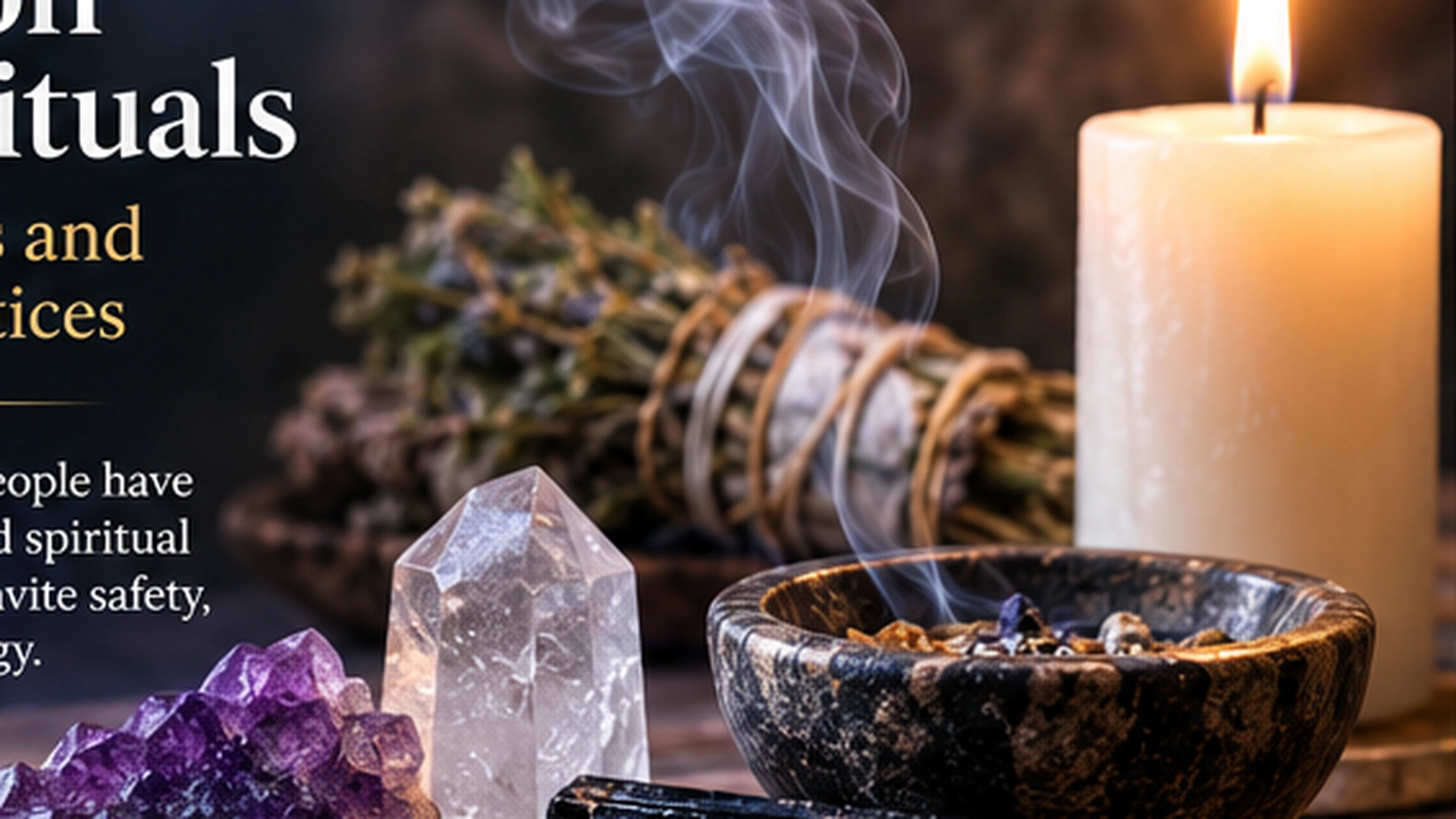
Incense, fumigation, washing, sprinkling, herbs, bells, drums, and spoken sound appear in many protective ceremonies. Their use may be devotional, sensory, hygienic, social, or symbolic. Smoke can also cause respiratory irritation and fire risk, and plants may be toxic or protected species. Historical use is not automatic proof of medical safety.
Community and Specialist Leadership
Many traditional rites are not private do-it-yourself activities. Priests, healers, elders, diviners, manuscript specialists, household heads, or craftspeople may hold the knowledge or authority. Community participation can transform protection from a private fear response into a public statement of responsibility and belonging.
Are Protection Spells Scientifically Proven?
There is no reliable scientific evidence that a spell, charm, symbol, or ritual creates a supernatural shield against illness, violence, accidents, legal problems, or financial loss. Historical records demonstrate belief and practice; they do not independently verify invisible causation.
Ritual may still affect experience. Repetition, focused attention, social support, sensory cues, and shared meaning can influence emotion and behavior. A person who feels calmer may sleep better, communicate more clearly, or remember practical precautions. These indirect effects are different from proof that an object repels spirits or guarantees safety.
Modern research on magical thinking also warns against treating all belief as pathology. Magical thinking appears across ordinary life, religion, culture, anxiety, and clinical conditions. A 2026 systematic review found a broad range of cognitive, emotional, social, and psychiatric associations rather than one simple explanation.[15]
The key practical question is whether the practice supports life or restricts it. When someone repeatedly checks, prays, counts, cleanses, or performs a ritual because they feel unable to tolerate uncertainty, the behavior may resemble a compulsion. The American Psychological Association notes that compulsive rituals can reinforce obsessive fear and that exposure and response prevention is a first-line treatment for obsessive-compulsive disorder.[14]
Ethical Boundaries and Cultural Cautions
Do not present Africa as one magical culture. Ethiopian scrolls, Egyptian amulets, Kabylie jewelry, Yoruba medicine, Kongo power figures, and many other traditions have different histories and custodians.
Do not expose restricted knowledge. Some rites, texts, medicines, and objects are private, initiated, gendered, hereditary, or community-controlled.
Do not invent “ancient” rituals. A modern mixture of salt, candles, feathers, runes, and African symbols is a new eclectic practice unless evidence shows otherwise.
Do not promise medical or legal protection. Ritual cannot replace healthcare, locks, fire alarms, safe housing, legal advice, or emergency services.
Do not use sacred text as decoration without context. Qur’anic passages, Ge’ez prayers, divine names, and funerary texts deserve careful handling.
Do not remove archaeological objects. Concealed bottles, marked timbers, foundation deposits, and grave goods should be reported to heritage professionals.
Do not exploit fear. Charging escalating fees to remove curses, threatening clients, or isolating them from family and medical care is abusive.
A Safe, Nonreligious Protection Ritual for a Home
A modern symbolic practice can be meaningful without claiming ancient authority or supernatural certainty. The following sequence is intentionally secular, low-risk, and practical.
1. Inspect the home: test locks, smoke alarms, carbon-monoxide alarms where relevant, lighting, electrical outlets, and emergency exits.
2. Clean one threshold or shared room as a visible beginning. Avoid toxic mixtures, uncontrolled flames, and heavy smoke.
3. Write a short household commitment such as: “We will protect one another through honesty, preparation, and care.”
4. Place emergency contacts, first-aid supplies, and a charged flashlight where everyone can find them.
5. Invite trusted relatives, friends, or neighbors to share food and learn how to reach you in an emergency.
6. Close with a moment of gratitude or silence. Describe it honestly as a personal or family ritual, not an inherited ancient ceremony.
This practice does not guarantee safety. Its value lies in combining symbolic intention with practical preparation and social connection.
Common Misunderstandings
“Every Protective Symbol Has One Universal Meaning”
Symbols do not work like globally standardized road signs. An eye, hand, knot, animal, color, or star receives meaning from a specific language, story, object, owner, and setting.
“Old Means Authentic and Powerful”
Age can make an object historically important, but it does not prove effectiveness. Some traditions are recent, some ancient practices disappeared, and many modern reconstructions combine sources that never belonged together.
“Religion and Magic Are Easy to Separate”
The categories overlap historically. One observer may call an act prayer, another magic, another medicine, and another heritage. Scholars therefore examine what practitioners called the act and how it functioned in their society.
“Protection Rituals Are Harmless Because They Are Spiritual”
They can become harmful when they involve fire, smoke, toxic substances, animal cruelty, financial exploitation, delayed treatment, coercion, harassment, or obsessive repetition.
Key Takeaways
Protection spells and rituals are historically widespread but culturally specific.
Words, objects, images, materials, placement, and specialist authority often work together.
Ancient Egyptian, Mesopotamian, Ethiopian, Islamic, Mediterranean, and English examples should not be collapsed into one system.
Apotropaic means intended to avert or turn away harm.
Historical evidence proves that people used protective practices, not that supernatural outcomes are scientifically guaranteed.
Ritual can provide attention, calm, identity, and social support, but it must not replace practical safety or healthcare.
Responsible study requires cultural context, uncertainty, community respect, and clear separation between evidence and belief.
People Also Ask
What is a protection spell?
A protection spell is a spoken, written, or performed formula believed to avert harm. Its form and authority depend on the culture, religion, historical period, and practitioner.
What is a protection ritual?
A protection ritual is a structured sequence of meaningful actions intended to create safety, blessing, boundaries, or reassurance. It may include prayer, objects, marking, washing, smoke, or community participation.
What does apotropaic mean?
Apotropaic means intended to turn away or avert evil, danger, or misfortune. The term is commonly used for protective images, marks, objects, and architectural features.
What is the difference between an amulet and a talisman?
An amulet is often described as an object carried to repel harm, while a talisman is prepared to attract a desired effect. In historical practice, the terms overlap and are not universal categories.
Did ancient Egyptians use protection spells?
Yes. Ancient Egyptian protection could combine amulets, divine images, materials, placement, and spoken recitations. The details varied by period and purpose.
What were witch marks used for?
In early-modern Britain, many marks near doors, windows, and fireplaces are interpreted as apotropaic signs intended to protect buildings. Some individual marks remain disputed.
Are protection spells real?
They are real as beliefs, texts, rituals, objects, and cultural practices. Scientific evidence does not show that they create guaranteed supernatural protection.
Can protection rituals become compulsive?
Yes. When rituals are repeatedly performed to neutralize intrusive fear and become difficult to resist, they may be part of obsessive-compulsive symptoms and deserve professional support.
Frequently Asked Questions
Is it respectful to copy a historical protection symbol?
It depends on the symbol, community, and use. Public museum study is different from copying restricted, funerary, royal, or sacred objects for commercial decoration. Credit the source and avoid claiming inherited authority.
Can I use salt, smoke, or candles for protection?
You may use them symbolically where legal and safe, but they do not guarantee protection. Consider allergies, pets, children, ventilation, fire rules, and environmental impact.
Is the evil eye symbol the same everywhere?
No. Beliefs about harmful sight and counter-symbols vary across Mediterranean, Middle Eastern, African, European, and South Asian settings. Modern souvenir forms also have commercial meanings.
Are prayers the same as spells?
Practitioners may distinguish prayer as asking a deity and magic as directing an outcome, but historical boundaries are not always clear. Use the community’s own terminology where possible.
What should I do if I find a concealed ritual object in an old building?
Leave it in place, photograph its context, avoid opening or cleaning it, and contact a local heritage authority, museum, archaeologist, or finds specialist.
How can I study protective magic responsibly?
Start with a named community and object, use museums and academic research, distinguish belief from evidence, respect living custodians, and state uncertainty clearly.
Conclusion
Protection spells and rituals reveal how people have responded to vulnerability. They translate uncertainty into objects that can be held, words that can be repeated, boundaries that can be marked, and gatherings that can make fear socially manageable. Their persistence does not mean that every practice is ancient, universal, or scientifically effective.
The most useful interpretation is neither ridicule nor unquestioning belief. It is careful attention to evidence, context, and human need. A protective object can be art, prayer, memory, political power, medicine, household strategy, and personal reassurance at the same time. Understanding those layers allows us to respect the past without making unsupported promises in the present.
Article Information
- Publisher
- Ancestral Temple
- Editor
- Ancestral Temple
- Last updated
- Jul 30, 2026
- Last reviewed
- Jul 30, 2026
- Content version
- 5fc1d12fcc
This educational article should be read as cultural and spiritual information, not as medical, legal, financial, or emergency advice.
Helpful Related Guidance
About the Author
 Ancestral Temple
Spiritual guide and practitioner with decades of experience in ancestral wisdom, rituals, and divine guidance.
Related Posts
View All







Comments
We'd love to hear your thoughts.